Chevrolet BOLT EV Owner Manual (GMNA-Localizing-U.S./Canada/Mexico-
11434431) - 2018 - crc - 2/14/18
260 Vehicle Care
1. Windshield Washer FluidReservoir. See Washer Fluid
0 261.
2. Cabin Heating Coolant Reservoir. See Cooling System
0 260.
3. High Voltage Battery Coolant Reservoir. See Cooling System
0 260.
4. HPDM (High Power Distribution Module).
5. APM (Accessory Power Module), OBCM (On-Board
Charging Module).
6. Brake Fluid Reservoir. See Brake Fluid 0263.
7. SPIM, APM, and Charger Module Coolant Reservoir. See
Cooling System 0260.
8. Battery. See Battery - North
America 0264.
9. Underhood Compartment Fuse Block. Underhood
Compartment Fuse Block
0 272.Cooling System
It is not necessary to regularly
check coolant unless a leak is
suspected or an unusual noise is
heard. A coolant loss could indicate
a problem. Have it inspected and
repaired by your dealer.
The following explains the cooling
systems and how to check coolant
levels.
.
High Voltage Battery
. Single Power Inverter Module
(SPIM), Accessory Power
Module (APM), and Charger
Module
. Cabin Heating
High Voltage Battery
During vehicle operation and also
during charging, the high voltage
battery cells in the vehicle are kept
within a normal operating
temperature range. If the
temperature rises above this
temperature, the battery cooling
system turns on the air conditioning
compressor and cools the coolant until the correct temperature is
reached. If the temperature falls
below this temperature, a high
voltage heater, located outside the
battery on a cradle, heats the
coolant until the correct temperature
is reached.
Single Power Inverter Module
(SPIM), Accessory Power
Module (APM), and Charger
Module
The SPIM, APM, and charger
module are cooled using a separate
coolant loop. These modules are
kept below a maximum temperature.
If the temperature rises above this
temperature, the electric cooling fan
will turn on to cool the coolant.
Cabin Heating
Cabin heating is maintained by
coolant heated by the Coolant
Heater Control Module (CHCM),
separate from the power electronics
and battery coolant loops. This
module heats the coolant based on
temperature inputs from the cabin
climate control systems.
Chevrolet BOLT EV Owner Manual (GMNA-Localizing-U.S./Canada/Mexico-
11434431) - 2018 - crc - 2/14/18
Vehicle Care 275
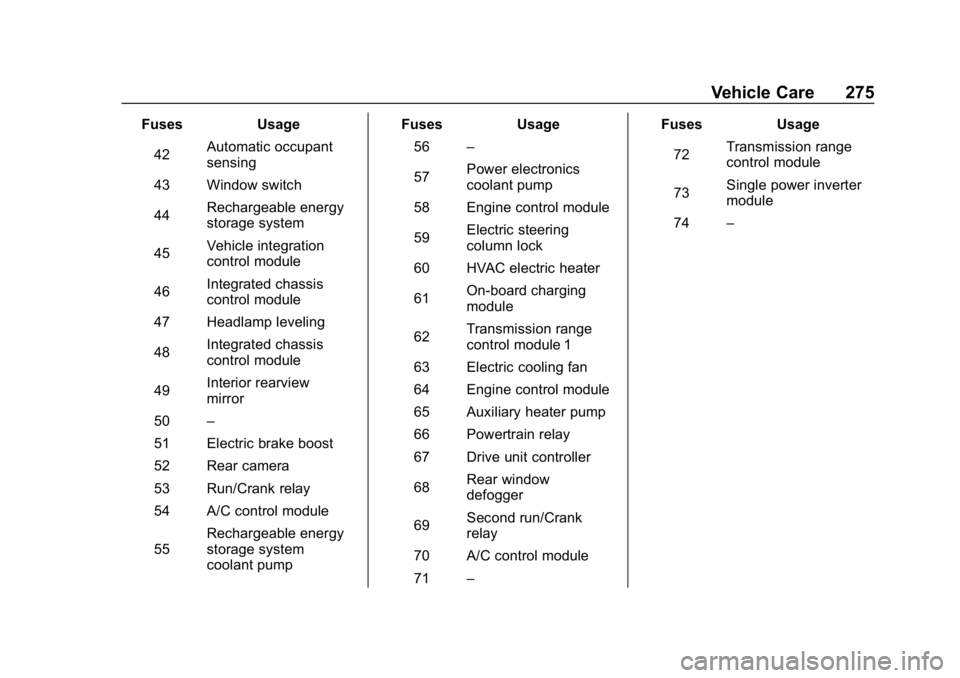
FusesUsage
42 Automatic occupant
sensing
43 Window switch
44 Rechargeable energy
storage system
45 Vehicle integration
control module
46 Integrated chassis
control module
47 Headlamp leveling
48 Integrated chassis
control module
49 Interior rearview
mirror
50 –
51 Electric brake boost
52 Rear camera
53 Run/Crank relay
54 A/C control module
55 Rechargeable energy
storage system
coolant pump Fuses
Usage
56 –
57 Power electronics
coolant pump
58 Engine control module
59 Electric steering
column lock
60 HVAC electric heater
61 On-board charging
module
62 Transmission range
control module 1
63 Electric cooling fan
64 Engine control module
65 Auxiliary heater pump
66 Powertrain relay
67 Drive unit controller
68 Rear window
defogger
69 Second run/Crank
relay
70 A/C control module
71 – Fuses
Usage
72 Transmission range
control module
73 Single power inverter
module
74 –
Chevrolet BOLT EV Owner Manual (GMNA-Localizing-U.S./Canada/Mexico-
11434431) - 2018 - crc - 2/14/18
Technical Data 331
Vehicle Data
Capacities and Specifications
The following approximate capacities are given in metric and English conversions.
Refer toRecommended Fluids and Lubricants 0327 for more information.
Application Capacities Metric English
Air Conditioning Refrigerant For the air conditioning system refrigerant charge
type and amount, see the refrigerant label under the hood. See your dealer for more information.
Cooling Systems High Voltage Battery 7.0 L 7.4 qt
Power Electronics 3.8 L 4.0 qt
Heater 2.0 L 2.1 qt
Wheel Nut Torque 140 Y100 lb ft
All capacities are approximate. When adding, be sure to fill to the approximate level, as recommended in this
manual. Recheck fluid level after filling.