2018 BUICK LACROSSE air conditioning
[x] Cancel search: air conditioningPage 175 of 362

Buick LaCrosse Owner Manual (GMNA-Localizing-U.S./Canada-10999169) -
2018 - crc - 3/28/17
174 Driving and Operating
.The Auto Stop time is greater
than two minutes.
Auto Stop (Vehicles with
eAssist)
If equipped, when the brakes are
applied and the vehicle is at a
complete stop, the engine may turn
off. When stopped, the tachometer
displays AUTO STOP. See
Tachometer 0112. When the brake
pedal is released or the accelerator
pedal is pushed, the engine will
restart.
The vehicle may remain in Auto
Stop for up to two minutes. The vehicle may remain in Auto
Stop even after it is shifted into
P (Park). If the driver opens the door
or unbuckles the seat belt the
vehicle will exit Auto Stop and
restart the engine.
There are several conditions that
may prevent an Auto Stop or cause
an Auto Start.
Auto Stop may be
deactivated when:
.
The engine, transmission,
or high voltage battery is not at
the required operating
temperature.
. The outside temperature is not
in the required operating range,
typically below −20 °C (−4 °F).
. The system may not be able to
shut off the engine in order to
maintain the air conditioning
comfort level or defrost system
settings. See Dual Automatic
Climate Control System 0152.
To maximize fuel economy, use
the ECO air conditioning mode. .
The transmission is in any gear
other than D (Drive).
. The high voltage battery charge
is low.
. The hood is not fully closed.
. The malfunction indicator lamp
is on.
. High humidity is detected.
The Engine Will Restart when:
. The brake pedal is released.
. The accelerator pedal is applied.
. Shifting out of D (Drive) to any
other gear besides P (Park).
. The air conditioning or defrost
system needs the compressor to
maintain interior comfort. See
Dual Automatic Climate Control
System 0152. To maximize fuel
economy, use the ECO air
conditioning mode.
. The engine is required to run for
either heater or climate control
performance, or the climate
control system is turned from off
Page 176 of 362
Buick LaCrosse Owner Manual (GMNA-Localizing-U.S./Canada-10999169) -
2018 - crc - 3/28/17
Driving and Operating 175
to normal air conditioning,
or defrost. SeeDual Automatic
Climate Control System 0152.
. The high voltage battery charge
is low and requires recharging.
. Auto Stop time is greater than
two minutes.
. The hood is opened.
Engine Heater
The engine heater, if available, can
help in cold weather conditions at or
below −18 °C (0 °F) for easier
starting and better fuel economy
during engine warm-up. Plug in the
coolant heater at least four hours
before starting the vehicle. An
internal thermostat in the plug end
of the cord will prevent engine
heater operation at temperatures
above −18 °C (0 °F).
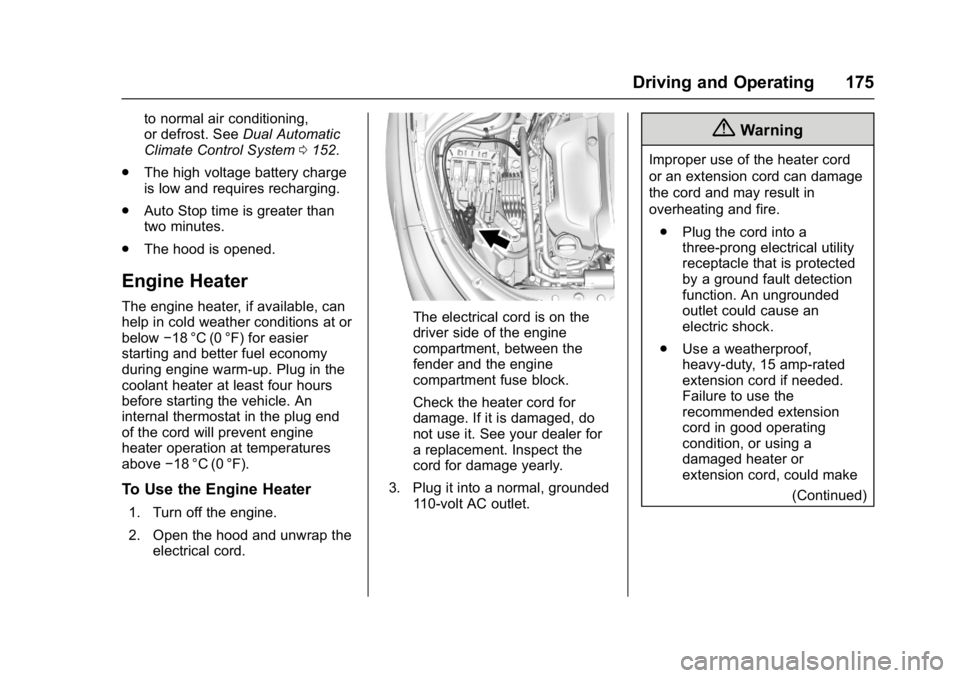
To Use the Engine Heater
1. Turn off the engine.
2. Open the hood and unwrap the
electrical cord.
The electrical cord is on the
driver side of the engine
compartment, between the
fender and the engine
compartment fuse block.
Check the heater cord for
damage. If it is damaged, do
not use it. See your dealer for
a replacement. Inspect the
cord for damage yearly.
3. Plug it into a normal, grounded 110-volt AC outlet.
{Warning
Improper use of the heater cord
or an extension cord can damage
the cord and may result in
overheating and fire.
. Plug the cord into a
three-prong electrical utility
receptacle that is protected
by a ground fault detection
function. An ungrounded
outlet could cause an
electric shock.
. Use a weatherproof,
heavy-duty, 15 amp-rated
extension cord if needed.
Failure to use the
recommended extension
cord in good operating
condition, or using a
damaged heater or
extension cord, could make
(Continued)
Page 245 of 362

Buick LaCrosse Owner Manual (GMNA-Localizing-U.S./Canada-10999169) -
2018 - crc - 3/28/17
244 Vehicle Care
If Steam Is Coming from the
Engine Compartment
{Warning
Steam and scalding liquids from a
hot cooling system are under
pressure. Turning the pressure
cap, even a little, can cause them
to come out at high speed and
you could be burned. Never turn
the cap when the cooling system,
including the pressure cap, is hot.
Wait for the cooling system and
pressure cap to cool.
See Overheated Engine Protection
Operating Mode 0244 for
information on driving to a safe
place in an emergency.
If No Steam Is Coming from
the Engine Compartment
If an engine overheat warning is
displayed but no steam can be seen
or heard, the problem may not be
too serious. Sometimes the engine
can get a little too hot when the
vehicle: .
Climbs a long hill on a hot day
. Stops after high-speed driving
. Idles for long periods in traffic
If the overheat warning is displayed
with no sign of steam: 1. Turn the air conditioning off.
2. Turn the heater on to the highest temperature and to the
highest fan speed. Open the
windows as necessary.
3. When it is safe to do so, pull off the road, shift to P (Park) or
N (Neutral), and let the
engine idle.
If the engine coolant temperature
gauge is no longer in the
overheated area or the engine
coolant temperature warning light no
longer displays, the vehicle can be
driven. Continue to drive the vehicle
slowly for about 10 minutes. Keep a
safe distance from the vehicle in
front. If the warning does not come
back on, continue to drive normally
and have the cooling system
checked for proper fill and function. If the warning continues, pull over,
stop, and park the vehicle
right away.
If there is no sign of steam, idle the
engine for three minutes while
parked. If the warning is still
displayed, turn off the engine until it
cools down. Also, see
Overheated
Engine Protection Operating Mode
0 244.
Overheated Engine
Protection
Operating Mode
This emergency operating mode
allows the vehicle to be driven to a
safe place in an emergency
situation. If an overheated engine
condition exists, an overheat
protection mode which alternates
firing groups of cylinders helps
prevent engine damage. In this
mode, there is significant loss in
power and engine performance.
The engine coolant temperature
warning light comes on the
instrument panel, to indicate the
vehicle has entered overheated
Page 265 of 362

Buick LaCrosse Owner Manual (GMNA-Localizing-U.S./Canada-10999169) -
2018 - crc - 3/28/17
264 Vehicle Care
Tire Terminology and
Definitions
Air Pressure:The amount of
air inside the tire pressing
outward on each square inch of
the tire. Air pressure is
expressed in kPa (kilopascal)
or psi (pounds per square inch).
Accessory Weight
:The
combined weight of optional
accessories. Some examples of
optional accessories are
automatic transmission, power
windows, power seats, and air
conditioning.
Aspect Ratio
:The relationship
of a tire's height to its width.
Belt
:A rubber coated layer of
cords between the plies and the
tread. Cords may be made from
steel or other reinforcing
materials. Bead
:The tire bead contains
steel wires wrapped by steel
cords that hold the tire onto
the rim.
Bias Ply Tire
:A pneumatic tire
in which the plies are laid at
alternate angles less than
90 degrees to the centerline of
the tread.
Cold Tire Pressure
:The
amount of air pressure in a tire,
measured in kPa (kilopascal)
or psi (pounds per square inch)
before a tire has built up heat
from driving. See Tire Pressure
0 266.
Curb Weight
:The weight of a
motor vehicle with standard and
optional equipment including the
maximum capacity of fuel, oil,
and coolant, but without
passengers and cargo.
DOT Markings
:A code molded
into the sidewall of a tire
signifying that the tire is in
compliance with the U.S. Department of Transportation
(DOT) Motor Vehicle Safety
Standards. The DOT code
includes the Tire Identification
Number (TIN), an alphanumeric
designator which can also
identify the tire manufacturer,
production plant, brand, and
date of production.
GVWR
:Gross Vehicle Weight
Rating. See Vehicle Load Limits
0 166.
GAWR FRT
:Gross Axle Weight
Rating for the front axle. See
Vehicle Load Limits 0166.
GAWR RR
:Gross Axle Weight
Rating for the rear axle. See
Vehicle Load Limits 0166.
Intended Outboard Sidewall
:
The side of an asymmetrical tire
that must always face outward
when mounted on a vehicle.
Kilopascal (kPa)
:The metric
unit for air pressure.
Page 324 of 362

Buick LaCrosse Owner Manual (GMNA-Localizing-U.S./Canada-10999169) -
2018 - crc - 3/28/17
Technical Data 323
Vehicle Data
Capacities and Specifications
ApplicationCapacities
Metric English
Air Conditioning Refrigerant For the air conditioning system refrigerant type and charge amount, see the refrigerant label under thehood. See your dealer for more information.
Engine Cooling System 9.0 L 9.5 qt
Engine Oil with Filter 2.5L L4 Engine 4.7 L 5.0 qt
3.6L V6 Engine 5.7 L 6.0 qt
Fuel Tank AWD 61.3 L 16.2 gal
FWD 59.8 L 15.8 gal
Wheel Nut Torque 140 Y100 lb ft
All capacities are approximate. When adding, be sure to fill to the approximate level, as recommended in this
manual. Recheck fluid level after filling.
Page 351 of 362

Buick LaCrosse Owner Manual (GMNA-Localizing-U.S./Canada-10999169) -
2018 - crc - 3/28/17
350 Index
IndexA
Accessories andModifications . . . . . . . . . . . . . . . . . . 229
Accessory Power . . . . . . . . . . . . . . . 176
Adaptive Cruise Control . . . . . . . . 195
Adaptive Forward Lighting (AFL) . . . . . . . . . . . . . . . . . 146
Adaptive Forward Lighting (AFL) Light . . . . . . . . . . . . . . . . . . . . 124
Add-On Electrical Equipment . . . 226
Additional Information
OnStar . . . . . . . . . . . . . . . . . . . . . . . 344
Additional Maintenance and Care . . . . . . . . . . . . . . . . . . . . . . 316
Adjustments Lumbar, Front Seats . . . . . . . . . . . . 54
Air Cleaner/Filter, Engine . . . . . . . 238
Air Conditioning . . . . . . . . . . . . . . . . 152
Air Filter, Passenger Compartment . . . . . . . . . . . . . . . . . 158
Air Intake . . . . . . . . . . . . . . . . . . . . . . . 158
Air Vents . . . . . . . . . . . . . . . . . . . . . . . 157
Airbag System Check . . . . . . . . . . . . . . . . . . . . . . . . . . 80
How Does an Airbag
Restrain? . . . . . . . . . . . . . . . . . . . . . 73
Passenger Sensing System . . . . 75 Airbag System (cont'd)
What Makes an Airbag
Inflate? . . . . . . . . . . . . . . . . . . . . . . . . 73
What Will You See after an
Airbag Inflates? . . . . . . . . . . . . . . . 73
When Should an Airbag Inflate? . . . . . . . . . . . . . . . . . . . . . . . . 72
Where Are the Airbags? . . . . . . . . 70
Airbags
Adding Equipment to theVehicle . . . . . . . . . . . . . . . . . . . . . . . . 79
Passenger Status Indicator . . . .116
Readiness Light . . . . . . . . . . . . . . .115
Servicing Airbag-Equipped Vehicles . . . . . . . . . . . . . . . . . . . . . . . 79
System Check . . . . . . . . . . . . . . . . . . 68
Alarm Vehicle Security . . . . . . . . . . . . . . . . 42
Alert Lane Change . . . . . . . . . . . . . . . . . 214
Side Blind Zone (SBZA) . . . . . . 213
All-Season Tires . . . . . . . . . . . . . . . . 260
All-Wheel Drive . . . . . . . . . . . . 187, 248
Antilock Brake System (ABS) . . . 187 Warning Light . . . . . . . . . . . . . . . . . 120
Appearance Care Exterior . . . . . . . . . . . . . . . . . . . . . . . 300
Interior . . . . . . . . . . . . . . . . . . . . . . . . 305