2018 AUDI Q3 flat tire
[x] Cancel search: flat tirePage 174 of 230
Wheels
maximum permissible road
speeds . See also ¢&.
in General
information on page 166 .
Tire pressure monitoring
system *
means a system that detects
when one or more of a vehicle's
tires are underinflated and illumi nates a low tire pressure warning
telltale.
Tread
means that portion of a tire that
comes into contact with the road.
Tread separation
means pulling away of the tread
from the tire carcass.
Treadwear indicators {TWI)
means the projections within the principal grooves designed to give
a visual indication of the degrees
of wear of the tread. See
¢ page 175, Treadwear indicator
for more information on measur
ing tire wear.
Uniform Tire Quality Grading
is a tire information system devel
oped by the United S tates Nat ion
a l Highway Traffic Safety Admin
istration (NHTSA) that is designed
to help buyers make relative com-
1 72
parisons among tires . The UTQG
is not a safety rat ing and not a
guarantee that a tire will last for
a prescribed number of miles (kilome ters) or perform in a cer
tain way. It simply gives tire buy
ers add it iona l information to
combine with other considera
tions, such as price, brand loyalty and dealer recommendations. U n
der UTQG , tires are graded by the
tire manufacturers in three areas:
treadwear, tract ion, and tempera
t ure res istance. The UTQG infor
mation on the tires , molded into
the sidewalls .
U.S. DOT Tire Identification
Number {TIN)
This is the tire's "serial number".
It beg ins with the letters "DO T"
and indicates that the tire meets
all federal standards . The next
two numbers or letters indicate
the plant where it was manufac
tured, and the last fo ur numbers
represent the week and year of
manufacture. Fo r example,
DOT ... 2217 ...
means that the ti re was produced
in the 22nd week of 2017. The
other numbers are ma rketing co
des that may or may not be used .,..
Page 175 of 230

0 C0
-N
" N
-0
0
::, a)
by the tire manufacturer. This in
formation is used to contact con
sumers if a tire defect requires a
recall.
Ve hicle capacity weight
means the rated cargo and lug
gage load plus 150 lbs. (68 k ilo
grams) times the vehicle's desig
nated seating capacity.
Vehicle ma ximum load on the
tire
means that load on an individual
tire that is determined by distrib
uting to each axle its share of the
maximum loaded vehicle weight
and dividing by two.
Vehicle normal load on the tire
means that load on an individual
tire that is determined by distrib
uting to each axle its share of the
curb weight, accessory weight,
and normal occupant weight (dis
tributed in accordance with¢
ta
ble on page
178) and dividing by
two.
Occupant loading and distr i
bution for vehicle normal load
for various design ated seating
capacities
Refer to the tire inflation pres
sure label¢
page 176, fig. 147
Wheels
for the number of seating posi
tions . Refer to the table ¢
table
on page
178 for the number of
people that correspond to the ve
hicle normal load.
New tires or wheels
Audi recommends having all work
on tires or wheels performed by an authorized Audi dealer or au
thorized Audi Service Facility.
These facilities have the proper
knowledge and are equipped with
the required tools and replace ment parts.
.,,. New tires do not yet have the
optimum gripp ing properties .
Drive carefully and at moderate
speeds for the first 350 miles (500 km) with new tires.
.,,. Only use tires with the same de
sign, size (rolling circumference)
and as close to the same tread
pattern as possible on all four
wheels.
.,,. Do not replace tires individually .
At least replace both tires on the
same axle at the same time.
.,,. Audi recommends that you use
Audi Original Tires . If you would
like to use different tires, please note that the tires may perform ...
173
Page 176 of 230

Wheels
differently even if they are the
same size
c::> .,&..
~ If you would like to equip your
vehicle with a tire/rim combina tion that is different from what
was installed at the factory, con
sult with an authorized Audi
dealer or authorized Audi Service
Facility before making a pur
chase
c::> ,& .
If the spare tire is different from
the regular tires installed on the
vehicle - for example, if winter
tires or wide tires are installed -
then only use the spare tire tem porarily in case of emergency and
drive carefully while it is in use. It
should be replaced with a regular
tire as soon as possible.
Applies to: vehicles with all wheel
drive: all four wheels must be
equipped with tires that are the
same brand and have the same
construction and tread pattern so
that the drive system is not dam
aged by different wheel speeds. For this reason, in case of emer
gency, only use a spare tire that has the same circumference as
the regular tires.
174
A WARNING -
-Only use tire/rim combina tions and suitable wheel bolts
that have been approved by
Audi. Otherwise, damage to
the vehicle and an accident
could result.
-For technical reasons, it is not possible to use tires from oth
er vehicles - in some cases,
you cannot even use tires from
the same vehicle model.
-Make sure that the tires you select have enough clearance
to the vehicle. Replacement
tires should not be chosen
simply based on the nominal size, because tires with a dif
ferent construction can differ
greatly even if they are the
same size. If there is not
enough clearance, the tires or
the vehicle can be damaged and this can reduce driving
safety and increase the risk of
an accident.
-Only use tires that are more than six years old when abso
lutely necessary and drive
carefully when doing so.
-Do not use run-flat tires on
your vehicle. Using them when ...
Page 177 of 230

0
"' .... N
" N .... 0 0 ::,
"'
not permitted can lead to ve
hicle damage or accidents.
-If you install wheel covers on the vehicle, make sure they allow enough air circulation to
cool the brake system. If they
do not, this could increase the risk of an accident.
Tire wear/damage
Fig. 145 Tire profile : treadwear indica
tor
Tire wear
Check the tires regularly for wear.
-Inflation pressure that is too low or high can increase tire wear
considerably.
-Driving quickly through curves, rapid acceleration and heavy
braking increase tire wear.
-Have an authorized Audi dea ler
or authorized Audi Service Facili-
l ) Obey any applicable regulations in your
country.
Wheels
ty check the wheel alignment if
there is unusual wear.
-Have the wheels rebalanced if an imbalance is causing noticeable
vibration in the steering wheel. If you do not, the tires and other
vehicle components could wear more quickly.
Treadwear indicator
Original equipment tires contain
treadwear indicators in the tread pattern, which are bars that are 1/16 in (1.6 mm) high and are
spaced evenly around the tire per pendicular to the running d irec
tion
i:::> fig. 145. The letters "TWI "
or triang les on the tire sidewall
indicate the location of the tread
wear indicators.
The tires have reached the mini mum tread depth
l ) when they
have worn down to the treadwear
indicators. Replace the tires with
new ones
i:::> .&..
Tire rotation
Rotating the tires regularly is rec
ommended to ensure the tires
wear evenly. To rotate the tires, install the tires from the rear axle ..,.
175
Page 180 of 230
Wheels
and the tire pressures specified
on the label on the driver's side B
pillar, always follow the specifica
tion on the B-pillar label
¢ page 176, fig. 146.
Make sure that the tire designa
tion on your tire matches the des-
Model/ Tire designation
Engine
ignation on the tire pressure label
and the tire pressure table.
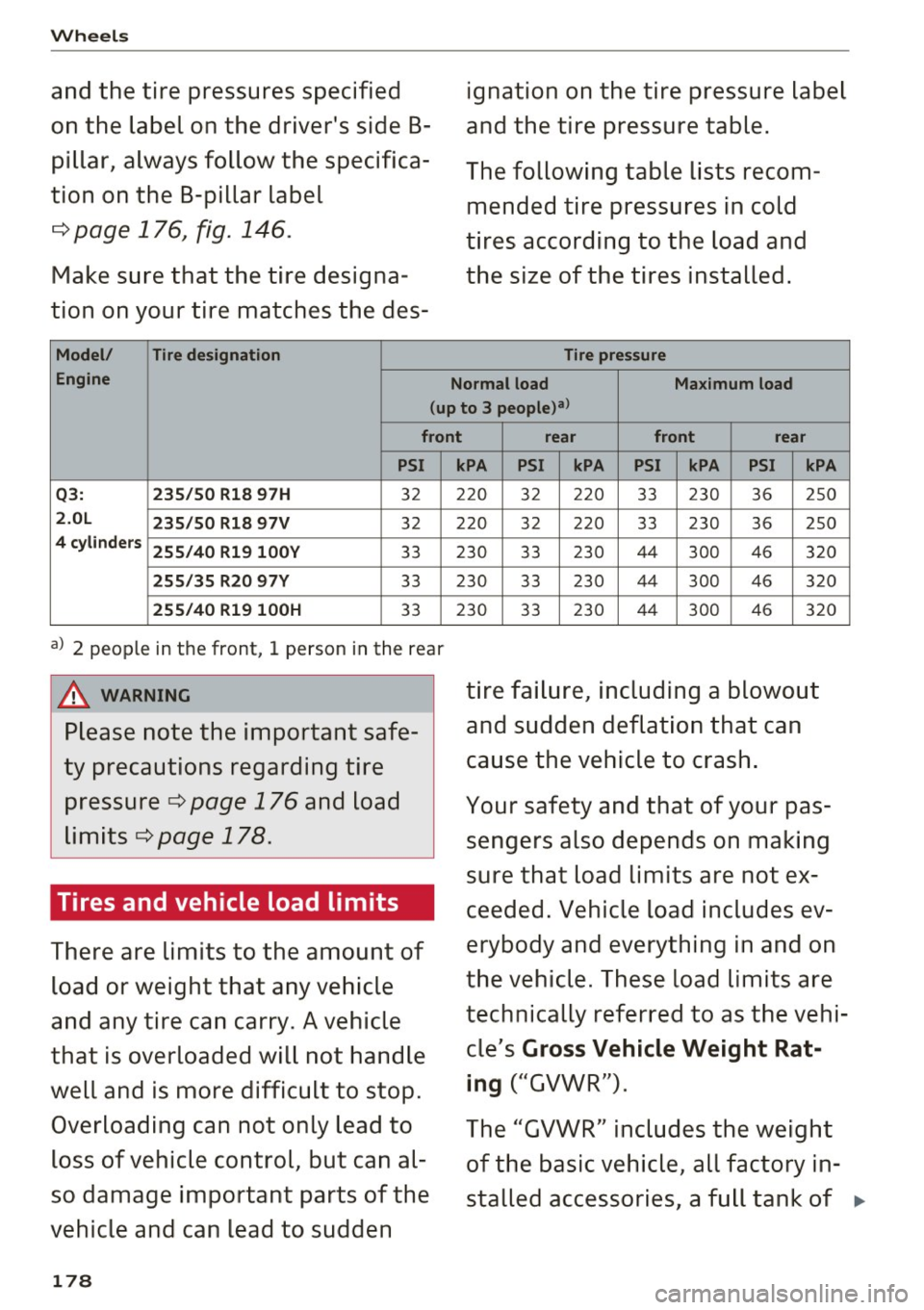
The following table lists recom mended tire pressures in cold
tires according to the load and
the size of the tires installed.
Tire pressure
Normal load Maximum load
(up to 3 people)a)
front rear front rear
PSI
Q3: 235/50 Rl8 97H 32
2.0L
235/50 Rl8 97V 32
4 cylinders 255/40 Rl9 l00Y 33
255/35 R20 97Y 33
255/40 Rl9 l00H 33
a) 2 peop le in the front ; 1 perso n in the rear
.8, WARNING
Please note the important safe
ty precautions regarding tire
pressure ¢
page 176 and load
limits ¢
page 178.
Tires and vehicle load limits
There are limits to the amount of
load or weight that any vehicle
and any tire can carry. A vehicle
that is overloaded will not handle
well and is more difficult to stop.
Overloading can not only lead to
loss of vehicle control, but can al
so damage important parts of the
vehicle and can lead to sudden
178
kPA PSI kPA PSI kPA PSI kPA
220 32 220 33 230 36 250
220 3 2 22 0
33 230
36 250
230 33 230 44
300 46 320
230 33 230 44 300 4
6 320
230 33 230 44 300 46 320
tire failure, including a blowout
and sudden deflation that can
cause the vehicle to crash.
Your safety and that of your pas
sengers also depends on making
sure that load limits are not ex
ceeded. Vehicle load includes ev
erybody and everything in and on
the vehicle. These load limits are
technically referred to as the vehi
cle's
Gross Vehicle Weight Rat
ing
("GVWR").
The "GVWR" includes the weight
of the basic vehicle, all factory in
stalled accessories, a full tank of
11>
Page 181 of 230
fuel, oil, coolant and other fluids plus maximum load. The maxi
mum load includes the number of
passengers that the vehicle is in
tended to carry ("seating capaci
ty") with an assumed weight of
1 50 lbs. (68 kg) for each passen
ger at a designated seating posi
tion and the total weight of any
luggage in the vehicle. If you tow
a trailer, the weight of the trailer
hitch and the tongue weight of
the loaded trailer must be includ
ed as part of the vehicle load.
The
Gr oss Axle Weight R ating
("GAWR") is the maximum load
that can be applied at each of the
veh icle's two axles.
The fact that there is an upper limit to your vehicle's Gross Vehi
cle Weight Rating means that the
total weight of whatever is being
carried in the vehicle (including
the weight of a trai ler hitch and
the tongue weight of the loaded
trailer) is limited. The more pas
sengers in the vehicle or passen
gers who are heavier than the
standard weights assumed mean
that less weight can be carried as
~ luggage.
-N
" N
-0
0
::, a)
Wheels
The Gross Vehicle Weight Rating and the Gross Axle Weight Rating
are listed on the safety compli
ance sticker label located on the
driver's side B-pillar.
_&. WA RNIN G
Overloading a vehicle can cause
loss of vehicle control, a crash
or other accident, serious per
sonal injury, and even death.
- Carrying more weight than
your vehicle was designed to carry will prevent the vehicle
from handling properly and increase the risk of the loss of
vehicle control.
-The brakes on a vehicle that
has been overloaded may not
be able to stop the vehicle
within a safe distance.
- Tires on a vehicle that has
been overloaded can fail sud
denly, including a blowout and
sudden deflation, causing loss
of control and a crash.
- Always make sure that the to
tal load being transported -
including the weight of a trail
er hitch and the tongue
weight of a loaded trailer -
does not make the vehicle heavier than the vehicle's
Gross Veh icle Weight Rating .
179
Page 182 of 230
Wheels
Determining correct load
limit
Use the example below to calcu
late the total weight of the pas
sengers and luggage or other
things that you plan to transport so that you can make sure that
your vehicle will not be overload ed .
Steps for Determining Correct
Load Limit
1 . Locate the statement "THE
COMBINED WEIGHT OF OCCU PANTS AND CARGO SHOULD
NEVER EXCEED XXX KG OR XXX
LBS"on your vehicle 's placard
(tire inflation pre ssure label)
c:::> page 176, fig. 146.
2. Determine the combined
weight of the driver and pas
sengers that will be riding in
your vehicle.
3 . Subtra ct the combined weight
of the driver and passengers
from
"XXX" kilograms or " XXX"
pounds shown on the sticker
c:::> page 176 , fig. 146 .
4. The re sulting figure equals the
available amount of cargo and luggage load capacity. For ex
ample, if the
"XXX" amount
equals 1400 lbs. and there will
180
be five 150 lbs. passengers in
your vehicle, the amount of available cargo and luggage load capacity is 650 lb s.
(1400-750 (5 X 150) = 650
lb s.)
5. Determine the combined weight of luggage and cargo
being loaded on the vehicle.
That weight may not safely ex
ceed the available cargo and luggage load capacity calculat
ed in Step 4 .
6. If your vehicle will be towing a trailer, load from your trailer
will be transferred to your ve
hicle. Con sult this manual to
determine how this reduces
the available cargo and lug gage load capacity of your vehi
cle .
~check the tire sidewall
(c:::> page 167, fig. 144) to deter
mine the designated load rating
for a specific tire.
· Wheel bolts and rims
Wheel bolts
W heel bolts mus t be clean and loose n/tighten
eas ily.
Rims
R ims with a bo lted r im ring * or with bo lted wheel
covers" co nsist of mult ip le p ieces . T h ese compo-
n ents were bolted togethe r usin g s pec ial bolts ..,.
Page 185 of 230

0 co ......
"' ,....
"' ...... 0 0 :::,
00
A WARNING 1 = -
The traction grade ass igned to this tire is
based on straight-ahead braking traction
tests, and does not include acceleration, cor nering, hydroplaning or peak tract ion charac
teristics.
A WARNING
The temperature grade for this t ire is estab
lished for a t ire that is properly inflated and
no t overloaded. Excess ive speed, underinfla
tion, or excessive loading, either separately or
in combination, can cause heat buildup and
possible tire failure.
A WARNING
Temperature grades apply to tires that are properly inflated and not over or underinflat
ed.
Tire pressure monitoring system
(!) General notes
Applies to: veh icles with tire pressure monitoring system
-
Each tire, including the spare (if provided),
should be checked monthly when co ld and inflat
ed to the inflation pressure recommended by the
vehicle manufacturer on the vehicle placa rd or
tire i nflat ion pressure label. (If your vehicle has
tires of a different s ize tha n the s ize indicated on
the veh icle placard or tire inflation pressure la
be l, yo u sh ou ld de termine the prope r tire infla
tion pressure for those tires).
As an added safety feature, your veh icle has been
eq uipped w ith a tire pressu re monito ring sys tem
(TPMS) that ill uminates a low tire p ress ure te ll
tale when one or more of your tires is significan t
l y under-inflated. Accordingly, when the low tire
p ressure tellta le illuminates, you should stop and
check yo ur tires as soon as possible, and inflate
them to the proper pressure. Driving on a s ignifi
cantly under-i nflated tire causes the tire to over
h eat and can lead to t ire failure . Unde r-inflation
a lso reduces fuel efficiency and t ire t read life,
Wh eel s
and may affect the vehicle 's handling an d stop
ping ability.
Please note tha t the TPM S is not a s ubstitute fo r
prope r ti re maintenance, a nd it is the dr iver's re
spons ibility to maintain co rrect t ire pressure,
even if under-inflatio n has not reached the level
to t rigge r ill umination of the TPMS low t ire pres
s ur e te lltale .
Yo ur vehicle has also been equipped with a TPMS
malfunction indicator to indicate when the sys
tem is not ope rating properly. The TP MS ma l
funct ion indicator is combined with the low t ire
pressure telltale. When the system detects a
malfu nction, the telltale w ill flash for app roxi
mately one m inute and t hen rema in continuously
illuminated . Thi s seque nce w ill cont inue upon
s u bsequent vehicle star t-ups as long as the mal
funct ion exists.
When the malfunction indicator is illum inated,
the system may not be able to detect o r signal
l ow tire p ressure as intended. TPMS malfunct ions
may occur fo r a v arie ty of reaso ns, including the
insta llation o f replacement or al ternate tires or
whee ls on the vehicle that p revent the TPMS
from functioning proper ly . Always check the
TPMS ma lf u nction te lltale after replac ing one or
more tires or wheels on yo ur vehicle to ensure
that the rep lacement or a lt ernate tires and
wheels allow the TPMS to continue to function prope rly.
' If the Tire Pressure Monitoring System
indicator appears
Applies to: vehicles wi th Tire Pressur e Mon ito ring System in·
dicator
The tire pressure indicator in the ins trument
cluster informs you if the tire pressure is too low
or if there is a system malfunction .
Using the ABS sensors, the tire pressure monitor
ing system compares the tire tread c ircumfer
ence and v ibration characterist ics of the ind ividu
al tires. If the pressure changes in one o r more
whee ls, this is indicated in the inst rument cl uste r
display with t he
[IJ indica to r light and a mes
sage . If only one tire is affec ted, the locat ion of
that tire w ill be indicated. .,,.
183