2018 Alfa Romeo Giulietta ECU
[x] Cancel search: ECUPage 78 of 216

Main recommendations to carry
children safely
Install the child restraint systems on
the rear seat, which is the most protected
position in the event of an impact.
Keep children in rearward facing child
restraint systems for as long as possible,
at least until 3–4 years old.
Should a rearward facing child
restraint system be installed on the rear
seats, it is advisable to position it as far
forward as the position of the front seat
allows.
If the passenger side front airbag is
deactivated always check the permanent
switching on of the warning light
in
the panel above the interior rear-view
mirror to make sure that it has actually
been deactivated.
Carefully follow the instructions
supplied with the child restraint system.
Keep the instructions in the vehicle along
with the other documents and this
handbook. Do not use second-hand child
seats without instructions.
Only one child is to be strapped into
each restraint system; never carry two
children simultaneously.
Always check that the seat belts do
not rest on the child’s neck.
Always check that the seat belt is well
fastened by pulling on it.
While travelling, do not let the child sit
incorrectly or unfasten the belts.
Never allow a child to put the belt's
diagonal section under an arm or behind
their back.
Never carry children on your lap, even
newborns. No-one can hold a child in the
case of a crash.
In the event of an accident, replace the
child restraint system with a new one. In
addition, and depending on the type of
child restraint system installed, replace
the Isofix anchorages or the seat belt
with which the child restraint system was
connected.
The rear head restraint can be
removed if needed to install a child
restraint system. The head restraint must
always be present in the vehicle and
fitted if the seat is used by an adult
passenger or a child sitting in a restraint
system without backrest.
WARNING
70)The diagram is indicative and for fitting
purposes only. Fit the child restraint system
according to the instructions, which must be
included.
71)If a Universal ISOFIX child seat system
is not fixed to all three anchorages, it will not
be able to protect the child correctly. In a
crash, the child could be seriously or fatally
injured.72)Fit the child restraint system when the
car is stationary. The child restraint system
is correctly secured to the brackets when
you hear the click. Follow the instructions for
assembly, disassembly and positioning that
the Manufacturer must supply with the child
restraint system.
73)Do not use the same lower anchorage to
install more than one child restraint system.
76
SAFETY
Page 87 of 216

WHEN PARKED
Always remove the ignition key when
leaving the car.
When parking and leaving the car,
proceed as follows:
engage a gear (1st gear if facing uphill
or reverse if facing downhill) and leave
the wheels turned;
stop the engine and engage the
handbrake.
Block the wheels with a wedge or a stone
if the car is parked on a steep slope.
On versions equipped with Alfa TCT
transmission, before releasing the brake
pedal, wait for letter P to be displayed.
IMPORTANTNEVERleave the car with
the gearbox in neutral (or, on versions
equipped with Alfa TCT transmission,
before placing the gear lever at P).
HANDBRAKE
To engage the handbrake, pull lever 2
fig. 62 upwards until the car is secured.
When the handbrake is engaged and the
ignition key is on MAR-ON, the
instrument panel warning light
will
switch on.
To release it, raise lever 2 slightly, hold
down button 1 and lower the lever: the
warning light
on the instrument
panel switches off.
93) 94)
IMPORTANT Carry out these
manoeuvres with the brake pedal
pressed.
IMPORTANT For cars equipped with a
front armrest, lift it up to ensure that it
does not interfere with the action of the
handbrake.
WARNING
93)Never leave children unattended in the
car. Always remove the key from the ignition
when leaving the car and take it with you.
94)The car should be braked after a few
clicks of the parking brake: if this is not so,
contact an Alfa Romeo Dealership to have it
adjusted. Always park the car safely as
indicated by the Highway Code and as
described above.
TWIN CLUTCH TRANSMISSION
(for versions/markets, where provided)
SELECTOR LEVER
The lever has the following positions:
P= Park
R= Reverse
N= Neutral
D= Drive, (automatic forward speed)
+= Sequential upshifting
−= Sequential downshifting
If the lever is used in sequential mode,
moving the latter from D to the left, the
positions towards + or – are unstable.
The lever has a button A, which must be
pressed to move the lever to P or R.
Shifting from D to "Sequential mode" and
vice versa is free.
Shifting from D to N is free.
Shifting from N to R and from R to P is
possible only with button on gear lever
pressed.
STARTING THE ENGINE
Starting is only permitted with gear lever
in position P or N (with or without brake
pedal pressed).
On starting, the system is at N or P (the
latter means neutral, but with the car’s
wheels locked mechanically).
62A0K0615C
85
Page 95 of 216

When reverse gear is engaged an
acoustic signal is automatically activated
if there is an obstacle within the range of
operation.
The acoustic signal:
increasesas distance between the car
and the obstacle decreases;
becomes continuouswhen the
distance between the car and the
obstacle is less that 30 cm and stops
immediately if the distance increases;
is constantif the distance is unvaried;
if this situation occurs for the side
sensors, the signal will stop after about
3 seconds to avoid, for example,
indications in the event of manoeuvres
alongside walls.
OPERATION WITH A TRAILER
Parking sensor operation is automatically
turned off when the trailer electric cable
plug is fitted into the car tow hook
socket.
31)
The sensors are automatically
reactivated when the trailer's cable plug
is removed.
101) 102)
IMPORTANT NOTES
During parking manoeuvres, pay the
utmost attention to any obstacles that
could be located above or below the
sensors.
Objects set close to the car rear, under
certain circumstances are not detectedand could therefore cause damage to the
car or be damaged.
The following conditions may influence
the performance of the parking
assistance system:
reduced sensor sensitivity and a
reduction in the parking assistance
system performance could be due to the
presence on the surface of the sensor of:
ice, snow, mud, thick paint
The sensors may detect a
non-existent obstacle (echo interference)
due to mechanical interference, for
example when washing the car, in rain
(strong wind), hail.
The signals sent by the sensors can
also be altered by the presence of
ultrasonic systems (e.g. pneumatic brake
systems or pneumatic drills) near the
vehicle.
sensor performance can also be
influenced by the position of the sensors.
For example by a change in the ride
setting (caused by the wear of the shock
absorbers, suspension), overloading the
car and carrying out specific tuning
operations that require the car to be
lowered;
The detection of obstacles at the top
part of the car may not be guaranteed
because the system detects obstacles
that could cause an impact with the car in
the bottom part.
IMPORTANT
31)The sensor must be free of mud, dirt,
snow or ice in order for the system to work.
Be careful not to scratch or damage the
sensors while cleaning them. Avoid using dry,
rough or hard cloths. The sensors must be
washed using clean water, with the addition
of vehicle shampoo if necessary. When using
special washing equipment such as high
pressure jets or steam cleaning, clean the
sensors very quickly keeping the jet more
than 10 cm away.
WARNING
101)Only have the bumpers repainted or
any retouches to the paintwork in the area of
the sensors carried out by an Alfa Romeo
Dealership. Incorrect paint application could
affect the operation of the parking sensors.
102)Parking and other dangerous
manoeuvres are, however, always the
driver’s responsibility. While carrying out
these manoeuvres, always make sure that
no people (especially children) or animals are
in the area concerned. The parking sensors
are an aid for the driver, but the driver must
never allow their attention to lapse during
potentially dangerous manoeuvres, even
those executed at low speeds.
93
Page 106 of 216
REPLACING AN EXTERIOR BULB
FRONT LIGHT CLUSTERS
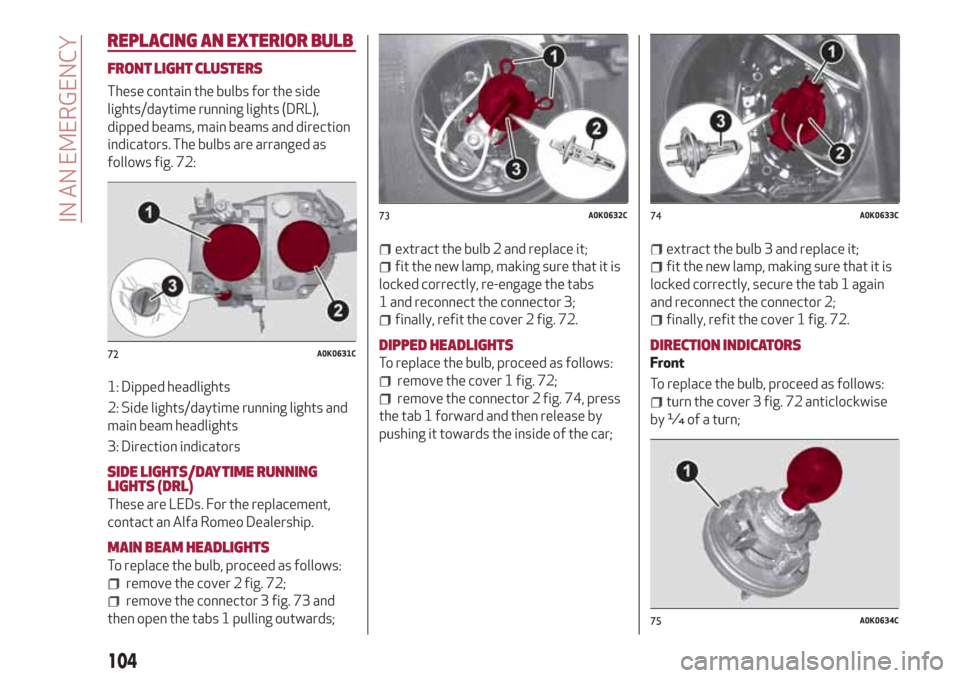
These contain the bulbs for the side
lights/daytime running lights (DRL),
dipped beams, main beams and direction
indicators. The bulbs are arranged as
follows fig. 72:
1: Dipped headlights
2: Side lights/daytime running lights and
main beam headlights
3: Direction indicators
SIDE LIGHTS/DAYTIME RUNNING
LIGHTS (DRL)
These are LEDs. For the replacement,
contact an Alfa Romeo Dealership.
MAIN BEAM HEADLIGHTS
To replace the bulb, proceed as follows:
remove the cover 2 fig. 72;
remove the connector 3 fig. 73 and
then open the tabs 1 pulling outwards;
extract the bulb 2 and replace it;
fit the new lamp, making sure that it is
locked correctly, re-engage the tabs
1 and reconnect the connector 3;
finally, refit the cover 2 fig. 72.
DIPPED HEADLIGHTS
To replace the bulb, proceed as follows:
remove the cover 1 fig. 72;
remove the connector 2 fig. 74, press
the tab 1 forward and then release by
pushing it towards the inside of the car;
extract the bulb 3 and replace it;
fit the new lamp, making sure that it is
locked correctly, secure the tab 1 again
and reconnect the connector 2;
finally, refit the cover 1 fig. 72.
DIRECTION INDICATORS
Front
To replace the bulb, proceed as follows:
turn the cover 3 fig. 72 anticlockwise
by ¼ of a turn;
72A0K0631C
73A0K0632C74A0K0633C
75A0K0634C
104
IN AN EMERGENCY
Page 107 of 216

replace the bulb + bulb holder
assembly 1 fig. 75.
Side
These are LEDs. For the replacement,
contact an Alfa Romeo Dealership.
FRONT FOG LIGHTS
(for versions/markets, where provided)
For replacing these bulbs, contact an Alfa
Romeo Dealership.
REAR LIGHT CLUSTERS
These contain the side lights, brake
lights, direction indicators (bulbs in fixed
light cluster), reversing light and rear fog
light (bulb in light cluster on tailgate).
Removing the fixed light cluster
Proceed as follows:
open the boot and unscrew the screw
1 fig. 76 securing the rear light cluster;
extract the light cluster by removing it
with both hands in the direction indicated
by the arrows;
disconnect the electrical connector
and replace the bulb concerned.
SIDE LIGHTS/BRAKE LIGHTS
These are LEDs. For the replacement,
contact an Alfa Romeo Dealership.
DIRECTION INDICATORS
With the light cluster removed, to replace
the bulb undo the two screws 1 fig. 77,
remove the bulb holder and replace bulb
2.
REAR FOG LIGHTS/REVERSING
LIGHTS
To replace the bulbs proceed as follows:
open the luggage compartment and
remove the cover 1 fig. 78 using a
screwdriver in the point indicated by an
arrow;
remove the connector 3 fig. 79and
extract the bulb holder assembly by
releasing the retaining tab 1 and then by
loosening the screw 2;
76A0K0635C
77A0K0636C
78A0K0637C
79A0K0638AC
105
Page 121 of 216
Move the vehicle by approximately 10 m
to promote the distribution of sealant;
stop the vehicle safely, operate the
handbrake and restore pressure using
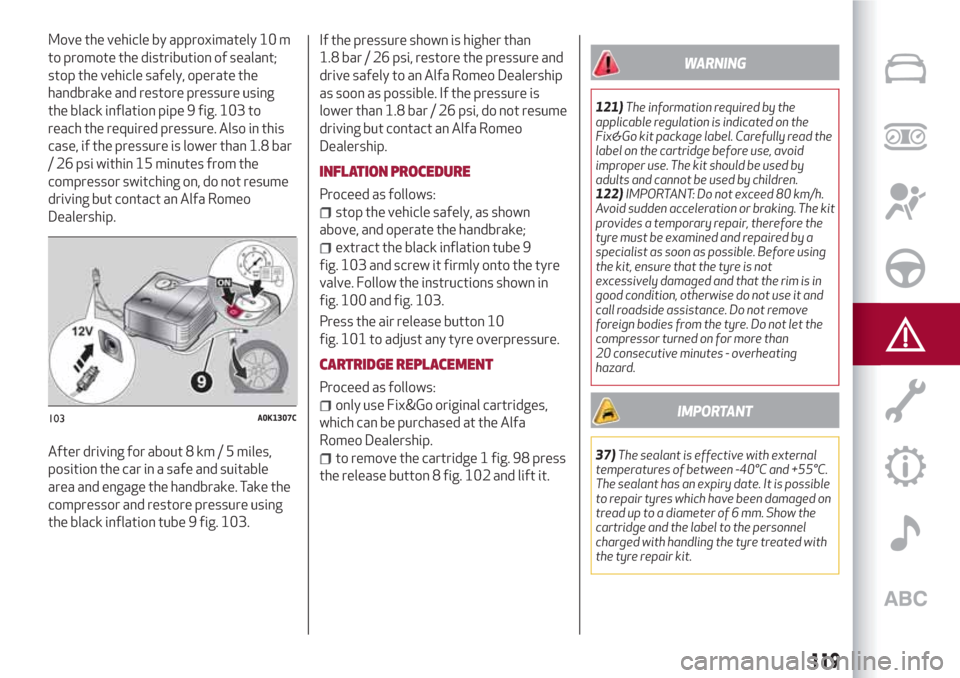
the black inflation pipe 9 fig. 103 to
reach the required pressure. Also in this
case, if the pressure is lower than 1.8 bar
/ 26 psi within 15 minutes from the
compressor switching on, do not resume
driving but contact an Alfa Romeo
Dealership.
After driving for about 8 km / 5 miles,
position the car in a safe and suitable
area and engage the handbrake. Take the
compressor and restore pressure using
the black inflation tube 9 fig. 103.If the pressure shown is higher than
1.8 bar / 26 psi, restore the pressure and
drive safely to an Alfa Romeo Dealership
as soon as possible. If the pressure is
lower than 1.8 bar / 26 psi, do not resume
driving but contact an Alfa Romeo
Dealership.
INFLATION PROCEDURE
Proceed as follows:
stop the vehicle safely, as shown
above, and operate the handbrake;
extract the black inflation tube 9
fig. 103 and screw it firmly onto the tyre
valve. Follow the instructions shown in
fig. 100 and fig. 103.
Press the air release button 10
fig. 101 to adjust any tyre overpressure.
CARTRIDGE REPLACEMENT
Proceed as follows:
only use Fix&Go original cartridges,
which can be purchased at the Alfa
Romeo Dealership.
to remove the cartridge 1 fig. 98 press
the release button 8 fig. 102 and lift it.
WARNING
121)The information required by the
applicable regulation is indicated on the
Fix&Go kit package label. Carefully read the
label on the cartridge before use, avoid
improper use. The kit should be used by
adults and cannot be used by children.
122)IMPORTANT: Do not exceed 80 km/h.
Avoid sudden acceleration or braking. The kit
provides a temporary repair, therefore the
tyre must be examined and repaired by a
specialist as soon as possible. Before using
the kit, ensure that the tyre is not
excessively damaged and that the rim is in
good condition, otherwise do not use it and
call roadside assistance. Do not remove
foreign bodies from the tyre. Do not let the
compressor turned on for more than
20 consecutive minutes - overheating
hazard.
IMPORTANT
37)The sealant is effective with external
temperatures of between -40°C and +55°C.
The sealant has an expiry date. It is possible
to repair tyres which have been damaged on
tread up to a diameter of 6 mm. Show the
cartridge and the label to the personnel
charged with handling the tyre treated with
the tyre repair kit.
103A0K1307C
119
Page 123 of 216

FUEL CUT-OFFSYSTEM
Operation
This intervenes in the case of an impact
causing:
the fuel supply cut-off with the engine
consequently switching off;
the automatic unlocking of the doors;
the switching on of the interior lights.
The intervention of the system is
indicated by a message shown on the
display.
Carefully check the vehicle for fuel leaks,
for instance in the engine compartment,
under the vehicle or near the tank area.
125)
After a collision, turn the ignition key to
STOP to prevent the battery from
running down.
To restore the correct operation of the
car, proceed as follows:
turn the ignition key to the MAR
position;
activate the right direction indicator;
deactivate the right direction
indicator;
activate the left direction indicator;
deactivate the left direction indicator;
activate the right direction indicator;
deactivate the right direction
indicator;
activate the left direction indicator;
deactivate the left direction indicator;
ignition key turned to the OFF
position;
turn the ignition key to the MAR-ON
position.
WARNING
125)If, after an impact, you smell fuel or
notice leaks from the fuel system, do not
reactivate the system to avoid the risk of
fire.
TCT - KEY REMOVAL
The ignition key can be removed only if
the gear lever is in position P (Park).
If the battery is flat and the ignition key is
engaged, the latter is locked in position.
To remove the key manually, proceed as
follows:
apply the handbrake;
dashboard fuses (to remove, insert
your hand in housing 1 fig. 106and lower
flap 2);
using the Allen key provided (see
fig. 107) unscrew the two top screws 2
fig. 108securing cover 1;
106A0K0527C
121
Page 124 of 216

unlock the steering wheel adjustment
lever 1 fig. 109;
pull the steering wheel towards you
until it is in the end of travel position,
then lock it by operating lever 1;
using the Allen key, undo the two lower
screws 1 fig. 110securing the cover;
remove the trim 1 fig. 111for the
upper cover;
remove the left side trim 1 fig. 112for
the cover;
remove the lower cover 1
fig. 113detaching the clips fig. 114from
the upper cover;
107A0K0713C
108A0K0711C
109A0K0710C
110A0K0732C
111A0K0733C
112A0K0734C
122
IN AN EMERGENCY