2018.5 OPEL MOVANO_B air condition
[x] Cancel search: air conditionPage 137 of 271

Climate control135Note
Refrigerant R-134a may contain
fluorinated greenhouse gases with a
global warming potential of 1430.
Front air conditioning system is filled with 0.58 kg and has a CO 2
equivalent of 0.83 tonnes, the front
and rear air conditioning system in
Combi variants is filled with 1.1 kg
and has a CO 2 equivalent of
1.57 tonnes and the front and rear air
conditioning system in Bus variants
is filled with 1.7 kg and has a CO 2
equivalent of 2.43 tonnes.
Depending on vehicle, information
regarding air conditioning refrigerant
appears on a label located in the
engine compartment.
Page 139 of 271

Driving and operating137Driving hints
Driving economically
ECO mode ECO mode is a function that
optimises fuel consumption. It affects
engine power and torque,
acceleration, gear shift indication,
heating, air conditioning and electrical consumers.
ActivationPress ECO. Control indicator
illuminates when activated and a corresponding message appears in
the Driver Information Centre 3 106.
During driving, it is possible to
temporarily disable ECO mode, e.g.
to increase engine performance, by
depressing the accelerator pedal
firmly.
ECO mode is reactivated when
pressure is reduced on the
accelerator pedal.
Deactivation
Press ECO again. Control indicator
extinguishes.
Control of the vehicle
Never coast with engine not
running (except during Autostop)
Many systems will not function in this
situation (e.g. brake servo unit, power
steering). Driving in this manner is a
danger to yourself and others. All
systems function during an Autostop,
but there may be a controlled
reduction in power steering assist and
vehicle speed is reduced.Stop-start system 3 140.
Pedals To ensure the pedal travel is
uninhibited, there must be no mats in
the area of the pedals.
Use only floor mats which fit properly and are fixed by the retainers on the
driver's side.
Driving downhill
Engage a gear when driving downhill
to ensure that sufficient brake
pressure is available.
Steering If power steering assist is lost
because the engine stops or due to a system malfunction, the vehicle can
be steered but may require increased
effort.
Page 144 of 271

142Driving and operating9Warning
Switch off engine and ignition
before exiting the vehicle.
Conditions for an Autostop
The stop-start system checks if each
of the following conditions is fulfilled,
otherwise an Autostop will be
inhibited and control indicator \ will
illuminate in the instrument cluster.
● the stop-start system is not manually deactivated
● the bonnet is fully closed
● the vehicle battery is sufficiently charged and in good condition
● the engine is warmed up
● the engine coolant temperature is
not too high
● the ambient temperature is not too low
● the defrosting function is not activated
● the climate control system does not inhibit an Autostop
● the rear air conditioning system is
not activated
● the brake vacuum is sufficient
● the self-cleaning function of the diesel particle filter is not active
3 146
● the vehicle has moved since the last Autostop
Otherwise an Autostop will be
inhibited.
An Autostop may become
unavailable as the ambient
temperature approaches freezing
point.
Certain settings of the climate control
system may also inhibit an Autostop.
See "Climate control" chapter for
further information 3 120.
Immediately after motorway driving
an Autostop may be inhibited.
New vehicle running-in 3 138.
Vehicle battery discharge protection
To ensure reliable engine restarts, several vehicle battery discharge
protection features are implemented
as part of the stop-start system.Restart of the engine by the driverManual transmission
With the selector lever in neutral,
depress the clutch pedal to restart the
engine.
Note
If any gear is selected, the clutch
pedal must be fully depressed to
restart the engine.
If the engine does not restart first
time, depress clutch pedal fully again.Manual transmission automated
With the selector lever in position N
(or A/M ) and the parking brake
released, release the brake pedal to
restart the engine.
Engaging reverse gear or depressing
the accelerator pedal may also restart the engine.
The green control indicator Ï will
extinguish in the instrument cluster
when the engine is restarted. If
certain conditions are not fulfilled, a
restart will not take place. Start using
the ignition key.
Starting the engine 3 139.
Page 158 of 271

156Driving and operatingstart off quickly, release the brake
pedal and accelerate immediately
after engaging a gear.
In automatic mode the transmission
shifts to other gears automatically,
dependent on driving conditions.
To engage manual mode, move the
selector lever towards A/M. The
current gear will appear in the
transmission display.
To engage first gear, depress brake
pedal and move selector lever
towards + or -. Shift to a higher or
lower gear by moving selector lever to + or -. Gears can be skipped by
moving the selector lever repeatedly
at short intervals.
Stopping the vehicle In automatic or manual mode,
first gear is engaged and the clutch is
released when the vehicle is stopped. In R, reverse gear remains engaged.
When stopping on gradients, engage parking brake or depress the brake
pedal. To prevent overheating of the
clutch, an intermittent audiblewarning may sound as a signal to
depress the brake pedal or apply the
parking brake.
Switch off engine if stopping for a lengthy period, e.g. in traffic jams.
When the vehicle is parked and the
driver's door is opened, a warning
chime will sound if neutral is not
selected or the brake pedal has not
been depressed.
Engine braking
Automatic mode
When driving downhill, the manual
transmission automated does not shift into higher gears until a fairly
high engine speed has been reached. It shifts down in good time when
braking.
Manual mode
To utilise the engine braking effect,
select a lower gear in good time when driving downhill.Rocking the vehicle
Rocking the vehicle is only
permissible if the vehicle is stuck in
sand, mud, snow or a hole. Move the
selector lever between R and A/M (or
between + and -) in a repeat pattern,
while applying light pressure to the
accelerator pedal. Do not race the
engine and avoid sudden
acceleration.
Parking
Apply the parking brake. The most recently engaged gear (see
transmission display) remains
engaged. With N, no gear is engaged.
When the ignition is switched off, the transmission no longer responds to
movement of the selector lever.
If the ignition is not switched off, or the parking brake has not been applied, a
warning chime will sound upon
opening the driver's door.
Manual mode If a higher gear is selected when the
engine speed is too low, or a lower
gear when the speed is too high, the
Page 191 of 271
Vehicle care189● See the Owner's Manual forfurther information.
● Explosive gas may be present in the vicinity of the battery.
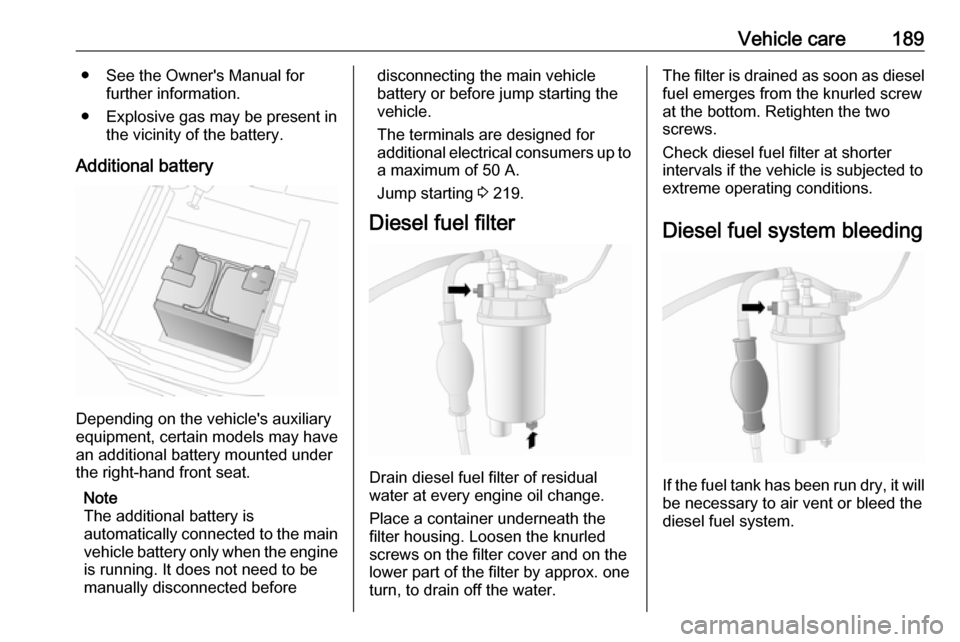
Additional battery
Depending on the vehicle's auxiliary
equipment, certain models may have
an additional battery mounted under
the right-hand front seat.
Note
The additional battery is
automatically connected to the main vehicle battery only when the engine
is running. It does not need to be
manually disconnected before
disconnecting the main vehicle
battery or before jump starting the vehicle.
The terminals are designed for
additional electrical consumers up to
a maximum of 50 A.
Jump starting 3 219.
Diesel fuel filter
Drain diesel fuel filter of residual
water at every engine oil change.
Place a container underneath the
filter housing. Loosen the knurled
screws on the filter cover and on the
lower part of the filter by approx. one
turn, to drain off the water.
The filter is drained as soon as diesel fuel emerges from the knurled screw
at the bottom. Retighten the two
screws.
Check diesel fuel filter at shorter
intervals if the vehicle is subjected to
extreme operating conditions.
Diesel fuel system bleeding
If the fuel tank has been run dry, it will be necessary to air vent or bleed the
diesel fuel system.
Page 203 of 271

Vehicle care201
To help in replacing fuses, a fuse
extractor is located in the instrument
panel fuse box.
Place the fuse extractor on the
various types of fuse from the top or
side, and withdraw fuse.
Engine compartment fusebox
Located below the coolant expansion tank.
Some circuits may be protected by
several fuses.
Due to restricted accessibility, have
fuses replaced by a workshop.SymbolCircuitSRight side lightsTLeft side lightsWRight low beamaLeft low beam>Front fog lightLLeft high beamNRight high beamuABSKWindscreen wiperSymbolCircuitnHeating and ventilation
system / Air conditioningVHeated windscreenQPneumatic suspension
Instrument panel fuse box
Located behind the trim panel on the
left-hand side of the instrument panel.
Pull upper part of trim panel to
remove.
Do not store any objects behind this
panel.
Page 204 of 271

202Vehicle careSome circuits may be protected by
several fuses.SymbolCircuitZInfotainment system / Seat
heating / Driver Information
Centre / Audio connec‐
tions / Alarm?Power outletÌCigarette lightereInstrument panelUCentral locking0Interior lightsOTurn lights / Rear fog lights / Body control moduleDIAGDiagnostic connectoruABS / Electronic Stability
ProgramdInterior lights / Brake lightsZBody control moduleSTOPBrake lightSymbolCircuitIBody control module /
Power windows / Heating
and ventilation system / Air
conditioningmLeft heated rear windownRight heated rear windowRWindscreen washerMElectronic immobiliserUHeated seatsFBLCornering lightlHands-free connection&TachographPTOPower take-offjHornÍPreheating / Diesel fuel filterxClimate control fandHeated exterior mirrorsTLeft-hand side lightSRight-hand side lightSymbolCircuitONavigation systemADPAdditional adaptations,Power windows / Body
control module
Load compartment fuse box
Combi
Located behind the trim panel on the
right-hand side of the load
compartment, beside the rear door.
Page 207 of 271

Vehicle care205
Vehicles with Rear-wheel drive: A
hydraulic jack and a set of extension
pieces for use with the jack are also
included.
Wheel changing 3 214.
Spare wheel 3 216.
Towing the vehicle 3 221.
Vehicles without spare wheel
Some vehicles are equipped with a
tyre repair kit instead of a spare
wheel.
To access this unit, slide the seat fully forwards and fold down the backrest.
If cover is fitted, raise cover slightly
and slide it backwards to remove.
Note
Do not attempt to remove the unit
from beneath the seat. Risk of injury.
Tyre repair kit 3 211.
Wheels and tyres
Tyre condition, wheel condition Drive over edges slowly and at right
angles if possible. Driving over sharp
edges can cause tyre and wheel
damage. Do not trap tyres on the kerb when parking.
Regularly check the wheels for
damage. Seek the assistance of a
workshop in the event of damage or
unusual wear.
We recommend not swapping the
front wheels with the rear wheels and
vice versa, as this can affect vehicle
stability. Always use less worn tyres
on the rear axle.
Tyres
Factory-fitted tyres are matched to the chassis and offer optimum driving comfort and safety.