2018.5 OPEL CORSA E parking brake
[x] Cancel search: parking brakePage 217 of 271

Vehicle care215pressure sensors were replaced. The
tyre pressure sensor matching
process should also be performed
after replacing a spare wheel with a
road wheel containing a tyre pressure sensor.
The malfunction light w and the
warning message or code should
extinguish at the next ignition cycle.
The sensors are matched to the
wheel positions, using a relearn tool,
in the following order: left side front
wheel, right side front wheel, right
side rear wheel and left side rear
wheel. The turn light at the current
active position is illuminated until
sensor is matched.
Consult a workshop for service. There
are 2 minutes to match the first wheel position, and 5 minutes overall to
match all four wheel positions. If it
takes longer, the matching process
stops and must be restarted.
The tyre pressure sensor matching
process is:
1. Apply the parking brake.
2. Turn the ignition on.3. On vehicles with automatic transmission: set the selector
lever to P.
On vehicles with manual
transmission automated: Keep
brake pedal depressed. Move and hold the selector lever for
5 seconds to position N until P is
displayed in the Driver
Information Centre. P indicates
that the tyre pressure sensor
matching process can be started.
On vehicles with manual
transmission: select neutral.
4. Use MENU on the stalk to select
the Vehicle Information
Menu ? in the Driver
Information Centre.
5. Turn the adjuster wheel to scroll to
the tyre pressure menu.
Midlevel display:
Uplevel display:
Page 220 of 271
218Vehicle careTyre chains are permitted on tyres of
size 195/55 R16 with rims of size
16 x 6 and 16 x 6.5, the latter only in combination with limited steering
angle. Seek the assistance of a
workshop.
Tyre chains are not permitted on tyres of size 215/45 R17 and 215/40 R18.
The use of tyre chains is not permitted on the temporary spare wheel.
Tyre repair kit Minor damage to the tyre tread can be
repaired with the tyre repair kit.
Do not remove foreign bodies from
the tyres.
Tyre damage exceeding 4 mm or that is at the tyre's side wall near the rim
cannot be repaired with the tyre repair kit.9 Warning
Do not drive faster than 80 km/h.
Do not use for a lengthy period.
Steering and handling may be
affected.
If you have a flat tyre:
Apply the parking brake and engage
first gear, reverse gear or P.
The tyre repair kit is stowed in the load
compartment.
Depending on the equipment, the tyre repair kit is in a compartment in the
right sidewall or in a compartment
under the floor cover.
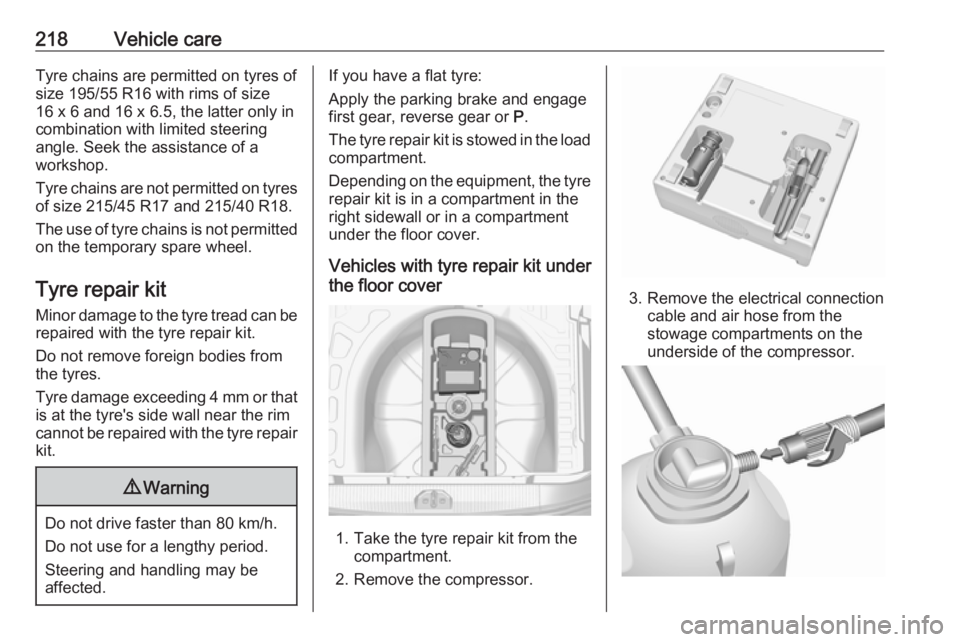
Vehicles with tyre repair kit under
the floor cover
1. Take the tyre repair kit from the compartment.
2. Remove the compressor.
3. Remove the electrical connection cable and air hose from the
stowage compartments on the
underside of the compressor.
Page 225 of 271

Vehicle care223Wheel changing
Make the following preparations and observe the following information:
● Park the vehicle on a level, firm and non-skid surface. The front
wheels must be in the straight- ahead position.
● Apply the parking brake and engage first gear, reverse gear or
P .
● Never change more than one wheel at once.
● Use the jack only to change wheels in case of puncture, not
for seasonal winter or summer
tyre change.
● The jack is maintenance-free. ● If the ground on which the vehicle
is standing is soft, a solid board
(max. 1 cm thick) should be
placed under the jack.
● Take heavy objects out of the vehicle before jacking up.
● No people or animals may be in the vehicle when it is jacked-up.
● Never crawl under a jacked-up vehicle.●Do not start the vehicle when it is
raised on the jack.
● Before screwing in the wheel bolts, clean them and lightly coat
the taper of each wheel bolt with
commercially available grease.9 Warning
Do not grease the thread of the
wheel bolt.
1. Steel wheels:
Pull off the wheel cover.
Alloy wheels with bolt caps: Disengage wheel bolt caps with a
screwdriver and remove. To
protect the wheel, place a soft
cloth between the screwdriver
and the alloy wheel.2. Install the wheel wrench ensuring that it locates securely and loosen
each wheel bolt by half a turn.
The wheels might be protected by
locking wheel bolts. To loosen
these specific bolts, first attach
the adapter for the locking wheel
bolts onto the head of the bolt
before installing the wheel
wrench. The adapter is located in
the glovebox.
Page 230 of 271

228Vehicle care● Apply the parking brake,transmission in neutral,
automatic transmission in P.
● Open the positive terminal protection caps of both vehiclebatteries.
Lead connection order:
1. Connect the red lead to the positive terminal of the booster
vehicle battery.
2. Connect the other end of the red lead to the positive terminal of the
discharged vehicle battery.
3. Connect the black lead to the negative terminal of the booster
vehicle battery.
4. Connect the other end of the black
lead to a vehicle grounding point,
such as the engine block or an
engine mounting bolt. Connect as far away from the discharged
vehicle battery as possible,
however at least 60 cm.
Route the leads so that they cannot
catch on rotating parts in the engine
compartment.
To start the engine: 1. Start the engine of the vehicle providing the jump.
2. After 5 minutes, start the other engine. Start attempts should be
made for no longer than
15 seconds at an interval of
1 minute.
3. Allow both engines to idle for approx. 3 minutes with the leads
connected.4. Switch on electrical consumers (e.g. headlights, heated rear
window) of the vehicle receiving
the jump start.
5. Reverse above sequence exactly when removing leads.
Page 231 of 271

Vehicle care229Towing
Towing the vehicle
Wrap a cloth around the tip of a flat
screwdriver to prevent paint damage.
Insert the screwdriver in the slot at the
lower part of the cap. Release the cap by carefully moving the screwdriver
downwards.
The towing eye is stowed with the
vehicle tools 3 209.
Screw in the towing eye as far as it will
go until it stops in a horizontal
position.
Attach a tow rope – or better still a tow
rod – to the towing eye.
The towing eye must only be used for
towing and not for recovering the
vehicle.
Switch on ignition to release steering wheel lock and to permit operation of
brake lights, horn and windscreen
wiper.
Switch the selector lever to neutral.
Release the parking brake.
Caution
Drive slowly. Do not drive jerkily.
Excessive tractive force can
damage the vehicle.
When the engine is not running,
considerably more force is needed to
brake and steer.
To prevent the entry of exhaust gases from the towing vehicle, switch on the
air recirculation and close the
windows.
Vehicles with automatic transmission: the vehicle must be towed facing
forwards, not faster than 80 km/h nor further than 100 km. In all other cases
and when the transmission is
defective, the front axle must be
raised off the ground.
Vehicles with manual transmission
automated: the vehicle must only be
towed facing forwards with the front axle raised off the ground.
Seek the assistance of a workshop. After towing, unscrew the towing eye.
Insert cap at the top and engage
downwards.
Page 268 of 271

266Heated rear window ..................... 33
Heated steering wheel .................76
Heated windscreen .......................34
Heating ........................................ 40
Heating and ventilation system . 123
High beam ........................... 96, 115
High beam assist ..................96, 116
Hill start assist ........................... 150
Horn ....................................... 15, 77
I
Identification plate .....................238
Ignition switch positions .............134
Immobiliser ............................ 29, 95
Indicators ...................................... 84
Inductive charging ........................82
Info Display ................................. 101
Information displays...................... 97
Instrument cluster ........................84
Instrument panel fuse box .........207
Instrument panel illumination control .................................... 119
Instrument panel overview ........... 10
Interior care ............................... 233
Interior lighting ............................ 119
Interior lights ...................... 120, 204
Interior mirrors .............................. 31
Interruption of power supply ......144
Introduction .................................... 3J
Jump starting ............................. 227
K Key, memorised settings ..............24
Keys ............................................. 22
Keys, locks ................................... 22
L Lane departure warning .......93, 176
Lashing eyes ............................... 71
Light switch ................................ 113
Load compartment ................27, 67
Load compartment cover .............69
Loading information .....................73
Low fuel ....................................... 95
LPG .............................. 86, 179, 239
M
Malfunction indicator light ............92
Manual anti-dazzle ......................31
Manual mode .....................143, 148
Manual transmission .................. 145
Manual transmission automated 145
Manual windows ..........................32
Memorised settings ......................24
Mirror adjustment ........................... 8 Misted light covers .....................119N
New vehicle running-in ..............134
Number plate light .....................203
O Object detection systems ...........160
Odometer ..................................... 84
Oil, engine .......................... 235, 239
OnStar ........................................ 108
Operate pedal ............................... 93
Outside temperature ....................79
Overrun cut-off ........................... 136
P Parking ................................ 20, 139
Parking assist ...................... 94, 160
Parking brake ............................ 150
Parking lights ............................. 119
Particulate filter ........................... 140
Performance .............................. 244
Performing work ........................190
Power outlets ............................... 81
Power steering.............................. 93
Power windows ............................ 32
Preheating ................................... 94
Puncture ..................................... 223
R
Radio Frequency Identification (RFID) ..................................... 263
Radio remote control ...................23