Page 109 of 160

8-17
8
14. Remove the engine oil tank filler cap, and
then gradually fill the oil tank with the remain-
ing oil quantity while regularly checking the oil
level on the dipstick.
15. Install and tighten the engine oil tank filler cap.
TIPBe sure to wipe off spilled oil on any parts after the
engine and exhaust system have cooled down. NOTICEECB00301In order to prevent clutch slippage (since the
engine oil also lubricates the clutch), do not
mix any chemical additives. Do not use oils
with a diesel specification of “CD” or oils of a higher quality than specified. In addition,
do not use oils labeled “ENERGY CONSERV-
ING II” or higher.
Make sure that no foreign material enters the
crankcase.
16. Start the engine, and then let it idle for several
minutes while checking it for oil leakage. If oil
is leaking, immediately turn the engine off and
check for the cause.
17. Turn the engine off, and then check the oil level and correct it if necessary.EBU23471CoolantThe coolant level should be checked before each
ride. In addition, the coolant must be changed at
the intervals specified in the periodic maintenance
and lubrication chart.EBU27945To check the coolant level1. Place the ATV on a level surface.
Recommended oil:
See page 10-1.
Oil quantity: Without oil filter element replacement:1.75 L (1.85 US qt, 1.54 Imp.qt)
With oil filter element replacement: 1.85 L (1.96 US qt, 1.63 Imp.qt)
U2LS62E0.book Page 17 Thursday, February 25, 2016 8:44 AM
Page 113 of 160

8-21
8
9. Connect the coolant reservoir hose.
10. Pour the recommended coolant into the res- ervoir to the maximum level mark, and then
install the reservoir cap. NOTICE: Mix anti-
freeze with distilled water only. However, if
distilled water is not available, soft water
may be used for refilling. Do not use hard
water or salt water since they are harmful
to the engine.
[ECB00992]
11. Pour the recommended coolant into the radi- ator until it is full.
12. Install the radiator cap, start the engine, let it idle for several minutes, and then turn it off. 13. Remove the radiator cap to check the coolant
level in the radiator. If it is low, add sufficient
coolant until it reaches the top of the radiator,
and then install the radiator cap.
14. Start the engine, and then check for coolant leakage.
TIPIf any leakage is found, have a Yamaha dealer
check the cooling system. 15. Install the panel.EBU26808Cleaning the air filter elementThe air filter element should be cleaned at the in-
tervals specified in the periodic maintenance and
lubrication chart. Clean or, if necessary, replace
the air filter element more frequently if you are rid-
ing in unusually wet or dusty areas.TIPThere is a check hose at the bottom of the air filter
case. If dust or water collects in this hose, empty
the hose and clean the air filter element and air fil-
ter case.
Antifreeze/water mixture ratio:1:1
Recommended antifreeze: High-quality ethylene glycol antifreeze con-
taining corrosion inhibitors for aluminum
engines
Coolant quantity: Radiator (including all routes):1.68 L (1.78 US qt, 1.48 Imp.qt)
Coolant reservoir (up to the maximum level
mark): 0.25 L (0.26 US qt, 0.22 Imp.qt)
U2LS62E0.book Page 21 Thursday, February 25, 2016 8:44 AM
Page 119 of 160

8-27
8
4. Install the gasket, tailpipe, and retainer and
align the bolt holes.
5. Install the bolts and tighten them to the spec- ified torque.
6. Install the tailpipe cover and align the bolt holes.
7. Install the bolts and tighten them to the spec- ified torque.
WARNING
EWB02341Do not start the engine when cleaning the
spark arrester, otherwise it could cause injury
to the eyes, burns, carbon monoxide poison-
ing, possibly leading to death, and start a fire.
Always let the exhaust system cool prior to
touching exhaust components. EBU26812Adjusting the engine idling speedThe engine idling speed must be checked and, if
necessary, adjusted as follows at the intervals
specified in the periodic maintenance and lubrica-
tion chart.TIPA diagnostic tachometer is needed to make this
adjustment. 1. Start the engine and warm it up.
2. Attach the tachometer to the spark plug lead.
1. Tailpipe
2. Spark arresterTightening torque:Retainer bolt:10 N·m (1.0 kgf·m, 7.2 lb·ft)
1
2
Tightening torque: Tailpipe cover bolt:8 N·m (0.8 kgf·m, 5.8 lb·ft)
U2LS62E0.book Page 27 Thursday, February 25, 2016 8:44 AM
Page 120 of 160

8-28
83. Check the engine idling speed and, if neces-
sary, adjust it to specification by turning the
idle adjusting screw. To increase the engine
idling speed, turn the idle adjusting screw in
direction (a), and to decrease it, turn the
screw in direction (b).
TIPIf the specified idling speed cannot be obtained as
described above, have a Yamaha dealer make the
adjustment. EBU24048Adjusting the throttle lever free playThe throttle lever free play should be checked and,
if necessary, adjusted at the intervals specified in
the periodic maintenance and lubrication chart.
The throttle lever free play should measure 2.0–4.0
mm (0.08–0.16 in) as shown. Periodically check
the throttle lever free play and, if necessary, adjust
it as follows.TIPThe engine idling speed must be checked, and
adjusted if necessary, before adjusting the throttle
lever free play. 1. Slide the rubber cover back.
2. Loosen the locknut.
3. To increase the throttle lever free play, turnthe throttle lever free play adjusting bolt in di-
rection (a). To decrease the throttle lever free
play, turn the adjusting bolt in direction (b).
1. Idle adjusting screwEngine idling speed:1500–1700 r/min
1
(a)
(b)
U2LS62E0.book Page 28 Thursday, February 25, 2016 8:44 AM
Page 121 of 160

8-29
8
4. Tighten the locknut.
5. Slide the rubber cover to its original position.
EBU24061Valve clearanceThe valve clearance changes with use, resulting in
improper air-fuel mixture and/or engine noise. To
prevent this from occurring, the valve clearance
must be adjusted by a Yamaha dealer at the inter-
vals specified in the periodic maintenance and lu-
brication chart.
EBU24081Adjusting the reverse lock release ca-
bleThe reverse lock release cable stretches with use,
which can result in improper function. Therefore,
the reverse lock release cable should be checked
and adjusted at the intervals specified in the peri-
odic maintenance and lubrication chart.EBU29602BrakesReplacement of brake components requires pro-
fessional knowledge. Brake service should be
performed by a Yamaha dealer.
WARNING
EWB02572Operating with improperly serviced or adjust-
ed brakes could lead to a loss in braking ability
and an accident. EBU24131Checking the front and rear brake padsThe front and rear brake pads must be checked
for wear at the intervals specified in the periodic
maintenance and lubrication chart.
1. Rubber cover
2. Throttle lever free play adjusting bolt
3. Locknut
4. Throttle lever free play
32
4
(a)(b)
1
U2LS62E0.book Page 29 Thursday, February 25, 2016 8:44 AM
Page 124 of 160
8-32
8
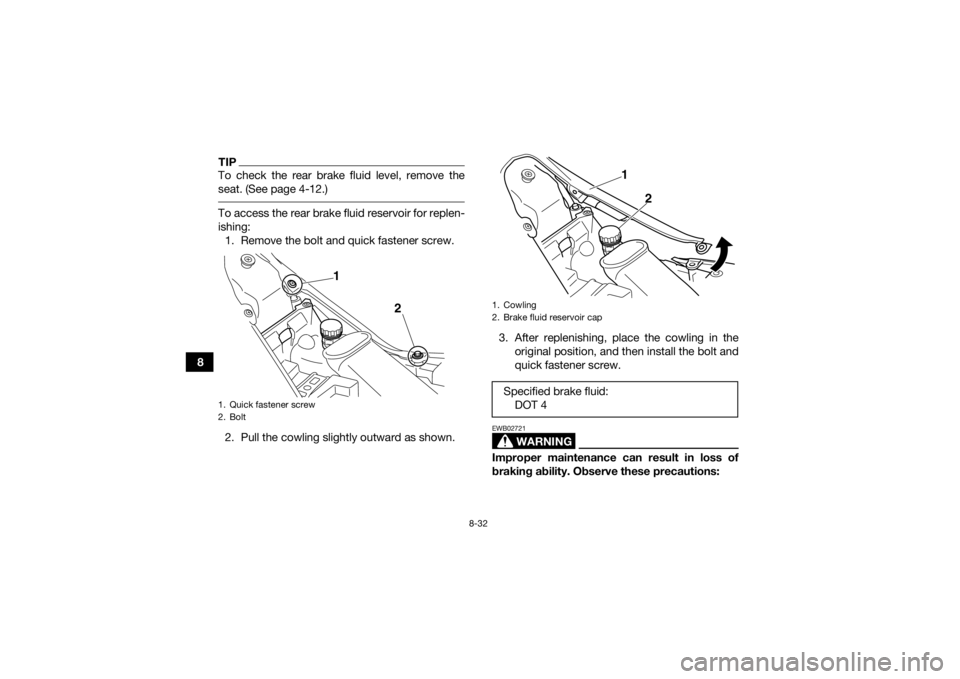
TIPTo check the rear brake fluid level, remove the
seat. (See page 4-12.) To access the rear brake fluid reservoir for replen-
ishing:1. Remove the bolt and quick fastener screw.
2. Pull the cowling slightly outward as shown. 3. After replenishing, place the cowling in the
original position, and then install the bolt and
quick fastener screw.
WARNING
EWB02721Improper maintenance can result in loss of
braking ability. Observe these precautions:
1. Quick fastener screw
2. Bolt
1
2
1. Cowling
2. Brake fluid reservoir capSpecified brake fluid:DOT 4
1
2
U2LS62E0.book Page 32 Thursday, February 25, 2016 8:44 AM
Page 125 of 160

8-33
8
Insufficient brake fluid may allow air to enter
the brake system, reducing braking perfor-
mance.
Clean the filler cap before removing. Use
only DOT 4 brake fluid from a sealed contain-
er.
Use only the specified brake fluid; otherwise,
the rubber seals may deteriorate, causing
leakage.
Refill with the same type of brake fluid. Add-
ing a brake fluid other than DOT 4 may result
in a harmful chemical reaction.
Be careful that water does not enter the
brake fluid reservoir when refilling. Water will
significantly lower the boiling point of the flu-
id and may result in vapor lock.
NOTICEECB01161Brake fluid may damage painted surfaces or
plastic parts. Always clean up spilled fluid im-
mediately. As the brake pads wear, it is normal for the brake
fluid level to gradually go down. A low brake fluid
level may indicate worn brake pads and/or brake
system leakage; therefore, be sure to check the brake pads for wear and the brake system for
leakage. If the brake fluid level goes down sud-
denly, have a Yamaha dealer check the cause be-
fore further riding.
EBU24293Changing the brake fluidHave a Yamaha dealer change the brake fluid at
the intervals specified in the periodic maintenance
and lubrication chart. In addition, have the oil seals
of the master cylinders and calipers as well as the
brake hoses replaced at the intervals listed below
or whenever they are damaged or leaking.
Oil seals: Replace every two years.
Brake hoses: Replace every four years.EBU24395Checking the front brake lever free
playThe brake lever free play must be checked at the
intervals specified in the periodic maintenance
and lubrication chart. The brake lever should have
no free play as shown. If there is free play, have a
Yamaha dealer check the brake system.
U2LS62E0.book Page 33 Thursday, February 25, 2016 8:44 AM
Page 126 of 160
8-34
8
EBU24614Checking the brake pedal heightThe brake pedal height must be checked and, if
necessary, adjusted at the intervals specified in
the periodic maintenance and lubrication chart.
The top of the brake pedal should be positioned
15.3 mm (0.60 in) below the top of the footrest as
shown. If the brake pedal is not positioned as
specified, have a Yamaha dealer adjust it.
EBU24716Adjusting the parking brake free playThe parking brake free play must be checked and,
if necessary, adjusted at the intervals specified in
the periodic maintenance and lubrication chart.
Cable length “A” should measure 47–51 mm
(1.85–2.01 in). Adjust the parking brake free play
as follows.
1. No brake lever free play
1. Brake pedal height
1
U2LS62E0.book Page 34 Thursday, February 25, 2016 8:44 AM