2017 YAMAHA WR 250F check oil
[x] Cancel search: check oilPage 405 of 432

ELECTRICAL COMPONENTS
9-69
4. Install:
• Seat
• Side cover (left/right)
Refer to “GENERAL CHASSIS” on page 5-
1.
EAS2GBB385CHECKING AND CHARGING THE BATTERYEWA
WARNING
Batteries generate explosive hydrogen gas
and contain electrolyte which is made of
poisonous and highly caustic sulfuric acid.
Therefore, always follow these preventive
measures:
• Wear protective eye gear when handling or
working near batteries.
• Charge batteries in a well-ventilated area.
• Keep batteries away from fire, sparks or
open flames (e.g., welding equipment,
lighted cigarettes).
• DO NOT SMOKE when charging or han-
dling batteries.
• KEEP BATTERIES AND ELECTROLYTE
OUT OF REACH OF CHILDREN.
• Avoid bodily contact with electrolyte as it
can cause severe burns or permanent eye
injury.
FIRST AID IN CASE OF BODILY CONTACT:
EXTERNAL
• Skin — Wash with water.
• Eyes — Flush with water for 15 minutes
and get immediate medical attention.
INTERNAL
• Drink large quantities of water or milk fol-
lowed with milk of magnesia, beaten egg
or vegetable oil. Get immediate medical at-
tention.
ECA
NOTICE
• This is a VRLA (Valve Regulated Lead Ac-
id) battery. Never remove the sealing caps
because the balance between cells will not
be maintained and battery performance
will deteriorate.
• Charging time, charging amperage and
charging voltage for a VRLA (Valve Regu-
lated Lead Acid) battery are different from
those of conventional batteries. The VRLA
(Valve Regulated Lead Acid) battery
should be charged according to the appro-
priate charging method. If the battery is
overcharged, the electrolyte level will drop
considerably. Therefore, take special care
when charging the battery.
TIP
Since VRLA (Valve Regulated Lead Acid) bat-
teries are sealed, it is not possible to check the
charge state of the battery by measuring the
specific gravity of the electrolyte. Therefore, the
charge of the battery has to be checked by
measuring the voltage at the battery terminals.
1. Remove:
• Side cover (left/right)
• Seat
Refer to “GENERAL CHASSIS” on page 5-
1.
2. Disconnect:
• Battery leads
(from the battery terminals)
ECA
NOTICE
First, disconnect the negative battery lead
“1”, and then positive battery lead “2”.
3. Remove:
• Battery
4. Check:
• Battery charge
▼▼▼▼▼▼▼▼▼▼▼▼▼▼▼▼▼▼▼▼▼▼▼▼▼▼▼▼▼▼▼▼
a. Connect a pocket tester to the battery termi-
nals.
TIP
• The charge state of a VRLA (Valve Regulated
Lead Acid) battery can be checked by mea-
suring its open-circuit voltage (i.e., the voltage
when the positive battery terminal is discon-
nected).
• No charging is necessary when the open-cir-
cuit voltage equals or exceeds 12.8 V.
b. Check the charge of the battery, as shown in
the charts and the following example. • Positive tester probe
positive battery terminal
• Negative tester probe
negative battery terminal
1
2
Page 410 of 432

ELECTRICAL COMPONENTS
9-74
e. Crank the engine by pushing the start switch
and gradually increase the spark gap until a
misfire occurs.
▲▲▲▲▲▲▲▲▲▲▲▲▲▲▲▲▲▲▲▲▲▲▲▲▲▲▲▲▲▲▲▲
EAS2GBB389CHECKING THE SPARK PLUG CAP
1. Remove:
• Spark plug cap
(from the spark plug lead)
2. Check:
• Spark plug cap resistance
Out of specification Replace.
▼▼▼▼▼▼▼▼▼▼▼▼▼▼▼▼▼▼▼▼▼▼▼▼▼▼▼▼▼▼▼▼
a. Connect the pocket tester ( 1k) to the
spark plug cap.
b. Measure the spark plug cap resistance.
▲▲▲▲▲▲▲▲▲▲▲▲▲▲▲▲▲▲▲▲▲▲▲▲▲▲▲▲▲▲▲▲
EAS2GBB390CHECKING THE IGNITION COIL
1. Disconnect:
• Ignition coil terminal
(from the sub wire harness)
• Spark plug cap
(from the ignition coil)
2. Check:
• Primary coil resistance
Out of specification Replace.
▼▼▼▼▼▼▼▼▼▼▼▼▼▼▼▼▼▼▼▼▼▼▼▼▼▼▼▼▼▼▼▼
a. Connect the pocket tester ( 1) to the igni-
tion coil.b. Measure the primary coil resistance.
▲▲▲▲▲▲▲▲▲▲▲▲▲▲▲▲▲▲▲▲▲▲▲▲▲▲▲▲▲▲▲▲
3. Check:
• Secondary coil resistance
Out of specification Replace.
▼▼▼▼▼▼▼▼▼▼▼▼▼▼▼▼▼▼▼▼▼▼▼▼▼▼▼▼▼▼▼▼
a. Connect the pocket tester ( 1k) to the ig-
nition coil.
b. Measure the secondary coil resistance.
▲▲▲▲▲▲▲▲▲▲▲▲▲▲▲▲▲▲▲▲▲▲▲▲▲▲▲▲▲▲▲▲
Resistance
7.50–12.50 k
Pocket tester
90890-03112
Analog pocket tester
YU-03112-C
Primary coil resistance
2.16–2.64
Pocket tester
90890-03112
Analog pocket tester
YU-03112-C
• Positive tester probe
Ignition coil terminal 1 “1”
• Negative tester probe
Ignition coil terminal 2 “2”
Secondary coil resistance
8.64–12.96 k
Pocket tester
90890-03112
Analog pocket tester
YU-03112-C
• Positive tester probe
Ignition coil terminal 1 “1”
• Negative tester probe
Spark plug lead “2”
Page 412 of 432

ELECTRICAL COMPONENTS
9-76
CHECKING THE STARTER MOTOR OPERA-
TION
1. Check:
• Starter motor operation
Does not operate Perform the electric
starting system troubleshooting, starting
with step 4.
Refer to “ELECTRIC STARTING SYSTEM”
on page 9-6.
▼▼▼▼▼▼▼▼▼▼▼▼▼▼▼▼▼▼▼▼▼▼▼▼▼▼▼▼▼▼▼▼
a. Connect the positive battery terminal “1” and
starter motor lead “2” with a jumper lead “3”.
EWA
WARNING
• A wire that is used as a jumper lead must
have at least the same capacity of the bat-
tery lead, otherwise the jumper lead may
burn.
• This check is likely to produce sparks,
therefore, make sure no flammable gas or
fluid is in the vicinity.
b. Check the starter motor operation.
▲▲▲▲▲▲▲▲▲▲▲▲▲▲▲▲▲▲▲▲▲▲▲▲▲▲▲▲▲▲▲▲
EAS28150CHECKING THE STATOR COIL
1. Disconnect:
• Stator coil coupler
(from the wire harness)
2. Check:
• Stator coil resistance
Out of specification Replace the stator
coil.
▼▼▼▼▼▼▼▼▼▼▼▼▼▼▼▼▼▼▼▼▼▼▼▼▼▼▼▼▼▼▼▼
a. Connect the pocket tester ( 1) to the sta-
tor coil coupler as shown.b. Measure the stator coil resistance.
▲▲▲▲▲▲▲▲▲▲▲▲▲▲▲▲▲▲▲▲▲▲▲▲▲▲▲▲▲▲▲▲
EAS2GBB394CHECKING THE RECTIFIER/REGULATOR
1. Check:
• Charging voltage
Out of specification Replace the rectifier/
regulator.
▼▼▼▼▼▼▼▼▼▼▼▼▼▼▼▼▼▼▼▼▼▼▼▼▼▼▼▼▼▼▼▼
a. Set the digital tachometer to the ignition coil.
b. Connect the pocket tester (DC 20 V) to the
rectifier/regulator coupler as shown. Stator coil resistance
0.528–0.792 (W–W)
Pocket tester
90890-03112
Analog pocket tester
YU-03112-C
• Positive tester probe
White “1”
• Negative tester probe
White “2”
• Positive tester probe
White “1”
• Negative tester probe
White “3”
• Positive tester probe
White “2”
• Negative tester probe
White “3”
Regulated voltage (DC)
14.1–14.9 V
Digital tachometer
90890-06760
Digital tachometer
YU-39951-B
Pocket tester
90890-03112
Analog pocket tester
YU-03112-C
• Positive tester probe
Red “1”
• Negative tester probe
Black “2”
123
Page 420 of 432
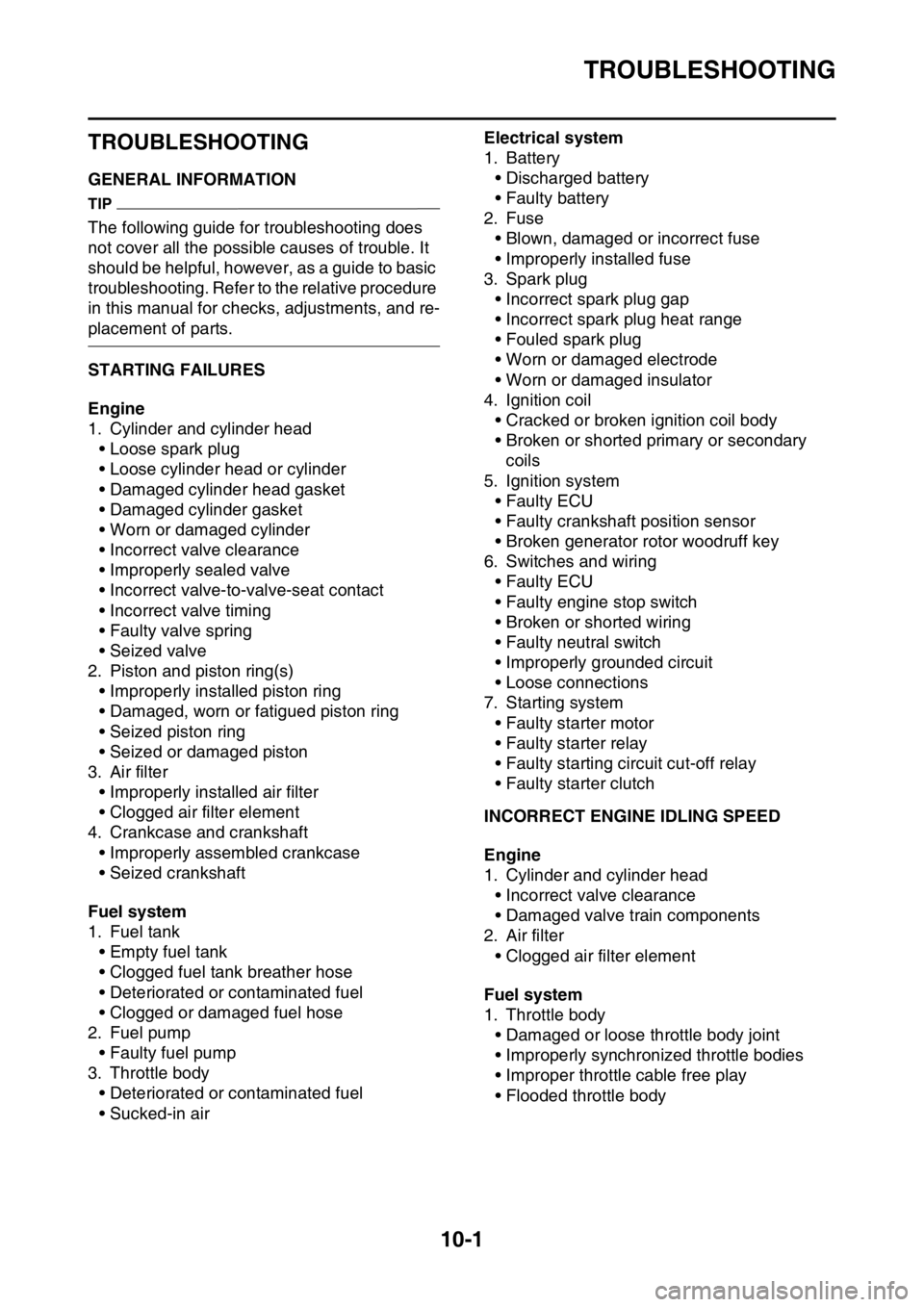
TROUBLESHOOTING
10-1
EAS2GBB405
TROUBLESHOOTING
EAS2GBB406GENERAL INFORMATION
TIP
The following guide for troubleshooting does
not cover all the possible causes of trouble. It
should be helpful, however, as a guide to basic
troubleshooting. Refer to the relative procedure
in this manual for checks, adjustments, and re-
placement of parts.
EAS2GBB407STARTING FAILURES
Engine
1. Cylinder and cylinder head
• Loose spark plug
• Loose cylinder head or cylinder
• Damaged cylinder head gasket
• Damaged cylinder gasket
• Worn or damaged cylinder
• Incorrect valve clearance
• Improperly sealed valve
• Incorrect valve-to-valve-seat contact
• Incorrect valve timing
• Faulty valve spring
• Seized valve
2. Piston and piston ring(s)
• Improperly installed piston ring
• Damaged, worn or fatigued piston ring
• Seized piston ring
• Seized or damaged piston
3. Air filter
• Improperly installed air filter
• Clogged air filter element
4. Crankcase and crankshaft
• Improperly assembled crankcase
• Seized crankshaft
Fuel system
1. Fuel tank
• Empty fuel tank
• Clogged fuel tank breather hose
• Deteriorated or contaminated fuel
• Clogged or damaged fuel hose
2. Fuel pump
• Faulty fuel pump
3. Throttle body
• Deteriorated or contaminated fuel
• Sucked-in airElectrical system
1. Battery
• Discharged battery
• Faulty battery
2. Fuse
• Blown, damaged or incorrect fuse
• Improperly installed fuse
3. Spark plug
• Incorrect spark plug gap
• Incorrect spark plug heat range
• Fouled spark plug
• Worn or damaged electrode
• Worn or damaged insulator
4. Ignition coil
• Cracked or broken ignition coil body
• Broken or shorted primary or secondary
coils
5. Ignition system
• Faulty ECU
• Faulty crankshaft position sensor
• Broken generator rotor woodruff key
6. Switches and wiring
• Faulty ECU
• Faulty engine stop switch
• Broken or shorted wiring
• Faulty neutral switch
• Improperly grounded circuit
• Loose connections
7. Starting system
• Faulty starter motor
• Faulty starter relay
• Faulty starting circuit cut-off relay
• Faulty starter clutch
EAS2GBB408INCORRECT ENGINE IDLING SPEED
Engine
1. Cylinder and cylinder head
• Incorrect valve clearance
• Damaged valve train components
2. Air filter
• Clogged air filter element
Fuel system
1. Throttle body
• Damaged or loose throttle body joint
• Improperly synchronized throttle bodies
• Improper throttle cable free play
• Flooded throttle body
Page 426 of 432

LIST OF SELF-DIAGNOSTIC AND FAIL-SAFE ACTIONS
10-7
*1: Symbols used in the explanations of the malfunction history
: Normal
: There is currently a malfunction or abnormal condition.
: A malfunction or abnormal condition occurred previously, but the affected system or component
is currently operating normally.
ACTUATOR OPERATION TABLE62 Malfunction history ( )
code erasure *1
• There is no history.
• There is some history.•00
• Other: Displays the total
number of ( ) and ( ).Replace all ( ) with ( )
by the operation start pro-
cessing.
64 Setting history display
• There is no history.
• There is some history.
• History is unknown (Histo-
ry data is damaged).Displays the presence or ab-
sence of the setting history by
Power Tuner.
•00
•01
•02—
65 Setting map erasure
• There is no setting.
• There is some setting.Displays the presence or ab-
sence of the setting history by
Power Tuner.
•00
•01Erase all setting maps by
the operation start process-
ing.
70 Program version number Displays a program version
No.—
Diag-
nostic
code
No.Item Actuation Procedure
30 Ignition coil Actuates the ignition coil five
times at one-second inter-
vals.
“WARNING” on the Yamaha
diagnostic tool blinks five
times when the ignition coil is
actuated.Check that a spark is gener-
ated five times.
• Connect an ignition
checker.
36 Injector Actuates the injector five
times at one-second inter-
vals.
“WARNING” on the Yamaha
diagnostic tool blinks five
times when the radiator fan
motor relay is actuated.TIP: Before performing
this operation, be sure to
disconnect the fuel pump
coupler.
Check that injector is actu-
ated five times by listening
for the operating sound. Diag-
nostic
code
No.Item Display Procedure