2017 YAMAHA VX DELUXE ride
[x] Cancel search: ridePage 41 of 106

Watercraft operation
35
craft operation or when the watercraft is in
neutral.
TIP:
The no-wake mode can only be activated
after 5 seconds have elapsed since starting
the engine.
If the no-wake mode is activated when the
watercraft is operating in neutral, the re-
verse gate will move to the forward posi-
tion.
Activating and deactivating the no-wake
mode
Activation of the no-wake mode will be con-
firmed by the number of beeps when the
“NO-WAKE MODE” switch is pushed, and by
the digital speedometer display of the multi-
function information center. (See page 38 for
information on the multifunction information
center.)
TIP:
The beeps and the blinking digital speedom-
eter display also indicate the activation of the
cruise assist. (See page 36 for information on
the cruise assist.)
To activate the no-wake mode:
(1) Release the throttle lever and let the en-
gine speed return to idle.
(2) Push and hold the “NO-WAKE MODE”
switch. Once the beeper sounds three
times quickly and “8” (when kilometers
are selected) or “5” (when miles are se-
lected) starts blinking in the digital
speedometer display, the no-wake
mode is activated. Keep the throttle leverin the fully closed (idle) position when the
no-wake mode is activated.
TIP:
The digital speedometer display blinks con-
tinually while the no-wake mode is activated.
To deactivate the no-wake mode:
Perform one of the following operations. The
beeper sounds two times quickly and the di-
gital speedometer display stops blinking
when the no-wake mode is deactivated.
Push the “NO-WAKE MODE” switch.
Squeeze the throttle lever.
Squeeze the RiDE lever.
TIP:
The no-wake mode is also deactivated when
the engine is stopped.
Number
of beepsNo-wake mode oper-
ationDigital
speedome-
ter display
ActivatedStarts
blinking
DeactivatedStops
blinking
1“NO-WAKE MODE” switch
1
UF4G71E0.book Page 35 Wednesday, July 27, 2016 9:32 AM
Page 63 of 106

Pre-operation checks
57
EJU31982
WARNING
EWJ00412
Failure to inspect or maintain the watercraft properly increases the possibility of an ac-
cident or damage to the watercraft. Do not operate the watercraft if you find any prob-
lem. If a problem cannot be corrected by the procedures provided in this manual, have
the watercraft inspected by a Yamaha dealer.
EJU41234Pre-operation checklist
Before using this watercraft, be sure to perform the checks in the following checklist.
ITEM ROUTINE PAGE
PRE-LAUNCH CHECKS
Engine compartmentVentilate the engine compartment.
Check inside the engine compartment for damage.59
Fuel systemCheck the fuel system for leakage.
Check the fuel level in the fuel tank.59
Water separatorCheck the water separator for water. 59
Engine unitCheck the exterior of the engine unit for damage. 60
Engine oil levelCheck the engine oil level. 60
Bilge waterCheck the engine compartment for bilge water. 60
BatteryCheck the battery connections and electrolyte level. 60
Steering systemCheck the steering system for proper operation. 61
RiDE lever Check the RiDE lever for proper operation. 62
Throttle leverCheck the throttle lever for proper operation. 62
Remote control transmitter
(VX Deluxe / VX Cruiser /
VX Limited)Check the remote control transmitter for proper op-
eration.62
Engine shut-off cord (lan-
yard)Check the engine shut-off cord (lanyard) for dam-
age.62
SwitchesCheck the start switch, engine stop switch, and en-
gine shut-off switch for proper operation.63
Storage compartmentsCheck the storage compartments for damage and
water.63
Fire extinguisher holder,
cover, and bandCheck the fire extinguisher holder, cover, and band
for damage.63
Fire extinguisherCheck the condition of the fire extinguisher. 64
Safety equipmentCheck that safety equipment meeting the applica-
ble regulations is on board.64
Hull and deckCheck the hull and deck for damage. 64
Jet intakeCheck the jet intake for damage and clogging. 64
Jet thrust nozzle and re-
verse gate Check the jet thrust nozzle and reverse gate for
damage.64
UF4G71E0.book Page 57 Wednesday, July 27, 2016 9:32 AM
Page 68 of 106

Pre-operation checks
62
right and left fully turned positions of the jet
thrust nozzle.
EJU43213RiDE lever checks
Operate the RiDE lever several times to make
sure that operation is smooth throughout the
whole range. Also, make sure that the RiDElever returns automatically to its fully closed
position when released.
EJU42181Throttle lever checks
Operate the throttle lever several times to
make sure that operation is smooth through-
out the whole range. Also, make sure that the
throttle lever returns automatically to its fully
closed (idle) position when released.
EJU40113Remote control transmitter check
(VX Deluxe / VX Cruiser / VX Limited)
Make sure that the remote control transmitter
operates properly. (See page 26 for Yamaha
Security System setting procedures and
page 33 for Low RPM Mode activation pro-
cedures.)
EJU32664Engine shut-off cord (lanyard) check
Make sure that the engine shut-off cord (lan-
yard) is not damaged. If the cord is damaged,
replace it. WARNING! Never try to repair
the engine shut-off cord (lanyard) or tie it Difference between fully turned posi-
tions of jet thrust nozzle (distances A
and B):
Maximum 5 mm (0.20 in)
UF4G71E0.book Page 62 Wednesday, July 27, 2016 9:32 AM
Page 71 of 106

Pre-operation checks
65
Securely install the stern drain plugs by tight-
ening them until they stop.
EJU43810Hood check
Push down the hood latch and make sure
that it is securely closed.
EJU40146Post-launch checks
Perform the post-launch checks in the pre-
operation checklist while the watercraft is in
the water and the engine is running.
To perform the post-launch checks:
(1) Launch the watercraft. (See page 68 for
information on launching the watercraft.)
(2) Perform the checks and make sure that
there are no malfunctioning items or oth-
er problems.
EJU40553Cooling water pilot outlet check
Make sure that water is discharged from the
cooling water pilot outlet while the engine isrunning. (See page 29 for information on the
cooling water pilot outlet.)
EJU32715Multifunction information center check
Make sure that the multifunction information
center operates properly. (See page 38 for in-
formation on proper operation of the multi-
function information center.)
EJU43392Shift system check
Operate the throttle lever and RiDE lever, and
check that the watercraft moves or does not
move according to the displayed shift indica-
tor. (See page 31 for shift system operation
procedures.) WARNING! To avoid colli-
sions, operate at safe speeds and keep a
1Stern drain plug
1
UF4G71E0.book Page 65 Wednesday, July 27, 2016 9:32 AM
Page 73 of 106

Operation
67
EJU32903
Operating your watercraft
WARNING
EWJ00511
Before operating your watercraft, become
familiar with all of the controls. Consult a
Yamaha dealer about any control or func-
tion that you do not fully understand. Fail-
ure to understand how the controls work
could cause an accident or prevent you
from avoiding an accident.
EJU32965Getting to know your watercraft
Operating your watercraft requires skills ac-
quired through practice over a period of time.
Take the time to learn the basic techniques
well before attempting more difficult maneu-
vers.
Operating your new watercraft can be a very
enjoyable activity, providing you with hours of
pleasure. However, it is essential to familiar-
ize yourself with the operation of the water-
craft to achieve the skill level necessary to
enjoy riding safely.
Before operating this watercraft, read this
owner’s/operator’s manual, the Riding Prac-
tice Guide, the Riding Instruction card, and all
labels on the watercraft. Pay particular atten-
tion to the safety information beginning on
page 10. These materials should give you an
understanding of the watercraft and its oper-
ation.
Remember: This watercraft is designed to
carry the operator and up to 2 passengers.
Never exceed the maximum load limit or al-
low more than 3 persons (or 2 persons if a
wakeboarder or water-skier is being pulled)
to ride the watercraft at any time.
EJU33006Learning to operate your watercraft
Before operating the watercraft, always per-
form the pre-operation checks listed on page
57. The short time spent checking the water-
craft will reward you with added safety and
reliability.
Check local laws before operating your wa-
tercraft.
Operate defensively at safe speeds and keep
a safe distance away from people, objects,
and other watercraft. Select a wide area to
learn in, where there is good visibility and
light boat traffic.
Use the buddy system—operate with some-
one nearby. Scan constantly for people, ob-
jects, and other watercraft. Be alert for
conditions that limit your visibility or block
your vision of others.
You should grip the handlebars firmly and
keep both feet on the floor of the footwell. Do
not attempt to ride with passengers until your
operating skills are fully developed.Maximum load:
240 kg (530 lb)
Load is the total weight of cargo, op-
erator, and passengers.
UF4G71E0.book Page 67 Wednesday, July 27, 2016 9:32 AM
Page 74 of 106

Operation
68
EJU40212Riding position
Operator riding position
The operator should grip the handlebars firm-
ly with both hands and sit astride the seat
with both feet on the floor of the footwell.
Passenger riding position
The passenger(s) should hold on firmly, either
to the person in front of them or to the hand-
grip provided, and sit astride the seat with
their feet on the floor of the footwell. Never al-
low a passenger to ride in front of the opera-
tor. (See page 17 for information on the riding
position when pulling a wakeboarder or wa-
ter-skier.)
EJU32803Launching the watercraft
When launching the watercraft, make sure
that there are no obstacles around you.
If the watercraft is launched from a trailer,
someone should make sure that waves do
not push the watercraft into the trailer.
EJU36346Starting the engine on water
WARNING
EWJ01531
Do not apply throttle when anyone is at the
rear of the watercraft. Turn the engine off
or keep it at idle. Water and debris exiting
the jet thrust nozzle can cause severe in-
jury.
To start the engine:
(1) VX Deluxe / VX Cruiser / VX Limited: If
the lock mode is selected for the
Yamaha Security System setting, select
the unlock mode. (See page 26 for
Yamaha Security System setting proce-
dures.)
(2) Move the watercraft to an area that is
free from weeds and debris, and has a
water depth of at least 60 cm (2 ft) from
the bottom of the watercraft. NOTICE:
Never run the engine in water that is
less than 60 cm (2 ft) deep from the
bottom of the watercraft, otherwise
pebbles or sand could be sucked into
the jet intake, causing impeller dam-
age and engine overheating.
[ECJ00473]
(3) Attach the engine shut-off cord (lanyard)
to your left wrist, and then attach the clip
to the engine shut-off switch. (See page
27 for information on operating the en-
gine shut-off switch.) WARNING! Check
UF4G71E0.book Page 68 Wednesday, July 27, 2016 9:32 AM
Page 76 of 106

Operation
70
tion. (See page 31 for shift system operation
procedures.)
EJU43422Turning the watercraft
WARNING
EWJ01782
Do not release the throttle lever when
trying to steer away from objects—you
need throttle to steer. A collision could
result in severe injury or death.
When operating at higher speeds, make
gradual turns or slow down before turn-
ing. Sharp high-speed turns may cause
the watercraft to slide sideways or spin,
throwing the operator and passenger(s)
overboard, which could cause an injury.
Take early action to avoid collisions. The
RiDE system is not a braking device for
avoiding dangerous situations.
Steering control depends on the combination
of handlebar position and the amount of
throttle.
Water sucked in through the intake grate is
pressurized by the impeller in the jet pump.
As the pressurized water is expelled from the
pump through the jet thrust nozzle, it creates
thrust to move and steer the watercraft. The
higher the engine speed, the more thrust pro-
duced.
The amount of jet thrust, in addition to the po-
sition of the handlebars, determines how
sharply you turn.
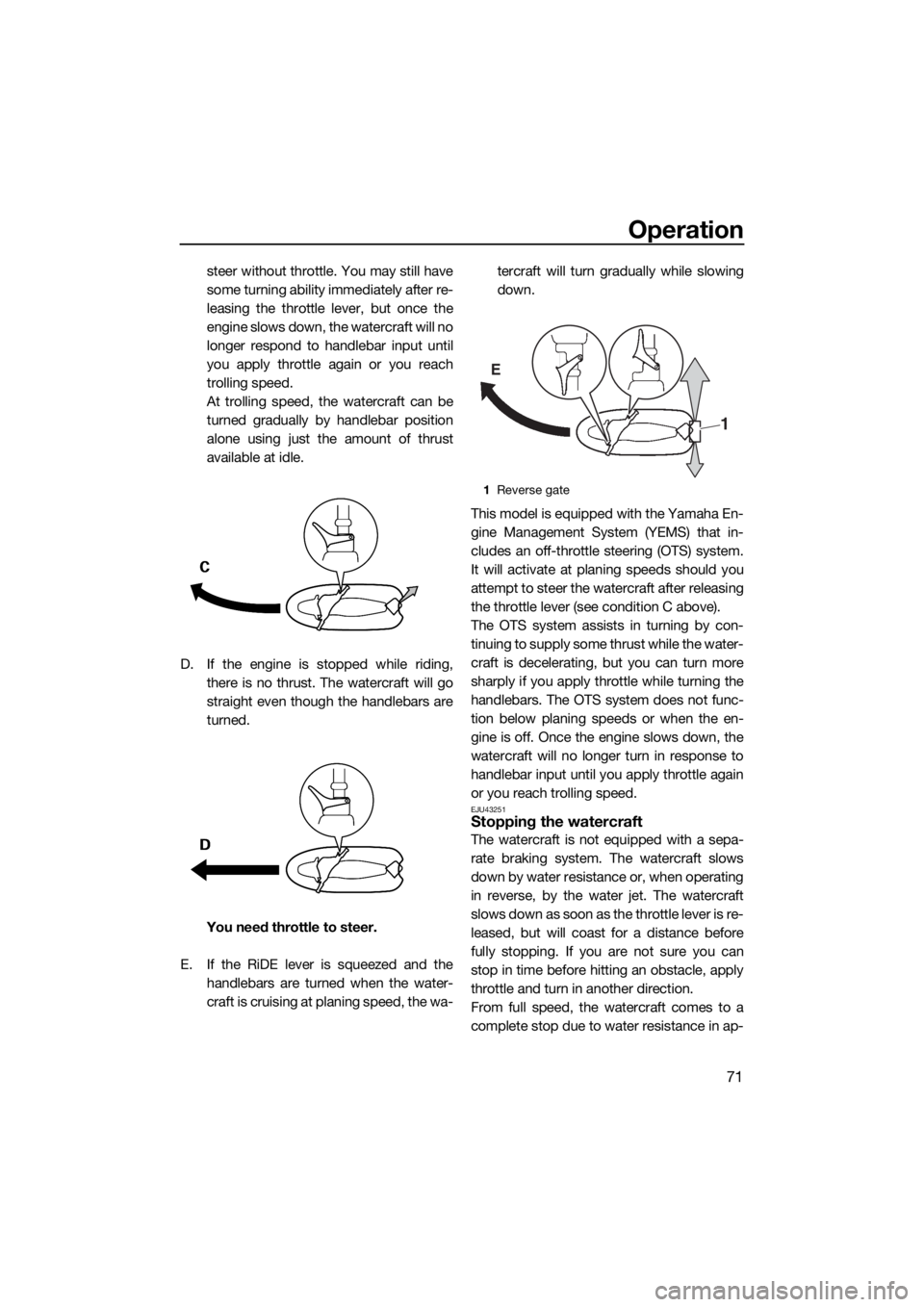
A. More throttle produces higher thrust, so
the watercraft will turn more sharply.
B. Less throttle produces lower thrust, so
the watercraft will turn more gradually.
C. Releasing the throttle lever completely
produces only minimum thrust. If you are
traveling at speeds above trolling, you
will have rapidly decreasing ability to
1“F” (Forward position)
1
UF4G71E0.book Page 70 Wednesday, July 27, 2016 9:32 AM
Page 77 of 106
Operation
71
steer without throttle. You may still have
some turning ability immediately after re-
leasing the throttle lever, but once the
engine slows down, the watercraft will no
longer respond to handlebar input until
you apply throttle again or you reach
trolling speed.
At trolling speed, the watercraft can be
turned gradually by handlebar position
alone using just the amount of thrust
available at idle.
D. If the engine is stopped while riding,
there is no thrust. The watercraft will go
straight even though the handlebars are
turned.
You need throttle to steer.
E. If the RiDE lever is squeezed and the
handlebars are turned when the water-
craft is cruising at planing speed, the wa-tercraft will turn gradually while slowing
down.
This model is equipped with the Yamaha En-
gine Management System (YEMS) that in-
cludes an off-throttle steering (OTS) system.
It will activate at planing speeds should you
attempt to steer the watercraft after releasing
the throttle lever (see condition C above).
The OTS system assists in turning by con-
tinuing to supply some thrust while the water-
craft is decelerating, but you can turn more
sharply if you apply throttle while turning the
handlebars. The OTS system does not func-
tion below planing speeds or when the en-
gine is off. Once the engine slows down, the
watercraft will no longer turn in response to
handlebar input until you apply throttle again
or you reach trolling speed.
EJU43251Stopping the watercraft
The watercraft is not equipped with a sepa-
rate braking system. The watercraft slows
down by water resistance or, when operating
in reverse, by the water jet. The watercraft
slows down as soon as the throttle lever is re-
leased, but will coast for a distance before
fully stopping. If you are not sure you can
stop in time before hitting an obstacle, apply
throttle and turn in another direction.
From full speed, the watercraft comes to a
complete stop due to water resistance in ap-
1Reverse gate
E
1
UF4G71E0.book Page 71 Wednesday, July 27, 2016 9:32 AM