Page 74 of 172
6-5
6
EBU31921On-Command drive knobThe vehicle handles differently in each of the drive modes (“2WD”, “4WD” and “DIFF LOCK”). For
example, the vehicle requires more effort to turn in “DIFF LOCK” than in “2WD”. Always stop the
vehicle before changing the position of the On-Command drive knob. The meter display changes
according to the selected drive mode. The differen t drive indicators, and the differential gear lock
indicator light “DIFF. LOCK” come on as follows:
Knob position Indication Drive mode
No indicator light.
“2WD” (two-wheel drive): Power is supplied to the rear
wheels.
“4WD” (four-wheel drive): Power is supplied to the rear and
front wheels.
“DIFF LOCK” (four-wheel drive with the differential gear
locked): Power is supplied to the rear and front wheels and
the differential gear is locked.
Unlike in four-wheel drive, all wheels turn at the same
speed.
UB427BE0.book Page 5 Friday, February 5, 2016 2:14 PM
Page 75 of 172
6-6
6
TIPWhen the knob is set to “DIFF LOCK” or “4WD”, the differential gear lock indicator and indica-
tor light will flash until the differential gear is completely locked or unlocked.
When the indicator and indicator light are flashi ng, turning the steering wheel back and forth
will help the differential gear lock to engage or disengage.
Riding before the differential gear is properly engaged or disengaged (e.g., when the indicator
and indicator light are flashing) will cause the vehicle speed to be limited until the differential
gear is completely engaged or disengaged. UB427BE0.book Page 6 Friday, February 5, 2016 2:14 PM
Page 87 of 172
7-9
7
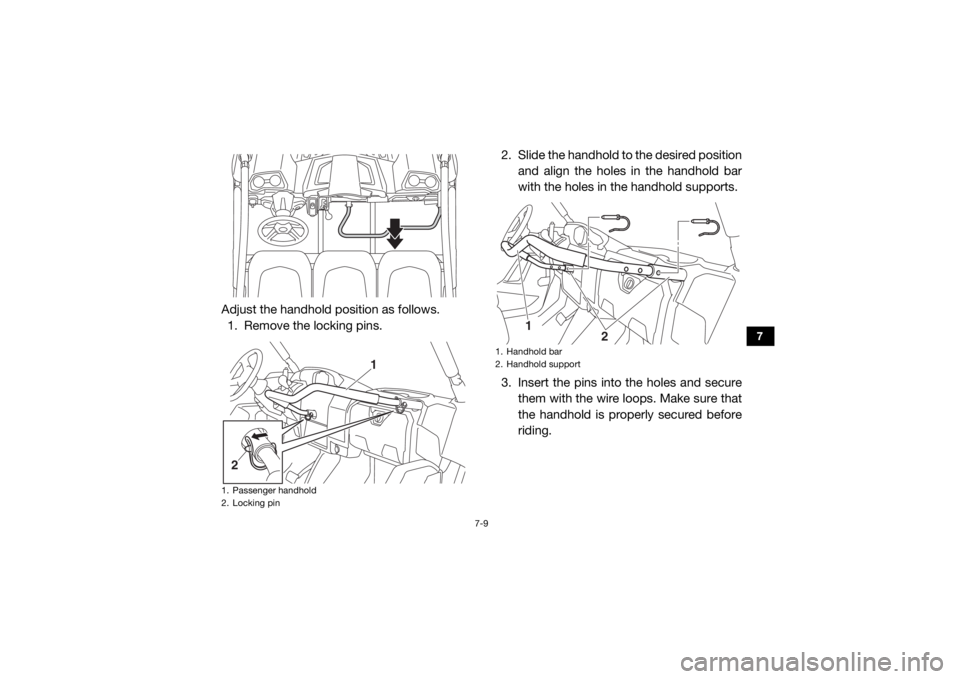
Adjust the handhold position as follows.1. Remove the locking pins. 2. Slide the handhold to the desired position
and align the holes in the handhold bar
with the holes in the handhold supports.
3. Insert the pins into the holes and secure them with the wire loops. Make sure that
the handhold is properly secured before
riding.1. Passenger handhold
2. Locking pin
1
2
1. Handhold bar
2. Handhold support
2
1
UB427BE0.book Page 9 Friday, February 5, 2016 2:14 PM
Page 91 of 172
7-13
7
Practice for new Yamaha Viking users
You should become familiar with the perfor-
mance characteristics of the vehicle in a lar-
ge, flat area that is free of obstacles and other
vehicles. Practice controlling the accelerator
pedal, brakes, steering, and drive select lever.
Drive at slow speeds with gradual accelera-
tion and turning. Practice smooth throttle ap-
plication. Practice slowing down before
turning. Practice maintaining a steady throttle
through the turn. Avoid higher speeds until
you are thoroughly familiar with the operation
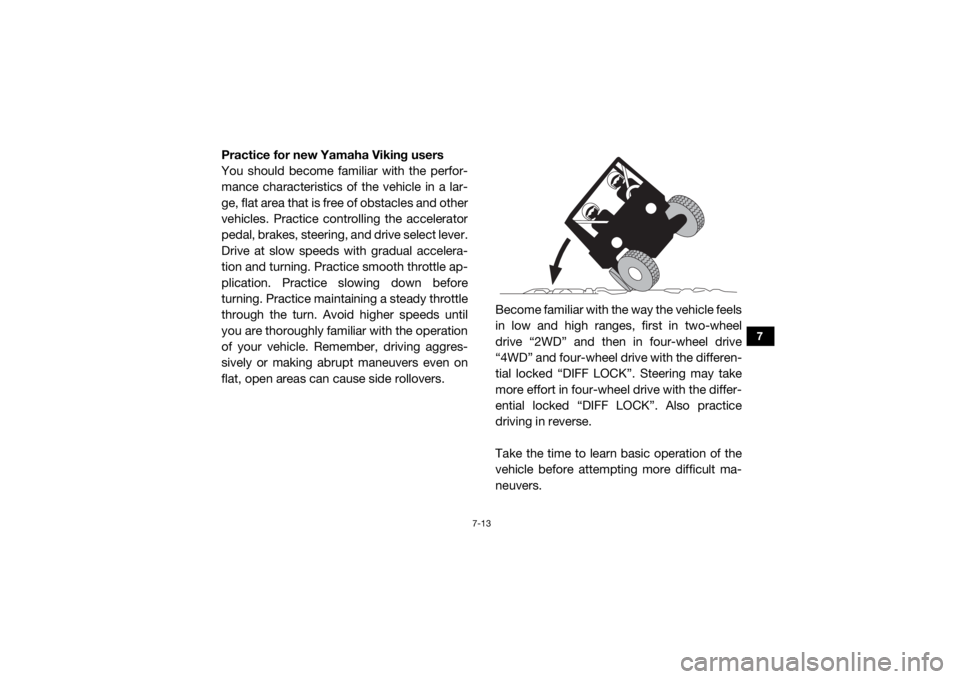
of your vehicle. Remember, driving aggres-
sively or making abrupt maneuvers even on
flat, open areas can cause side rollovers. Become familiar with the way the vehicle feels
in low and high ranges, first in two-wheel
drive “2WD” and then in four-wheel drive
“4WD” and four-wheel drive with the differen-
tial locked “DIFF LOCK”. Steering may take
more effort in four-wheel drive with the differ-
ential locked “DIFF LOCK”. Also practice
driving in reverse.
Take the time to learn basic operation of the
vehicle before attempting more difficult ma-
neuvers.UB427BE0.book Page 13 Friday, February 5, 2016 2:14 PM
Page 94 of 172

7-16
7
Parking on a flat area
When parking on a flat area, stop the engine
and shift the drive select lever into the neutral
position. Apply the parking brake to help pre-
vent the vehicle from rolling.
Parking on a slope
The parking brake acts only on the rear
wheels when in “2WD”. For the parking brake
to take effect on all four wheels, shift to “DIFF
LOCK” before stopping the engine.
If you park on a hill that is too steep the vehi-
cle may roll out of control. Never park on hills
that are so steep you cannot walk up them
easily. If you must park on an incline follow
these instructions:1. Bring the vehicle to a stop by applying the brake pedal.
2. Put the vehicle in “DIFF LOCK”.
3. Turn the key to “ ” (off).
4. With the brake pedal applied, set the parking brake. 5. Block the front and rear wheels with
rocks or other objects.
Loading
The total weight of operator, passengers, ac-
cessories, cargo, trailer tongue weight, and
the vehicle itself must not exceed 1080 kg
(2381 lb). Vehicle loading can affect handling.
See “Loading” on page 6-7.
EBU33360Operation on different surfaces and
terrainsGo slowly and proceed with caution when op-
erating on an unfamiliar surface or terrain.
This vehicle may handle differently in certain
types of terrains or on certain surfaces. You
may come upon hidden rocks, bumps, or
holes without enough time to react. To avoid
loss of control or rollover, always be alert to
changing surfaces or terrain when operating
the vehicle.
UB427BE0.book Page 16 Friday, February 5, 2016 2:14 PM
Page 96 of 172

7-18
7
side of a hill, which increases your risk of roll-
over. Practice first on gentle slopes before at-
tempting steeper hills. Always check the
terrain carefully before attempting any hill.
To climb a hill, you need traction, momentum,
and steady throttle. For more traction and
control for climbing steeper and/or rougher
slopes, shift into low gear and select “4WD”
or “DIFF LOCK”. Travel fast enough to main-
tain momentum, but not so fast that you can-
not react to changes in the terrain as you
climb.
Slow down when you reach the crest of the
hill if you cannot see clearly what is on the
other side – there could be another person, an
obstacle, or a sharp drop-off.
If you start to lose traction or momentum
when climbing, and decide you will be unable
to continue, use the brakes to stop. Do not at-
tempt to turn the vehicle around. With your
foot on the brake pedal, look behind you and
plan your descent. Shift the drive select lever
into reverse so you can use engine braking toslow your descent. Release the brake and be-
gin to coast down the hill. Use engine braking
as much as possible, gently applying the
brakes when necessary.
Downhill
Check the terrain carefully before going
downhill. When possible, choose a path that
lets you drive your vehicle straight downhill.
Choose your path carefully and drive slowly
enough to be able to react to obstacles that
you encounter.
For more traction and control, before going
down steeper and/or rougher slopes, shift
into low gear and select “4WD” or “DIFF
LOCK”. Engine braking will help you go
downhill slowly. Go as slowly as possible. If
you begin to go too fast, apply the brakes
gently. Avoid hard application of the brakes,
which could cause the vehicle to slide.UB427BE0.book Page 18 Friday, February 5, 2016 2:14 PM
Page 109 of 172
8-10
8
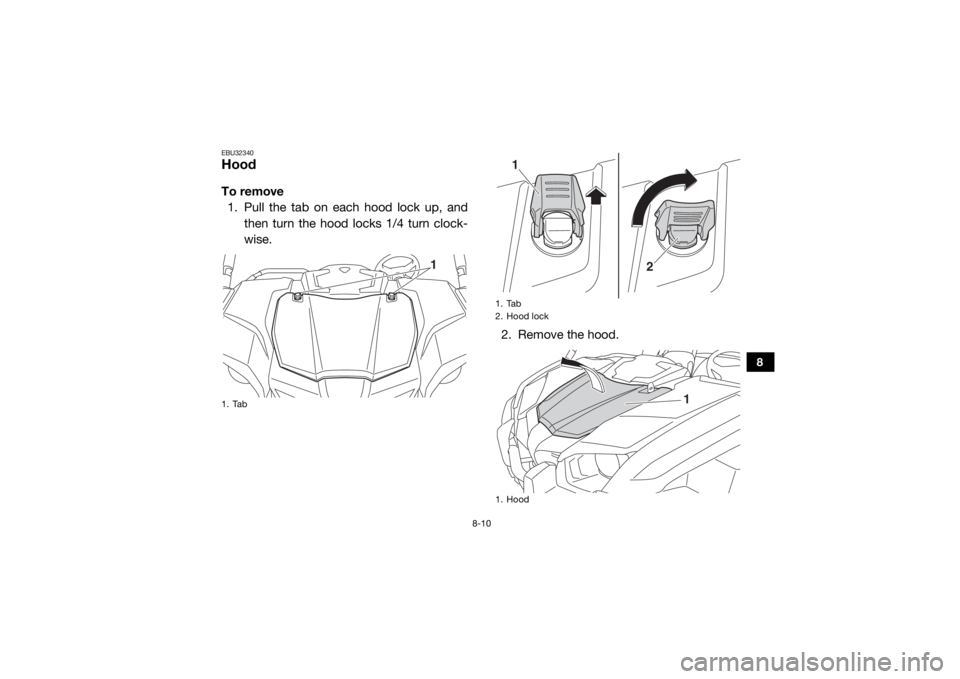
EBU32340HoodTo remove1. Pull the tab on each hood lock up, and then turn the hood locks 1/4 turn clock-
wise.
2. Remove the hood.1. Tab
1
1. Tab
2. Hood lock
1. Hood
1
2
1
UB427BE0.book Page 10 Friday, February 5, 2016 2:14 PM
Page 110 of 172
8-11
8
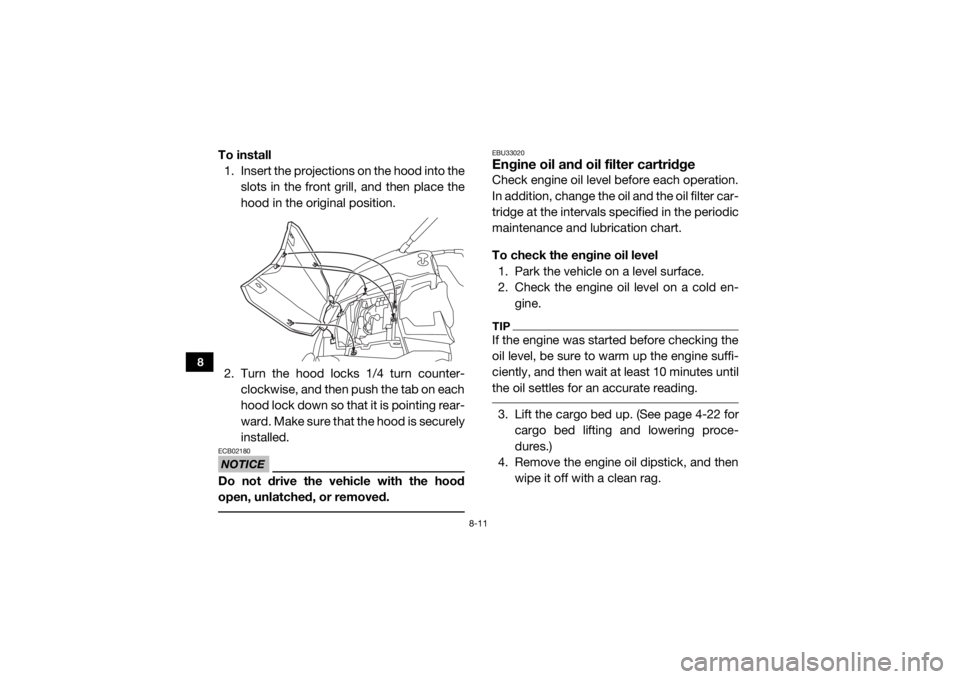
To install1. Insert the projections on the hood into the
slots in the front grill, and then place the
hood in the original position.
2. Turn the hood locks 1/4 turn counter- clockwise, and then push the tab on each
hood lock down so that it is pointing rear-
ward. Make sure that the hood is securely
installed.NOTICEECB02180Do not drive the vehicle with the hood
open, unlatched, or removed.
EBU33020Engine oil and oil filter cartridgeCheck engine oil level before each operation.
In addition, change the oil and the oil filter car-
tridge at the intervals specified in the periodic
maintenance and lubrication chart.
To check the engine oil level1. Park the vehicle on a level surface.
2. Check the engine oil level on a cold en- gine.TIPIf the engine was started before checking the
oil level, be sure to warm up the engine suffi-
ciently, and then wait at least 10 minutes until
the oil settles for an accurate reading. 3. Lift the cargo bed up. (See page 4-22 forcargo bed lifting and lowering proce-
dures.)
4. Remove the engine oil dipstick, and then
wipe it off with a clean rag.
UB427BE0.book Page 11 Friday, February 5, 2016 2:14 PM