2017 YAMAHA SUPERJET warning
[x] Cancel search: warningPage 41 of 78

Pre-operation checks
35
EJU32282
Pre-operation check pointsEJU40686Pre-launch checks
Perform the pre-launch checks in the pre-op-
eration checklist while the watercraft is on
land.
To perform the pre-launch checks:
(1) Remove the hood. (See page 24 for hood
removal and installation procedures.)
(2) Perform the checks and make sure that
there are no malfunctioning items or oth-
er problems.
(3) After completing these checks, install the
hood in its original position.
EJU32334Engine compartment check
WARNING
EWJ00462
Failure to ventilate the engine compart-
ment could result in a fire or explosion. Do
not start the engine if there is a fuel leak.
Ventilate the engine compartment. Leave the
engine compartment open for a few minutes
to allow any fuel vapors to escape.
Make sure that there is no damage inside the
engine compartment.
EJU34208Fuel system checks
WARNING
EWJ00382
Leaking fuel can result in fire or explosion.
Check for fuel leakage regularly.
If any fuel leakage is found, the fuel sys-
tem must be repaired by a qualified me-
chanic. Improper repairs can make the
watercraft unsafe to operate.
Make sure that there is no damage, leakage,
or other problem in the fuel system.
Check:
Carburetor for leakage
Fuel filler cap and seal for damage
Fuel in fuel tank for water and dirt
Fuel tank for damage and leakage
Fuel hoses and joints for damage and leak-
age
Fuel filter for leakage
Fuel cock for leakage
Fuel tank breather hose for damage and
leakage
Releasing the pressure in the fuel tank
Release the pressure in the fuel tank before
each use.
To release the pressure in the fuel tank:
(1) Loosen the fuel filler cap slowly and re-
move it to release any pressure in the fuel
tank.
(2) Securely install the fuel filler cap by tight-
ening it until it stops.
EJU32365Fuel level check
Check the fuel level in the fuel tank.
1Fuel filler cap
UF4D73E0.book Page 35 Wednesday, March 23, 2016 11:40 AM
Page 42 of 78

Pre-operation checks
36
Add fuel if necessary. (See page 29 for infor-
mation on filling the fuel tank.)
EJU32424Water separator check
Make sure that no water has collected in the
water separator. If water has collected in the
water separator, drain it. (See page 22 for in-
formation on draining the water separator.)
EJU40182Engine unit check
Check the exterior of the engine unit for dam-
age or other problem.
EJU41012Bilge water check
Make sure that no bilge water has collected in
the engine compartment. If bilge water has
collected in the engine compartment, wipe it
up with a dry cloth. NOTICE: Excessive wa-
ter in the engine compartment can splash
into the engine, which can result in severe
damage.
[ECJ00342]
EJU32485
Battery checks
Make sure that the battery terminals and
breather hose are not damaged and that the
battery leads and breather hose are connect-
ed properly. WARNING! Fire or explosion
could result if the breather hose is dam-aged, obstructed, or not connected prop-
erly.
[EWJ00452]
Make sure that the electrolyte level is be-
tween the minimum and maximum level
marks. WARNING! Never operate the wa-
tercraft if the battery does not have suffi-
cient power to start the engine or if it
shows any other signs of decreased pow-
er. Loss of battery power may leave you
stranded.
[EWJ01241]
Make sure that the battery is securely held in
place.
EJU32614Steering system checks
Turn the handlebars to the right and left sev-
eral times to make sure that operation is
smooth and unrestricted throughout the
1Water separator
1Positive (+) battery terminal: Red lead
2Negative (–) battery terminal: Black lead
3Breather hose
1Maximum level mark
2Minimum level mark
UF4D73E0.book Page 36 Wednesday, March 23, 2016 11:40 AM
Page 44 of 78

Pre-operation checks
38
Make sure that there is the proper amount of
throttle lever free play when the throttle lever
is in the fully closed (idle) position.
EJU32664Engine shut-off cord (lanyard) check
Make sure that the engine shut-off cord (lan-
yard) is not damaged. If the cord is damaged,
replace it. WARNING! Never try to repair
the engine shut-off cord (lanyard) or tie it
together. The engine shut-off cord (lan-
yard) may not pull free when the operator
falls off, allowing the watercraft to conti-
nue to run and cause an accident.
[EWJ01221]EJU41021
Switch checks
NOTICE
ECJ01361
Do not run the engine for more than 15
seconds on land without supplying water,
otherwise the engine could overheat.
Check the start switch, the engine stop
switch, and the engine shut-off switch for
proper operation. (See pages 19 to 19 for in-
formation on operating each switch.)
To check the operation of the switches:
(1) Push the start switch to make sure that
the engine starts.
(2) As soon as the engine starts running,
push the engine stop switch to make
sure that the engine stops immediately.
(3) Restart the engine, and then pull the en-
gine shut-off cord (lanyard) to remove
the clip from the engine shut-off switch
to make sure that the engine stops im-
mediately.
EJU41211Storage pouch checks
Make sure that the storage pouch is not dam-
aged and that water has not collected in the
pouch. Also, make sure that the storage
1Throttle lever free play
Throttle lever free play:
7.0–10.0 mm (0.28–0.39 in)
1Engine shut-off switch
2Clip
3Start switch
4Engine stop switch
5Engine shut-off cord (lanyard)
123
4
5
UF4D73E0.book Page 38 Wednesday, March 23, 2016 11:40 AM
Page 46 of 78
Operation
40
EJU32903
Operating your watercraft
WARNING
EWJ00511
Before operating your watercraft, become
familiar with all of the controls. Consult a
Yamaha dealer about any control or func-
tion that you do not fully understand. Fail-
ure to understand how the controls work
could cause an accident or prevent you
from avoiding an accident.
EJU32924Getting to know your watercraft
Operating your watercraft requires skills ac-
quired through practice over a period of time.
Take the time to learn the basic techniques
well before attempting more difficult maneu-
vers.
Operating your new watercraft can be a very
enjoyable activity, providing you with hours of
pleasure. However, it is essential to familiar-
ize yourself with the operation of the water-
craft to achieve the skill level necessary to
enjoy riding safely.
Before operating this watercraft, read this
owner’s/operator’s manual, the Riding Prac-
tice Guide, the Riding Instruction card, and all
labels on the watercraft. Pay particular atten-
tion to the safety information beginning on
page 8. These materials should give you an
understanding of the watercraft and its oper-
ation.
Remember: This watercraft is designed to
carry the operator only. Never have more
than one person on the watercraft at any
time.
EJU32985Learning to operate your watercraft
Before operating the watercraft, always per-
form the pre-operation checks listed on page
33. The short time spent checking the water-craft will reward you with added safety and
reliability.
Check local laws before operating your wa-
tercraft.
Operate defensively at safe speeds and keep
a safe distance away from people, objects,
and other watercraft. Select a wide area to
practice maneuvering in, where there is good
visibility and light boat traffic.
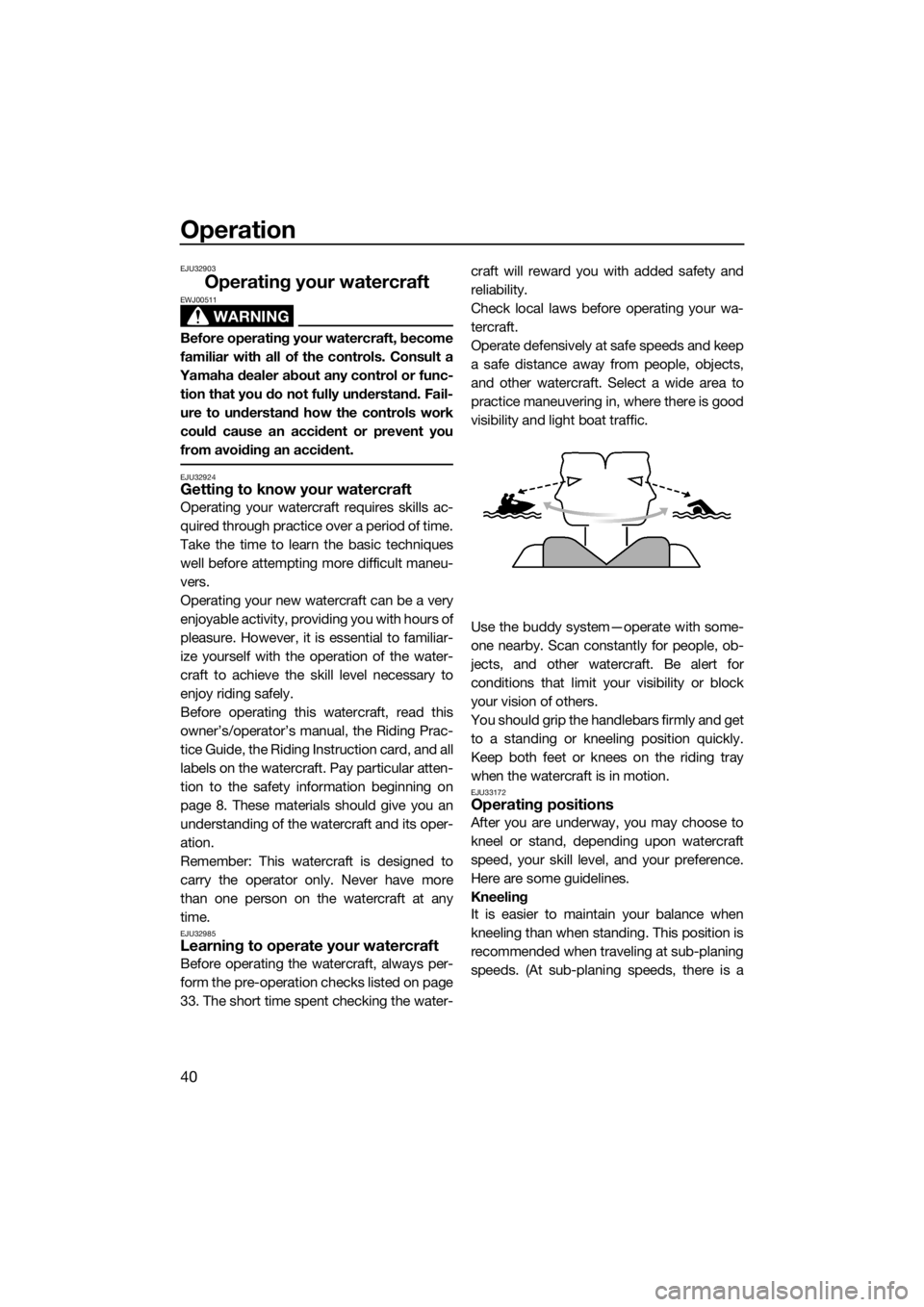
Use the buddy system—operate with some-
one nearby. Scan constantly for people, ob-
jects, and other watercraft. Be alert for
conditions that limit your visibility or block
your vision of others.
You should grip the handlebars firmly and get
to a standing or kneeling position quickly.
Keep both feet or knees on the riding tray
when the watercraft is in motion.
EJU33172Operating positions
After you are underway, you may choose to
kneel or stand, depending upon watercraft
speed, your skill level, and your preference.
Here are some guidelines.
Kneeling
It is easier to maintain your balance when
kneeling than when standing. This position is
recommended when traveling at sub-planing
speeds. (At sub-planing speeds, there is a
UF4D73E0.book Page 40 Wednesday, March 23, 2016 11:40 AM
Page 47 of 78

Operation
41
wake, but the watercraft is moving through
the water rather than skimming on top of it.)
At very slow speeds, it may be necessary to
support your upper-body weight with your el-
bows resting on the gunwales, trailing your
legs in the water.
Standing
After you are comfortable handling the water-
craft from a kneeling position, try standing as
the watercraft gains speed. The watercraft
will become easier to balance as the speed
increases, because jet thrust provides stabil-
ity as well as directional control. When you
are moving slowly, or preparing to stop, you
will probably need to return to the kneeling
position to maintain your balance.
EJU32822Launching the watercraft
When launching the watercraft, make sure
that there are no obstacles around you.If the watercraft is launched from a trailer,
someone should make sure that waves do
not push the watercraft into the trailer.
After the watercraft is in the water, turn it
around so that the bow faces the direction
you wish to go.
EJU32836Starting the engine on water
WARNING
EWJ01521
Do not apply throttle when others are at
the rear of the watercraft. Turn the engine
off or keep it at idle. Water and debris ex-
iting the jet thrust nozzle can cause severe
injury.
To start the engine:
(1) Move the watercraft to an area that is
free from weeds and debris, and has a
water depth of at least 60 cm (2 ft) from
the bottom of the watercraft. NOTICE:
Never run the engine in water that is
less than 60 cm (2 ft) deep from the
bottom of the watercraft, otherwise
pebbles or sand could be sucked into
the jet intake, causing impeller dam-
age and engine overheating.
[ECJ00473]
UF4D73E0.book Page 41 Wednesday, March 23, 2016 11:40 AM
Page 48 of 78

Operation
42
(2) Turn the fuel cock knob to “ON”.
(3) Attach the engine shut-off cord (lanyard)
to your left wrist, and then attach the clip
to the engine shut-off switch. (See page
19 for information on operating the en-
gine shut-off switch.) WARNING! Check
that the engine shut-off cord (lanyard)
is attached correctly. If the engine
shut-off cord (lanyard) is not attached
correctly, it may not pull free when the
operator falls off, allowing the water-
craft to continue to run and cause an
accident.
[EWJ00582]
(4) Pull the choke knob all the way out to
start a cold engine.
TIP:
The choke should not be used when the en-
gine is warm.
(5) While lightly squeezing the throttle lever,
push the start switch (green button) to
start the engine. (See page 19 for infor-
mation on operating the start switch.)
WARNING! Do not apply too much
throttle when starting the engine, oth-
erwise the watercraft will accelerate
unexpectedly. This could cause a col-
lision or cause the operator to be
thrown overboard.
[EWJ00592]
(6) After the engine has warmed up, push
the choke knob in to its original position.
TIP:
If the choke knob is left pulled out, the engine
will stall.
1Clip
2Engine shut-off switch
3Engine shut-off cord (lanyard)
12
3
START
UF4D73E0.book Page 42 Wednesday, March 23, 2016 11:40 AM
Page 49 of 78

Operation
43
EJU32863Stopping the engine
Release the throttle lever, and then push the
engine stop switch (red button) to stop the
engine. WARNING! You need throttle to
steer. Shutting the engine off can cause
you to hit an obstacle you are attempting
to avoid. A collision could result in severe
injury or death.
[EWJ00602]
EJU32873
Leaving the watercraft
If leaving the watercraft, remove the clip from
the engine shut-off switch to prevent acci-
dental starting or unauthorized operation by
children or others.
EJU41172Operating the watercraft
When the engine is running, the watercraft
will move forward at trolling speed even if thethrottle lever is in the fully closed (idle) posi-
tion.
EJU33244Turning the watercraft
WARNING
EWJ00762
Do not release the throttle lever when
trying to steer away from objects—you
need throttle to steer. A collision could
result in severe injury or death.
When operating at higher speeds, make
gradual turns or slow down before turn-
ing. Sharp high-speed turns may cause
the watercraft to slide sideways or spin,
throwing the operator overboard, which
could cause an injury.
Steering control depends on the combination
of handlebar position and the amount of
throttle.
Water sucked in through the intake grate is
pressurized by the impeller in the jet pump.
As the pressurized water is expelled from the
pump through the jet thrust nozzle, it creates
thrust to move and steer the watercraft. The
higher the engine speed, the more thrust pro-
duced.
The amount of jet thrust, in addition to the po-
sition of the handlebars, determines how
sharply you turn.
STOP
UF4D73E0.book Page 43 Wednesday, March 23, 2016 11:40 AM
Page 51 of 78

Operation
45
general, the higher the speed or the sharper
the turn, the more you lean.
EJU33273Stopping the watercraft
The watercraft is not equipped with a sepa-
rate braking system. It is stopped by water
resistance when the throttle lever is released.
From full speed, the watercraft comes to a
complete stop in approximately 90 m (300 ft)
after the throttle lever is released or the en-
gine is stopped, although this distance will
vary depending on many factors, including
gross weight, water surface conditions, and
wind direction. The watercraft slows down as
soon as the throttle lever is released, but will
coast for a distance before fully stopping. If
you are not sure you can stop in time beforehitting an obstacle, apply throttle and turn in
another direction.
WARNING
EWJ00723
Allow adequate stopping distance.
Take early action to avoid collisions. Re-
member, watercraft and other boats do
not have brakes.
Operate defensively at safe speeds and
keep a safe distance away from people,
objects, and other watercraft to give you
time to stop.
Do not shut the engine off when slowing
down in case you need engine power to
steer away from a boat or other obstacle
that comes into your path.
EJU33075Starting off
WARNING
EWJ00712
To avoid collisions:
Scan constantly for people, objects, and
other watercraft. Be alert for conditions
that limit your visibility or block your vi-
sion of others.
Operate defensively at safe speeds and
keep a safe distance away from people,
objects, and other watercraft.
Do not follow directly behind watercraft
or other boats. Do not go near others to
spray or splash them with water. Avoid
UF4D73E0.book Page 45 Wednesday, March 23, 2016 11:40 AM