2017 YAMAHA SUPERJET engine overheat
[x] Cancel search: engine overheatPage 56 of 78
Care and storage
50
EJU41192
Post-operation care
WARNING
EWJ00321
Always turn the fuel cock knob to “OFF”
when storing the watercraft, otherwise
fuel could leak out into the engine or en-
gine compartment, which would create a
fire hazard.
After using the watercraft, always take it out
of the water, clean it, and store it. Leaving the
watercraft in the water for extended periods
will accelerate the rate of normal deteriora-
tion of the jet pump and hull. Marine organ-
isms and corrosion are some of the
conditions that can shorten the life of many
watercraft components.
EJU3351AFlushing the cooling water passages
NOTICE
ECJ01361
Do not run the engine for more than 15
seconds on land without supplying water,
otherwise the engine could overheat.
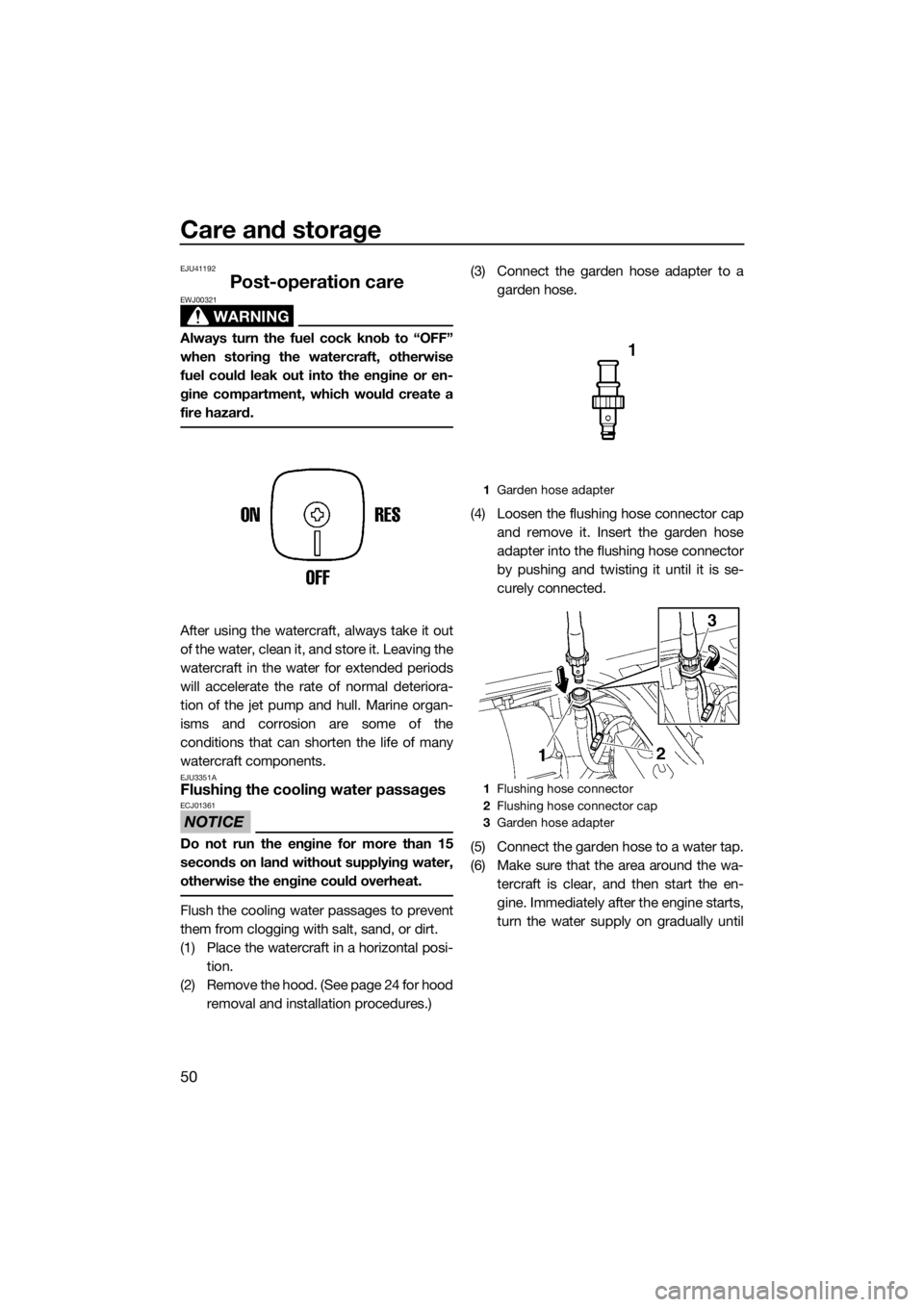
Flush the cooling water passages to prevent
them from clogging with salt, sand, or dirt.
(1) Place the watercraft in a horizontal posi-
tion.
(2) Remove the hood. (See page 24 for hood
removal and installation procedures.)(3) Connect the garden hose adapter to a
garden hose.
(4) Loosen the flushing hose connector cap
and remove it. Insert the garden hose
adapter into the flushing hose connector
by pushing and twisting it until it is se-
curely connected.
(5) Connect the garden hose to a water tap.
(6) Make sure that the area around the wa-
tercraft is clear, and then start the en-
gine. Immediately after the engine starts,
turn the water supply on gradually until
1Garden hose adapter
1Flushing hose connector
2Flushing hose connector cap
3Garden hose adapter
UF4D73E0.book Page 50 Wednesday, March 23, 2016 11:40 AM
Page 61 of 78

Care and storage
55
Steering cable ball joint (handlebar end)
and steering cable inner wire (handlebar
end)
To access the steering cable ball joint (han-
dlebar end) and steering cable inner wire
(handlebar end), remove the steering pole
cover. (See step 1 in “Adjusting the jet
thrust nozzle angle” on page 57 for infor-
mation on removing the steering pole cov-
er.)
Steering cable ball joint (jet thrust nozzle
end) and steering cable inner wire (jet
thrust nozzle end)
EJU40944Rustproofing
NOTICE
ECJ01361
Do not run the engine for more than 15
seconds on land without supplying water,
otherwise the engine could overheat.
Spray metallic parts of the hull and engine
with a rust inhibitor.
To rustproof the internal engine components:
(1) Remove the hood. (See page 24 for hood
removal and installation procedures.)
(2) Loosen the silencer cap and remove it.
(3) Make sure that the area around the wa-
tercraft is clear, and then start the engine
in a well-ventilated area.
(4) Run the engine at a fast idle.
(5) Quickly spray as much rust inhibitor as
possible through the hole in the silencer
cover. Keep spraying until the engine
stalls (or a maximum of 15 seconds).
WARNING! Do not pour or spray gaso-
line, or any substance other than a
rust inhibitor through the hole in the
silencer cover. Do not spray flamma-
ble rust inhibitor products on engine
surfaces while the engine is hot. Oth-
erwise, a fire or explosion could oc-
cur.
[EWJ00302]
(6) Securely install the silencer cap by tight-
ening it until it stops. NOTICE: Be sure
to install the silencer cap securely af-
ter fogging the engine, otherwise wa-
ter could enter the engine and cause
damage.
[ECJ00153]
(7) Securely install the hood in its original
position.
1Silencer cap
UF4D73E0.book Page 55 Wednesday, March 23, 2016 11:40 AM
Page 72 of 78

Trouble recovery
66
EJU34625
Emergency proceduresEJU34635Cleaning the jet intake and impeller
WARNING
EWJ00783
Before attempting to remove weeds or de-
bris from the jet intake or impeller area,
shut the engine off and remove the clip
from the engine shut-off switch. Severe in-
jury or death could result from coming in
contact with the rotating parts of the jet
pump.
If weeds or debris gets caught in the jet intake
or impeller, cavitation can occur, causing jet
thrust to decrease even though engine speed
rises. If this condition is allowed to continue,
the engine will overheat and may seize.
NOTICE: If weeds or debris gets caught in
the jet intake, do not operate the water-
craft above trolling speed until they have
been removed.
[ECJ00654]
If there is any sign that the jet intake or impel-
ler is clogged with weeds or debris, return to
shore and check the intake and impeller. Al-ways stop the engine before beaching the
watercraft.
(1) Place a suitable clean cloth or carpeting
underneath the watercraft to protect it
from abrasions and scratches. Turn the
watercraft on its side as shown.
NOTICE: Always turn the watercraft
over onto its port (left) side. When
turning the watercraft on its side, sup-
port the bow so that the handlebars
are not bent or damaged.
[ECJ00662]
STOP
UF4D73E0.book Page 66 Wednesday, March 23, 2016 11:40 AM
Page 76 of 78

70
Index
2-stroke engine oil ................................... 28
A
After removing the watercraft from the
water ..................................................... 49
B
Battery care.............................................. 51
Battery checks ......................................... 36
Battery, jumping ....................................... 67
Beaching the watercraft ........................... 49
Bilge water check..................................... 36
Bilge water, draining ................................ 30
Bilge water, draining on water ................. 30
Boarding and starting in deep water........ 47
Boarding and starting in shallow water.... 46
Bow rope hole .......................................... 25
C
Capsized watercraft ................................. 48
Carburetor, adjusting ............................... 61
Choke cable, adjusting ............................ 61
Choke knob.............................................. 21
Cleaning ................................................... 54
Cleaning the watercraft ............................ 51
Cooling water pilot outlet ......................... 21
Cooling water pilot outlet check .............. 39
Craft Identification Number (CIN)............... 1
Cruising limitations..................................... 9
E
Emergency procedures ............................ 66
Engine break-in ........................................ 32
Engine compartment check ..................... 35
Engine idling speed, adjusting ................. 62
Engine overheat warning system ............. 22
Engine serial number ................................. 1
Engine shut-off cord (lanyard) check ....... 38
Engine shut-off switch ............................. 19
Engine stop switch................................... 19
Engine unit check..................................... 36
Enjoy your watercraft responsibly............ 15
Equipment ................................................ 24
F
Fire extinguisher check ............................ 39
Fire extinguisher container....................... 26
Fire extinguisher container checks .......... 39
Flushing the cooling water passages....... 50
Fuel .......................................................... 28Fuel and engine oil requirements ............. 28
Fuel cock knob......................................... 21
Fuel filter, checking .................................. 61
Fuel level check........................................ 35
Fuel system checks ................................. 35
Fuel tank, filling ........................................ 29
Fuse, replacing ......................................... 67
G
Getting to know your watercraft .............. 40
Glossary, watercraft ................................. 16
H
Hazard information................................... 13
Hood ........................................................ 24
Hood check .............................................. 39
Hull and deck check ................................ 39
I
Identification numbers ............................... 1
J
Jet intake and impeller, cleaning.............. 66
Jet intake checks ..................................... 39
Jet thrust nozzle angle, adjusting ............ 57
Jumper cables, connecting ...................... 67
L
Labels, important ....................................... 3
Labels, other .............................................. 7
Labels, warning .......................................... 4
Launching the watercraft ......................... 41
Learning to operate your watercraft......... 40
Leaving the watercraft.............................. 43
Limitations on who may operate the
watercraft ................................................ 8
Long-term storage ................................... 54
Lubrication ............................................... 54
Lubrication points .................................... 61
M
Main components, location of ................. 17
Maintenance............................................. 56
Manufactured date label ............................ 2
Mixing fuel and oil .................................... 28
O
Operating in weeded areas ...................... 49
Operating positions .................................. 40
Operating the watercraft .......................... 43
Operating your watercraft ........................ 40
Operation requirements ........................... 10
UF4D73E0.book Page 70 Wednesday, March 23, 2016 11:40 AM