2017 YAMAHA GRIZZLY 700 warning light
[x] Cancel search: warning lightPage 85 of 174

7-13
7
NOTICEECB00252Do not shift from low-range to high-range or
vice versa without coming to a complete stop.
Damage to the engine or drive train may occur. TURNING YOUR ATV
WARNING
EWB01772Always follow proper procedures for turning as
described in this Owner’s Manual. Practice
turning at low speeds before attempting to turn
at faster speeds. Do not turn at speeds too fast
for your skills or the conditions. ATV could go
out of control, causing a collision or overturn. To achieve maximum traction on unpaved surfac-
es, the two rear wheels turn together at the same
speed. Therefore, unless the wheel on the inside
of the turn is allowed to slip or lose some traction,
the ATV will resist turning. A special turning tech-
nique must be used to allow the ATV to make
turns quickly and easily. It is essential that this skill
be learned first at low speed.As you approach a curve, slow down and begin to
turn the handlebars in the desired direction. As
you do so, put your weight on the footboard to the
outside of the turn (opposite your desired direc-
tion) and lean your upper body into the turn. Use
the throttle to maintain an even speed through the
turn. This maneuver will let the wheel on the inside
of the turn slip slightly, allowing the ATV to make
the turn properly.
This procedure should be practiced at slow speed
many times in a large unpaved area with no obsta-
cles. If an incorrect technique is used, your ATV
1. Lean towards inside of turn.
2. Support your weight on the outer footboard.
U2UD61E0.book Page 13 Monday, April 25, 2016 10:55 AM
Page 90 of 174

7-18
7CROSSING A SLOPE
WARNING
EWB01633Improperly crossing hills or turning on hills
could cause loss of control or cause the ATV to
overturn.
Always follow proper procedures as de-
scribed in the Owner’s Manual.
Avoid hills with excessively slippery or loose
surfaces.
Avoid crossing the side of a steep hill.
Shift your weight to the uphill side of the ATV.
Never attempt to turn the ATV around on any
hill until you have mastered the turning tech-
nique as described in the Owner’s Manual on
level ground. Be very careful when turning
on any hill.
Traversing a sloping surface on your ATV requires
you to properly position your weight to maintain
proper balance. Be sure that you have learned the
basic riding skills on flat ground before attempting
to cross a sloping surface. Avoid slopes with slip-
pery surfaces or rough terrain that may upset your
balance.
As you travel across a slope, lean your body in the
uphill direction. It may be necessary to correct the
steering when riding on loose surfaces by pointing
the front wheels slightly uphill. When riding on
slopes, be sure not to make sharp turns either up
or down hill.
If your ATV does begin to tip over, gradually steer
in the downhill direction if there are no obstacles
in your path. As you regain proper balance, grad-
ually steer again in the direction you wish to travel.
U2UD61E0.book Page 18 Monday, April 25, 2016 10:55 AM
Page 154 of 174

8-58
8
NOTICEECB00641To prevent accidental short-circuiting, turn off
the main switch when checking or replacing a
fuse. 2. Remove the blown fuse, and then install anew fuse of the specified amperage.
WARNING! Always use a fuse of the spec-
ified rating, and never use a substitute ob-
ject in place of the proper fuse. An
improper fuse or a substitute object can
cause damage to the electrical system,
which could lead to a fire.
[EWB02173]
3. Turn the key to “ ” (on) and turn on the elec-trical circuits to check if the devices operate.
4. If the fuse immediately blows again, have a Yamaha dealer check the electrical system.
Specified fuses:
Main fuse:40.0 A
Headlight fuse: 10.0 A
Ignition fuse: 10.0 A
Four-wheel-drive motor fuse: 10.0 A
Signaling system fuse: 10.0 A
Auxiliary DC jack fuse: 10.0 A
Radiator fan motor fuse: 20.0 A
Fuel injection system fuse: 15.0 A
EPS fuse: 40.0 A
U2UD61E0.book Page 58 Monday, April 25, 2016 10:55 AM
Page 159 of 174
8-63
8
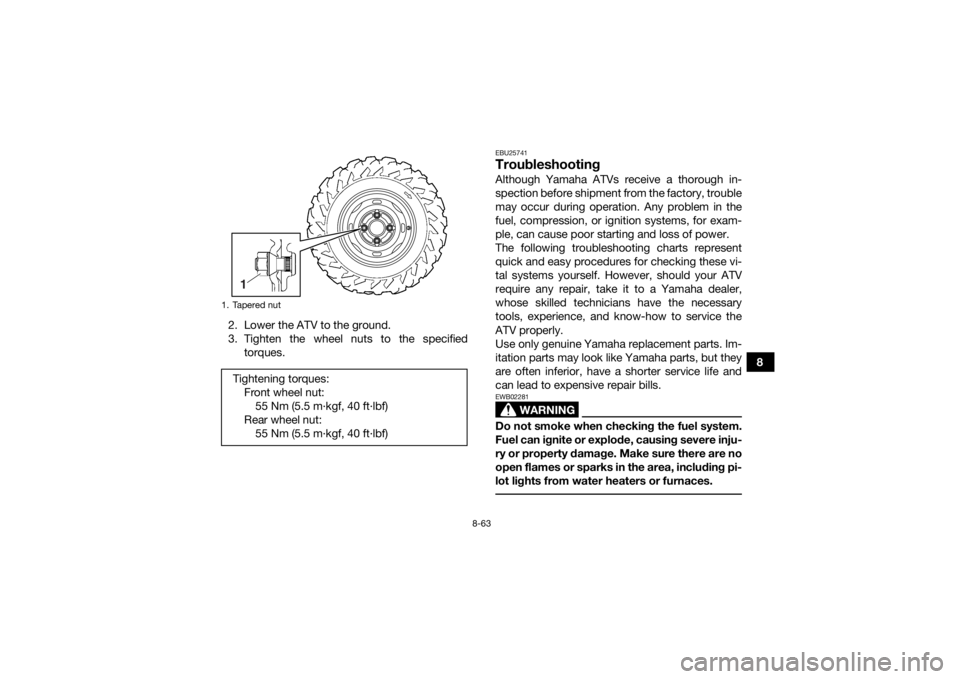
2. Lower the ATV to the ground.
3. Tighten the wheel nuts to the specified
torques.
EBU25741TroubleshootingAlthough Yamaha ATVs receive a thorough in-
spection before shipment from the factory, trouble
may occur during operation. Any problem in the
fuel, compression, or ignition systems, for exam-
ple, can cause poor starting and loss of power.
The following troubleshooting charts represent
quick and easy procedures for checking these vi-
tal systems yourself. However, should your ATV
require any repair, take it to a Yamaha dealer,
whose skilled technicians have the necessary
tools, experience, and know-how to service the
ATV properly.
Use only genuine Yamaha replacement parts. Im-
itation parts may look like Yamaha parts, but they
are often inferior, have a shorter service life and
can lead to expensive repair bills.
WARNING
EWB02281Do not smoke when checking the fuel system.
Fuel can ignite or explode, causing severe inju-
ry or property damage. Make sure there are no
open flames or sparks in the area, including pi-
lot lights from water heaters or furnaces.
1. Tapered nutTightening torques:Front wheel nut:55 Nm (5.5 m·kgf, 40 ft·lbf)
Rear wheel nut: 55 Nm (5.5 m·kgf, 40 ft·lbf)1
U2UD61E0.book Page 63 Monday, April 25, 2016 10:55 AM
Page 169 of 174

10-5
10
Meter lighting:EL (Electroluminescent)
Neutral indicator light: LED
Reverse indicator light:
LED
Coolant temperature warning light: LED
EPS warning light: LED
Park indicator light:
LED
Engine trouble warning light: LED
High-range indicator light: LED
Low-range indicator light:
LED
Differential gear lock indicator light: LEDFuses:Main fuse:
40.0 A
Fuel injection system fuse: 15.0 A
EPS fuse: 40.0 A
Headlight fuse:
10.0 A
Signaling system fuse: 10.0 A Ignition fuse:
10.0 A
Auxiliary DC jack fuse: 10.0 A
Four-wheel-drive motor fuse:
10.0 A
Radiator fan motor fuse: 20.0 A
EBU30402For Europe only
The figures quoted are emission levels and are not
necessarily safe working levels. Whilst there is a
correlation between the emission and exposure
levels, this cannot be used reliably to determine
whether or not further precautions are required.
Factors that influence the actual level of exposure
of work-force include the characteristics of the
work room, the other sources of noise, etc. i.e. the
number of machines and other adjacent process-
es, and the length of time for which an operator is
exposed to the noise. Also the permissible expo-
sure level can vary from country. This information,
however, will enable the user of the machine to
make a better evaluation of the hazard and risk.
U2UD61E0.book Page 5 Monday, April 25, 2016 10:55 AM
Page 172 of 174

12-1
12
INDEX
AAccessories and loading ................................................ 6-5
Accessories, auxiliary jack ........................................... 4-24
Air filter element, cleaning ............................................ 8-38
Axle boots .................................................................... 8-49BBattery .......................................................................... 8-53
Brake fluid, changing ...................................................8-46
Brake fluid level, checking ........................................... 8-44
Brake lever, front .......................................................... 4-15
Brake levers, checking and lubricating ........................ 8-50
Brake pads, checking the front and rear ..................... 8-43
Brake pedal and rear brake lever ................................. 4-15
Brake pedal, checking and lubricating ........................ 8-51
Brake pedal free play, adjusting .................................. 8-47
Brakes .......................................................................... 8-43
Brakes, front and rear .................................................... 5-3CCables, checking and lubricating ................................. 8-49
Carrier, front ................................................................. 4-23
Carrier, rear .................................................................. 4-23
Chassis fasteners ........................................................... 5-6
Cleaning ......................................................................... 9-1
Coolant ................................................................. 5-3, 8-30
Coolant temperature warning light ................................. 4-3DDifferential gear oil ............................................... 5-3, 8-28
Drive select lever .......................................................... 4-16
Drive select lever and driving in reverse ........................ 6-2
EEngine break-in .............................................................. 6-4
Engine oil ....................................................................... 5-3
Engine oil and oil filter cartridge .................................. 8-21
Engine stop switch ......................................................... 4-8
Engine trouble warning light .......................................... 4-3
EPS warning light ........................................................... 4-3FFinal gear oil ......................................................... 5-3, 8-25
Four-wheel-drive/differential gear lock indicator ........... 4-4
Front and rear brake lever free play, checking ............ 8-46
Fuel ...................................................................... 4-16, 5-3
Fuel tank cap ............................................................... 4-16
Fuses, replacing ........................................................... 8-57HHandlebar switches ....................................................... 4-8
Headlight beam, adjusting ........................................... 8-61
Headlight bulb, replacing ............................................. 8-59
High-range indicator light .............................................. 4-2
Horn switch .................................................................... 4-9IIdentification numbers ................................................. 11-1
Indicator lights and warning lights ................................. 4-2
Instruments, lights and switches ................................... 5-7LLabel locations ............................................................... 1-1
Light switch .................................................................... 4-8
Low-range indicator light ............................................... 4-2
U2UD61E0.book Page 1 Monday, April 25, 2016 10:55 AM