2017 VOLVO XC90 TWIN ENGINE HYBRID oil temperature
[x] Cancel search: oil temperaturePage 389 of 584

STARTING AND DRIVING
}}
387
Driving through standing water
The vehicle should be driven with extreme cau-tion if it is necessary to drive through standingwater.
The vehicle can be driven through water up to adepth approximately level with the floor at walk-ing speed to help prevent water from enteringthe differential and/or the transmission or dam-aging electrical components.
•If possible, check the depth of the waterbefore driving through it. Take particular carewhen driving through flowing water.
•Before driving through water, always selectthe Off Road drive mode to ensure that thegasoline engine is running and to maximizeground clearance.
•After driving through water, apply the brakesand check that they are functioning correctly.
•Clean the electrical connections for trailerwiring after driving in mud or water.
•When driving through water, maintain lowspeed and do not stop in the water.
CAUTION
•Damage may occur to the engine, trans-mission, electrical components, etc. if thevehicle is driven through water higherthan its floor level. Be aware that wavescreated by other vehicles could cause thelevel to temporarily be above the vehicle'sfloor level.
•Damage to any components due to waterabove the floor level, vapor lock or insuffi-cient oil is not covered under warranty.
•If the engine has been stopped while thevehicle is in water, do not attempt torestart it. Have the vehicle towed out ofthe water and inspected by a trained andqualified Volvo service technician.
WARNING
•Avoid driving through standing or rushingwater. Doing so can be dangerous and itmay also be difficult to determine theactual depth of the water.
•If water cannot be avoided, after drivingthrough the water, press lightly on thebrake pedal to ensure that the brakes arefunctioning normally. Water or mud canmake the brake linings slippery, resultingin delayed braking effect.
Related information
•Towing recommendations (p. 389)
Overheating the engine andtransmission
In demanding driving conditions, such as whentransporting heavy loads, driving in mountainousareas or in very hot weather there is a risk ofoverheating the engine or transmission.
•The engine's output may be slightly limited ifthere is a risk of overheating.
•Remove e.g., auxiliary lights mounted in frontof the grille in hot weather.
•If the temperature of the engine coolantbecomes too high, the warning symbol willilluminate and the message Enginetemperature/Stop safely will be displayed.Stop the vehicle as soon as possible in asafe place and let the engine idle for severalminutes.
•If the message Engine temperature/Hightemperature Turn off engine or Enginecoolant/Stop safely is displayed, stopsafely and turn off the engine.
•If the transmission begins to overheat, analternative gear shifting program will beselected. An integrated protective functionwill also by activated, the warning symbol willilluminate and the message TransmissionwarmHigh temperature Reduce speedor Transmission warmStop safely, waitfor cooling will be displayed in the instru-ment panel.
Page 390 of 584

||
STARTING AND DRIVING
388
•The air conditioning may be switched offtemporarily.
•After a prolonged period of driving, do notturn off the engine immediately after stop-ping.
•The engine cooling fan commonly continuesto run for several minutes after the enginehas been turned off.
WARNING
The cooling fan (located at the front of theengine compartment, behind the radiator) maystart or continue to operate (for up to6 minutes) after the engine has beenswitched off.
Related information
•Driving with a trailer (p. 397)
•Before a long distance trip (p. 385)
Winter driving
Check your vehicle before the approach of coldweather.
The following advice is worth noting:
•Make sure that the engine coolant contains50 percent antifreeze. Any other mixture willreduce freeze protection. This gives protec-tion against freezing down to –31 °F(–35 °C). The use of "recycled" antifreeze isnot approved by Volvo. Different types ofantifreeze must not be mixed.
•Volvo recommends using only genuine Volvoantifreeze in your vehicle's radiator.
•Try to keep the fuel tank well filled – thishelps prevent the formation of condensationin the tank. In addition, in extremely coldweather conditions it is worthwhile to addfuel line de-icer before refueling.
•The viscosity of the engine oil is important.Oil with low viscosity (thinner oil) improvescold-weather starting as well as decreasingfuel consumption while the engine is warm-ing up. Full synthetic 0W-30 oil is recom-mended for driving in areas with sustainedlow temperatures.
•The load placed on the battery is greater dur-ing the winter since the windshield wipers,lighting, etc., are used more often. Moreover,the capacity of the battery decreases as thetemperature drops. In very cold weather, apoorly charged battery can freeze and be
damaged. It is therefore advisable to checkthe state of charge more frequently andspray an anti-rust oil on the battery posts.
•Volvo recommends the use of snow tires onall four wheels for winter driving.
•To prevent the washer fluid reservoir fromfreezing, add washer solvents containingantifreeze. This is important since dirt is oftensplashed on the windshield during winterdriving, requiring the frequent use of thewashers and wipers. Volvo Washer Solventshould be diluted as follows: Down to 14 °F(–10 °C): 1 part washer solvent and 4 partswater Down to 5 °F (–15 °C): 1 part washersolvent and 3 parts water Down to 0 °F(–18 °C): 1 part washer solvent and 2 partswater Down to –18 °F (–28 °C): 1 partwasher solvent and 1 part water.
•Use Volvo Teflon Lock Spray in the locks.
•Avoid using de-icing sprays as they cancause damage to the locks.
Related information
•Snow tires and chains (p. 485)
Page 406 of 584

||
STARTING AND DRIVING
404
NOTE
After a cold start, idle speed may be noticea-bly higher than normal for a short period. Thisis done to help bring components in theemission control system to their normal oper-ating temperature as quickly as possible,which enables them to control emissions andhelp reduce the vehicle's impact on the envi-ronment.
CAUTION
•When starting in cold weather, the auto-matic transmission may shift up at slightlyhigher engine speeds than normal untilthe automatic transmission fluid reachesnormal operating temperature.
•Do not race a cold engine immediatelyafter starting. Oil flow may not reachsome lubrication points fast enough toprevent engine damage.
•The engine should be idling when youmove the gear selector. Never accelerateuntil after you feel the transmissionengage. Accelerating immediately afterselecting a gear will cause harsh engage-ment and premature transmission wear.
•Selecting P or N when idling at a stand-still for prolonged periods of time will helpprevent overheating of the automatictransmission fluid.
Related information
•Ignition modes (p. 400)
•Turning the engine off (p. 404)
•Changing the remote key's battery (p. 235)
•Jump starting (p. 395)
Turning the engine off
The engine can be turned off using the startknob on the tunnel console.
Start knob in the tunnel console between the front seats
To turn off the engine:
–Turn the start knob toward STOP andrelease it to switch the engine off.
If the gear selector is in P or if the vehicle is mov-ing:
–Hold the knob in the STOP position until theengine stops.
Related information
•Starting the engine (p. 402)
•Ignition modes (p. 400)
Page 423 of 584

STARTING AND DRIVING
}}
421
Selecting a drive mode
1.Press the DRIVE MODE control in the tun-nel console.
>A pop-up menu will open in the centerdisplay.
2. Roll the control upward or downward to scrollto the desired drive mode.
A drive mode can also be selected by tap-ping its button on the center display.
3. Press the control again to select it.
When a driving mode cannot be selected, one ofthe following messages may be displayed:
•Not possible to select due to gear inmanual
•Not possible to select due to low battery
•Not possible to select due to lowtemperature
•Not possible to select due to limitations
•Not possible to select due to highspeed.
Available drive modes
HYBRID
This is the default mode.
The vehicle normally starts in Hybrid mode 4. Theengine management system uses both the elec-tric motor and gasoline engine (separately or intandem) and calculates the optimal levels of per-formance, fuel consumption and comfort. Athigher speeds, ground clearance is reducedautomatically to help reduce wind resistance.
The amount of driving done using only the elec-tric motor in Hybrid mode is determined by thehybrid battery's charge level and the need forheating/cooling in the passenger compartment.
If sufficient electrical energy is available, only theelectric motor will be activated when the driverpresses the accelerator pedal up to a certainlevel. Above this level, the gasoline engine willstart.
The instrument panel gauge when both the electricmotor and gasoline engine are being used
The long needle in the gauge indicates theamount of energy that the vehicle is currentlyusing. The short white line between the "light-ning" and "oil drop" symbols indicates theamount of energy available. See also the article"General information about the XC90 T8 TwinEngine Plug-in Hybrid" for additional information.
The gasoline engine starts when the responserequired when the driver presses the acceleratorpedal cannot be provided by the electric motoralone.
The gauge also indicates when the battery isbeing recharged (regenerated) during light brak-ing. See the article "Brakes" for additional infor-mation.
4Unless the vehicle was switched off in Off Road mode. If so, it will restart in Off Road mode.
Page 481 of 584
WHEELS AND TIRES
479
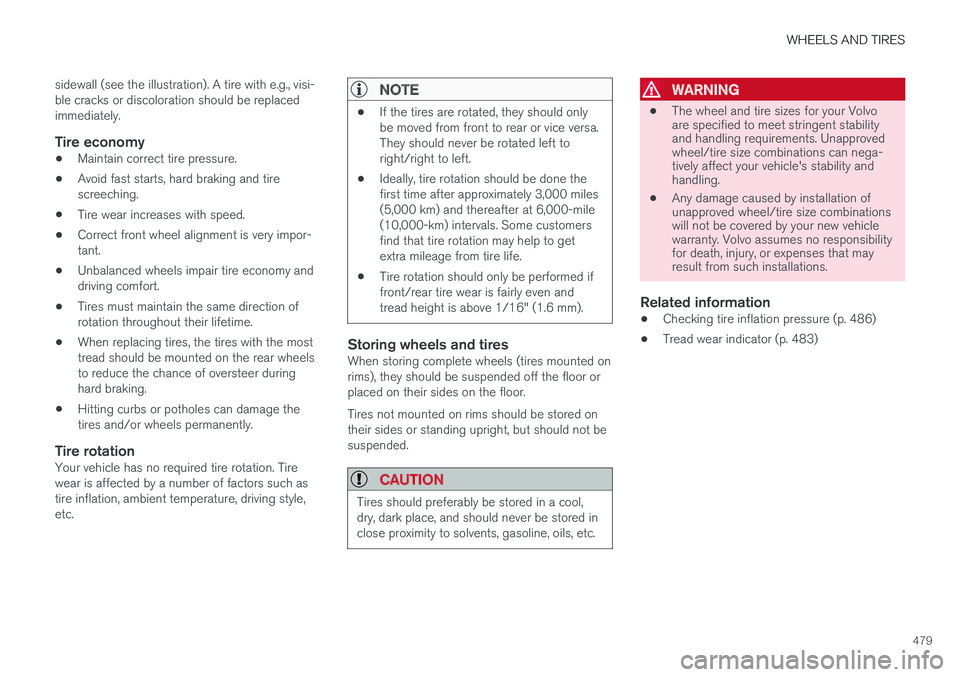
sidewall (see the illustration). A tire with e.g., visi-ble cracks or discoloration should be replacedimmediately.
Tire economy
•Maintain correct tire pressure.
•Avoid fast starts, hard braking and tirescreeching.
•Tire wear increases with speed.
•Correct front wheel alignment is very impor-tant.
•Unbalanced wheels impair tire economy anddriving comfort.
•Tires must maintain the same direction ofrotation throughout their lifetime.
•When replacing tires, the tires with the mosttread should be mounted on the rear wheelsto reduce the chance of oversteer duringhard braking.
•Hitting curbs or potholes can damage thetires and/or wheels permanently.
Tire rotation
Your vehicle has no required tire rotation. Tirewear is affected by a number of factors such astire inflation, ambient temperature, driving style,etc.
NOTE
•If the tires are rotated, they should onlybe moved from front to rear or vice versa.They should never be rotated left toright/right to left.
•Ideally, tire rotation should be done thefirst time after approximately 3,000 miles(5,000 km) and thereafter at 6,000-mile(10,000-km) intervals. Some customersfind that tire rotation may help to getextra mileage from tire life.
•Tire rotation should only be performed iffront/rear tire wear is fairly even andtread height is above 1/16" (1.6 mm).
Storing wheels and tires
When storing complete wheels (tires mounted onrims), they should be suspended off the floor orplaced on their sides on the floor.
Tires not mounted on rims should be stored ontheir sides or standing upright, but should not besuspended.
CAUTION
Tires should preferably be stored in a cool,dry, dark place, and should never be stored inclose proximity to solvents, gasoline, oils, etc.
WARNING
•The wheel and tire sizes for your Volvoare specified to meet stringent stabilityand handling requirements. Unapprovedwheel/tire size combinations can nega-tively affect your vehicle's stability andhandling.
•Any damage caused by installation ofunapproved wheel/tire size combinationswill not be covered by your new vehiclewarranty. Volvo assumes no responsibilityfor death, injury, or expenses that mayresult from such installations.
Related information
•Checking tire inflation pressure (p. 486)
•Tread wear indicator (p. 483)
Page 578 of 584

INDEX
576
K
Key
remote183, 238
Key blade242, 254
Keys240
L
Labels
list of560
location of559
Laminated panoramic roof 110, 111
Lane Keeping Aid 350, 353
settings 352
LATCH anchors 90
Leather care 550
Lighting panel 144
Load anchoring eyelets 226
Loading the vehicle 218, 484
Locking 244, 246
Locks and alarm 234
Low beam bulb, replacing 533
Low beams 147, 148
Low Speed Control 428
M
Maintenance504
hoisting the vehicle537
performed by the owner504
Malfunction indicator light130
Manual front seat adjustment167
Media player455
compatible file formats464
Media player (infotainment system) 459
Menus
instrument panel 155, 157, 158, 160
Mirrors
defroster206
power door108
retractable108
Mirrors, rearview mirror114
Modem 471
Motor oil
checking 541, 542
MP3 files 464
Multifunctional front seats 170, 171
MY CAR 115, 116
N
Navigation system
voice commands129
Net
cargo223
O
Occupant safety62
Occupant weight sensor74
Octane recommendations392
Odometer101
Oil
checking541, 542
Oil quality568
On-board diagnostics504
On-board Diagnostic socket26
On Call Roadside Assistance14
Opening the hood539
Options26
Outside temperature sensor120
Overhead courtesy lighting152
Overheating, engine387
Page 581 of 584

INDEX
579
Steering wheel 164
adjusting 166
heated 208
horn 164
keypad 164
Steering wheel paddles 164
Stone chips, touching up 553, 554
Storage compartments 220
Studded tires 485
Sunroof
laminated panoramic roof 110, 111
Sun shade 113, 115
Sun visor 229
Suspension 429
System updates 506
T
Tailgate
locking/unlocking249
locking/unlocking (private locking) 253
operating with the foot movement sen-
sor243
power operated251
wiper/washer164
Tailgate wipers544
Technician certification59
Temperature
perceived188
Temperature sensor
ambient 120
Tethering
wi-fi sharing 470
Three-way catalytic converter 394
Timer
preconditioning 192
Tire inflation pressure 569
Tire Pressure Monitoring System 491, 494
calibrating 495
Tire Pressure Monitoring System (TPMS) 495
Tires 478, 488
changing 487
changing from summer to winter 483
glossary of terms 482
improving economy 478
inflation pressure 486
inflation pressure table 569
installing (mounting) a wheel on the
vehicle 491
rotation 479
snow 485
specifications 480
storing 479
studded 485
tire pressure monitoring system 491, 494
tire sealing system496, 498, 501
tread wear indicator483
uniform tire quality grading485
wheel bolts489
Tire sealing system496, 498, 501
Top tether anchors (child restraint sys-
tems)92
Touching up paint553, 554
Towing a trailer397, 399
trailer hitch398
Towing eyelet389
Towing the vehicle389
Traction control263
Trailer towing397, 399
trailer hitch398
Transmission
gear shift indicator425
general description424, 425
Hill Start Assist381
oil570
shifting with steering wheel paddles 427
shiftlock override424
Travel Link443
Alerts446
Fuel446
Sports448
weather444