Page 458 of 560

WHEELS AND TIRES
456
Tire terminology The following is a glossary of tire-related terms.
The tire suppliers may have additional markings, notes or warnings such as standard load, radialtubeless, etc.• Tire information placard
: A placard show-
ing the OE (Original Equipment) tire sizes,recommended inflation pressure, and themaximum weight the vehicle can carry.
• Tire Identification Number (TIN)
: A number
on the sidewall of each tire providing infor-mation about the tire brand and manufactur-ing plant, tire size and date of manufacturer.
• Inflation pressure
: A measure of the
amount of air in a tire.
• Standard load
: A class of P-metric or Metric
tires designed to carry a maximum load at35 psi [37 psi (2.5 bar) for Metric tires].Increasing the inflation pressure beyond thispressure will not increase the tires load car-rying capability.
• Extra load
: A class of P-metric or Metric
tires designed to carry a heavier maximumload at 41 psi [43 psi (2.9 bar) for Metrictires]. Increasing the inflation pressurebeyond this pressure will not increase thetire's load carrying capability.
• kPa
: Kilopascal, a metric unit of air pressure.
• PSI
: Pounds per square inch, a standard unit
of air pressure. •
B-pillar
: The structural member at the side
of the vehicle behind the front door.
• Bead area of the tire
: Area of the tire next
to the rim.
• Sidewall of the tire
: Area between the bead
area and the tread.
• Tread area of the tire
: Area of the perime-
ter of the tire that contacts the road whenmounted on the vehicle.
• Rim
: The metal support (wheel) for a tire or a
tire and tube assembly upon which the tirebeads are seated.
• Maximum load rating
: a figure indicating
the maximum load in pounds and kilogramsthat can be carried by the tire. This rating isestablished by the tire manufacturer.
• Maximum permissible inflation pressure
:
the greatest amount of air pressure thatshould ever be put in the tire. This limit is setby the tire manufacturer.
• Recommended tire inflation pressure
:
inflation pressure, established by Volvo,which is based on the type of tires that aremounted on a vehicle at the factory. Thisinformation can be found on the tire inflationplacard(s) located on the driver's side B-pillarand in the tire inflation table in this chapter.
• Cold tires
: The tires are considered to be
cold when they have the same temperatureas the surrounding (ambient) air. This tem- perature is normally reached after the vehiclehas been parked for at least 3 hours.
Page 460 of 560

WHEELS AND TIRES
458
Loading specifications Properly loading your vehicle will provide maxi- mum return of vehicle design performance.
Weight designations
Before loading your vehicle, familiarize yourself with the following terms for determining yourvehicle's weight ratings, with or without a trailer,from the vehicle's Federal/Canadian Motor Vehi-cle Safety Standards (FMVSS/CMVSS) label, andthe vehicle's tire information placard:
Curb weight
The weight of the vehicle including a full tank of fuel and all standard equipment. It does notinclude passengers, cargo, or optional equipment.
Capacity weight
All weight added to the curb weight, including cargo and optional equipment. When towing,trailer hitch tongue load is also part of cargoweight.
Permissible axle weight
The maximum allowable weight that can be car- ried by a single axle (front or rear). These num-bers are shown on the Federal/Canadian MotorVehicle Safety Standards (FMVSS/CMVSS) label.The total load on each axle must never exceed itsmaximum permissible weight.
Gross vehicle weight (GVW)
The vehicle's curb weight + cargo + passengers.
Steps for Determining Correct Load Limit
1. Locate the statement "the combined weightof occupants and cargo should never exceed XXX kg or XXX lbs." on your vehicle's plac-ard.
2. Determine the combined weight of the driver and passengers that will be riding in yourvehicle.
3. Subtract the combined weight of the driver and passengers from XXX kg or XXX lbs.
4. The resulting figure equals the available amount of cargo and luggage load capacity.For example, if the "XXX" amount equals1400 lbs. and there will be five 150 lb. pas-sengers in your vehicle, the amount of availa-ble cargo and luggage load capacity is650 lbs. (1400 – 750 (5 × 150) = 650 lbs.)
5. Determine the combined weight of luggage and cargo being loaded on the vehicle. Thatweight may not safely exceed the availablecargo and luggage load capacity calculatedin Step 4.
6. If your vehicle will be towing a trailer, load from your trailer will be transferred to yourvehicle. Consult this manual to determinehow this reduces the available cargo and lug-gage load capacity of your vehicle.
WARNING
• Exceeding the permissible axle weight, gross vehicle weight, or any other weightrating limits can cause tire overheatingresulting in permanent deformation orcatastrophic failure.
• Do not use replacement tires with lowerload carrying capacities than the tires thatwere original equipment on the vehiclebecause this will lower the vehicle's GVWrating. Use only tires with the correct loadcarrying capacity. Consult your Volvoretailer for information.
Related information
• Label information (p. 532)
• Weights (p. 537)
Page 498 of 560

||
MAINTENANCE AND SERVICING
* Option/accessory.
496 •
Fuses 18–30, 35–37, 46–54 and 55–70 are called "Micro".
• Fuses 31–34, 38–45 and 71–78 are called"MCase" and should only be replaced by atrained and qualified Volvo service technician.
Function
A
– –
– –
– –
– –
– –
Front USB socket* 5
12-volt socket in the front tun- nel console 15
12-volt socket on the rear side of the tunnel console15
12-volt socket in the cargo com- partment15
– –
Driver's side headlight, certain LED models15
Passenger's side headlight, cer- tain LED models15
Function
A
– –
Heated windshield*, driver side Shunt
Heated windshield
*, driver side 40
Headlight washers
*25
Windshield washer 25
– –
Horn 20
Alarm siren 5
Brake system control module (valves, parking brake) 40
Windshield wipers 30
Tailgate window washer 25
Heated windshield
*, passenger
side 40
– –
Brake system control module (ABS pump)
40
– –
Function
A
Heated windshield*, passenger
side Shunt
Feed when ignition is switched on to: engine control module,transmission components, elec-trical power steering, centralelectrical module; Brake system control module 5
– –
Passenger side headlight Passenger's side headlight, cer- tain LED models
7.5
15
– –
– –
Battery connection control mod- ule 5
Air bags; Occupant Weight Sen- sor (OWS)5
Driver side headlight Driver's side headlight, certain LED models7.5
15
Accelerator pedal sensor 5
Page 516 of 560

MAINTENANCE AND SERVICING
514
Opening and closing the hood The hood is opened by releasing it from the pas- senger compartment and then by using the han-dle under the front edge of the hood.
Opening
With the hood completely closed, pull the control (located to the left of the brakepedal).
Turn the handle under the front edge of the hood counterclockwise to release it from thelock and lift.
Warning–hood not closed
When the hood lock has been com- pletely released, this symbol and agraphic will illuminate in the instrumentpanel and an audible signal will be
given. If the vehicle begins to roll, the audible sig-nal will be repeated several times. For additional information about this symbol, see also the article "Door and seat belt reminders."
NOTE
If the warning symbol remains on or if the audible signal is given even if the hood iscompletely closed and locked, consult atrained and qualified Volvo service technician.
Closing1. Press down the hood until it begins to close due to its own weight.
2. When the handle under the front edge of the hood is in the lock, press down on the hood to close it completely.
WARNING
• Be sure the hood is completely unob- structed while it is being closed.
• Check that the hood locks properly whenclosed. It must audibly lock on both sides.
• Never drive if the hood is not completelyclosed and locked.
• While driving, if there are any indicationsthat the hood is not locked in the closedposition, stop safely as soon as possibleand close it completely.
Page 537 of 560
SPECIFICATIONS
}}
* Option/accessory.535
Dimensions
The following table lists your vehicle's most important dimensions.
Dimension In.
(mm)
A Ground clearance (curb weight + 2 people) A8.9 (227)
B Wheelbase 117.5 (2984) C Length 194.9 (4950)
D Load length, floor, seat- back down 80.3 (2040)
49.6 (1260) BDimension
In.
(mm)
E Load length, floor 48.0 (1220)C
21.8 ( 554) D
F Height 69.9 (1776)
G Load height 32.1 (816)Dimension In.
(mm)
H Track, front (models with- out pneumatic suspen- sion) 65.9 (1673)
E
65.6 (1665) F
Track, front (models withpneumatic suspension) 66.0 (1676)
E
65.7 (1668) F
Page 538 of 560
||
SPECIFICATIONS
536
DimensionIn.
(mm)
I Track, rear (models with- out pneumatic suspen- sion) 65.8 (1675)
E
66.1 (1667) F
Track, rear (models withpneumatic suspension) 66.1 (1679)
E
65.8 (1671) F
J Load width, floor 46.9 (1192)
K Width 75.7 (1923)G
76.0 (1931) H
77.1 (1958) I
L Width incl. door mirrors (folded out) 84.3 (2140)
M Width incl. door mirrors (folded in) 79.1 (2008)
A
Varies slightly depending on tire size, chassis options, etc.
B From the second row of seats in 7-seat models *.
C 5-seat model
D 7-seat model
E Models with 20, 21 and 22 in. wheels.
F Models with 18 and 19 in. wheels.
G Chassis width.
H Width on models with 18 and 19 in. wheels.
I Width on models with 20, 21 and 22 in. wheels.
Related information
• Weights (p. 537)
Page 539 of 560
SPECIFICATIONS
}}
537
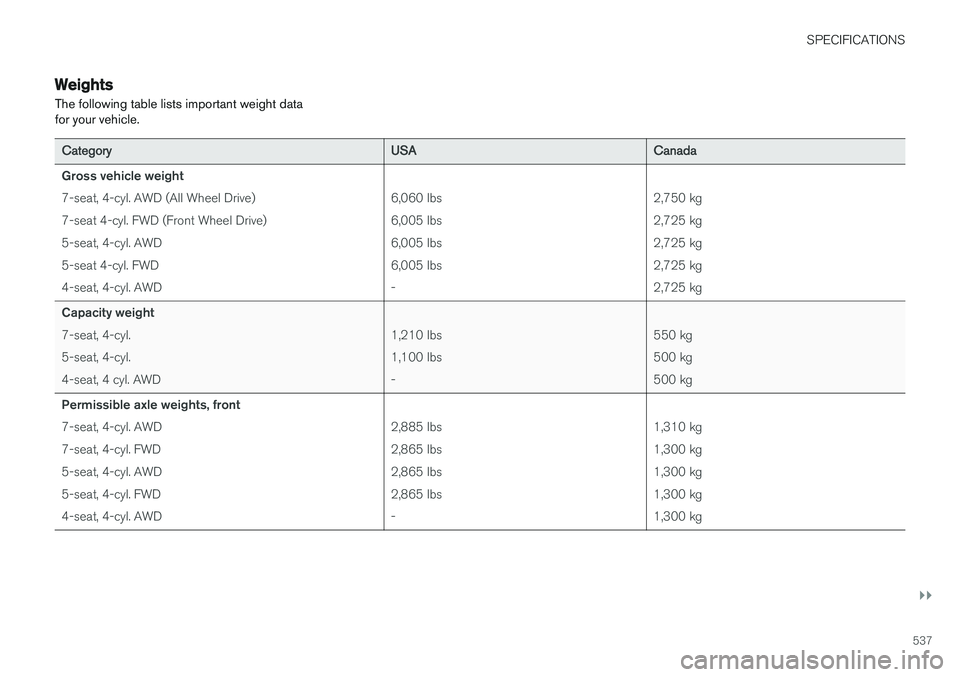
Weights The following table lists important weight data for your vehicle.
CategoryUSACanada
Gross vehicle weight 7-seat, 4-cyl. AWD (All Wheel Drive) 7-seat 4-cyl. FWD (Front Wheel Drive)5-seat, 4-cyl. AWD5-seat 4-cyl. FWD4-seat, 4-cyl. AWD 6,060 lbs6,005 lbs6,005 lbs6,005 lbs-2,750 kg2,725 kg2,725 kg2,725 kg2,725 kg
Capacity weight 7-seat, 4-cyl. 5-seat, 4-cyl.4-seat, 4 cyl. AWD 1,210 lbs1,100 lbs-550 kg500 kg500 kg
Permissible axle weights, front 7-seat, 4-cyl. AWD 7-seat, 4-cyl. FWD5-seat, 4-cyl. AWD5-seat, 4-cyl. FWD4-seat, 4-cyl. AWD 2,885 lbs2,865 lbs2,865 lbs2,865 lbs-1,310 kg1,300 kg1,300 kg1,300 kg1,300 kg
Page 540 of 560
||
SPECIFICATIONS
538
CategoryUSACanada
Permissible axle weights, rear 7-seat, 4-cyl. AWD 7-seat, 4-cyl. FWD5-seat, 4-cyl. AWD5-seat, 4-cyl. FWD4-seat, 4-cyl. AWD 3,280 lbs3,280 lbs3,280 lbs3,280 lbs-1,490 kg1,490 kg1,490 kg1,490 kg1,470 kg
Curb weight 7-seat, 4-cyl. 5-seat, 4-cyl.4-seat, 4 cyl. 4,370 - 4,680 lbs4,290 - 4,530 lbs-1,980 - 2,130 kg1,940 - 2,060 kg2,130 - 2,140 kg
Max. roof load 220 lbs
100 kg