2017 VOLKSWAGEN SCIROCCO LED
[x] Cancel search: LEDPage 136 of 400

The cargo payload may not be increased by using a roof rack without commensurately reducing the
weight from vehicle occupants ⇒ . Determining the Gross Vehicle Weight Rating ⇒ Tires and wheels.
Vehicle payload consists of the combined weight of the following:
x Passengers.
x Total luggage and other cargo.
x Roof load including the roof rack system.
x Factory-installed or retrofitted accessories.
x Hitch weight and tongue weight for trailer towing.
Please refer to the Gross Vehicle Weight Rating (GVWR) and the Gross front and rear Axle Weight Ratings (GAWR) for your vehicle, which are printed on the vehicle's Safety Compliance Certification Label on the driver door jamb.
WARNING
Exceeding maximum permissible weight ratings can result in vehicle damage, accidents, and serious personal injury.
x Never let the actual weights at the front and rear axles exceed the permissible Gross Axle Weight Rating. Also, never let the total of these actual weights exceed the Gross Vehicle Weight Rating.
x Always remember that the vehicle's handling and braking will be affected by extra load and the distribution of this load. Adjust your speed accordingly.
NOTICE
x Always distribute the load evenly and as low as possible in the vehicle. The vehicle capacity weight figures apply when the load is distributed evenly in the vehicle (passengers and luggage).
x When transporting a heavy load in the luggage compartment, carry the load as close to the rear axle (as far forward) as possible so that the vehicle's handling and braking are affected as little as possible.
Page 144 of 400
WARNING
Elastic straps have to be stretched when being attached to the tie-downs in the luggage compartment. Hooks on these straps can cause serious personal injury if not handled properly and attached securely.
x Always protect eyes and face from injury from the hooks when attaching them to the tie-downs in the luggage compartment.
x Always hold the hooks on elastic straps firmly when attaching to the vehicle and do not let them snap back and hit you.
x First attach the hooks on the straps to the tie-downs at the rear seat backrest in the luggage compartment and then to the tie-downs near the loading edge of the luggage compartment. This way, if one of the hooks on the elastic straps snaps back, it will move away from you, decreasing the risk of personal injury.
The maximum load for the tie-downs is about 380 lbs. (172 kg).
For suitable straps and luggage stowage systems, please see an authorized Volkswagen dealer or authorized Volkswagen Service Facility.
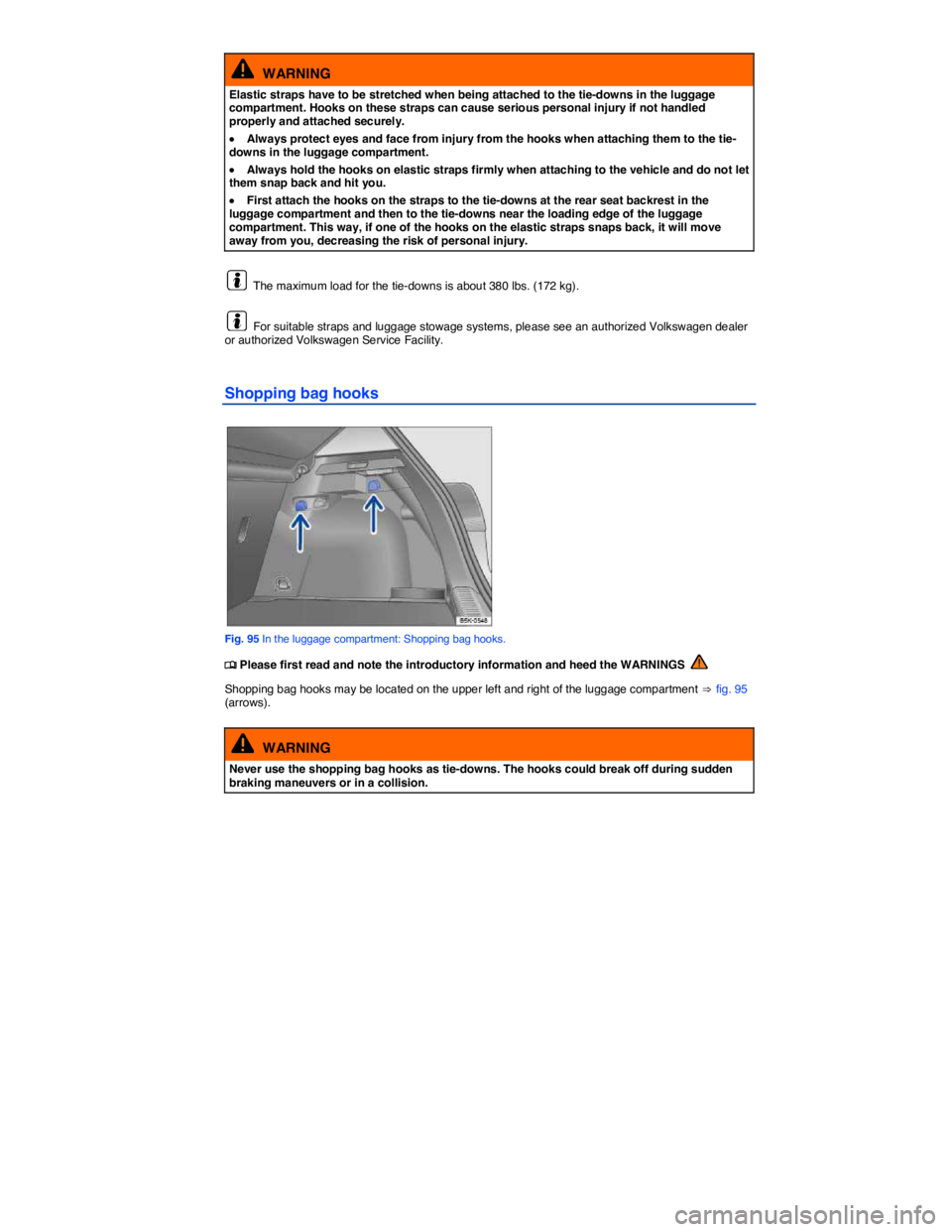
Shopping bag hooks
Fig. 95 In the luggage compartment: Shopping bag hooks.
Page 148 of 400
If a roof rack is installed, fuel consumption increases due to increased air resistance.
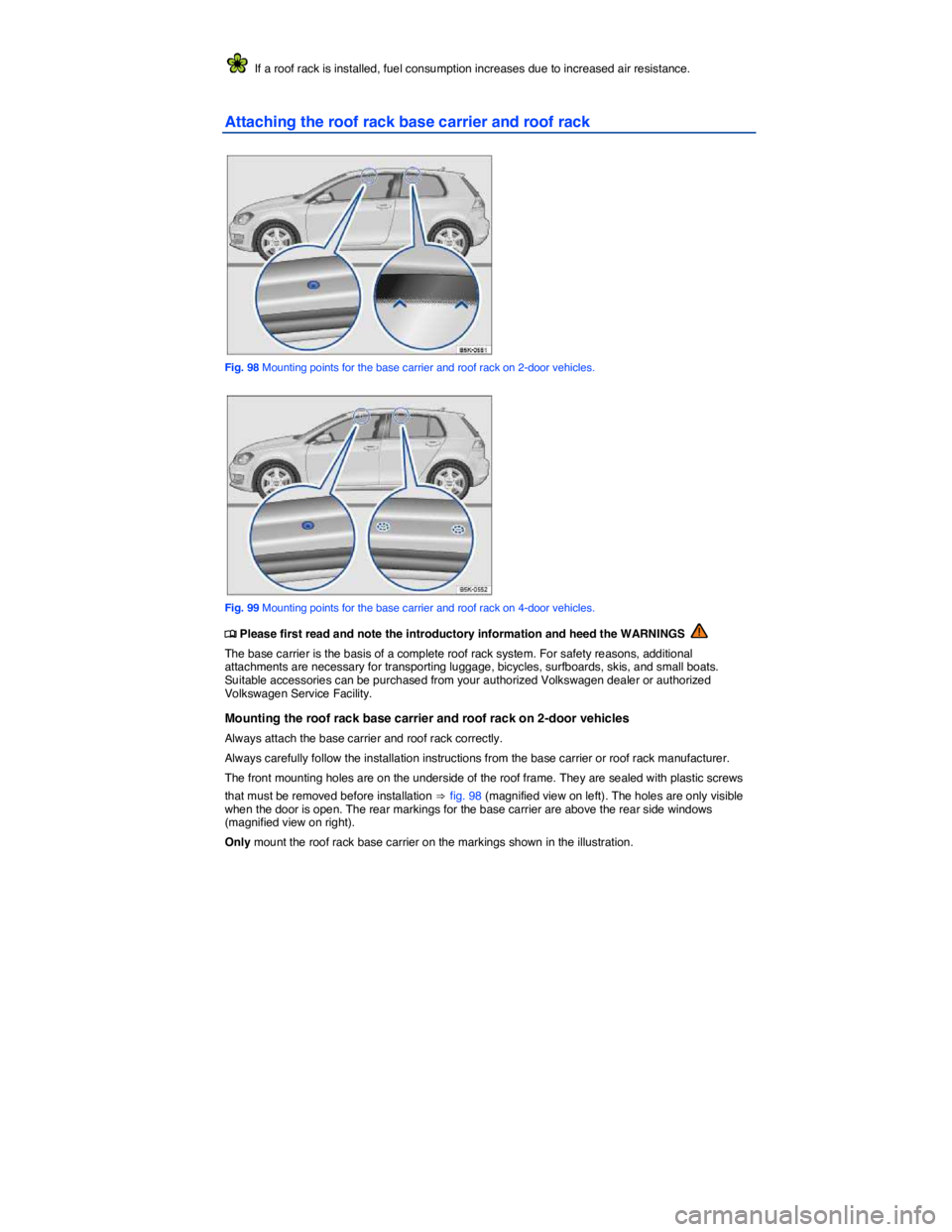
Attaching the roof rack base carrier and roof rack
Fig. 98 Mounting points for the base carrier and roof rack on 2-door vehicles.
Fig. 99 Mounting points for the base carrier and roof rack on 4-door vehicles.
Page 149 of 400
Once you have installed the base carrier correctly, you can secure the roof rack on the base carrier according to the manufacturer's instructions.
Mounting the roof rack base carrier and roof rack on 4-door vehicles
Always attach the base carrier and roof rack correctly.
Always carefully follow the installation instructions from the base carrier or roof rack manufacturer.
The front mounting holes are on the underside of the roof frame. They are sealed with plastic screws
that must be removed before installation ⇒ fig. 99 (magnified view on left). The rear markings for the base carrier are on the underside of the roof frame (magnified view on right).
The holes and markings are only visible when the door is open.
Only mount the roof rack base carrier on the markings shown in the illustration.
Once you have installed the base carrier correctly, you can secure the roof rack on the base carrier according to the manufacturer's instructions.
WARNING
Installing or using a base carrier or roof rack improperly can cause the entire system to fly off the vehicle, causing accidents and injuries.
x Always follow the installation instructions provided by the manufacturer.
x Use the base carrier and roof rack only if they are undamaged and properly installed.
x Secure the roof rack base carrier only at the attachment points shown in the illustration
⇒ fig. 98 or ⇒ fig. 99.
x Always install the base carrier and roof rack properly.
x Make sure that all bolts and fasteners are properly installed and properly tightened before every trip and retighten them as needed after driving a short distance. During a long trip, check all bolts and fasteners at each stop.
x Always properly install special fixtures for items such as bicycles, skis, surfboards, etc.
x Do not modify or repair the base carrier or roof rack.
Follow the installation instructions provided for installing the roof rack system. Always carry them in the vehicle.
Securing a load on the roof rack
Page 150 of 400

Distributing the load
Distribute the load evenly and secure it properly ⇒ .
Checking the mountings
After the base carrier and roof rack have been installed, check all bolts and fasteners after driving a short time and at regular intervals thereafter.
WARNING
If the maximum permissible roof load is exceeded, accidents and substantial vehicle damage may occur.
x Never exceed the specified roof load, the maximum Gross Axle Weight Rating, or the Gross Vehicle Weight Rating.
x Do not exceed the loading capacity of the roof rack, even if the permissible roof load is not fully utilized.
x Always make sure that loads are evenly distributed and that heavier items are, as far as possible, toward the front.
WARNING
Loose or improperly secured items can fall off the roof rack and cause accidents and injuries.
x Always use suitable, undamaged tie-down ropes and ratchet straps.
x Secure the load properly.
Page 152 of 400

WARNING
Improper use of the trailer hitch can cause accidents and injuries. An improperly installed, incorrect, or damaged trailer hitch can cause the trailer to separate from the towing vehicle and cause serious personal injuries.
x Only use an undamaged, properly mounted trailer hitch.
x Never repair or modify the trailer hitch.
x To reduce the risk of injury in rear-end collisions, and the risk to pedestrians and cyclists when the vehicle is parked, always remove the ball mount when you are not towing a trailer.
x Never install a “weight distributing” or “load equalizing” trailer hitch on your vehicle. The vehicle was not designed for these kinds of trailer hitches. The trailer hitch attachment can fail, causing the trailer to tear loose from the vehicle.
WARNING
Improper trailer towing can cause loss of vehicle control and serious personal injury.
x Driving with a trailer and carrying heavy or large things can change the way the vehicle handles, increase the distance it needs to stop safely, and cause accidents.
x Always secure the load properly with suitable and undamaged straps so that the load will not shift.
x Always adapt your speed and driving to the heavier load and the weight distribution in the vehicle. Take road, weather, traffic, and visibility conditions into account as well.
x Reduce your speed even more than you otherwise would when going downhill and under unfavorable load, weather, or wind conditions.
x Trailers with a high center of gravity tip more easily than trailers with a low center of gravity.
x Always avoid sudden maneuvers and hard braking.
x Be especially careful when passing other vehicles.
x Reduce speed immediately if the trailer shows the slightest sign of swaying.
x Never try to stop the swaying by accelerating.
x Always obey speed limits. In some areas, the speed limits for vehicles towing trailers are lower than for vehicles without trailers. Never drive faster than 50 mph (80 km/h; under exceptional circumstances, 60 mph - 100 km/h) when towing a trailer. This applies even if the local speed limit is higher.
If you are driving a new vehicle or a vehicle with a new or rebuilt engine, do not tow a trailer
during the break-in period, about 600 miles (1000 km) ⇒ Parts, accessories, repairs, and modifications.
If you tow a trailer, your vehicle may need maintenance more often because of the extra load it has to move.
When you are not towing, remove the trailer hitch ball. This helps keep the trailer hitch from causing damage to your vehicle and to others if your vehicle is hit from behind.
Some models need a trailer hitch to tow or tow-start other vehicles. You may want to always carry the ball mount in the vehicle after it has been removed. Be sure to stow it securely.
Page 154 of 400
WARNING
x An improperly installed or incorrect trailer hitch can cause a trailer to separate from the tow vehicle and cause serious personal injuries.
x If you don't have to tow a trailer any more, remove the entire trailer hitch. Always seal all bolt holes to prevent water and deadly exhaust fumes from getting into the vehicle.
NOTICE
x If the trailer lights are not connected properly, the vehicle's electronics may be damaged.
x If the trailer uses too much electricity, the vehicle's electronics may be damaged.
x Never connect the electrical system for the trailer directly to the electrical connections for the rear lights or to any other unsuitable power sources. Use only a suitable connector to provide power to the trailer.
If you tow a trailer frequently, Volkswagen recommends having the vehicle serviced between the regular maintenance and inspection intervals because of the extra load it has to pull.
Hitching up and connecting a trailer
Page 158 of 400

These dimensions are important because they help determine the way that the forces that arise during towing are applied to the receiver and its attachments to the vehicle. If you buy a ball mount and ball, make sure that they meet the following specifications.
Ball mount dimensions
x The drop height (A) from the center of the ball to the center of the hole for the securing pin on the ball mount must be at least 1 inch (25.4 mm) and at most 27/8 inches (73 mm).
x The pin-to-ball distance (B) from the center of the ball to the center of the hole for the securing pin on the ball mount must be no more than 7 inches (178 mm).
x The ball diameter must be no more than 11/4 inches (32 mm).
A ball mount and ball combination that does not meet these specifications can damage your vehicle
and may even fail in use ⇒ .
Never install a “weight distributing” or “load equalizing” trailer hitch on your vehicle. The vehicle is not
designed for this kind of trailer hitch ⇒ .
WARNING
An improperly installed or unsuitable trailer hitch can cause the trailer to separate from the towing vehicle and result in a major accident with serious personal injuries.
x Have any trailer hitch retrofit or other work on a trailer hitch done by a qualified workshop.
CAUTION
The ball mount sticks out behind the rear bumper and can cause injury to pedestrians and cyclists.
x To reduce the risk of injury in rear-end collisions, and the risk to pedestrians and cyclists when the vehicle is parked, always remove the ball carrier when you are not towing a trailer.
NOTICE
x Never use a ball larger than 11/4 inches (32 mm) on your vehicle. The vehicle was not designed to tow heavier trailers with a receiver larger than the specified ball. The increased loads can damage the attachment points for the trailer hitch.
x Never use an adapter to increase the size of the trailer hitch receiver from 11/4 inches (32 mm) to 2 inches (50.8 mm) or more to tow a trailer that is heavier than the maximum permissible trailer weight that your vehicle can tow.
x You can use an adapter if required for the proper installation of a bicycle rack or other similar carrier as long as the maximum weight limits are observed. When using bicycle racks or similar carriers, make sure that the rear lights are not blocked.
x Only use trailer hitches that are approved by the hitch manufacturer for your vehicle and model.