2017 TOYOTA YARIS drive belt
[x] Cancel search: drive beltPage 2 of 396

TABLE OF CONTENTS2
For your information....................... 6
Reading this manual .................... 10
How to search .............................. 11
Pictorial index .............................. 12
1-1. For safe useBefore driving ...................... 22
For safety drive ................... 24
Seat belts ............................ 26
SRS airbags ........................ 34
Front passenger occupant classification system ......... 46
Safety information for children ........................ 52
Child restraint systems ........ 53
Installing child restraints ...... 57
Exhaust gas precautions ..... 66
1-2. Theft deterrent system Engine immobilizer system............................... 67
Theft prevention labels (except Canada) ............... 69
2. Instrument cluster Warning lights and indicators........................... 72
Gauges and meters............. 77
Multi-information display ..... 79 3-1. Key information
Keys..................................... 84
3-2. Opening, closing and locking the doors
Side doors ........................... 89
Back door ............................ 94
3-3. Adjusting the seats Front seats........................... 98
Rear seats ......................... 101
Head restraints .................. 104
3-4. Adjusting the steering wheel and mirrors
Steering wheel ................... 107
Inside rear view mirror ....... 109
Outside rear view mirrors ............................. 111
3-5. Opening and closing the windows
Power windows.................. 113
4-1. Before driving Driving the vehicle ............. 116
Cargo and luggage ............ 127
Vehicle load limits .............. 131
Trailer towing ..................... 132
Dinghy towing (vehicles with an automatic
transmission) ................... 133
Dinghy towing (vehicles with a manual
transmission) ................... 134
1For safety and security
2Instrument cluster
3Operation of
each component
4Driving
Page 8 of 396

8
This vehicle is equipped with an event data recorder (EDR). The main pur-
pose of an EDR is to record, in certain crash or near crash-like situations,
such as an air bag deployment or hitting a road obstacle, data that will assist
in understanding how a vehicle’s systems performed. The EDR is designed to
record data related to vehicle dynamics and safety systems for a short period
of time, typically 30 seconds or less.
The EDR in this vehicle is designed to record such data as:• How various systems in your vehicle were operating;
• Whether or not the driver and passenger safety belts were buckled/fas-tened;
• How far (if at all) the driver was depressing the accelerator and/or brake
pedal; and,
• How fast the vehicle was traveling.
These data can help provide a better understanding of the circumstances in
which crashes and injuries occur.
NOTE: EDR data are recorded by your vehicle only if a non-trivial crash situ-
ation occurs; no data are recorded by the EDR under normal driving condi-
tions and no personal data (e.g., name, gender, age, and crash location) are
recorded. However, other parties, such as law enforcement, could combine
the EDR data with the type of personally identifying data routinely acquired
during a crash investigation.
To read data recorded by an EDR, special equipment is required, and access
to the vehicle or the EDR is needed. In addition to the vehicle manufacturer,
other parties, such as law enforcement, that have the special equipment, can
read the information if they have access to the vehicle or the EDR.
●Disclosure of the EDR data
Toyota will not disclose the data recorded in an EDR to a third party except
when:
• An agreement from the vehicle’s owner (or the lessee for a leased vehi- cle) is obtained
• In response to an official request by the police, a court of law or a govern-
ment agency
• For use by Toyota in a lawsuit
However, if necessary, Toyota may:
• Use the data for research on vehicle safety performance
• Disclose the data to a third party for research purposes without disclosing information about the specific vehicle or vehicle owner
Event data recorder
Page 9 of 396
9
The SRS airbag and seat belt pretensioner devices in your Toyota contain
explosive chemicals. If the vehicle is scrapped with the airbags and seat belt
pretensioners left as they are, this may cause an accident such as fire. Be
sure to have the systems of the SRS airbag and seat belt pretensioner
removed and disposed of by a qualified service shop or by your Toyota dealer
before you scrap your vehicle.
Special handling may apply,
See www.dtsc.ca.gov/hazardouswaste/perchlorate.
Your vehicle has components that may contain perchlorate. These compo-
nents may include airbag, seat belt pretensioners, and wireless remote con-
trol batteries.
Scrapping of your Toyota
Perchlorate Material
WARNING
■General precautions while driving
Driving under the influence: Never drive your vehicle when under the influ-
ence of alcohol or drugs that have impaired your ability to operate your vehi-
cle. Alcohol and certain drugs delay reaction time, impair judgment and
reduce coordination, which could lead to an accident that could result in
death or serious injury.
Defensive driving: Always drive defensively. Anticipate mistakes that other
drivers or pedestrians might make and be ready to avoid accidents.
Driver distraction: Always give your full attention to driving. Anything that
distracts the driver, such as adjusting controls, talking on a cellular phone or
reading can result in a collision with resulting death or serious injury to you,
your occupants or others.
■ General precaution regard ing children’s safety
Never leave children unattended in the vehicle, and never allow children to
have or use the key.
Children may be able to start the vehicle or shift the vehicle into neut\
ral.
There is also a danger that children may injure themselves by playing with
the cigarette lighter, the windows, or other features of the vehicle. In addi-
tion, heat build-up or extremely cold temperatures inside the vehicle can be
fatal to children.
Page 21 of 396

21
For safety and security1
1-1. For safe useBefore driving ...................... 22
For safety drive ................... 24
Seat belts ............................ 26
SRS airbags ........................ 34
Front passenger occupant classification system ......... 46
Safety information for children ........................ 52
Child restraint systems........ 53
Installing child restraints...... 57
Exhaust gas precautions..... 66
1-2. Theft deterrent system Engine immobilizer system .............................. 67
Theft prevention labels (except Canada) ............... 69
Page 24 of 396

241-1. For safe use
For safety drive
Adjust the angle of the seat-
back so that you are sitting
straight up and so that you do
not have to lean forward to
steer. (→P. 9 8 )
Adjust the seat so that you can
depress the pedals fully and so
that your arms bend slightly at
the elbow when gripping the
steering wheel. ( →P. 98, 107)
Lock the head restraint in place with the center of the head restraint
closest to the top of your ears. ( →P. 104)
Wear the seat belt correctly. ( →P. 2 6 )
Make sure that all occupants are we aring their seat belts before driv-
ing the vehicle. ( →P. 2 6 )
Use a child restraint system appropriate for the child until the child
becomes large enough to properly wear the vehicle’s seat belt.
( → P. 53)
Make sure that you can see the rear of the vehicle clearly, by adjust-
ing the inside and outside rear view mirrors properly. ( →P. 109, 111)
For safe driving, adjust the seat and mirror to an appropriate
position before driving.
Correct driving posture
1
2
Correct use of the seat belts
Adjusting the mirrors
3
4
Page 25 of 396

251-1. For safe use
1
For safety and security
WARNING
Observe the following precautions.
Failure to do so may result in death or serious injury.
●Do not adjust the position of the driver’s seat while driving.
Doing so could cause the driver to lose control of the vehicle.
● Do not place a cushion between the driver or passenger and the seatback.
A cushion may prevent correct posture from being achieved, and reduce
the effectiveness of the seat belt and head restraint.
● Do not place anything under the front seats.
Objects placed under the front seats may become jammed in the seat
tracks and stop the seat from locking in place. This may lead to an acci-
dent and the adjustment mechanism may also be damaged.
● Always observe the legal speed limit when driving on public roads.
● When driving over long distances, take regular breaks before you start to
feel tired.
Also, if you feel tired or sleepy while driving, do not force yourself to con-
tinue driving and take a break immediately.
Page 34 of 396
341-1. For safe use
SRS airbags
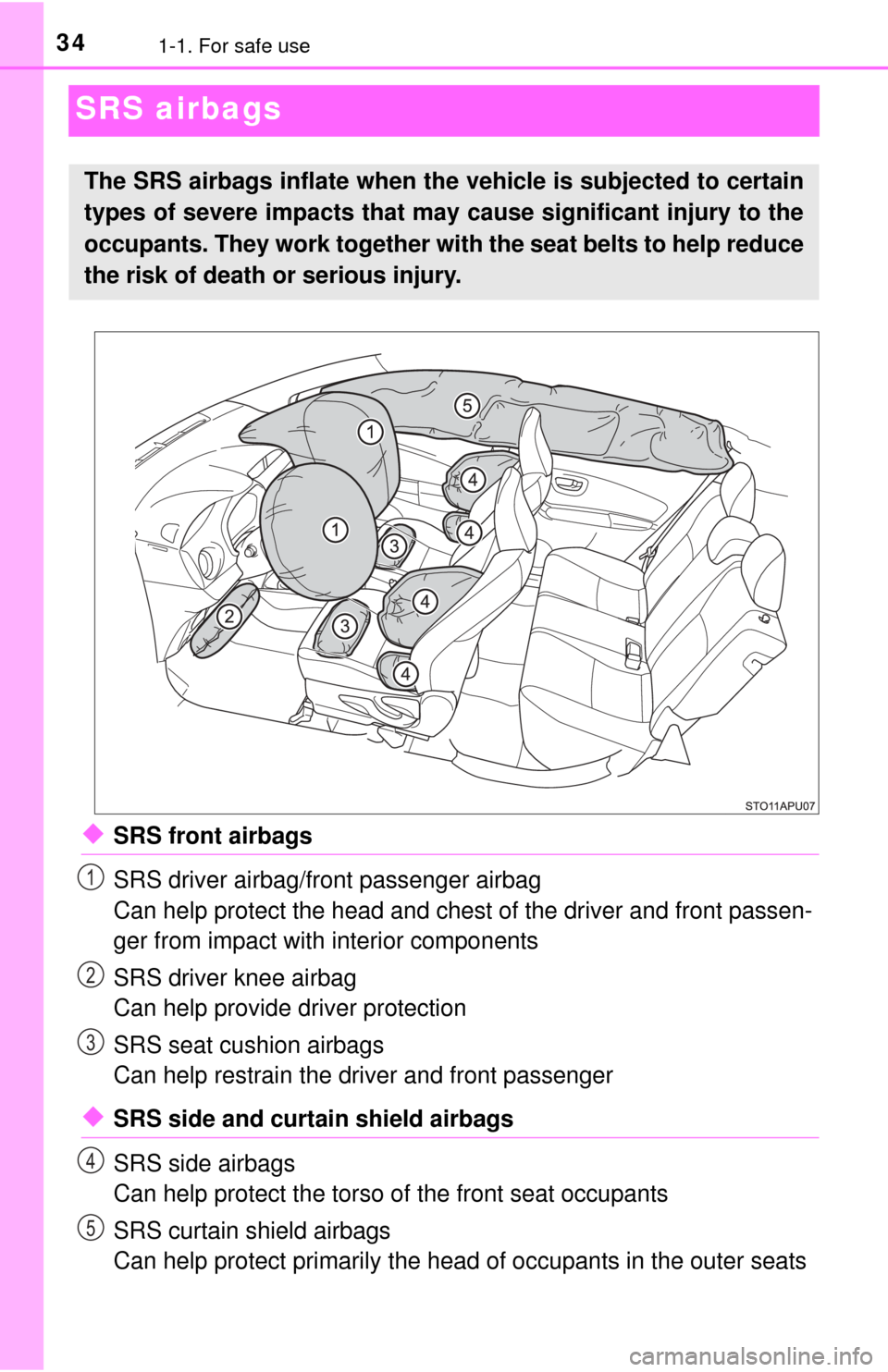
◆SRS front airbags
SRS driver airbag/front passenger airbag
Can help protect the head and chest of the driver and front passen-
ger from impact with interior components
SRS driver knee airbag
Can help provide driver protection
SRS seat cushion airbags
Can help restrain the driver and front passenger
◆SRS side and curtain shield airbags
SRS side airbags
Can help protect the torso of the front seat occupants
SRS curtain shield airbags
Can help protect primarily the head of occupants in the outer seats
The SRS airbags inflate when the vehicle is subjected to certain
types of severe impacts that may cause significant injury to the
occupants. They work together with the seat belts to help reduce
the risk of death or serious injury.
1
2
3
4
5
Page 35 of 396

351-1. For safe use
1
For safety and security
SRS airbag system components
Curtain shield airbags
Side impact sensors (front)
Side airbags
Side impact sensors (rear)
SRS warning light
Driver airbag
Passenger seat cushion air-
bag
Front passenger’s seat belt
buckle switch
Seat belt pretensioners and
force limiters
Side impact sensors (front
door)Driver seat cushion airbag
Driver’s seat belt buckle
switch
Driver knee airbag
Front impact sensors
Airbag sensor assembly
Front passenger occupant
classification system (ECU
and sensors)
Front passenger airbag
“AIR BAG ON” and “AIR BAG
OFF” indicator lights1
2
3
4
5
6
7
8
9
10
11
12
13
14
15
16
17
18