Page 119 of 396

1194-1. Before driving
4
Driving
■Driving in the rain
●Drive carefully when it is raining, because visibility will be reduced, the win-
dows may become fogged-up, and the road will be slippery.
● Drive carefully when it starts to rain, because the road surface will be espe-
cially slippery.
● Refrain from high speeds when driving on an expressway in the rain,
because there may be a layer of water between the tires and the road sur-
face, preventing the steering and brakes from operating properly.
■ Engine speed while driving
In the following conditions, the engine speed may become high while driving.
This is due to automatic up-shifting control or down-shifting implementation to
meet driving conditions. It does not indicate sudden acceleration.
●The vehicle is judged to be driving uphill or downhill
● When the accelerator pedal is released
■ Breaking in your new Toyota
To extend the life of the vehicle, observing the following precautions is recom-
mended:
●For the first 200 miles (300 km):
Avoid sudden stops.
● For the first 500 miles (800 km) (3-door models for Canada):
Do not tow a trailer.
● For the first 1000 miles (1600 km):
• Do not drive at extremely high speeds.
• Avoid sudden acceleration.
• Do not drive continuously in low gears.
• Do not drive at a constant speed for extended periods.
Page 200 of 396
2004-7. Driving tips
NOTICE
■Repairing or replacing snow tires (vehicles with a tire pressure warn-
ing system)
Request repairs or replacement of snow tires from Toyota dealers or legiti-
mate tire retailers.
This is because the removal and attachment of snow tires affects the opera-
tion of the tire pressure warning valves and transmitters.
■ Fitting tire chains (vehicles with a tire pressure warning system)
The tire pressure warning valves and transmitters may not function correctly
when tire chains are fitted.
Page 306 of 396
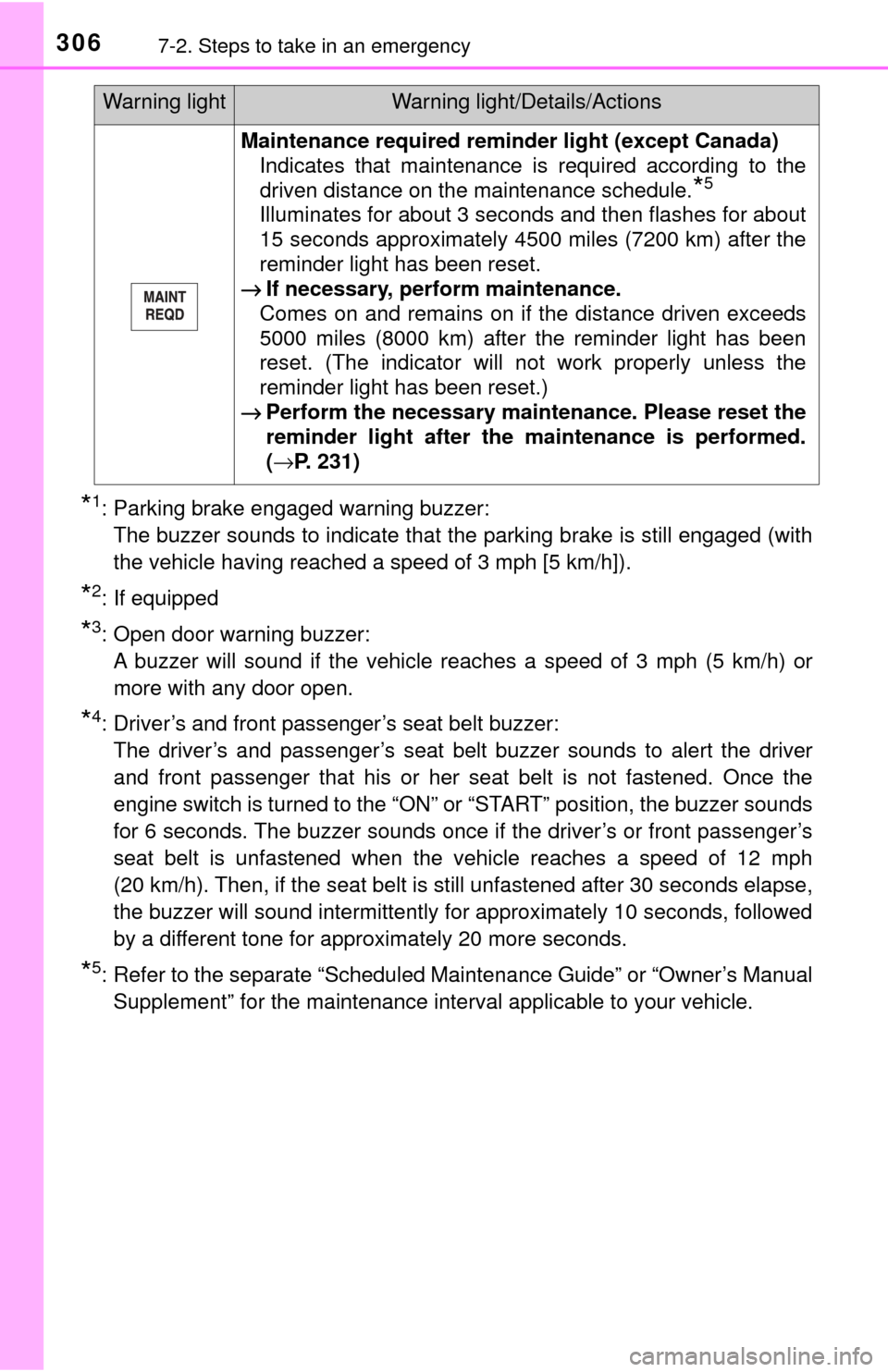
3067-2. Steps to take in an emergency
*1: Parking brake engaged warning buzzer: The buzzer sounds to indicate that the parking brake is still engaged (with
the vehicle having reached a speed of 3 mph [5 km/h]).
*2: If equipped
*3: Open door warning buzzer: A buzzer will sound if the vehicle reaches a speed of 3 mph (5 km/h) or
more with any door open.
*4: Driver’s and front passenger’s seat belt buzzer: The driver’s and passenger’s seat belt buzzer sounds to alert the driver
and front passenger that his or her seat belt is not fastened. Once the
engine switch is turned to the “ON” or “START” position, the buzzer sounds
for 6 seconds. The buzzer sounds once if the driver’s or front passenger’s
seat belt is unfastened when the vehicle reaches a speed of 12 mph
(20 km/h). Then, if the seat belt is still unfastened after 30 seconds elapse,
the buzzer will sound intermittently for approximately 10 seconds, followed
by a different tone for approximately 20 more seconds.
*5: Refer to the separate “Scheduled Maintenance Guide” or “Owner’s ManualSupplement” for the maintenance interval applicable to your vehicle.
Maintenance required reminder light (except Canada) Indicates that maintenance is required according to the
driven distance on the maintenance schedule.
*5
Illuminates for about 3 seconds and then flashes for about
15 seconds approximately 4500 miles (7200 km) after the
reminder light has been reset.
→ If necessary, perform maintenance.
Comes on and remains on if the distance driven exceeds
5000 miles (8000 km) after the reminder light has been
reset. (The indicator will not work properly unless the
reminder light has been reset.)
→ Perform the necessary maintenance. Please reset the
reminder light after the maintenance is performed.
(→P. 231)
Warning lightWarning light/Details/Actions
Page 344 of 396
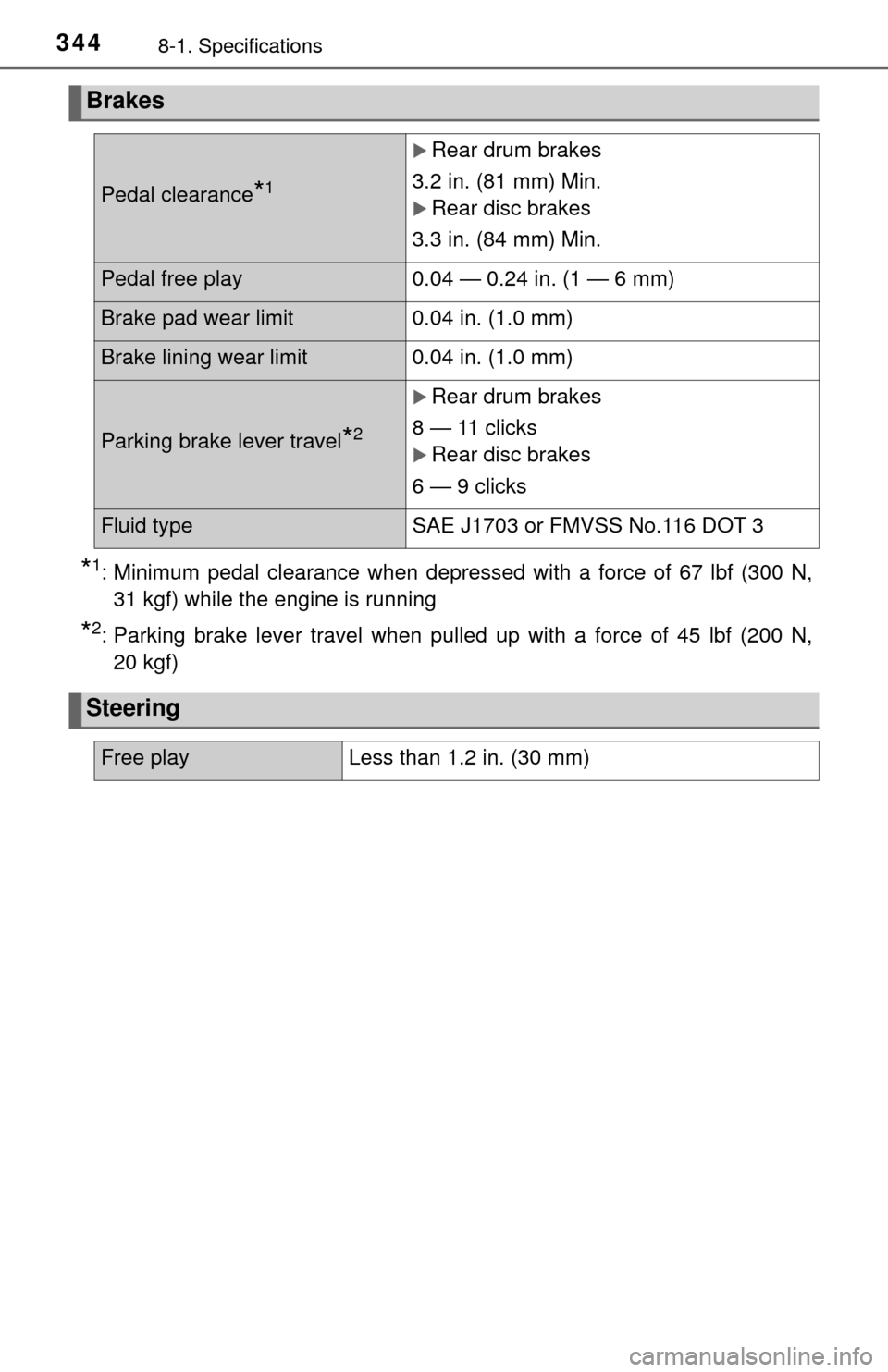
3448-1. Specifications
*1: Minimum pedal clearance when depressed with a force of 67 lbf (300 N,31 kgf) while the engine is running
*2: Parking brake lever travel when pulled up with a force of 45 lbf (200 N,20 kgf)
Brakes
Pedal clearance*1
Rear drum brakes
3.2 in. (81 mm) Min.
Rear disc brakes
3.3 in. (84 mm) Min.
Pedal free play0.04 — 0.24 in. (1 — 6 mm)
Brake pad wear limit0.04 in. (1.0 mm)
Brake lining wear limit0.04 in. (1.0 mm)
Parking brake lever travel*2
Rear drum brakes
8 — 11 clicks
Rear disc brakes
6 — 9 clicks
Fluid typeSAE J1703 or FMVSS No.116 DOT 3
Steering
Free playLess than 1.2 in. (30 mm)
Page 345 of 396
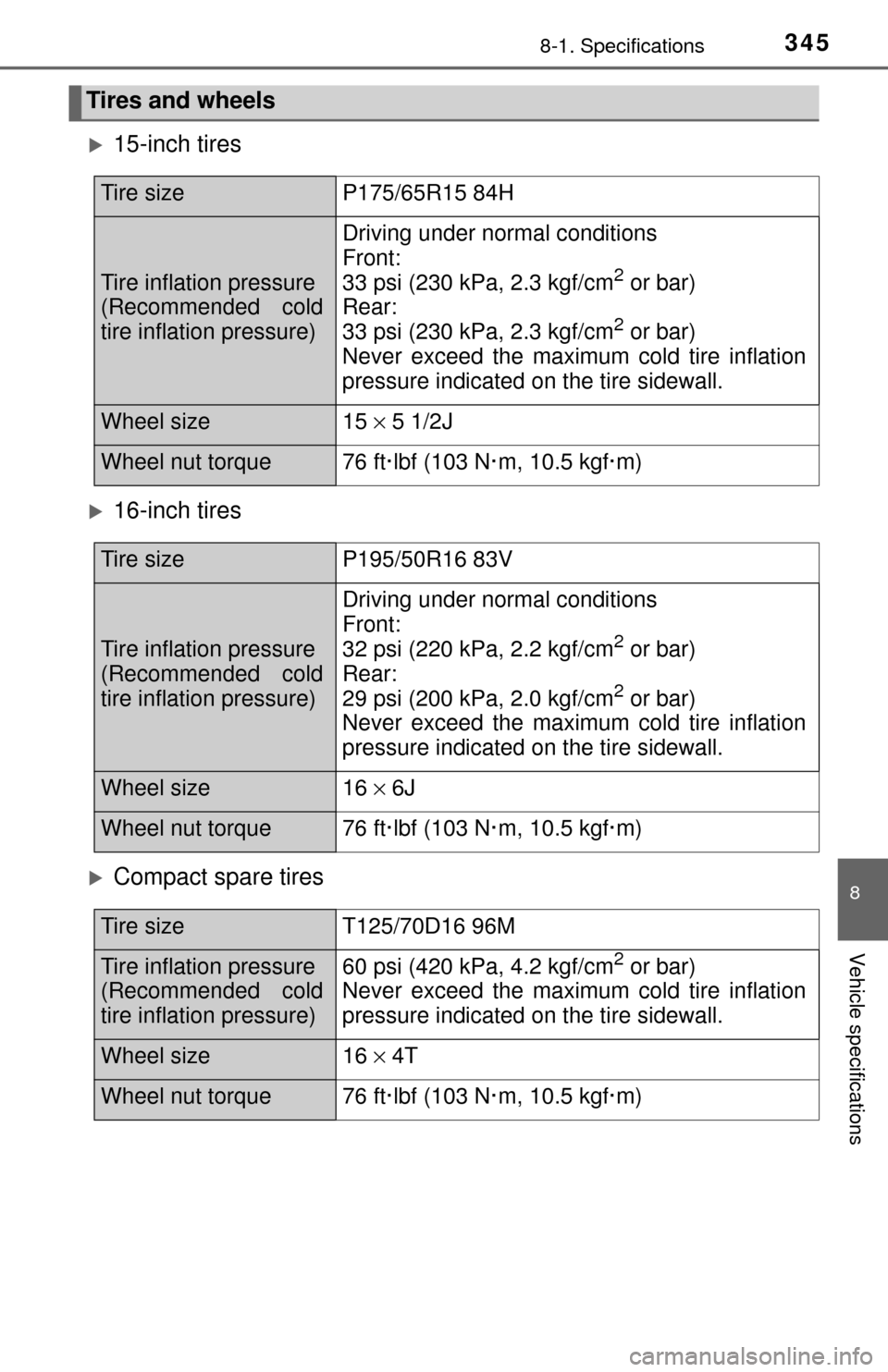
3458-1. Specifications
8
Vehicle specifications
15-inch tires
16-inch tires
Compact spare tires
Tires and wheels
Tire sizeP175/65R15 84H
Tire inflation pressure
(Recommended cold
tire inflation pressure)
Driving under normal conditions
Front:
33 psi (230 kPa, 2.3 kgf/cm
2 or bar)
Rear:
33 psi (230 kPa, 2.3 kgf/cm
2 or bar)
Never exceed the maximum cold tire inflation
pressure indicated on the tire sidewall.
Wheel size15 × 5 1/2J
Wheel nut torque76 ft·lbf (103 N·m, 10.5 kgf·m)
Tire sizeP195/50R16 83V
Tire inflation pressure
(Recommended cold
tire inflation pressure)
Driving under normal conditions
Front:
32 psi (220 kPa, 2.2 kgf/cm
2 or bar)
Rear:
29 psi (200 kPa, 2.0 kgf/cm
2 or bar)
Never exceed the maximum cold tire inflation
pressure indicated on the tire sidewall.
Wheel size16 × 6J
Wheel nut torque76 ft·lbf (103 N·m, 10.5 kgf·m)
Tire sizeT125/70D16 96M
Tire inflation pressure
(Recommended cold
tire inflation pressure)60 psi (420 kPa, 4.2 kgf/cm2 or bar)
Never exceed the maximum cold tire inflation
pressure indicated on the tire sidewall.
Wheel size16 × 4T
Wheel nut torque76 ft·lbf (103 N·m, 10.5 kgf·m)
Page 354 of 396

3548-1. Specifications
This information has been prepared in accordance with regulations
issued by the National Highway Traffic Safety Administration of the
U.S. Department of Transportation.
It provides the purchasers and/or prospective purchasers of Toyota
vehicles with information on uniform tire quality grading.
Your Toyota dealer will help answe r any questions you may have as
you read this information.
■DOT quality grades
All passenger vehicle tires must c onform to Federal Safety Require-
ments in addition to these grades. Quality grades can be found
where applicable on the tire sidewall between tread shoulder and
maximum section width.
For example: Treadwear 200 Traction AA Temperature A
■Treadwear
The treadwear grade is a comparative rating based on the wear
rate of the tire when tested under controlled conditions on a speci-
fied government test course.
For example, a tire graded 150 wo uld wear one and a half (1 - 1/2)
times as well on the government course as a tire graded 100.
The relative performance of tire s depends upon the actual condi-
tions of their use. Performance may differ significantly from the norm
due to variations in driving habits, service practices and differences
in road characteristics and climate.
Uniform Tire Quality Grading
Page 368 of 396
368
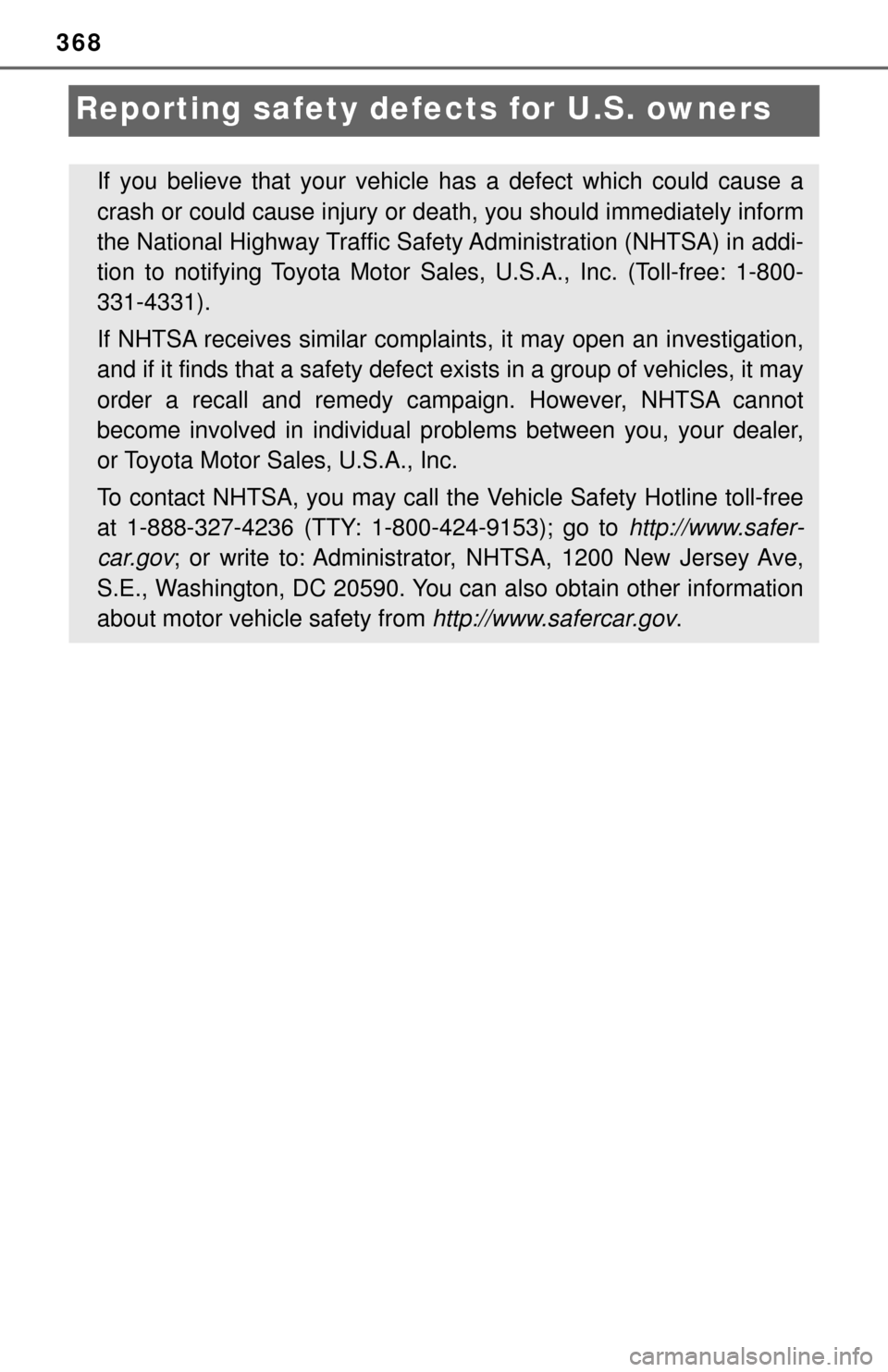
Reporting safety defects for U.S. owners
If you believe that your vehicl e has a defect which could cause a
crash or could cause injury or death, you should immediately inform
the National Highway Traffic Safety Administration (NHTSA) in addi-
tion to notifying Toyota Motor Sales, U.S.A., Inc. (Toll-free: 1-800-
331-4331).
If NHTSA receives similar complain ts, it may open an investigation,
and if it finds that a safety defect exists in a group of vehicles, it may
order a recall and remedy campaign. However, NHTSA cannot
become involved in individual prob lems between you, your dealer,
or Toyota Motor Sales, U.S.A., Inc.
To contact NHTSA, you may call t he Vehicle Safety Hotline toll-free
at 1-888-327-4236 (TTY: 1-800-424-9153); go to http://www.safer-
car.gov; or write to: Administrator, NHTSA, 1200 New Jersey Ave,
S.E., Washington, DC 20590. You can also obtain other information
about motor vehicle safety from http://www.safercar.gov.