Page 200 of 396
2004-7. Driving tips
NOTICE
■Repairing or replacing snow tires (vehicles with a tire pressure warn-
ing system)
Request repairs or replacement of snow tires from Toyota dealers or legiti-
mate tire retailers.
This is because the removal and attachment of snow tires affects the opera-
tion of the tire pressure warning valves and transmitters.
■ Fitting tire chains (vehicles with a tire pressure warning system)
The tire pressure warning valves and transmitters may not function correctly
when tire chains are fitted.
Page 223 of 396
223
6Maintenance and care
6-1. Maintenance and careCleaning and protecting the vehicle exterior .......... 224
Cleaning and protecting the vehicle interior ........... 227
6-2. Maintenance Maintenance requirements ................... 230
General maintenance........ 232
Emission inspection and maintenance (I/M)
programs......................... 235
6-3. Do-it-yourself maintenance Do-it-yourself service precautions ..................... 236
Hood ................................. 239
Positioning a floor jack ...... 241
Engine compartment ......... 243
Tires .................................. 253
Tire inflation pressure ....... 261
Wheels .............................. 265
Air conditioning filter.......... 268
Wireless remote control battery ............................. 270
Checking and replacing fuses ............................... 273
Light bulbs......................... 278
Page 234 of 396
2346-2. Maintenance
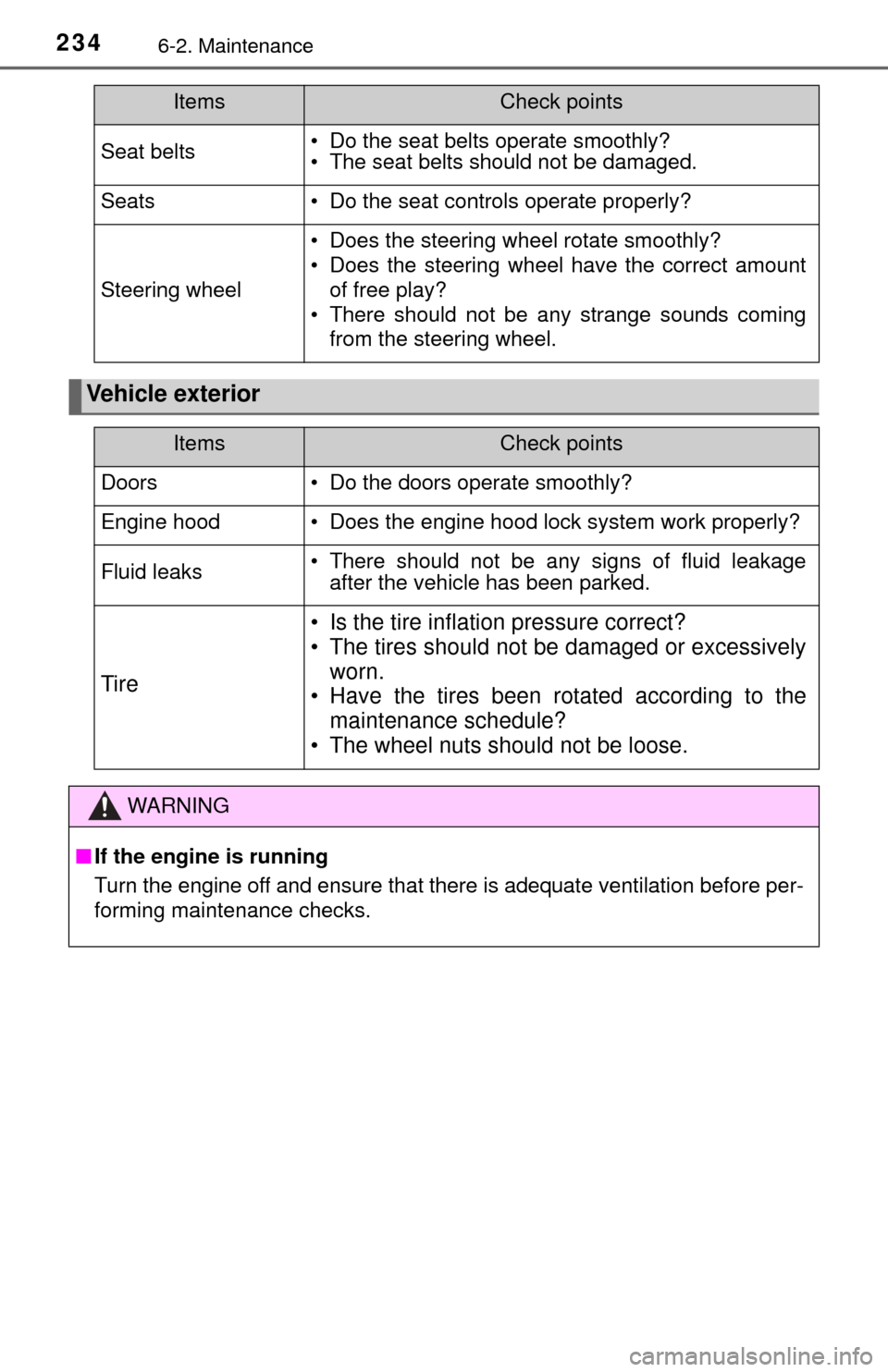
Seat belts• Do the seat belts operate smoothly?
• The seat belts should not be damaged.
Seats• Do the seat controls operate properly?
Steering wheel
• Does the steering wheel rotate smoothly?
• Does the steering wheel have the correct amountof free play?
• There should not be any strange sounds coming from the steering wheel.
Vehicle exterior
ItemsCheck points
ItemsCheck points
Doors• Do the doors operate smoothly?
Engine hood• Does the engine hood lock system work properly?
Fluid leaks• There should not be any signs of fluid leakageafter the vehicle has been parked.
Tire
• Is the tire inflation pressure correct?
• The tires should not be damaged or excessively
worn.
• Have the tires been rotated according to the maintenance schedule?
• The wheel nuts should not be loose.
WARNING
■ If the engine is running
Turn the engine off and ensure that there is adequate ventilation before per-
forming maintenance checks.
Page 237 of 396
2376-3. Do-it-yourself maintenance
6
Maintenance and care
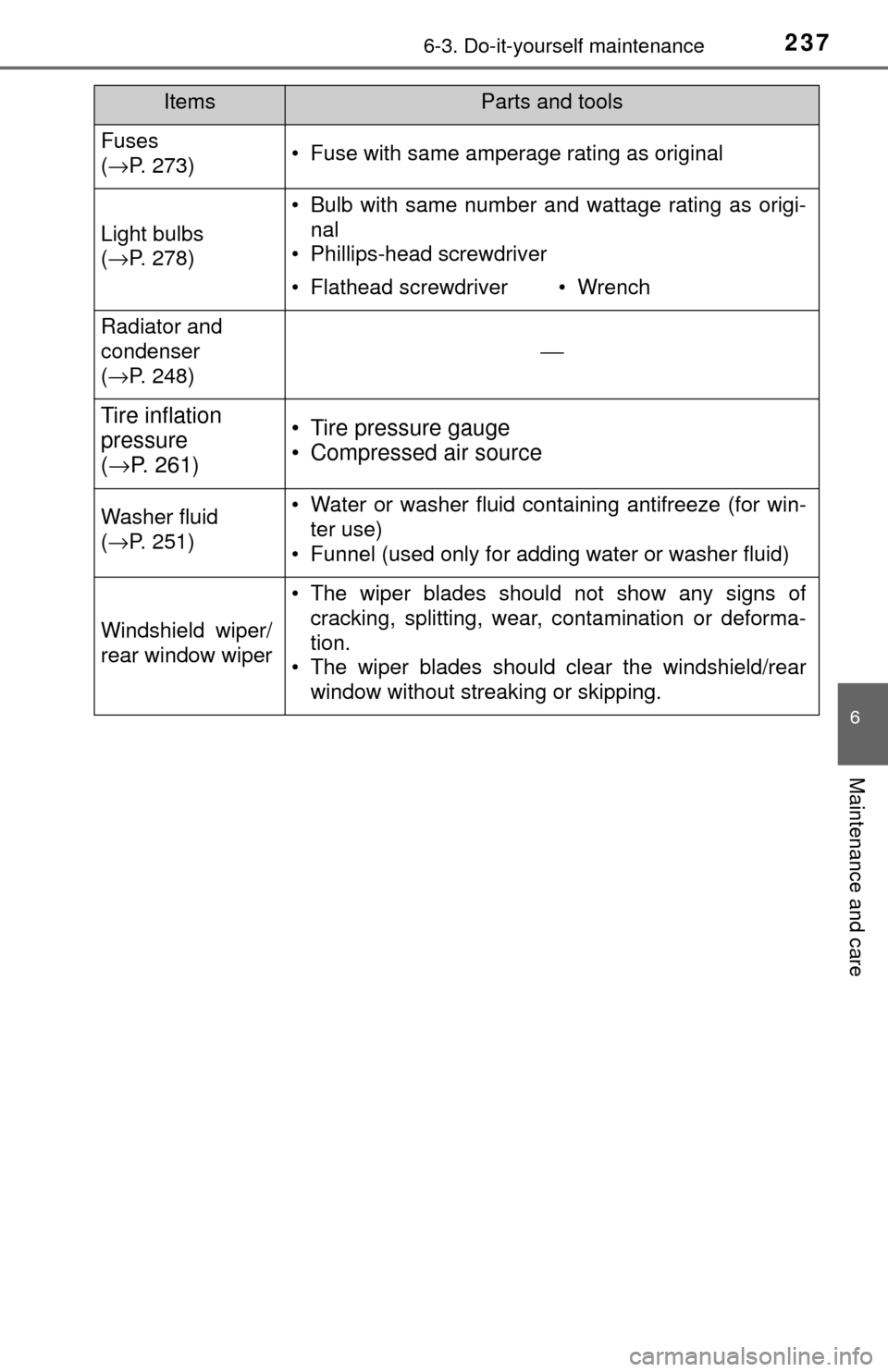
Fuses
(→ P. 273)• Fuse with same amperage rating as original
Light bulbs
(→ P. 278)
• Bulb with same number and wattage rating as origi-
nal
• Phillips-head screwdriver
• Flathead screwdriver• Wrench
Radiator and
condenser
( → P. 248)
⎯
Tire inflation
pressure
(→ P. 261)• Tire pressure gauge
• Compressed air source
Washer fluid
(→ P. 251)• Water or washer fluid containing antifreeze (for win-
ter use)
• Funnel (used only for adding water or washer fluid)
Windshield wiper/
rear window wiper
• The wiper blades should not show any signs of cracking, splitting, wear, contamination or deforma-
tion.
• The wiper blades should clear the windshield/rear
window without streaking or skipping.
ItemsParts and tools
Page 253 of 396
2536-3. Do-it-yourself maintenance
6
Maintenance and care
Tires
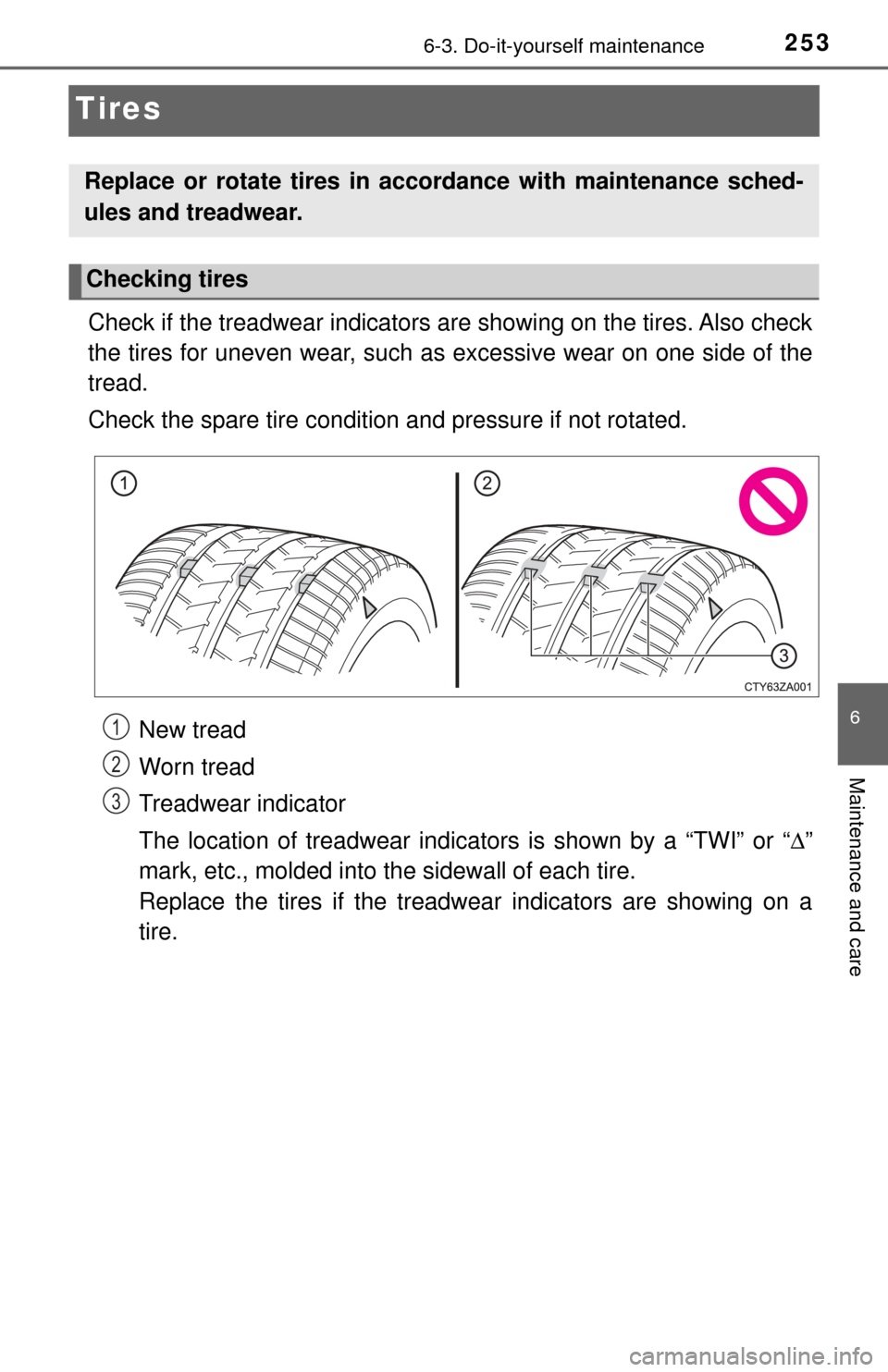
Check if the treadwear indicators are showing on the tires. Also check
the tires for uneven wear, such as excessive wear on one side of the
tread.
Check the spare tire condition and pressure if not rotated.
New tread
Worn tread
Treadwear indicator
The location of treadwear indicators is shown by a “TWI” or “ Δ”
mark, etc., molded into the sidewall of each tire.
Replace the tires if the treadwear indicators are showing on a
tire.
Replace or rotate tires in accordance with maintenance sched-
ules and treadwear.
Checking tires
1
2
3
Page 254 of 396
2546-3. Do-it-yourself maintenance
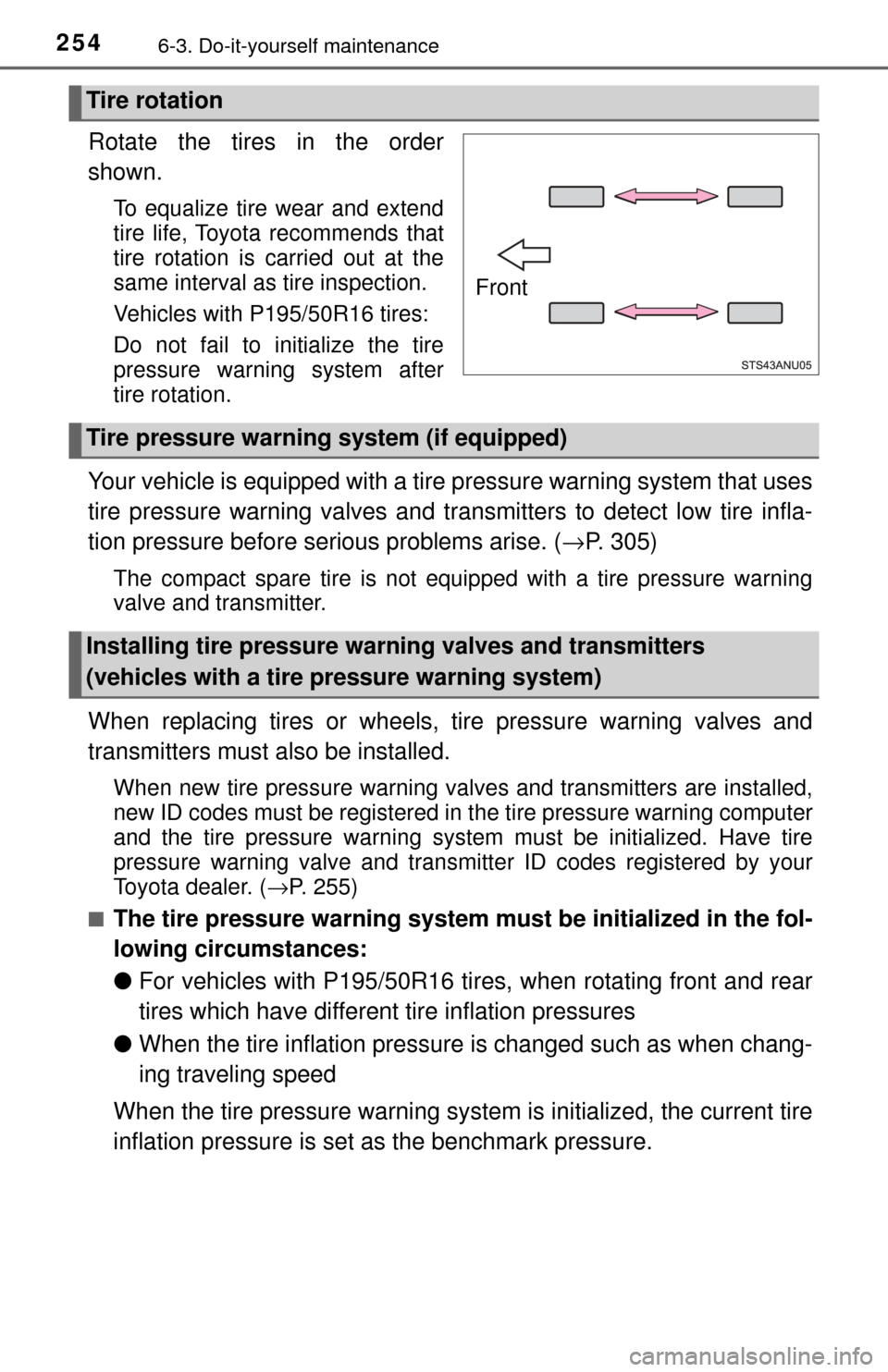
Rotate the tires in the order
shown.
To equalize tire wear and extend
tire life, Toyota recommends that
tire rotation is carried out at the
same interval as tire inspection.
Vehicles with P195/50R16 tires:
Do not fail to initialize the tire
pressure warning system after
tire rotation.
Your vehicle is equipped with a tire pressure warning system that uses
tire pressure warning valves and tr ansmitters to detect low tire infla-
tion pressure before serious problems arise. ( →P. 305)
The compact spare tire is not equipped with a tire pressure warning
valve and transmitter.
When replacing tires or wheels, tire pressure warning valves and
transmitters must also be installed.
When new tire pressure warning valves and transmitters are installed,
new ID codes must be registered in the tire pressure warning computer
and the tire pressure warning syst em must be initialized. Have tire
pressure warning valve and transmitter ID codes registered by your
Toyota dealer. ( →P. 255)
■The tire pressure warning system must be initialized in the fol-
lowing circumstances:
● For vehicles with P195/50R16 ti res, when rotating front and rear
tires which have different tire inflation pressures
● When the tire inflation pressure is changed such as when chang-
ing traveling speed
When the tire pressure warning system is initialized, the current tire
inflation pressure is set as the benchmark pressure.
Tire rotation
Front
Tire pressure warning system (if equipped)
Installing tire pressure warning valves and transmitters
(vehicles with a tire pressure warning system)
Page 255 of 396
2556-3. Do-it-yourself maintenance
6
Maintenance and care
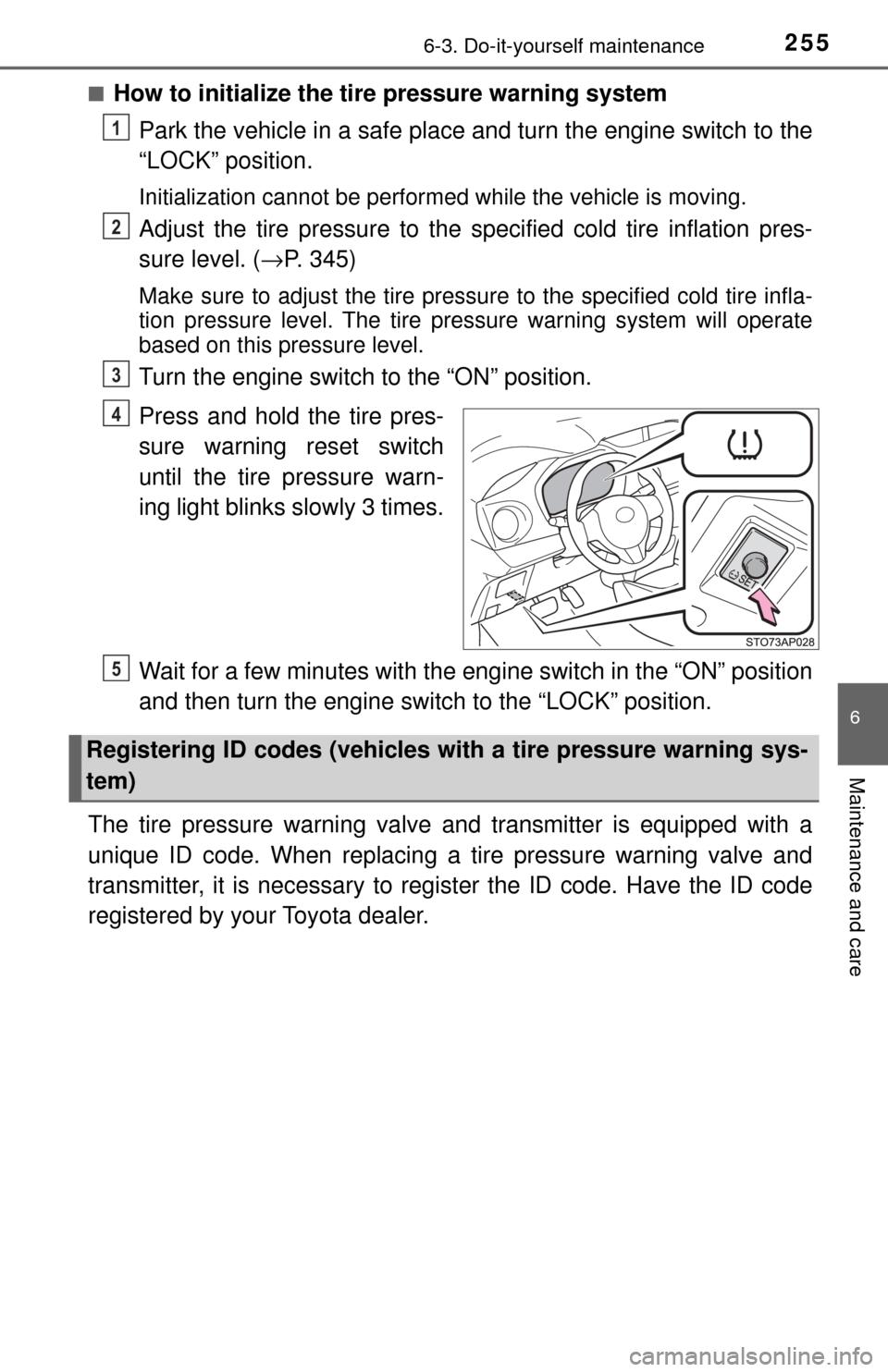
■How to initialize the tire pressure warning systemPark the vehicle in a safe place and turn the engine switch to the
“LOCK” position.
Initialization cannot be performed while the vehicle is moving.
Adjust the tire pressure to the specified cold tire inflation pres-
sure level. ( →P. 345)
Make sure to adjust the tire pressu re to the specified cold tire infla-
tion pressure level. The tire pressure warning system will operate
based on this pressure level.
Turn the engine switch to the “ON” position.
Press and hold the tire pres-
sure warning reset switch
until the tire pressure warn-
ing light blinks slowly 3 times.
Wait for a few minutes with the eng ine switch in the “ON” position
and then turn the engine switch to the “LOCK” position.
The tire pressure warning valve and transmitter is equipped with a
unique ID code. When replacing a tire pressure warning valve and
transmitter, it is necessary to register the ID code. Have the ID code
registered by your Toyota dealer.
1
2
3
4
Registering ID codes (vehicles with a tire pressure warning sys-
tem)
5
Page 256 of 396

2566-3. Do-it-yourself maintenance
■When to replace your vehicle’s tires
Tires should be replaced if:
●The treadwear indicators are showing on a tire.
●You have tire damage such as cuts, splits, cracks deep enough to
expose the fabric, and bulges indicating internal damage
●A tire goes flat repeatedly or cannot be properly repaired due to the size
or location of a cut or other damage
If you are not sure, consult with your Toyota dealer.
■Replacing tires and wheels (vehicles with a tire pressure warning
system)
If the ID code of the tire pressure warning valve and transmitter is not reg-
istered, the tire pressure warning system will not work properly. After driv-
ing for about 20 minutes, the tire pressure warning light blinks for 1
minute and stays on to indicate a system malfunction.
■Tire life
Any tire over 6 years old must be checked by a qualified technician even
if it has seldom or never been used or damage is not obvious.
■Routine tire inflation pressure checks (vehicles with a tire pressure
warning system)
The tire pressure warning system does not replace routine tire inflation
pressure checks. Make su re to check tire inflation pressure as part of
your routine of daily vehicle checks.
■Low profile tires (vehicles with 195/50R16 tires)
Generally, low profile tires will wear mo re rapidly and tire grip perfor-
mance will be reduced on snowy and/ or icy roads when compared to
standard tires. Be sure to use snow tires or tire chains on snowy and/or
icy roads and drive carefully at a speed appropriate for road and weather
conditions.