Page 573 of 668
5
573
5-2. Steps to take in an emergency
When trouble arises
VERSO_EE_OM64517E
Replacing a flat tire
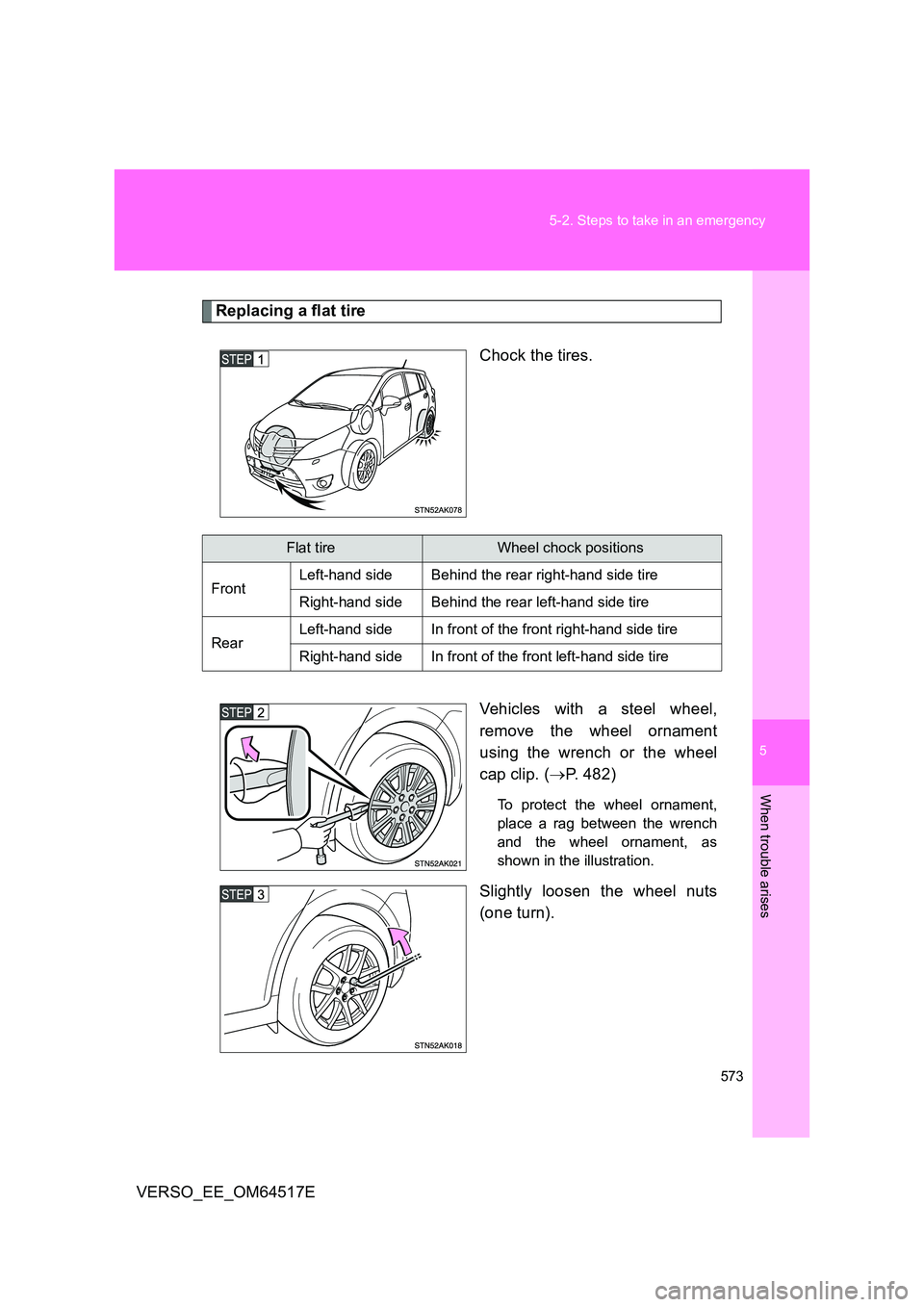
Chock the tires.
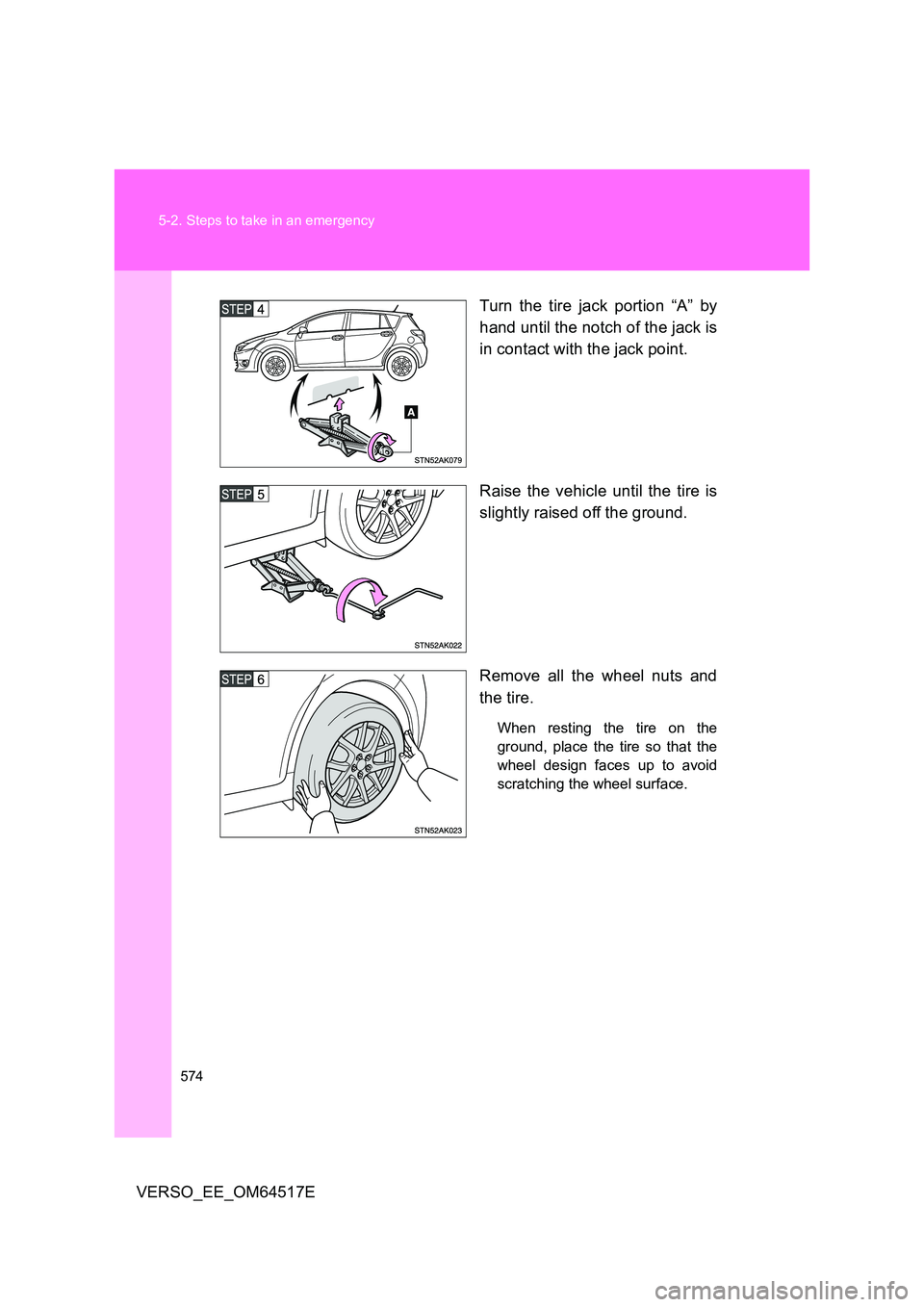
Vehicles with a steel wheel,
remove the wheel ornament
using the wrench or the wheel
cap clip. ( P. 482)
To protect the wheel ornament,
place a rag between the wrench
and the wheel ornament, as
shown in the illustration.
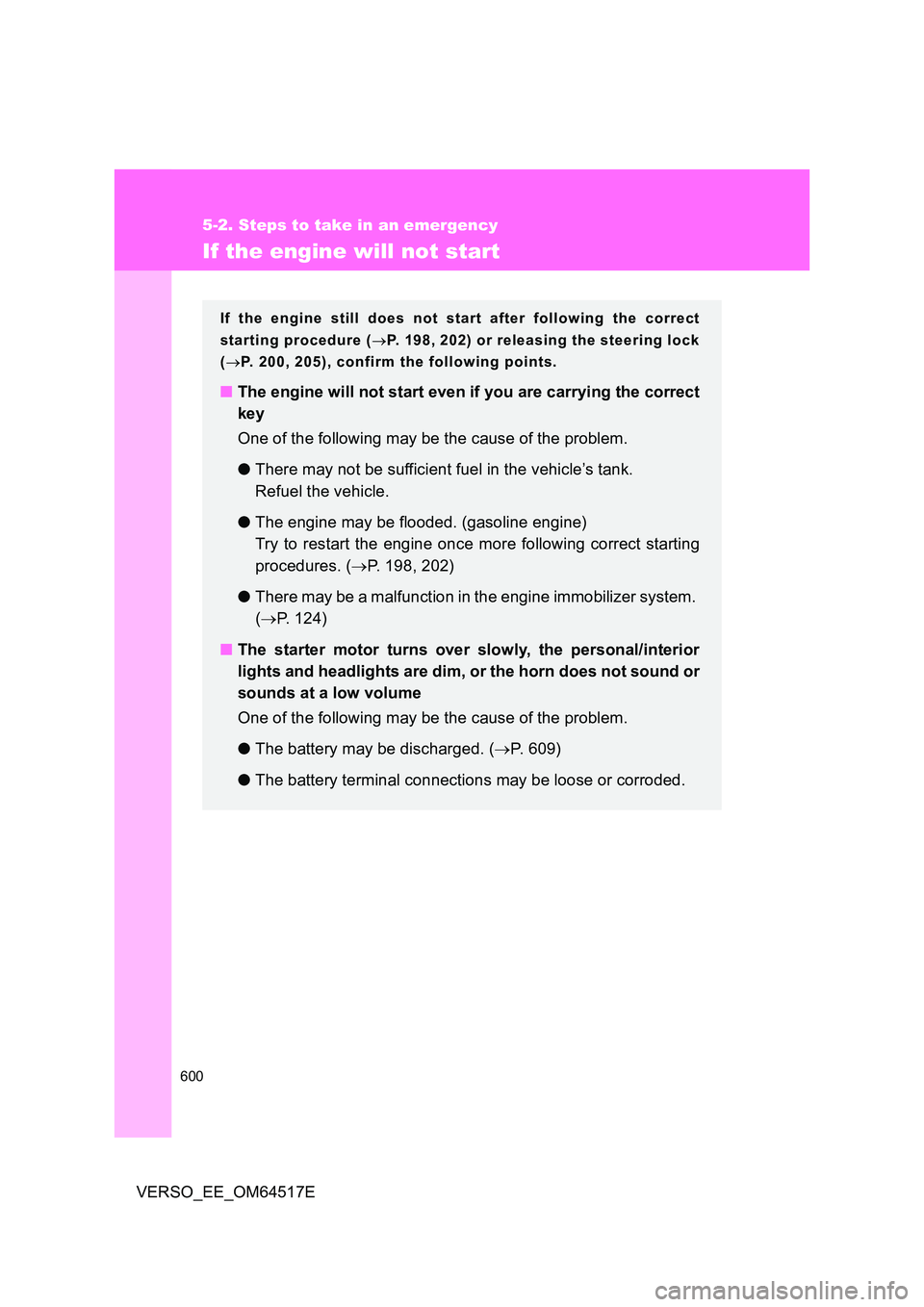
Slightly loosen the wheel nuts
(one turn).
Flat tireWheel chock positions
Front Left-hand side Behind the rear right-hand side tire
Right-hand side Behind the rear left-hand side tire
Rear Left-hand side In front of the front right-hand side tire
Right-hand side In front of the front left-hand side tire
Page 574 of 668
574
5-2. Steps to take in an emergency
VERSO_EE_OM64517E
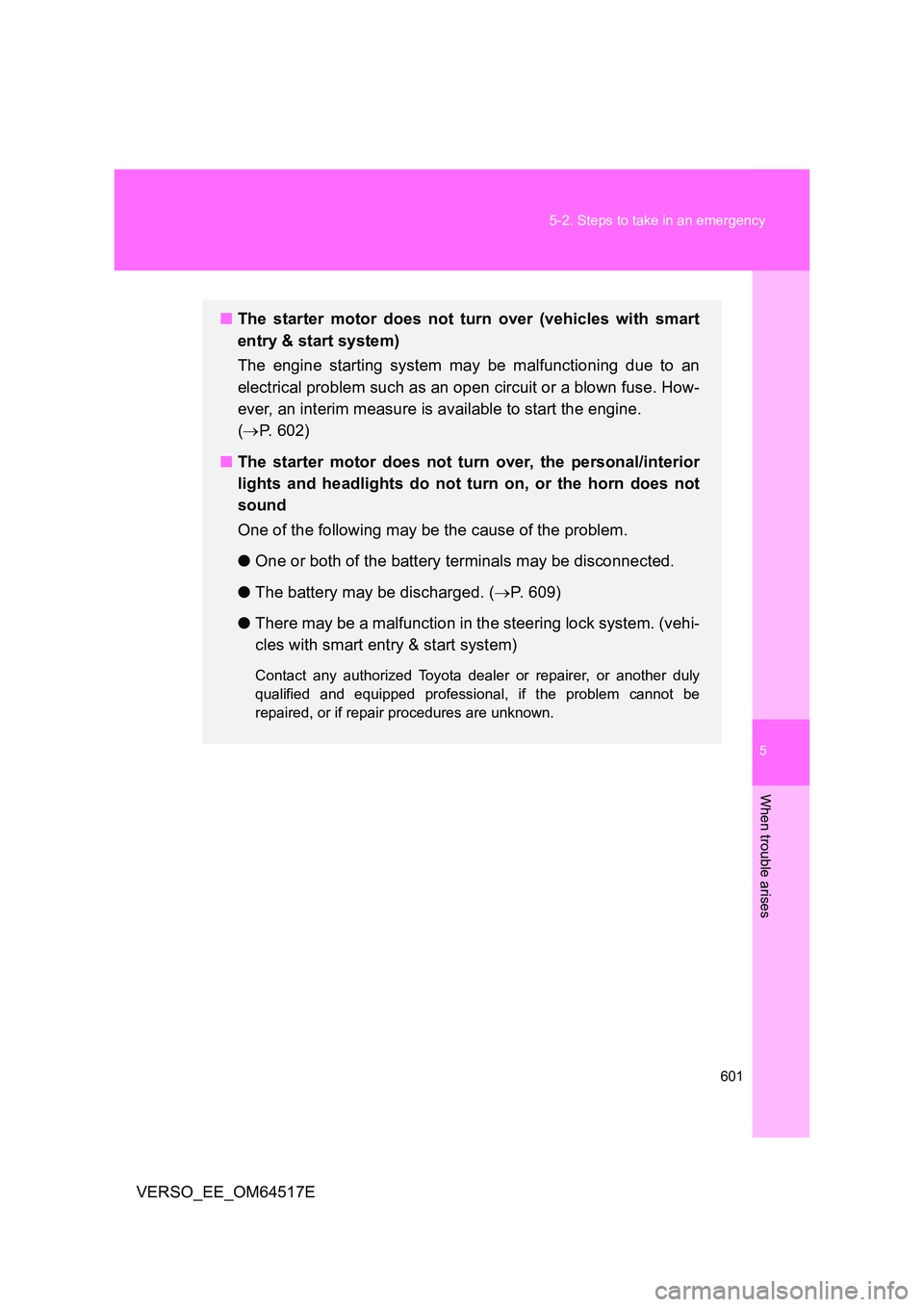
Turn the tire jack portion “A” by
hand until the notch of the jack is
in contact with the jack point.
Raise the vehicle until the tire is
slightly raised off the ground.
Remove all the wheel nuts and
the tire.
When resting the tire on the
ground, place the tire so that the
wheel design faces up to avoid
scratching the wheel surface.
Page 577 of 668

5
577
5-2. Steps to take in an emergency
When trouble arises
VERSO_EE_OM64517E
■ The compact spare tire (if equipped)
● The compact spare tire is identified by the label “TEMPORARY USE
ONLY” on the tire sidewall.
Use the compact spare tire temporarily only in an emergency.
● Make sure to check the tire inflation pressure of the compact spare tire.
( P. 639)
■ After completing the tire change (vehicles with the tire pressure warn-
ing system)
The tire pressure warning system must be reset. ( P. 469)
■ When using the spare tire (vehicles with the tire pressure warning sys-
tem)
As the spare tire is not equipped with a tire pressure warning valve and
transmitter, low inflation pressure of the spare tire will not be indicated by the
tire pressure warning system. Also, if you replace a flat tire with the spare
tire after the tire pressure warning light comes on, the light remains on.
■ If you have a flat front tire on a road covered with snow or ice (vehicles
with compact spare tire)
Install the compact spare tire on the rear of the vehicle. Perform the following
steps and fit tire chains to the front tires.
Replace a rear tire with the compact spare tire.
Replace the flat front tire with the tire removed from the rear of the
vehicle.
Fit tire chains to the front tires.
Page 594 of 668
594
5-2. Steps to take in an emergency
VERSO_EE_OM64517E
Taking precautions to avoid sudden braking, sudden accelera-
tion and sharp turns, drive carefully at under 80 km/h
(50 mph) to the nearest authorized Toyota dealer or repairer,
or another duly qualified and equipped professional for tire
repair or replacement.
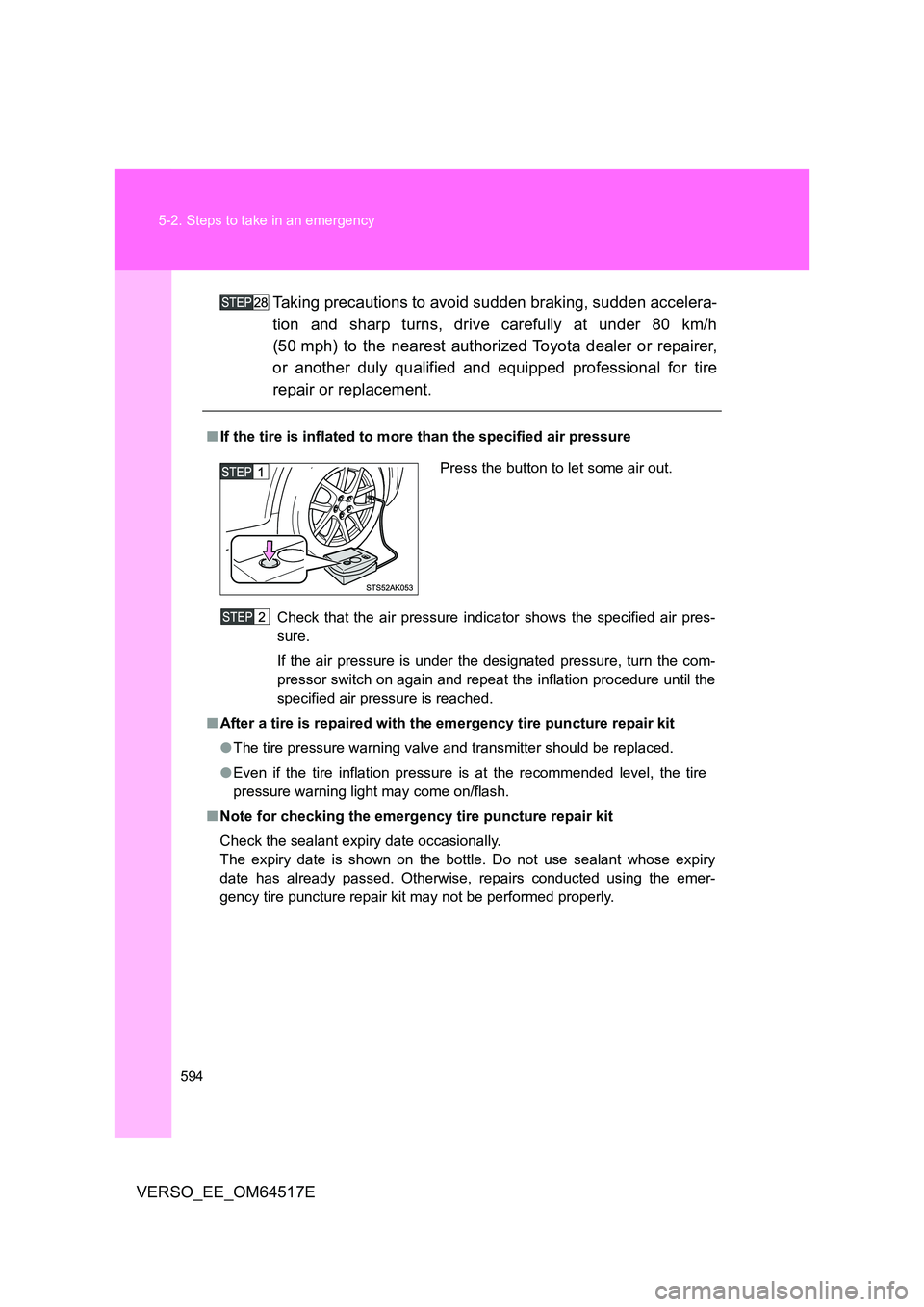
■ If the tire is inflated to more than the specified air pressure
Check that the air pressure indica tor shows the specified air pres-
sure.
If the air pressure is under the designated pressure, turn the com-
pressor switch on again and repeat the inflation procedure until the
specified air pressure is reached.
■ After a tire is repaired with the emergency tire puncture repair kit
● The tire pressure warning valve and transmitter should be replaced.
● Even if the tire inflation pressure is at the recommended level, the tire
pressure warning light may come on/flash.
■ Note for checking the emergency tire puncture repair kit
Check the sealant expiry date occasionally.
The expiry date is shown on the bottle. Do not use sealant whose expiry
date has already passed. Otherwise, repairs conducted using the emer-
gency tire puncture repair kit may not be performed properly.
Press the button to let some air out.
Page 600 of 668
600
5-2. Steps to take in an emergency
VERSO_EE_OM64517E
If the engine will not start
If the engine still does not start after following the correct
starting procedure ( P. 198, 202) or releasing the steering lock
( P. 200, 205), confirm the following points.
■The engine will not start even if you are carrying the correct
key
One of the following may be the cause of the problem.
● There may not be sufficient fuel in the vehicle’s tank.
Refuel the vehicle.
● The engine may be flooded. (gasoline engine)
Try to restart the engine once more following correct starting
procedures. ( P. 198, 202)
● There may be a malfunction in the engine immobilizer system.
( P. 124)
■ The starter motor turns over slowly, the personal/interior
lights and headlights are dim, or the horn does not sound or
sounds at a low volume
One of the following may be the cause of the problem.
● The battery may be discharged. (P. 609)
● The battery terminal connections may be loose or corroded.
Page 601 of 668
5
601
5-2. Steps to take in an emergency
When trouble arises
VERSO_EE_OM64517E
■ The starter motor does not turn over (vehicles with smart
entry & start system)
The engine starting system may be malfunctioning due to an
electrical problem such as an open circuit or a blown fuse. How-
ever, an interim measure is available to start the engine.
( P. 602)
■ The starter motor does not turn over, the personal/interior
lights and headlights do not turn on, or the horn does not
sound
One of the following may be the cause of the problem.
● One or both of the battery terminals may be disconnected.
● The battery may be discharged. (P. 609)
● There may be a malfunction in the steering lock system. (vehi-
cles with smart entry & start system)
Contact any authorized Toyota dealer or repairer, or another duly
qualified and equipped professional, if the problem cannot be
repaired, or if repair procedures are unknown.
Page 610 of 668

610
5-2. Steps to take in an emergency
VERSO_EE_OM64517E
■ Starting the engine when the battery is discharged (vehicles with a
Multidrive)
The engine cannot be started by push-starting.
■ To prevent battery discharge
● Turn off the headlights and the audio system while the engine is stopped.
● Turn off any unnecessary electrical components when the vehicle is run-
ning at a low speed for an extended period, such as in heavy traffic, etc.
Start the engine of the second vehicle. Increase the engine
speed slightly and maintain at that level for approximately 5
minutes to recharge the battery of your vehicle.
Vehicles with smart entry & start system: Open and close
any of the doors with the “ENGINE START STOP” switch
off.
Vehicles without smart entry & start system: Maintain the
engine speed of the second vehicle and turn the engine
switch to the “ON” position, then start the vehicle’s engine.
Vehicles with smart entry & start system: Maintain the
engine speed of the second vehicle and turn the “ENGINE
START STOP” switch to IGNITION ON mode, then start the
vehicle’s engine.
Once the vehicle’s engine has started, remove the jumper
cables in the exact reverse order in which they were con-
nected.
Once the engine starts, have the vehicle checked at any autho-
rized Toyota dealer or repairer, or another duly qualified and
equipped professional, as soon as possible.
Page 611 of 668
5
611
5-2. Steps to take in an emergency
When trouble arises
VERSO_EE_OM64517E
■ Charging the battery
The electricity stored in the battery will discharge gradually even when the
vehicle is not in use, due to natural discharge and the draining effects of cer-
tain electrical appliances. If the vehicle is left for a long time, the battery may
discharge, and the engine may be unable to start. (The battery recharges
automatically during driving.)
■ When recharging or replacing the battery (vehicles with Stop & Start
system)
For a while after the battery terminals has been disconnected and recon-
nected, for a while after the battery has been replaced, the Stop & Start sys-
tem may not automatically stop the engine for approximately 5 to
60 minutes.
■ When exchanging the battery (vehicles with Stop & Start system)
Use a battery specified for use with the Stop & Start system and equivalent
to the genuine battery. If an unsupported battery is used, Stop & Start sys-
tem functions may be restricted to protect the battery.
Also, battery performance may decrease and the engine may not be able to
restart. Contact any authorized Toyota dealer or repairer, or another duly
qualified and equipped professional.
WARNING
■ Avoiding battery fires or explosions
Observe the following precautions to prevent accidentally igniting the flam-
mable gas that may be emitted from the battery.
● Make sure the jumper cable is connected to the correct terminal and that it
is not unintentionally in contact with any part other than the intended termi-
nal.
● Do not allow the jumper cables to come into contact with the “+” and “-” ter-
minals.
● Do not allow open flame or use matches, cigarette lighters or smoke near
the battery.