Page 661 of 741

6608-2. Steps to take in an emergency
RAV4_OM_OM0R005U_(U)■
When recharging or replacing the ba ttery (vehicles with smart key sys-
tem)
● In some cases, it may not be possible to unlock the doors using the smart
key system when the battery is discharged. Use the wireless remote control
or the mechanical key to lock or unlock the doors.
● The engine may not start on the first attempt after the battery has recharged
but will start normally after the second attempt. This is not a malfunction.
● The engine switch mode is memorized by the vehicle. When the battery is
reconnected, the system will return to the mode it was in before the battery
was discharged. Before disconnecting the battery, turn the engine switch off.
If you are unsure what mode the engine switch was in before the battery dis-
charged, be especially careful when reconnecting the battery.
■ When the battery is removed or discharged
●The power back door (if equipped) must be initialized. ( →P. 121)
● The moon roof (if equipped) must be initialized. ( →P. 162)
● Toyota parking assist monitor (if equipped) must be initialized. (Refer to
“NAVIGATION AND MULTIMEDIA SYSTEM OWNER’S MANUAL”)
● Panoramic view monitor (if equipped) must be initialized. (Refer to “NAVI-
GATION AND MULTIMEDIA SYSTEM OWNER’S MANUAL”)
WARNING
■Avoiding battery fires or explosions
Observe the following precautions to prevent accidentally igniting the flam-
mable gas that may be emitted from the battery:
● Make sure each jumper cable is connected to the correct terminal and that
it is not unintentionally in contact with any other than the intended terminal.
● Do not allow the other end of the jumper cable connected to the “+” termi-
nal to come into contact with any other parts or metal surfaces in the area,
such as brackets or unpainted metal.
● Do not allow the + and - clamps of the jumper cables to come into contact
with each other.
● Do not smoke, use matches, cigarette lighters or allow open flame near
the battery.
Page 662 of 741
6618-2. Steps to take in an emergency
RAV4_OM_OM0R005U_(U)
8
When trouble arises
WARNING
■Battery precautions
The battery contains poisonous and corrosive acidic electrolyte, while
related parts contain lead and lead compounds. Observe the following pre-
cautions when handling the battery:
● When working with the battery, always wear safety glasses and take care
not to allow any battery fluids (acid) to come into contact with skin, clothing
or the vehicle body.
● Do not lean over the battery.
● In the event that battery fluid comes into contact with the skin or eyes,
immediately wash the affected area with water and seek medical attention.
Place a wet sponge or cloth over the affected area until medical attention
can be received.
● Always wash your hands after handling the battery support, terminals, and
other battery-related parts.
● Do not allow children near the battery.
NOTICE
■ When handling jumper cables
When connecting the jumper cables, ensure that they do not become entan-
gled in the cooling fans or engine drive belt.
Page 666 of 741
665
RAV4_OM_OM0R005U_(U)
8-2. Steps to take in an emergency
8
When trouble arises
If the vehicle becomes stuck
Stop the engine. Set the parking brake and shift the shift lever to P.
Remove the mud, snow or sand from around the stuck tire.
Place wood, stones or some other material to help provide traction
under the tires.
Restart the engine.
AWD models: Activate all-wheel drive lock mode. (→P. 296)
Shift the shift lever to D or R and release the parking brake. Then,
while exercising caution, depress the accelerator pedal.
■ When it is difficult to free the vehicle
Press to turn off TRAC.
Carry out the following procedures if the tires spin or the vehicle
becomes stuck in mud, dirt or snow:
1
2
3
4
5
6
2WD models
AWD models
Page 667 of 741
6668-2. Steps to take in an emergency
RAV4_OM_OM0R005U_(U)
WARNING
■When attempting to free a stuck vehicle
If you choose to push the vehicle back and forth to free it, make sure the
surrounding area is clear to avoid striking other vehicles, objects or people.
The vehicle may also lunge forward or lunge back suddenly as it becomes
free. Use extreme caution.
■ When shifting the shift lever
Be careful not to shift the shift lever with the accelerator pedal depressed.
This may lead to unexpected rapid acceleration of the vehicle that may
cause an accident resulting in death or serious injury.
NOTICE
■To avoid damaging the transmission and other components
● Avoid spinning the wheels and depressing the accelerator pedal more
than necessary.
● If the vehicle remains stuck even after these procedures are performed,
the vehicle may require towing to be freed.
Page 672 of 741
RAV4_OM_OM0R005U_(U)
6719-1. Specifications
9
Vehicle specifications
*: The engine oil capacity is a reference quantity to be used when changingthe engine oil. Warm up and turn off the engine, wait more than 5 minutes,
and check the oil level on the dipstick.
■
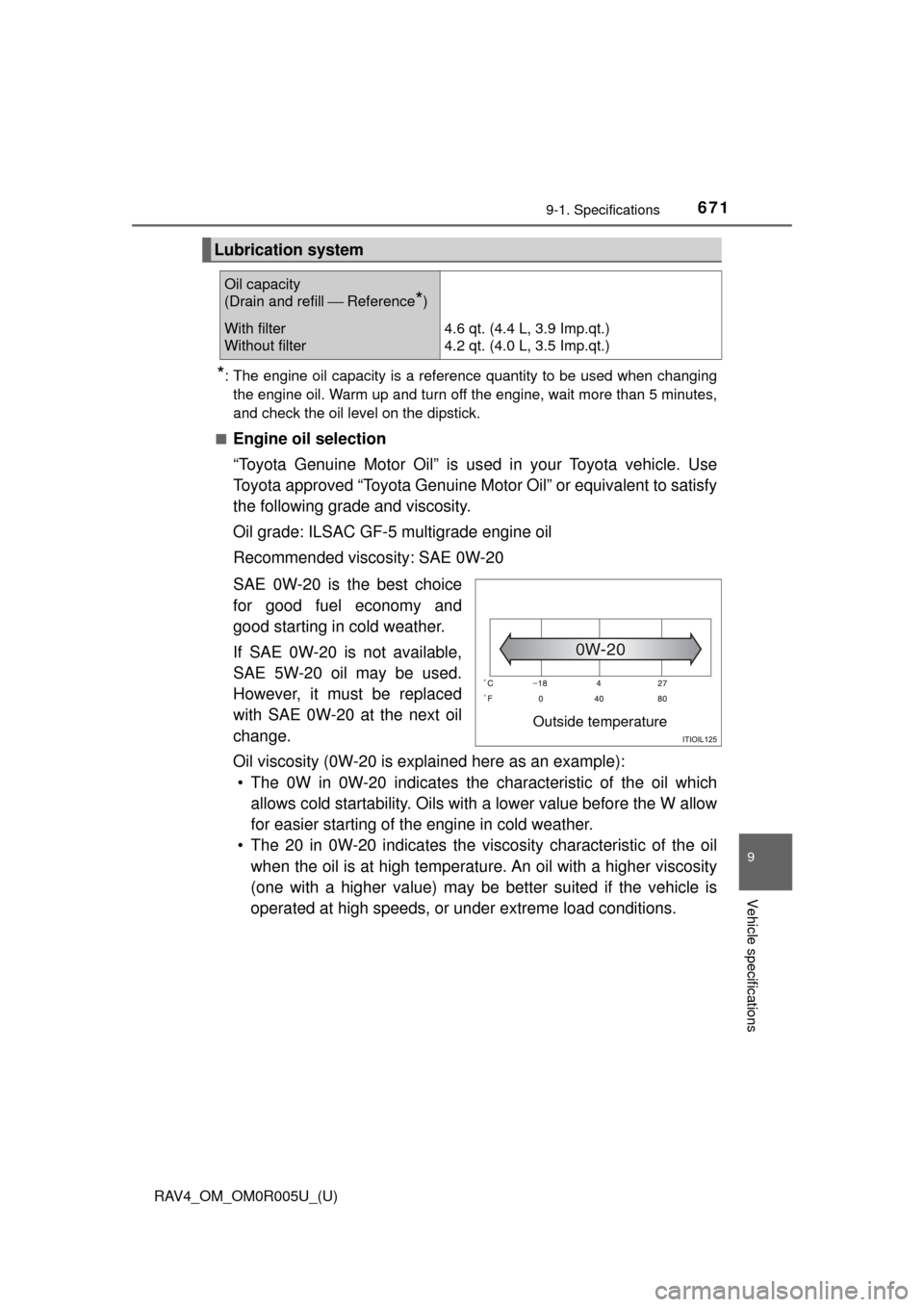
Engine oil selection
“Toyota Genuine Motor Oil” is us ed in your Toyota vehicle. Use
Toyota approved “Toyota Genuine Motor Oil” or equivalent to satisfy
the following grade and viscosity.
Oil grade: ILSAC GF-5 multigrade engine oil
Recommended viscosity: SAE 0W-20
SAE 0W-20 is the best choice
for good fuel economy and
good starting in cold weather.
If SAE 0W-20 is not available,
SAE 5W-20 oil may be used.
However, it must be replaced
with SAE 0W-20 at the next oil
change.
Oil viscosity (0W-20 is explained here as an example): • The 0W in 0W-20 indicates the characteristic of the oil which
allows cold startability. Oils with a lower value before the W allow
for easier starting of the engine in cold weather.
• The 20 in 0W-20 indicates the viscosity characteristic of the oil when the oil is at high temperature. An oil with a higher viscosity
(one with a higher value) may be better suited if the vehicle is
operated at high speeds, or under extreme load conditions.
Lubrication system
Oil capacity
(Drain and refill ⎯ Reference
*)
With filter
Without filter4.6 qt. (4.4 L, 3.9 Imp.qt.)
4.2 qt. (4.0 L, 3.5 Imp.qt.)
Outside temperature
Page 676 of 741
RAV4_OM_OM0R005U_(U)
6759-1. Specifications
9
Vehicle specifications
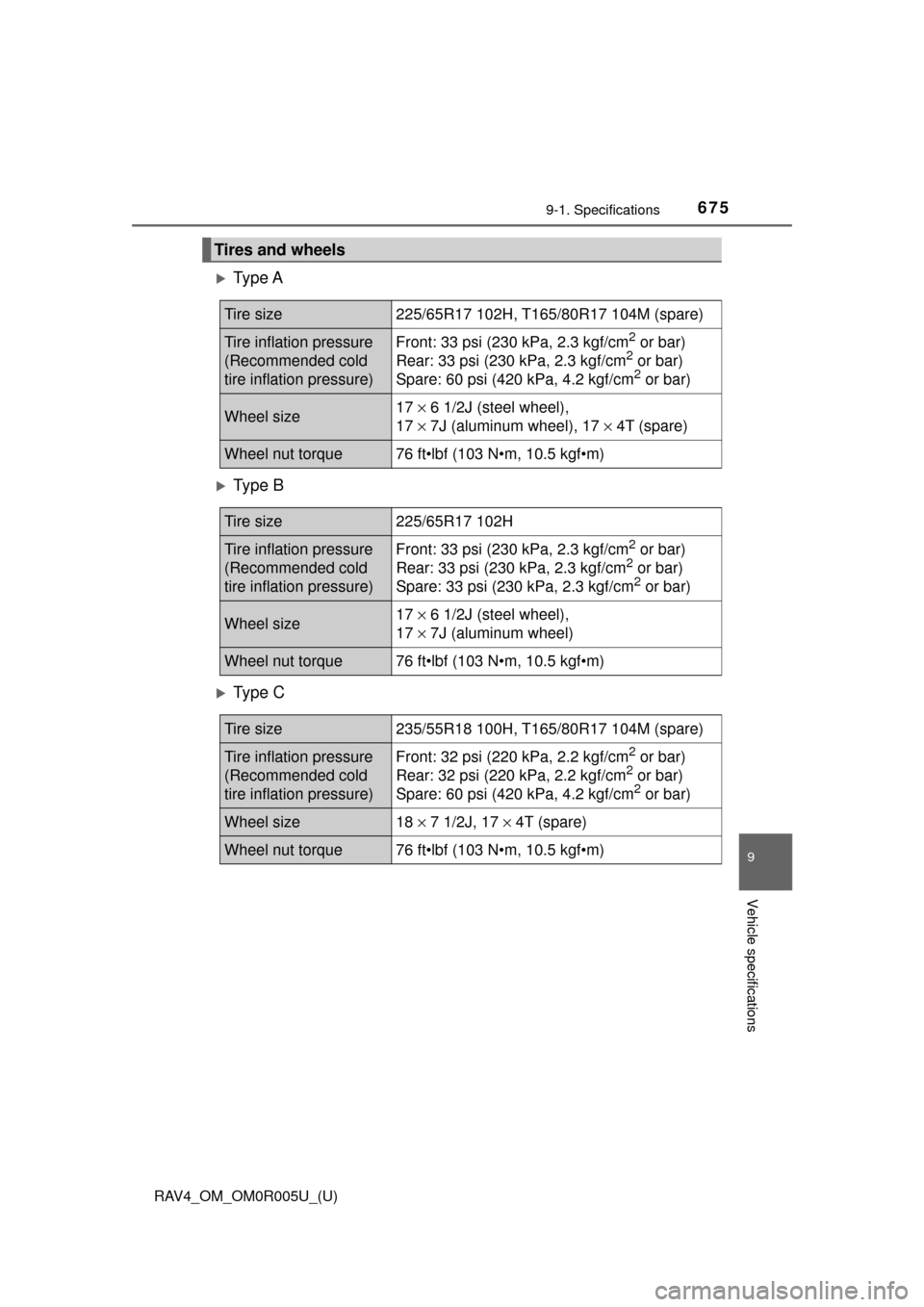
Ty p e A
Ty p e B
Ty p e C
Tires and wheels
Tire size225/65R17 102H, T165/80R17 104M (spare)
Tire inflation pressure
(Recommended cold
tire inflation pressure)Front: 33 psi (230 kPa, 2.3 kgf/cm2 or bar)
Rear: 33 psi (230 kPa, 2.3 kgf/cm2 or bar)
Spare: 60 psi (420 kPa, 4.2 kgf/cm2 or bar)
Wheel size17 × 6 1/2J (steel wheel),
17 × 7J (aluminum wheel), 17 × 4T (spare)
Wheel nut torque76 ft•lbf (103 N•m, 10.5 kgf•m)
Tire size225/65R17 102H
Tire inflation pressure
(Recommended cold
tire inflation pressure)Front: 33 psi (230 kPa, 2.3 kgf/cm2 or bar)
Rear: 33 psi (230 kPa, 2.3 kgf/cm2 or bar)
Spare: 33 psi (230 kPa, 2.3 kgf/cm2 or bar)
Wheel size17 × 6 1/2J (steel wheel),
17 × 7J (aluminum wheel)
Wheel nut torque76 ft•lbf (103 N•m, 10.5 kgf•m)
Tire size235/55R18 100H, T165/80R17 104M (spare)
Tire inflation pressure
(Recommended cold
tire inflation pressure)Front: 32 psi (220 kPa, 2.2 kgf/cm2 or bar)
Rear: 32 psi (220 kPa, 2.2 kgf/cm2 or bar)
Spare: 60 psi (420 kPa, 4.2 kgf/cm2 or bar)
Wheel size18 × 7 1/2J, 17 × 4T (spare)
Wheel nut torque76 ft•lbf (103 N•m, 10.5 kgf•m)
Page 678 of 741
677
RAV4_OM_OM0R005U_(U)
9-1. Specifications
9
Vehicle specifications
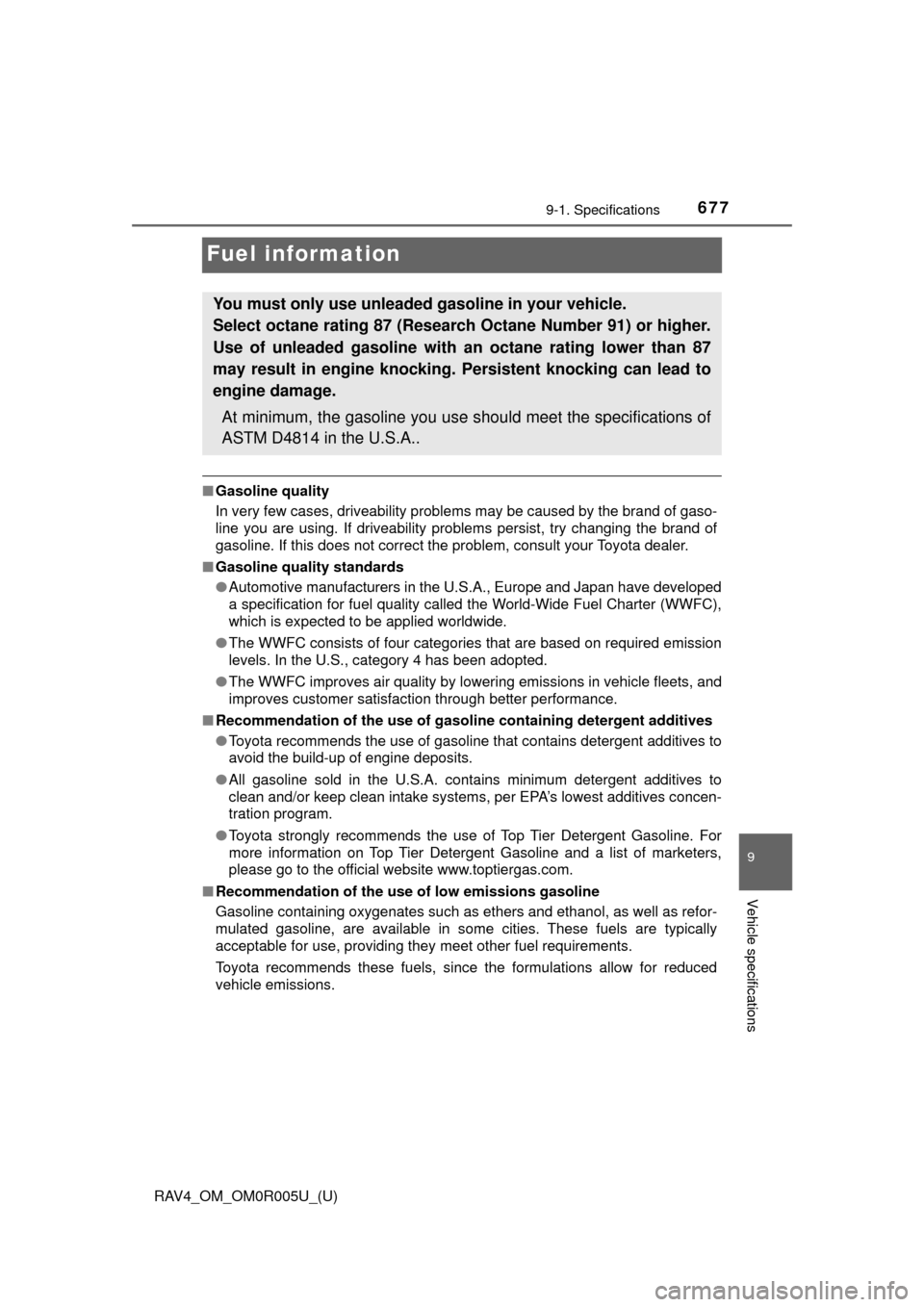
Fuel information
■Gasoline quality
In very few cases, driveability problems may be caused by the brand of gaso-
line you are using. If driveability problems persist, try changing the brand of
gasoline. If this does not correct the problem, consult your Toyota dealer.
■ Gasoline quality standards
●Automotive manufacturers in the U.S.A., Europe and Japan have developed
a specification for fuel quality called the World-Wide Fuel Charter (WWFC),
which is expected to be applied worldwide.
● The WWFC consists of four categor ies that are based on required emission
levels. In the U.S., category 4 has been adopted.
● The WWFC improves air quality by lowering emissions in vehicle fleets, and
improves customer satisfaction through better performance.
■ Recommendation of the use of gaso line containing detergent additives
● Toyota recommends the use of gasoline that contains detergent additives to
avoid the build-up of engine deposits.
● All gasoline sold in the U.S.A. contains minimum detergent additives to
clean and/or keep clean intake systems, per EPA’s lowest additives concen-
tration program.
● Toyota strongly recommends the use of Top Tier Detergent Gasoline. For
more information on Top Tier Detergent Gasoline and a list of marketers,
please go to the official website www.toptiergas.com.
■ Recommendation of the use of low emissions gasoline
Gasoline containing oxygenates such as ethers and ethanol, as well as refor-
mulated gasoline, are available in some cities. These fuels are typically
acceptable for use, providing they meet other fuel requirements.
Toyota recommends these fuels, since the formulations allow for reduced
vehicle emissions.
You must only use unleaded gasoline in your vehicle.
Select octane rating 87 (Research Octane Number 91) or higher.
Use of unleaded gasoline with an octane rating lower than 87
may result in engine knocking. Persistent knocking can lead to
engine damage.
At minimum, the gasoline you use s hould meet the specifications of
ASTM D4814 in the U.S.A..
Page 679 of 741

678
RAV4_OM_OM0R005U_(U)
9-1. Specifications
■Non-recommendation of the use of blended gasoline
●If you use gasohol in your vehicle, be sure that it has an octane rating no
lower than 87.
● Toyota does not recommend the use of gasoline containing methanol.
■ Non-recommendation of the use of gasoline containing MMT
Some gasoline contains an octane enhancing additive called MMT (Methylcy-
clopentadienyl Manganese Tricarbonyl).
Toyota does not recommend the use of gasoline that contains MMT. If fuel
containing MMT is used, your emission control system may be adversely
affected.
The malfunction indicator lamp on the instrument cluster may come on. If this
happens, contact your Toyota dealer for service.
■ If your engine knocks
●Consult your Toyota dealer.
● You may occasionally notice light knocking for a short time while accelerat-
ing or driving uphill. This is normal and there is no need for concern.
●
Use only gasoline containing up to 15%
ethanol.
DO NOT use any flex-fuel or gasoline
that could contain more than 15% etha-
nol, including from any pump labeled
E30, E50, E85 (which are only some
examples of fuel containing more than
15% ethanol).
DO NOT use gasoline
containing more than
15% ethanol.
(30% ethanol)
(50% ethanol)
(85% ethanol)