Page 700 of 796
7008-2. Steps to take in an emergency
PRIUS_OM_OM47B54U_(U)
WARNING
■When fixing the flat tire
●Stop your vehicle in a safe and flat area.
●Do not touch the wheels or the area around the brakes immediately
after the vehicle has been driven.
After the vehicle has been driven, the wheels and the area around the
brakes may be extremely hot. Touching these areas with hands, feet or
other body parts may result in burns.
●Connect the valve and hose securely with the tire installed on the vehi-
cle. If the hose is not properly co nnected to the valve, air leakage may
occur as sealant may be sprayed out.
●If the hose comes off the valve while inflating the tire, there is a risk
that the hose will move abru ptly due to air pressure.
●After inflation of the tire has comp leted, the sealant may splatter when
the hose is disconnected or some air is let out of the tire.
●Follow the operation procedure to repair the tire. If the procedures not
followed, the sealant may spray out.
●Keep back from the tire while it is being repaired, as there is a chance
of it bursting while the repair op eration is being performed. If you
notice any cracks or deformation of the tire, turn off the compressor
switch and stop the repair operation immediately.
●The repair kit may overheat if operated for a long period of time. Do not
operate the repair kit continuously for more than 40 minutes.
●Parts of the repair kit become hot during operation. Be careful handling
the repair kit during and after operation. Do not touch the metal part
connecting the bottle and the compressor. It will be extremely hot.
●Do not attach the vehicle speed warning sticker to an area other than
the one indicated. If the sticker is attached to an area where an SRS
airbag is located, such as the pad of the steering wheel, it may prevent
the SRS airbag from operating properly.
Page 710 of 796

7108-2. Steps to take in an emergency
PRIUS_OM_OM47B54U_(U)
Once the hybrid system has started, remove the jumper cables in
the exact reverse order from which they were connected.
To install the engine cover, conduct the removal procedure in
reverse. After installing, check that the fixed pins are inserted
securely.
Once the hybrid system starts, ha ve the vehicle inspected at your
Toyota dealer as soon as possible.
■ Starting the hybrid system when the 12-volt battery is discharged
The hybrid system cannot be started by push-starting.
■ To prevent 12-volt battery discharge
●Turn off the headlights and the audio system while the hybrid system is off.
● Turn off any unnecessary electrical components when the vehicle is running
at a low speed for an extended period, such as in heavy traffic.
■ When the 12-volt battery is removed or discharged
●Information stored in the ECU is cleared. When the 12-volt battery is
depleted, have the vehicle inspected at your Toyota dealer.
● Some systems may require initialization. ( →P. 756)
■ When removing the 12-volt battery terminals
When the 12-volt battery terminals are removed, the information stored in the
ECU is cleared. Before removing the 12-volt battery terminals, contact your
Toyota dealer.
■ Charging the 12-volt battery
The electricity stored in the 12-volt battery will discharge gradually even when
the vehicle is not in use, due to natural discharge and the draining effects of
certain electrical appliances. If the vehicle is left for a long time, the 12-volt
battery may discharge, and the hybrid system may be unable to start. (The
12-volt battery recharges automatically while the hybrid system is operating.)
7
8
Page 711 of 796
7118-2. Steps to take in an emergency
PRIUS_OM_OM47B54U_(U)
8
When trouble arises
■When recharging or repl acing the 12-volt battery
● In some cases, it may not be possible to unlock the doors using the smart
key system when the 12-volt battery is discharged. Use the wireless remote
control or the mechanical key to lock or unlock the doors.
● The hybrid system may not start on the first attempt after the 12-volt battery
has recharged but will start normally after the second attempt. This is not a
malfunction.
● The power switch mode is memorized by the vehicle. When the 12-volt bat-
tery is reconnected, the system will return to the mode it was in before the
12-volt battery was discharged. Before disconnecting the 12-volt battery,
turn the power switch off.
If you are unsure what mode the power switch was in before the 12-volt bat-
tery discharged, be especially careful when reconnecting the 12-volt battery.
● If the 12-volt battery discharges while the shift position is in P, it may not be
possible to shift the shift position to other positions. In this case, the vehicle
cannot be towed without lifting both front wheels because the front whee\
ls
will be locked. ( →P. 646)
■ When exchanging the 12-volt battery
●Use a 12-volt battery that conforms to European regulations.
● Use a 12-volt battery with the same case size as the previous 12-volt battery
and an equivalent 20 hour rate capacity (20HR) or greater.
• If the sizes differ, the 12-volt battery cannot be properly secured.
• If the 20 hour rate capacity is low, even if the time period where the vehi-
cle is not used is a short time, the 12-volt battery may discharge and the
hybrid system may not be able to start.
● For details, consult your Toyota dealer.
Page 747 of 796
PRIUS_OM_OM47B54U_(U)
7479-1. Specifications
9
Vehicle specifications
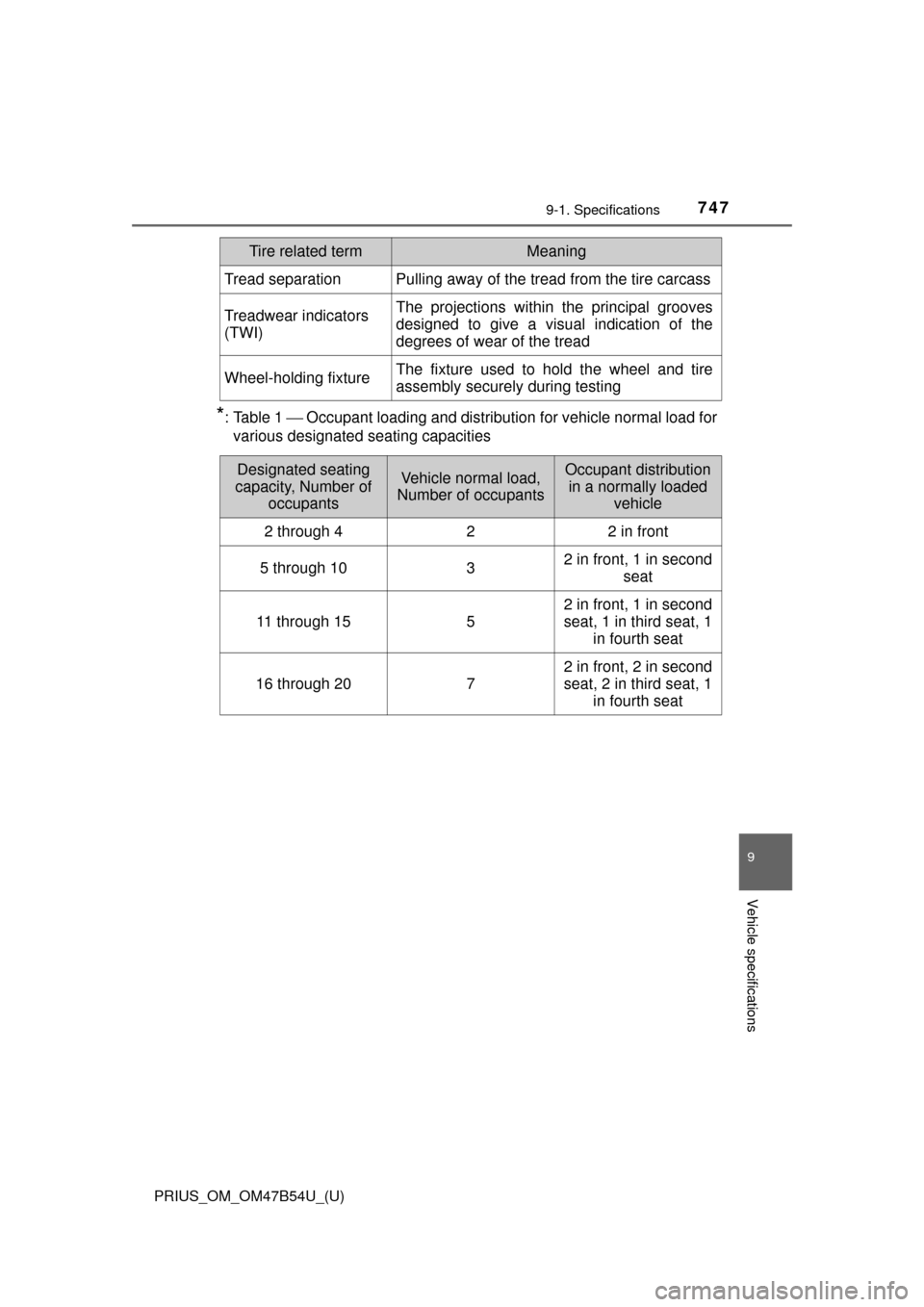
*: Table 1 ⎯ Occupant loading and distribution for vehicle normal load for
various designated seating capacities
Tread separationPulling away of the tread from the tire carcass
Treadwear indicators
(TWI)The projections within the principal grooves
designed to give a visual indication of the
degrees of wear of the tread
Wheel-holding fixtureThe fixture used to hold the wheel and tire
assembly securely during testing
Tire related termMeaning
Designated seating
capacity, Number of occupantsVehicle normal load,
Number of occupantsOccupant distribution
in a normally loaded vehicle
2 through 422 in front
5 through 1032 in front, 1 in second seat
11 through 155
2 in front, 1 in second
seat, 1 in third seat, 1 in fourth seat
16 through 207
2 in front, 2 in second
seat, 2 in third seat, 1
in fourth seat
Page 751 of 796
PRIUS_OM_OM47B54U_(U)
7519-2. Customization
9
Vehicle specifications
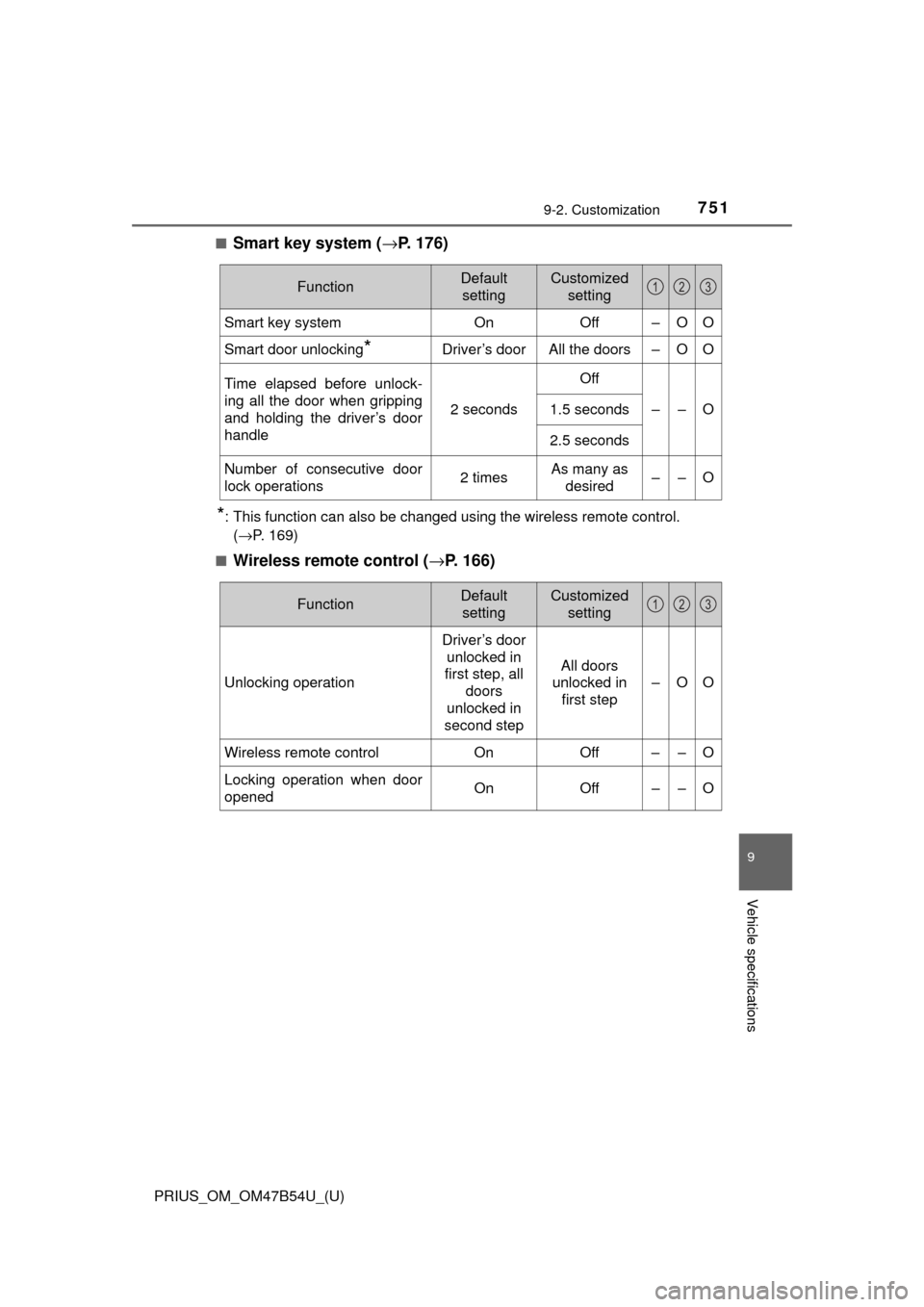
■Smart key system (→P. 176)
*: This function can also be changed using the wireless remote control.
(→P. 169)
■
Wireless remote control ( →P. 166)
FunctionDefault
settingCustomized setting
Smart key systemOnOff–OO
Smart door unlocking*Driver’s doorAll the doors–OO
Time elapsed before unlock-
ing all the door when gripping
and holding the driver’s door
handle
2 seconds
Off
––O1.5 seconds
2.5 seconds
Number of consecutive door
lock operations2 timesAs many as
desired––O
123
FunctionDefault settingCustomized setting
Unlocking operation
Driver’s door unlocked in
first step, all
doors
unlocked in
second step
All doors
unlocked in first step
–OO
Wireless remote control On Off – – O
Locking operation when door
opened On Off – – O
123
Page 759 of 796
759
PRIUS_OM_OM47B54U_(U)
10
For owners
Seat belt instructions for Canadian owners
(in French)
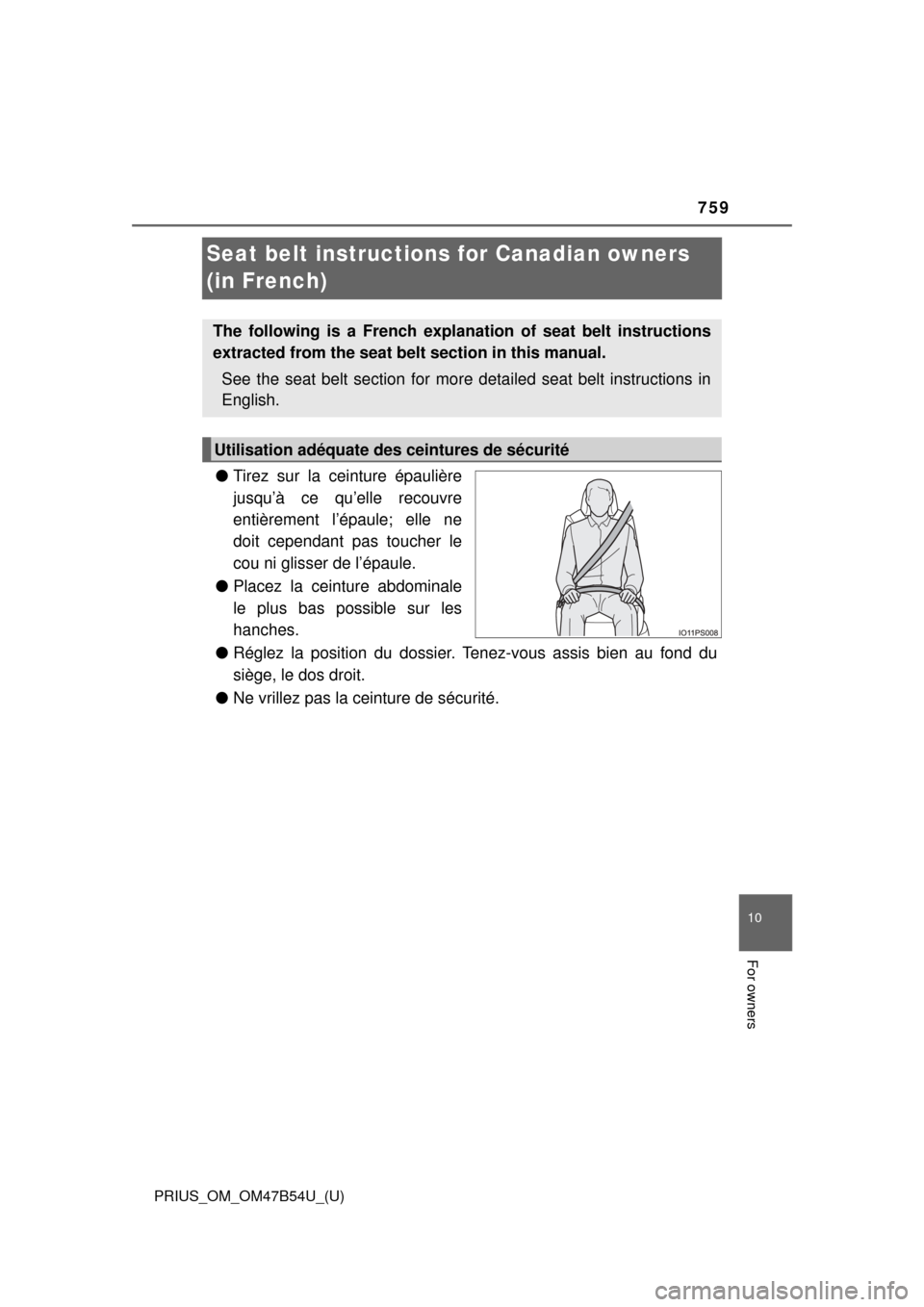
● Tirez sur la ceinture épaulière
jusqu’à ce qu’elle recouvre
entièrement l’épaule; elle ne
doit cependant pas toucher le
cou ni glisser de l’épaule.
● Placez la ceinture abdominale
le plus bas possible sur les
hanches.
● Réglez la position du dossier. Tenez-vous assis bien au fond du
siège, le dos droit.
● Ne vrillez pas la ceinture de sécurité.
The following is a French explan ation of seat belt instructions
extracted from the seat be lt section in this manual.
See the seat belt secti on for more detailed seat belt instructions in
English.
Utilisation adéquate des ceintures de sécurité
Page 760 of 796
760
PRIUS_OM_OM47B54U_(U)■
Ceintures de sécurité
Avec un chiffon ou une éponge, nettoyez à l’aide d’un savon doux
et de l’eau tiède. Vérifiez aussi les ceintures régulièrement pour
vous assurer qu’elles ne présentent
pas d’usure excessive, d’effilo-
chage ou de coupures.
Entretien et nettoyage
AVERTISSEMENT
■ Dommages et usure de la ceinture de sécurité
Vérifiez périodiquement le système de ceintures de sécurité. Vérifiez qu’il
n’y a pas de coupures, d’effilochures ni de pièces desserrées. N’utilisez pas
une ceinture de sécurité endommagée avant qu’elle ne soit remplacée. Les
ceintures de sécurité endommagées ne peuvent pas protéger les occu-
pants contre les blessures graves, voire mortelles.
Page 763 of 796
PRIUS_OM_OM47B54U_(U)
763
10
For owners
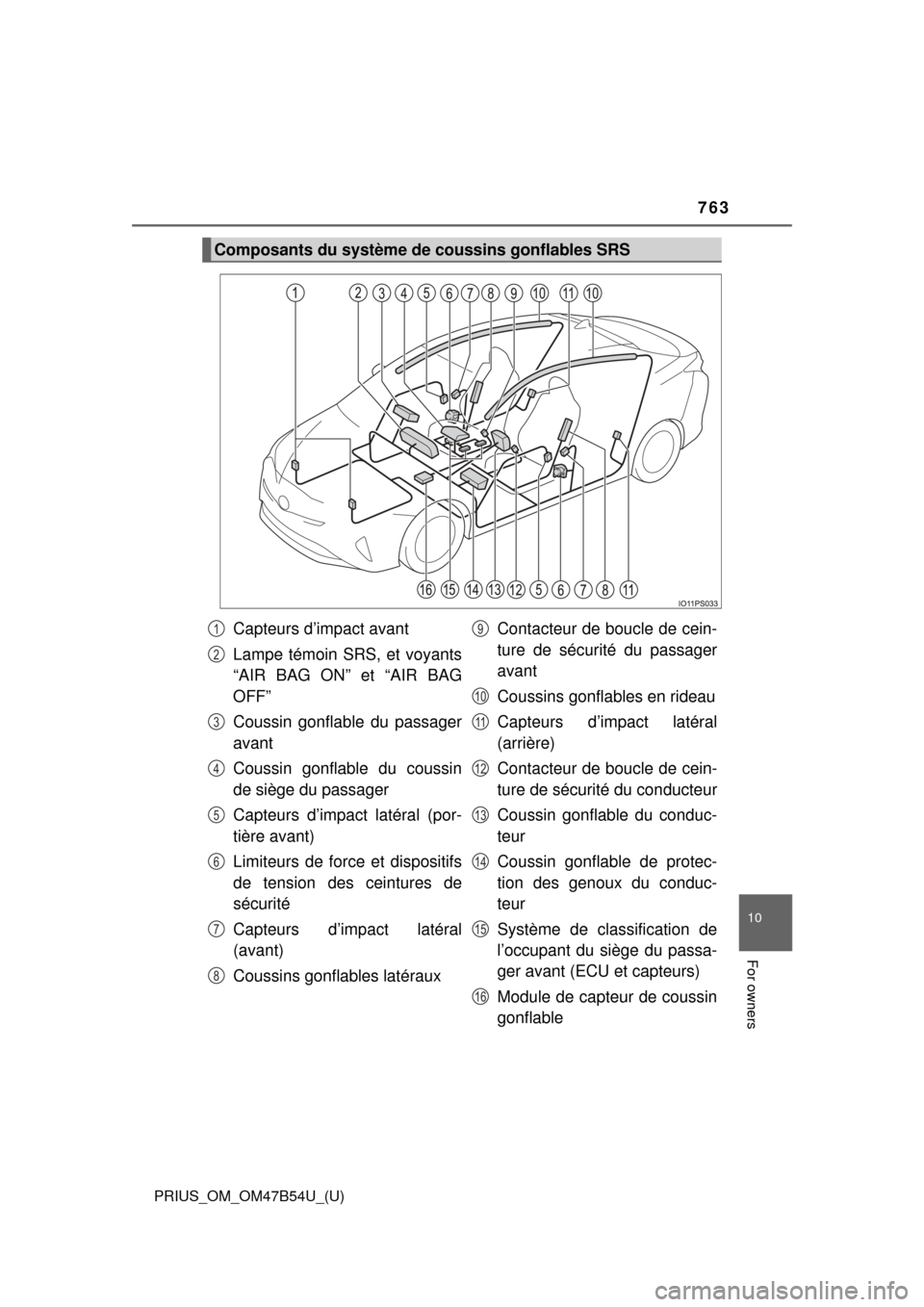
Composants du système de coussins gonflables SRS
Capteurs d’impact avant
Lampe témoin SRS, et voyants
“AIR BAG ON” et “AIR BAG
OFF”
Coussin gonflable du passager
avant
Coussin gonflable du coussin
de siège du passager
Capteurs d’impact latéral (por-
tière avant)
Limiteurs de force et dispositifs
de tension des ceintures de
sécurité
Capteurs d’impact latéral
(avant)
Coussins gonflables latérauxContacteur de boucle de cein-
ture de sécurité du passager
avant
Coussins gonflables en rideau
Capteurs d’impact latéral
(arrière)
Contacteur de boucle de cein-
ture de sécurité du conducteur
Coussin gonflable du conduc-
teur
Coussin gonflable de protec-
tion des genoux du conduc-
teur
Système de classification de
l’occupant du siège du passa-
ger avant (ECU et capteurs)
Module de capteur de coussin
gonflable1
2
3
4
5
6
7
8
9
10
11
12
13
14
15
16