2017 TOYOTA MIRAI fuel cap
[x] Cancel search: fuel capPage 263 of 464
2636-1. Using the air conditioning system and defogger
6
Interior features
MIRAI_OM_USA_OM62023U■
Fogging up of the windows
●The windows will easily fog up when the humidity in the vehicle is high.
Turning on will dehumidify the air from the outlets and defog the wind-
shield effectively.
● If you turn off, the windows may fog up more easily.
● The windows may fog up if the recirculated air mode is used.
■ Windshield fog detection function
When automatic mode is set, the humidity sensor ( →P. 266) detects fog on
the windshield and controls the air conditioning system to prevent fog.
■ Outside/recirculated air mode
●When driving on dusty roads such as tunnels or in heavy traffic, set the out-
side/recirculated air mode button to recirculated air mode. This is effective in
preventing outside air from entering the vehicle interior. During cooling oper-
ation, setting the recirculated air mode will also cool the vehicle interior
effectively.
● Outside/recirculated air mode may automatically switch depending on the
temperature setting or the inside temperature.
■ Operation of the air conditioni ng system in ECO HEAT/COOL mode
● In ECO HEAT/COOL mode, the air conditioning system is controlled as fol-
lows to prioritize fuel efficiency:
• Fluid (heating) heater and compressor operation controlled to restrict
heating/cooling capacity
• Fan speed restricted when automatic mode is selected
● To improve air conditioning performance, perform the following operations:
• Adjust the temperature settings and fan speed
• Touch while in , and is set
• Touch while in , and ECO HEAT/COOL mode is canceled
■ Operation of the air conditio ning system in Eco drive mode
When ECO MODE switch is pressed, oper ations switch over to ECO HEAT/
COOL mode. ( →P. 183)
■ When the outside temperature exceeds 75°F (24°C) and the air condition-
ing system is on
● In order to reduce the air conditioning power consumption, the air condition-
ing system may switch to recirculated air mode automatically. This may also
reduce fuel consumption.
● Recirculated air mode is selected as a default mode when the power switch
is turned to ON mode.
● It is possible to switch to outside air mode at any time by pressing .
Page 309 of 464
3097-1. Maintenance and care
MIRAI_OM_USA_OM62023U
7
Maintenance and care
NOTICE
■Cleaning the exterior lights
● Wash carefully. Do not use organic substances or scrub with a hard brush.
This may damage the surfaces of the lights.
● Do not apply wax to the surfaces of the lights.
Wax may cause damage to the lenses.
■ When washing the car
Do not remove the vehicle receptacle cap and directly pour water over the
vehicle receptacle. If water enters the vehicle receptacle, damage may
occur.
■ When using an automatic car wash
Set the wiper switch to the off position. (→P. 195)
If the wiper switch is in “AUTO” the wipers may operate and the wiper
blades may be damaged.
■ When using a high pressure car wash
● When washing the vehicle, do not let water of the high pressure washer hit
directly or the vicinity of the camera. Due to the shock from the high pres-
sure water, it is possible the device may not operate as normal.
● Do not bring the nozzle tip close to boots (rubber or resin manufactured
cover), connectors or the following parts. The parts may be damaged if
they come into contact with high-pressure water.
• Fuel cell stack
• Traction related parts
• Steering parts
• Suspension parts
• Brake parts
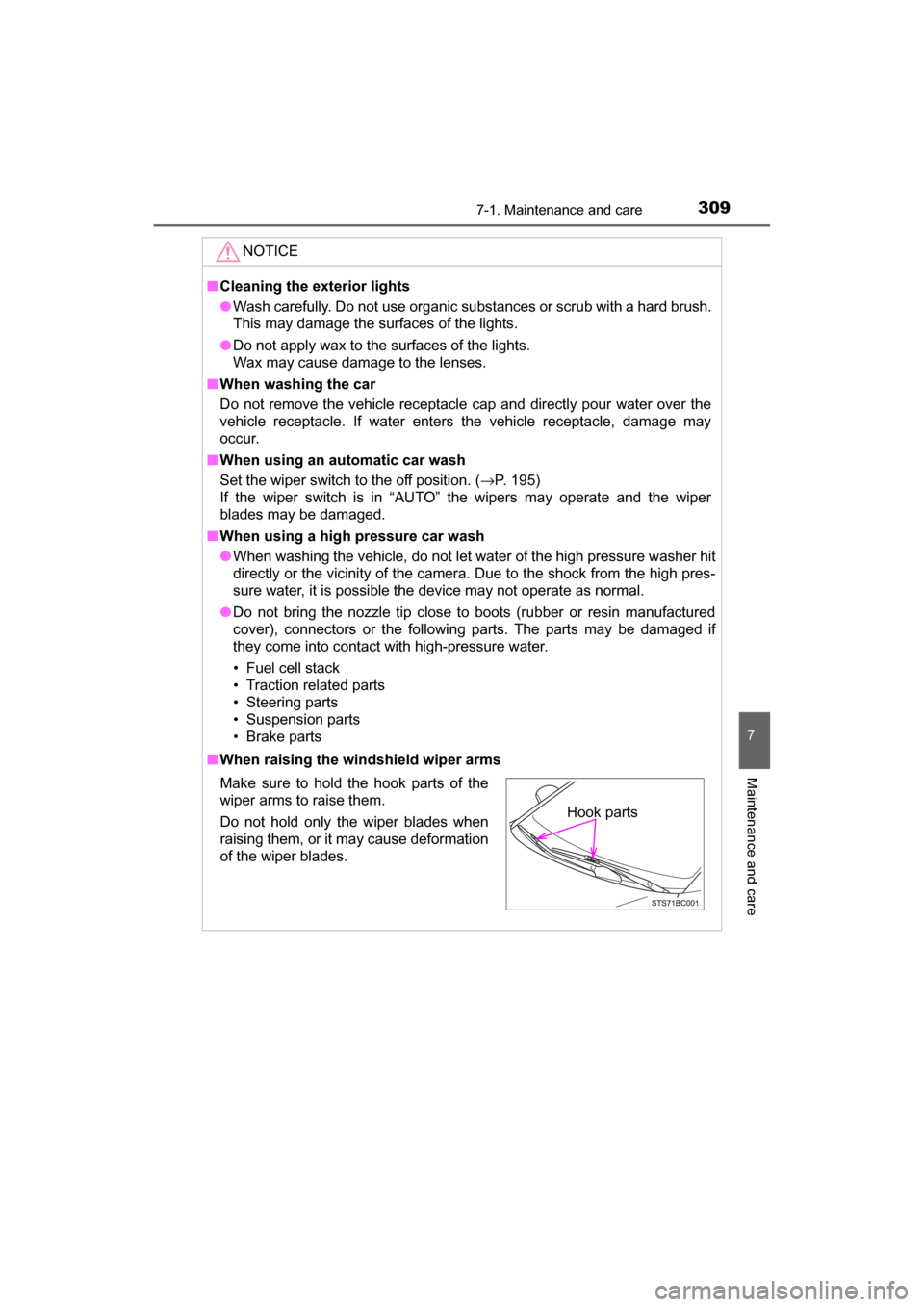
■ When raising the windshield wiper arms
Make sure to hold the hook parts of the
wiper arms to raise them.
Do not hold only the wiper blades when
raising them, or it may cause deformation
of the wiper blades.
Hook parts
Page 324 of 464
3247-3. Do-it-yourself maintenance
MIRAI_OM_USA_OM62023U
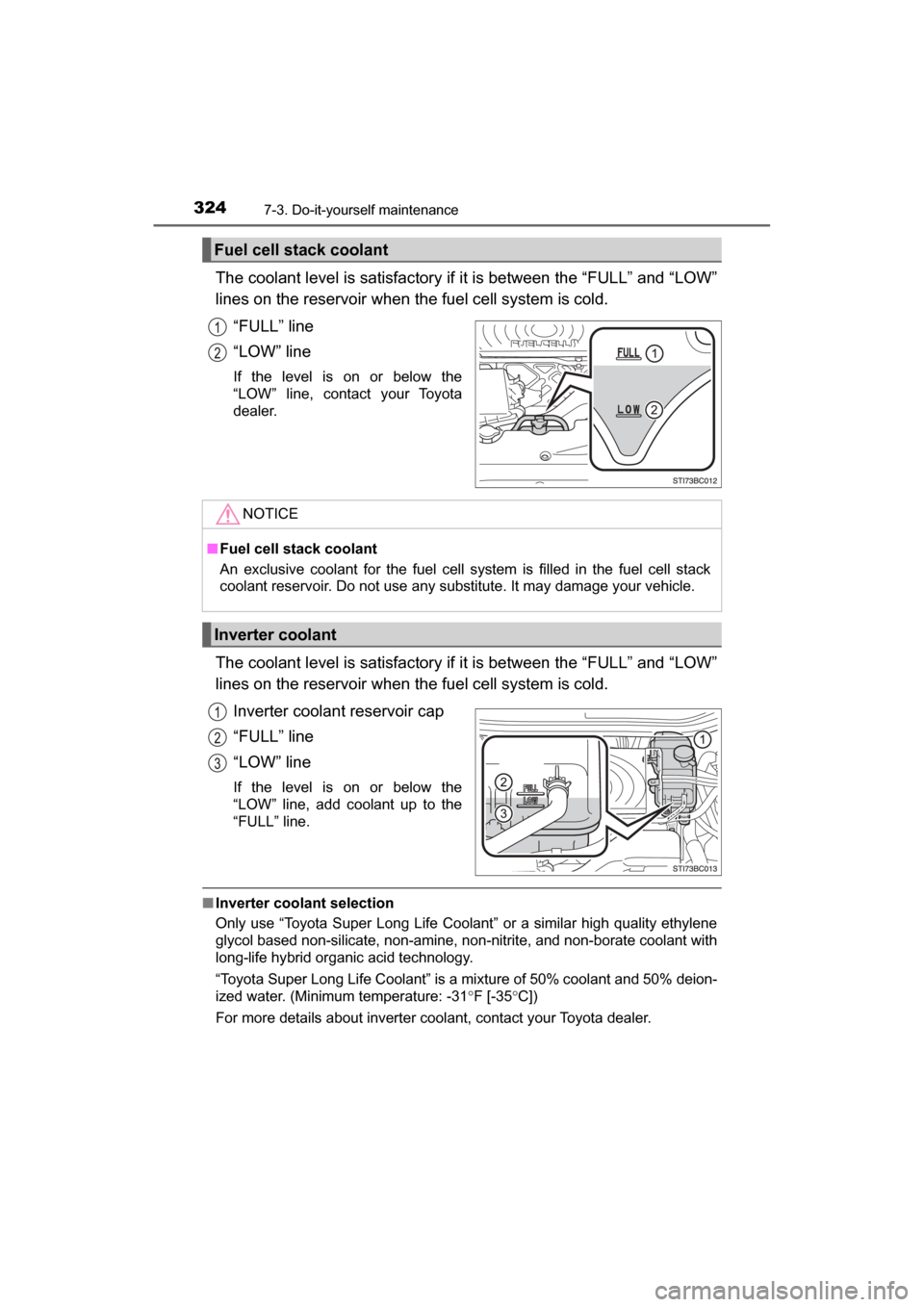
The coolant level is satisfactory if it is between the “FULL” and “LOW”
lines on the reservoir when the fuel cell system is cold.“FULL” line
“LOW” line
If the level is on or below the
“LOW” line, contact your Toyota
dealer.
The coolant level is satisfactory if it is between the “FULL” and “LOW”
lines on the reservoir when the fuel cell system is cold.Inverter coolant reservoir cap
“FULL” line
“LOW” line
If the level is on or below the
“LOW” line, add coolant up to the
“FULL” line.
■Inverter coolant selection
Only use “Toyota Super Long Life Coolant” or a similar high quality ethylene
glycol based non-silicate, non-amine, non-nitrite, and non-borate coolant with
long-life hybrid organic acid technology.
“Toyota Super Long Life Coolant” is a mixture of 50% coolant and 50% deion-
ized water. (Minimum temperature: -31 °F [-35° C])
For more details about inverter coolant, contact your Toyota dealer.
Fuel cell stack coolant
NOTICE
■ Fuel cell stack coolant
An exclusive coolant for the fuel cell system is filled in the fuel cell stack
coolant reservoir. Do not use any substitute. It may damage your vehicle.
Inverter coolant
Page 325 of 464
3257-3. Do-it-yourself maintenance
MIRAI_OM_USA_OM62023U
7
Maintenance and care
■If the inverter coolant level drops within a short time of replenishing
Visually check the radiators, hoses, inverter coolant reservoir cap, drain cock
and water pump.
If you cannot find a leak, have your Toyota dealer test the cap and check for
leaks in the cooling system.
Check the radiator and condenser and clear away any foreign objects.
If either of the above parts is ex tremely dirty or you are not sure of
their condition, have your vehicle inspected by your Toyota dealer.
WARNING
■ When the fuel cell system is hot
Do not remove the coolant reservoir caps.
The cooling system may be under pressure and may spray hot coolant if the
cap is removed, causing serious injuries, such as burns.
NOTICE
■When adding coolant
Coolant is neither plain water nor stra ight antifreeze. The correct mixture of
water and antifreeze must be used to provide proper lubrication, corrosion
protection and cooling. Be sure to read the antifreeze or coolant label.
■ If you spill coolant
Be sure to wash it off with water to prevent it from damaging parts or paint.
Radiator and condenser
WARNING
■When the fuel cell system is hot
Do not touch the radiator or condenser as they may be hot and cause seri\
-
ous injuries, such as burns.
Page 347 of 464
3477-3. Do-it-yourself maintenance
MIRAI_OM_USA_OM62023U
7
Maintenance and care
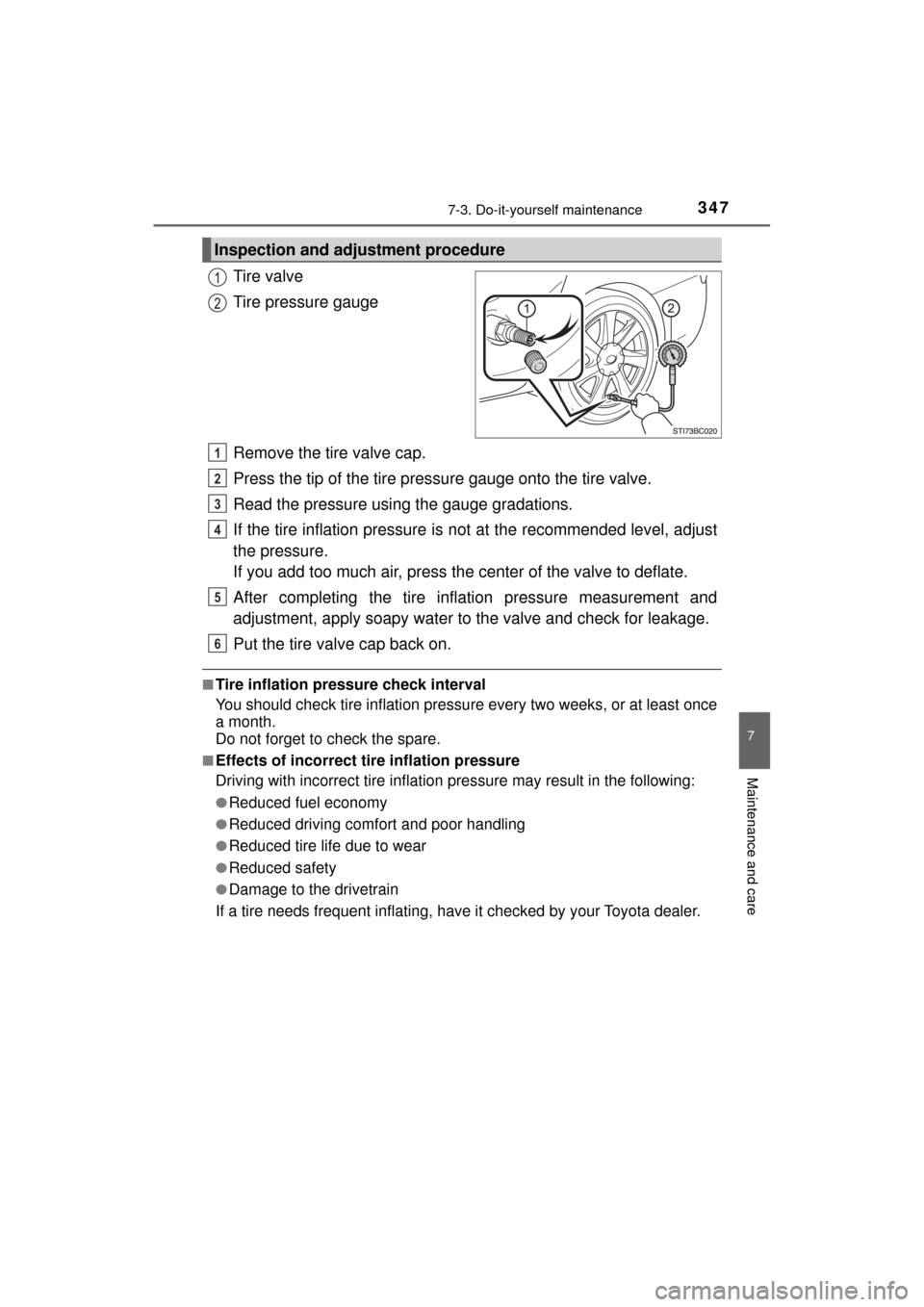
Tire valve
Tire pressure gauge
Remove the tire valve cap.
Press the tip of the tire pressure gauge onto the tire valve.
Read the pressure usi ng the gauge gradations.
If the tire inflation pressure is not at the recommended level, adjust
the pressure.
If you add too much air, press the center of the valve to deflate.
After completing the tire inflation pressure measurement and
adjustment, apply soapy water to the valve and check for leakage.
Put the tire valve cap back on.
■Tire inflation pressure check interval
You should check tire inflation pressure every two weeks, or at least once
a month.
Do not forget to check the spare.
■Effects of incorrect tire inflation pressure
Driving with incorrect tire inflation pressure may result in the following:
●Reduced fuel economy
●Reduced driving comfort and poor handling
●Reduced tire life due to wear
●Reduced safety
●Damage to the drivetrain
If a tire needs frequent inflating, have it checked by your Toyota dealer.
Inspection and adjustment procedure
1
2
3
4
5
6
Page 404 of 464
4048-2. Steps to take in an emergency
MIRAI_OM_USA_OM62023U■
When exchanging the 12-volt battery
Use a Central Degassing type 12-volt battery (Japanese Industrial Stan-
dards). Also, use 12-volt batteries with case sizes similar to one prior the
exchange and an equivalent 20 hour rate capacity (20HR) or greater.
• If the sizes differ, the 12-volt battery cannot be properly secured.
• If the 20 hour rate capacity is low, even if the time period where the vehicle
is not used is a short time, the 12-volt battery may discharge and fuel cell
system may not be able to start.
For details, consult your Toyota dealer.
WARNING
■ Avoiding 12-volt battery fires or explosions
Observe the following precautions to prevent accidentally igniting the flam-
mable gas that may be emitted from the 12-volt battery:
● Make sure each jumper cable is connected to the correct terminal and that
it is not unintentionally in contact with any other than the intended terminal.
● Do not allow the other end of the jumper cable connected to the “+” termi-
nal to come into contact with any other parts or metal surfaces in the area,
such as brackets or unpainted metal.
● Do not allow the + and - clamps of the jumper cables to come into contact
with each other.
● Do not smoke, use matches, cigarette lighters or allow open flame near
the 12-volt battery.
■ 12-volt battery precautions
The 12-volt battery contains poisonous and corrosive acidic electrolyte,
while related parts contain lead and lead compounds. Observe the following
precautions when handling the 12-volt battery:
● When working with the 12-volt battery, always wear safety glasses and
take care not to allow any 12-volt battery fluids (acid) to come into contact
with skin, clothing or the vehicle body.
● Do not lean over the 12-volt battery.
● In the event that 12-volt battery fluid comes into contact with the skin or
eyes, immediately wash the affected area with water and seek medical
attention.
Place a wet sponge or cloth over the affected area until medical attention
can be received.
● Always wash your hands after handling the 12-volt battery support, termi-
nals, and other battery-related parts.
● Do not allow children near the 12-volt battery.
Page 410 of 464

4108-2. Steps to take in an emergency
MIRAI_OM_USA_OM62023U
Start the fuel cell system and turn the air conditioning system on
to check that the radiator cooling fans operate and to check for
coolant leaks from th e radiator or hoses.
The fans operate when the air conditioning system is turned on immedi-
ately after a cold start. Confirm that the fans are operating by checking
the fan sound and air flow. If it is difficult to check these, turn the air con-
ditioning system on and off repeatedly.
(The fans may not operate in freezing temperatures.)
If the fans are not operating:
Stop the fuel cell system immedi ately and contact your Toyota
dealer.
If the fans are operating:
Have the vehicle inspected at the nearest Toyota dealer.
WARNING
■ When inspecting under the hood of your vehicle
Observe the following precautions.
Failure to do so may result in serious injury such as burns.
● If steam is seen coming from under the hood, do not open the hood until
the steam has subsided. The motor compartment may be very hot.
● After the fuel cell system has been turned off, check that the “READY”
indicator is off.
When the fuel cell system is operating, the cooling fans may suddenly
operate even if the fuel cell system stops. Do not touch or approach rotat-
ing parts such as the fans, which may lead to fingers or clothing (espe-
cially a tie, a scarf or a muffler) getting caught, resulting in serious injury.
● Do not loosen the coolant reservoir caps or radiator cap, while the fuel cell
system and radiator are hot.
High temperature steam or coolant could spray out.
6
7
Page 416 of 464
4169-1. Specifications
MIRAI_OM_USA_OM62023U
Maintenance data (fuel, fluid level, etc.)
*: Unladen vehicles
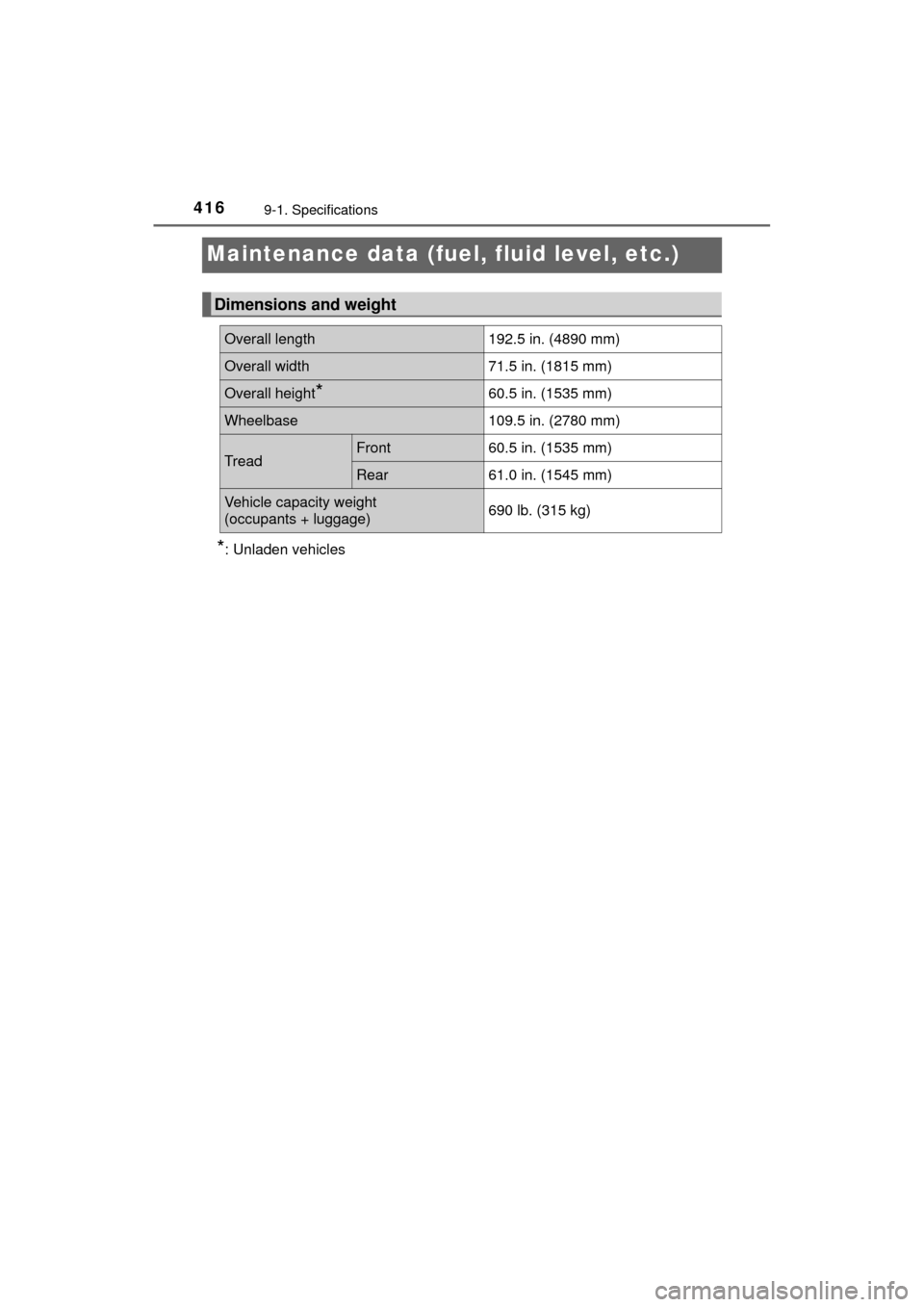
Dimensions and weight
Overall length 192.5 in. (4890 mm)
Overall width 71.5 in. (1815 mm)
Overall height*60.5 in. (1535 mm)
Wheelbase109.5 in. (2780 mm)
TreadFront60.5 in. (1535 mm)
Rear61.0 in. (1545 mm)
Vehicle capacity weight
(occupants + luggage) 690 lb. (315 kg)