Page 587 of 732

5878-2. Steps to take in an emergency
8
When trouble arises
HIGHLANDER_U (OM0E017U)■
When a tire is replaced with a spare tire
Vehicles with a compact spare tire
The compact spare tire is not equipped with a tire pressure warning valve
and transmitter. If a tire goes flat, the tire pressure warning light will not
turn off even though the flat tire ha s been replaced with the spare tire.
Replace the spare tire with the repair ed tire and adjust the tire inflation
pressure. The tire pressu re warning light will go off after a few minutes.
Vehicles with a full-size spare tire
The spare tire is also equipped with the tire pressure warning valve and
transmitter. The tire pres sure warning light will turn on if the tire inflation
pressure of the spare tire is low. If a tire goes flat, even though the flat tire
is replaced with the spare tire, the tire pressure warning light does not
turn off. Replace the spare tire with the repaired tire and adjust to the
proper tire inflatio n pressure. The tire pressure warning light will turn off
after a few minutes.
■Conditions that the tire pressure warning system may not function
properly
→ P. 5 3 7
■If the tire pressure warning light frequently comes on after blinking
for 1 minute
If the tire pressure warning light frequently comes on after blinking for 1
minute when the engine switch is turned on, have it checked by your
Toyota dealer.
■ Customization that can be co nfigured at Toyota dealer
The vehicle speed linked seat belt reminder buzzer can be disabled.
(Customizable features →P. 690) However, Toyota recommends that the seat
belt reminder buzzer be operational to alert the driver and front passenger
when seat belts are not fastened.
■ Warning buzzer
In some cases, the buzzer may not be heard because of noisy place or an
audio sound.
Page 588 of 732
5888-2. Steps to take in an emergency
HIGHLANDER_U (OM0E017U)
WARNING
■If both the ABS and the brake system warning lights remain on
Stop your vehicle in a safe place immediately and contact your Toyota
dealer. The vehicle will become extremely unstable during braking, and the
ABS system may fail, which could cause an accident resulting in death or
serious injury.
■ When the electric power steerin g system warning light comes on
The steering wheel may become extremely heavy.
When steering wheel operations are heavier than usual, grip the steering
wheel firmly and operate it using more force than usual.
■
If the tire pressure warning light comes on
Be sure to observe the following precautions. Failure to do so could
cause a loss of vehicle control and result in death or serious injury.
●Stop your vehicle in a safe place as soon as possible. Adjust the tire
inflation pressure immediately.
●If the tire pressure warning light co mes on even after tire inflation pres-
sure adjustment, it is probable that you have a flat tire. Check the tires.
If a tire is flat, change it with the spare tire and have the flat tire
repaired by the nearest Toyota dealer.
●Avoid abrupt maneuvering and braking. If the vehicle tires deteriorate,
you could lose control of the steering wheel or the brakes.
■If a blowout or sudden air leakage should occur
The tire pressure warning system may not activate immediately.
Page 589 of 732

5898-2. Steps to take in an emergency
8
When trouble arises
HIGHLANDER_U (OM0E017U)
WARNING
■Maintenance of the tires
Each tire, including the spare (if provided), should be checked monthly
when cold and inflated to the inflation pressure recommended by the
vehicle manufacturer on the vehicle placard or tire inflation pressure
label (tire and load information label). (If your vehicle has tires of a dif-
ferent size than the size indicated on the vehicle placard or tire inflation
pressure label [tire and load information label], you should determine
the proper tire inflation pressure for those tires.)
As an added safety feature, your vehicle has been equipped with a tire
pressure monitoring system (TPMS-ti re pressure warning system) that
illuminates a low tire pre ssure telltale (tire pressure warning light) when
one or more of your tires is significantly under-inflated. Accordingly,
when the low tire pressure telltale (tire pressure warning light) illumi-
nates, you should stop and check your tires as soon as possible, and
inflate them to the proper pressure. Driving on a significantly under-
inflated tire causes the tire to overheat and can lead to tire failure.
Under-inflation also reduces fuel effi ciency and tire tread life, and may
affect the vehicle’s hand ling and stopping ability.
Please note that the TPMS (tire pressure warning system) is not a sub-
stitute for proper ti re maintenance, and it is the driver’s responsibility to
maintain correct tire pressure, even if under-inflation has not reached
the level to trigger illumination of the TPMS low tire pressure telltale (tire
pressure warning light).
Your vehicle has also been equipped with a TPMS (tire pressure warn-
ing system) malfunction indicator to indicate when the system is not
operating properly. The TPMS (tire pressure warning system) malfunc-
tion indicator is combined with the lo w tire pressure telltale (tire pressure
warning light). When the system detects a malfunction, the telltale will
flash for approximately one minute and then remain continuously illumi-
nated. This sequence w ill continue upon subsequ ent vehicle start-ups
as long as the malfunction exists. When the malfunction indicator is illu-
minated, the system may not be able to detect or signal low tire pres-
sure as intended.
TPMS (tire pressure warning system) malfunctions may occur for a vari-
ety of reasons, including the installation of replacement or alternate tires
or wheels on the vehicle that prevent the TPMS (tire pressure warning
system) from functioning properly. Always check the TPMS (tire pres-
sure warning system) malfunction te lltale after replacing one or more
tires or wheels on your vehicle to ensure that the replacement or alter-
nate tires and wheels allow the TPMS (tire pressure warning system) to
continue to function properly.
Page 591 of 732
5918-2. Steps to take in an emergency
8
When trouble arises
HIGHLANDER_U (OM0E017U)
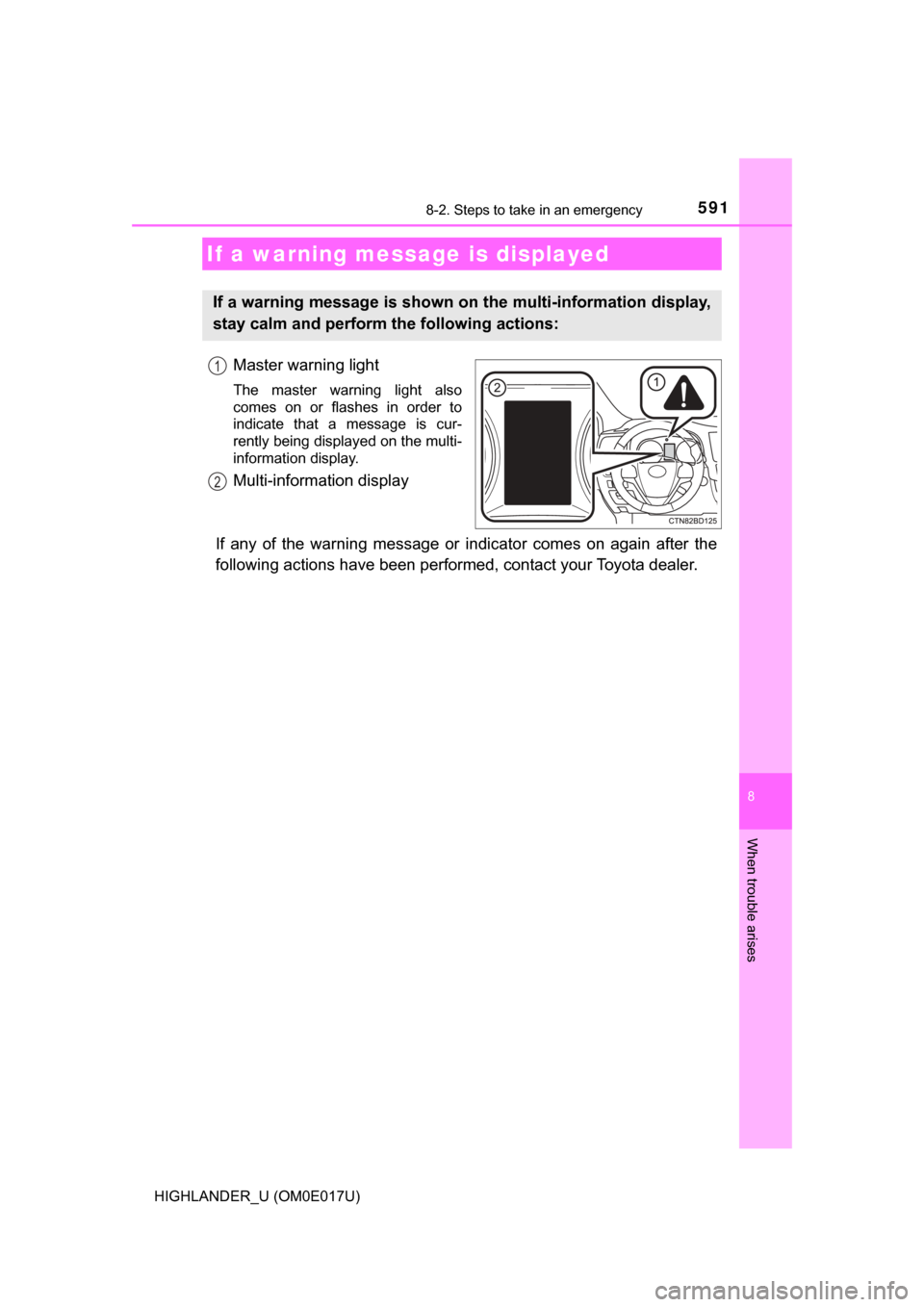
Master warning light
The master warning light also
comes on or flashes in order to
indicate that a message is cur-
rently being displayed on the multi-
information display.
Multi-information display
If any of the warning message or indicator comes on again after the
following actions have been performed, contact your Toyota dealer.
If a warning mess age is displayed
If a warning message is shown on the multi-information display,
stay calm and perform the following actions:
1
2
Page 599 of 732
5998-2. Steps to take in an emergency
8
When trouble arises
HIGHLANDER_U (OM0E017U)
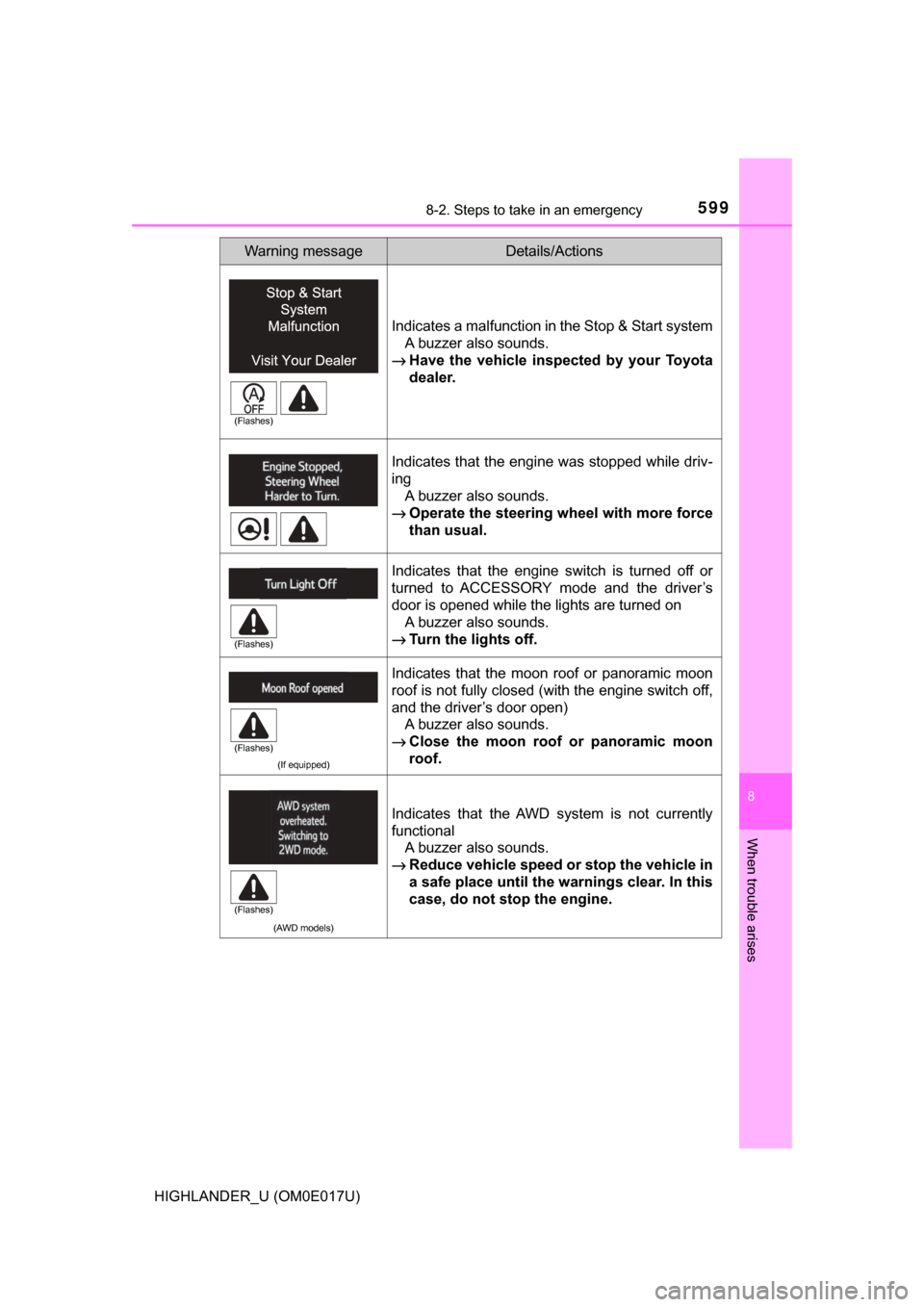
Indicates a malfunction in the Stop & Start systemA buzzer also sounds.
→ Have the vehicle inspect ed by your Toyota
dealer.
Indicates that the engine was stopped while driv-
ing A buzzer also sounds.
→ Operate the steering wheel with more force
than usual.
Indicates that the engine switch is turned off or
turned to ACCESSORY mode and the driver’s
door is opened while the lights are turned on
A buzzer also sounds.
→ Turn the lights off.
(If equipped)
Indicates that the moon roof or panoramic moon
roof is not fully closed (with the engine switch off,
and the driver’s door open)
A buzzer also sounds.
→ Close the moon roof or panoramic moon
roof.
(AWD models)
Indicates that the AWD system is not currently
functional
A buzzer also sounds.
→ Reduce vehicle speed or stop the vehicle in
a safe place until the warnings clear. In this
case, do not stop the engine.
Warning messageDetails/Actions
(Flashes)
(Flashes)
(Flashes)
(Flashes)
Page 601 of 732
6018-2. Steps to take in an emergency
8
When trouble arises
HIGHLANDER_U (OM0E017U)
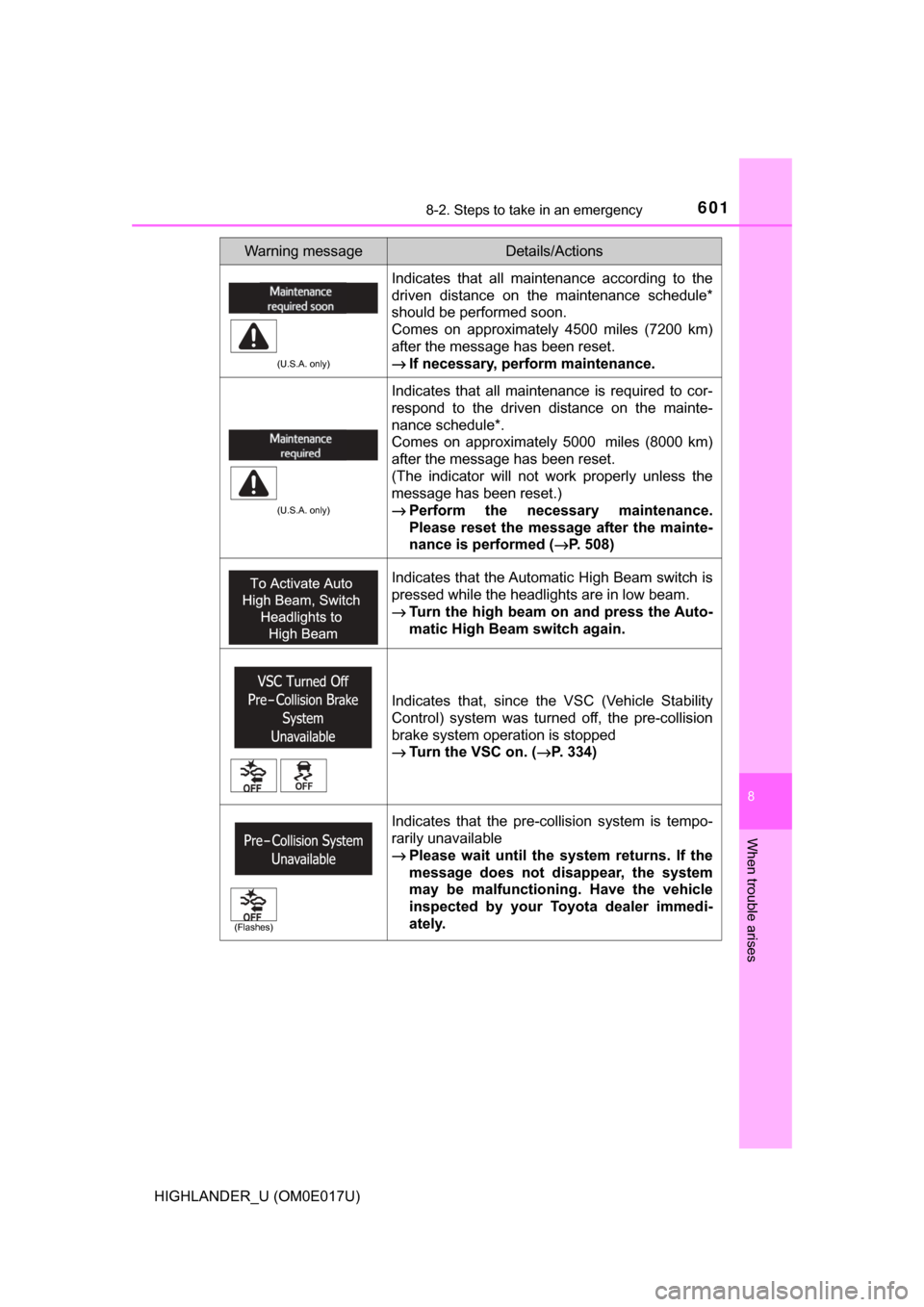
(U.S.A. only)
Indicates that all maintenance according to the
driven distance on the maintenance schedule*
should be performed soon.
Comes on approximately 4500 miles (7200 km)
after the message has been reset.
→If necessary, perform maintenance.
(U.S.A. only)
Indicates that all maintenance is required to cor-
respond to the driven distance on the mainte-
nance schedule*.
Comes on approximately 5000 miles (8000 km)
after the message has been reset.
(The indicator will not work properly unless the
message has been reset.)
→Perform the necessary maintenance.
Please reset the message after the mainte-
nance is performed ( →P. 508)
Indicates that the Automatic High Beam switch is
pressed while the headlights are in low beam.
→Turn the high beam on and press the Auto-
matic High Beam switch again.
Indicates that, since the VSC (Vehicle Stability
Control) system was turned off, the pre-collision
brake system operation is stopped
→Turn the VSC on. ( →P. 334)
Indicates that the pre-collision system is tempo-
rarily unavailable
→ Please wait until the system returns. If the
message does not disappear, the system
may be malfunctioning. Have the vehicle
inspected by your Toyota dealer immedi-
ately.
Warning messageDetails/Actions
(Flashes)
Page 603 of 732

6038-2. Steps to take in an emergency
8
When trouble arises
HIGHLANDER_U (OM0E017U)
After taking the specified steps to correct the suspected problem,
check that the warning message and light go off.
Have the malfunction repaired immediately. (vehicles with a
smart key system)
Interior buzzerExterior buzzerWarning messageDetails/Actions
Con-
tinu-
ous ⎯ The driver’s door was opened
when the shift lever was not in
P and the engine switch was
not turned off.
→
Shift the shift lever to P.
Con-
tinu-
ousContin-
uous
The driver’s door was opened
and closed while the electronic
key was not in the vehicle, the
shift lever was not in P and the
engine switch was not turned
off.
→Shift the shift lever to P.
→ Bring the electronic key
back into the vehicle.
OnceContin-
uous
An attempt was made to exit
the vehicle with the electronic
key and lock the doors without
first turning the engine switch
off when the shift lever was in P.
→Turn the engine switch off
and lock the doors again.
(Flashes)
(Displayed alternately)
(Flashes)
(Displayed alternately)
(Flashes)
Page 618 of 732
6188-2. Steps to take in an emergency
HIGHLANDER_U (OM0E017U)
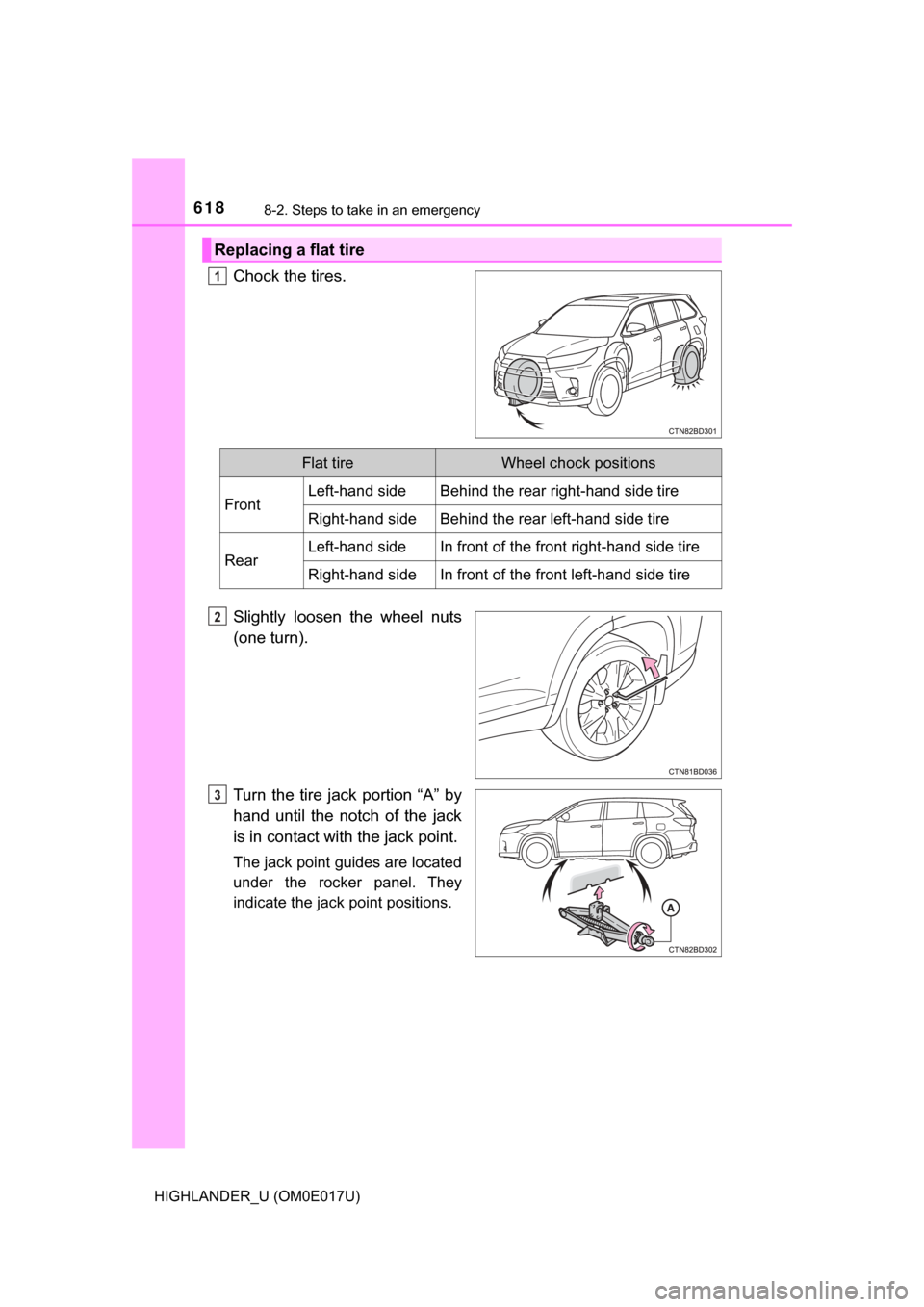
Chock the tires.
Slightly loosen the wheel nuts
(one turn).
Turn the tire jack portion “A” by
hand until the notch of the jack
is in contact with the jack point.
The jack point guides are located
under the rocker panel. They
indicate the jack point positions.
Replacing a flat tire
1
Flat tireWheel chock positions
FrontLeft-hand sideBehind the rear right-hand side tire
Right-hand sideBehind the rear left-hand side tire
RearLeft-hand sideIn front of the front right-hand side tire
Right-hand sideIn front of the front left-hand side tire
2
3