Page 621 of 732

6218-2. Steps to take in an emergency
8
When trouble arises
HIGHLANDER_U (OM0E017U)
WARNING
■Replacing a flat tire
●Do not touch the disc wheels or the area around the brakes immedi-
ately after the vehicle has been driven.
After the vehicle has been driven the disc wheels and the area around
the brakes will be extremely hot. To uching these areas with hands, feet
or other body parts while changing a tire, etc. may result in burns.
●Failure to follow these precautions could cause the wheel nuts to
loosen and the tire to fall off, resulting in death or serious injury.
• Have the wheel nuts tightened wit h a torque wrench to 76 ft•lbf (103
N•m, 10.5 kgf•m) as soon as possible after changing wheels.
• Do not attach a heavily damaged wheel ornament, as it may fly off the wheel while the vehicle is moving.
• When installing a tire, only use w heel nuts that have been specifi-
cally designed for that wheel.
• If there are any cracks or deforma tions in the bolt screws, nut
threads or bolt holes of the wheel, have the vehicle inspected by
your Toyota dealer.
• When installing the wheel nuts, be sure to install them with the
tapered ends facing inward. ( →P. 546)
●Observe the following precautions.
Failure to do so may re sult in serious injury:
• Do not try to remove the wheel ornament by hand. Take due care in handling the ornament to avoid unexpected personal injury.
• Lower the spare tire completely to the ground before removing it from under the vehicle.
Page 629 of 732

6298-2. Steps to take in an emergency
8
When trouble arises
HIGHLANDER_U (OM0E017U)■
If you have a flat front tire on a road covered with snow or ice (vehi-
cles with a compact spare tire)
Install the compact spare tire on one of the rear wheels of the vehicle.
Perform the following steps and fit
tire chains to the front tires:
Replace a rear tire with the compact spare tire.
Replace the flat front tire with the tire removed from the rear of the vehi-
cle.
Fit tire chains to the front tires.
WARNING
■When using the compact spare tire (vehicles with a compact spare
tire)
●Remember that the compact spare tire provided is specifically
designed for use with your vehicle. Do not use your compact spare tire
on another vehicle.
●Do not use more than one compact spare tires simultaneously.
●Replace the compact spare tire with a standard tire as soon as possi-
ble.
●Avoid sudden acceleration, abrupt steering, sudden braking and shift-
ing operations that cause sudden engine braking.
■When the compact spare tire is attached (vehicles with a compact
spare tire)
The vehicle speed may not be correctly detected, and the following sys-
tems may not operate correctly:
Also, not only can the following system not be utilized fully, but it may
even negatively affect the drive-train components:
• AWD system (if equipped)
1
2
3
• ABS & Brake assist
• VSC
•TRAC
• Dynamic radar cruise control
• Pre-Collision System
• EPS • Automatic High Beam
• LDA (Lane Departure Alert with
steering control)
• Intuitive parking assist (if equipped)
• Navigation system (if equipped)
Page 634 of 732
6348-2. Steps to take in an emergency
HIGHLANDER_U (OM0E017U)
One of the following may be the cause of the problem:
●One or both of the battery terminals may be disconnected.
● The battery may be discharged. ( →P. 638)
● There may be a malfunction in the steering lock system.
Contact your Toyota dealer if the problem cannot be repaired, or if repair
procedures are unknown.
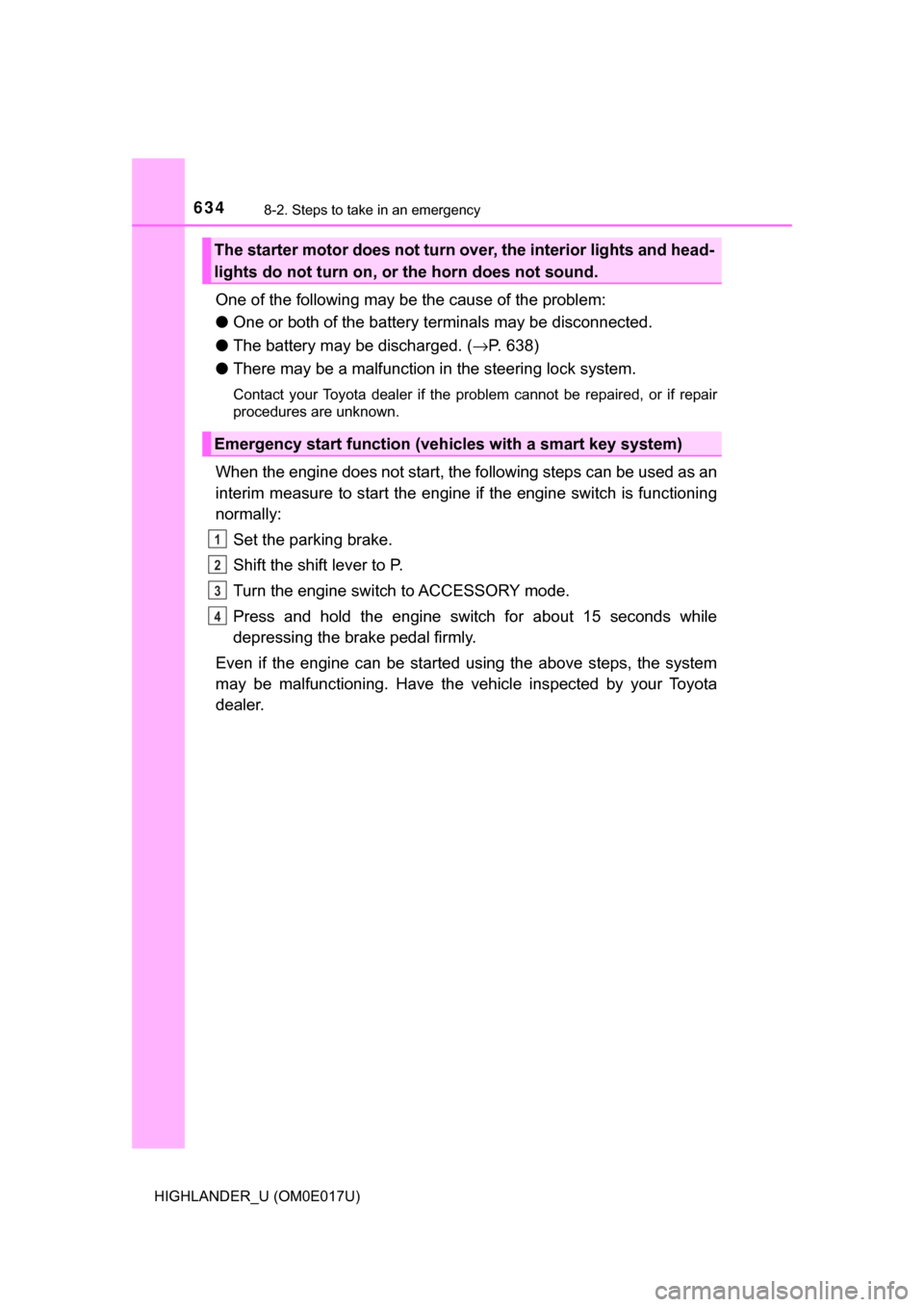
When the engine does not start, the following steps can be used as an
interim measure to start the engine if the engine switch is functioning
normally:
Set the parking brake.
Shift the shift lever to P.
Turn the engine switch to ACCESSORY mode.
Press and hold the engine switch for about 15 seconds while
depressing the brake pedal firmly.
Even if the engine can be started using the above steps, the system
may be malfunctioning. Have the ve hicle inspected by your Toyota
dealer.
The starter motor does not turn over, the interior lights and head-
lights do not turn on, or the horn does not sound.
Emergency start function (vehicles with a smart key system)
1
2
3
4
Page 636 of 732
6368-2. Steps to take in an emergency
HIGHLANDER_U (OM0E017U)
Ensure that the shift lever is in P and depress the brake pedal.
Touch the Toyota emblem side
of the electronic key to the
engine switch.
When the electronic key is
detected, a buzzer sounds and the
engine switch will turn to IGNITION
ON mode.
When the smart key system is
deactivated in customization set-
ting, the engine switch will turn to
ACCESSORY mode.
Firmly depress the brake pedal.
Check that and a message are shown on the multi-information dis-
play.
Press the engine switch.
In the event that the engine still ca nnot be started, contact your Toyota
dealer.
Starting the engine
1
2
3
4
Page 637 of 732

6378-2. Steps to take in an emergency
8
When trouble arises
HIGHLANDER_U (OM0E017U)
■Stopping the engine
Shift the shift lever to P and press the engine switch as you normally do when
stopping the engine.
■ Replacing the key battery
As the above procedure is a temporary measure, it is recommended that the
electronic key battery be replaced immediately when the battery is depleted.
(→P. 549)
■ Changing engine switch modes
Release the brake pedal and press the engine switch in step above.
The engine does not start and modes will be changed each time the switch is
pressed. ( →P. 222)
■ When the electronic key does not work properly
●Make sure that the smart key system has not been deactivated in the cus-
tomization setting. If it is off, turn the function on.
(Customizable features →P. 680)
● Check if battery-saving mode is set. If it is set, cancel the function.
(→P. 143)
WARNING
■ When using the mechanical key an d operating the power windows or
moon roof
Operate the power window or moon roof after checking to make sure that
there is no possibility of any passenger having any of their body parts
caught in the window or moon roof.
Also, do not allow children to operate the mechanical key. It is possible for
children and other passengers to get caught in the power window or moon
roof.
3
Page 647 of 732
6478-2. Steps to take in an emergency
8
When trouble arises
HIGHLANDER_U (OM0E017U)
Stop the engine. Set the parking brake and shift the shift lever to P.
Remove the mud, snow or sand from around the front wheels.
Place wood, stones or some other material under the front wheels
to help provide traction.
Restart the engine.
AWD models: Activate all-wheel drive lock mode. ( →P. 330)
Shift the shift lever to D or R and release the parking brake. Then,
while exercising caution, depress the accelerator pedal.
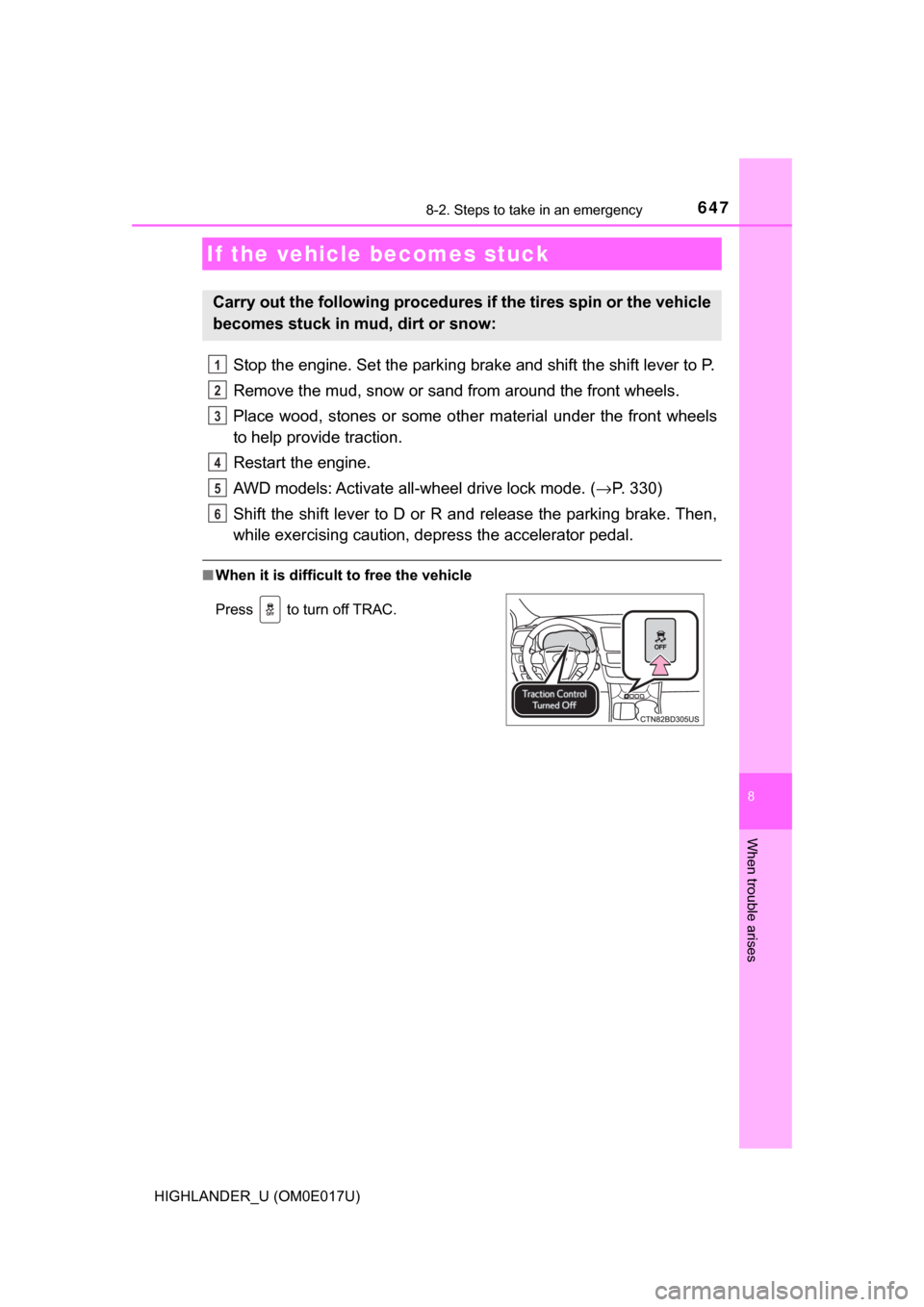
■ When it is difficult to free the vehicle
If the vehicle becomes stuck
Carry out the following procedures if the tires spin or the vehicle
becomes stuck in mud, dirt or snow:
Press to turn off TRAC.
1
2
3
4
5
6
Page 659 of 732
6599-1. Specifications
9
Vehicle specifications
HIGHLANDER_U (OM0E017U)
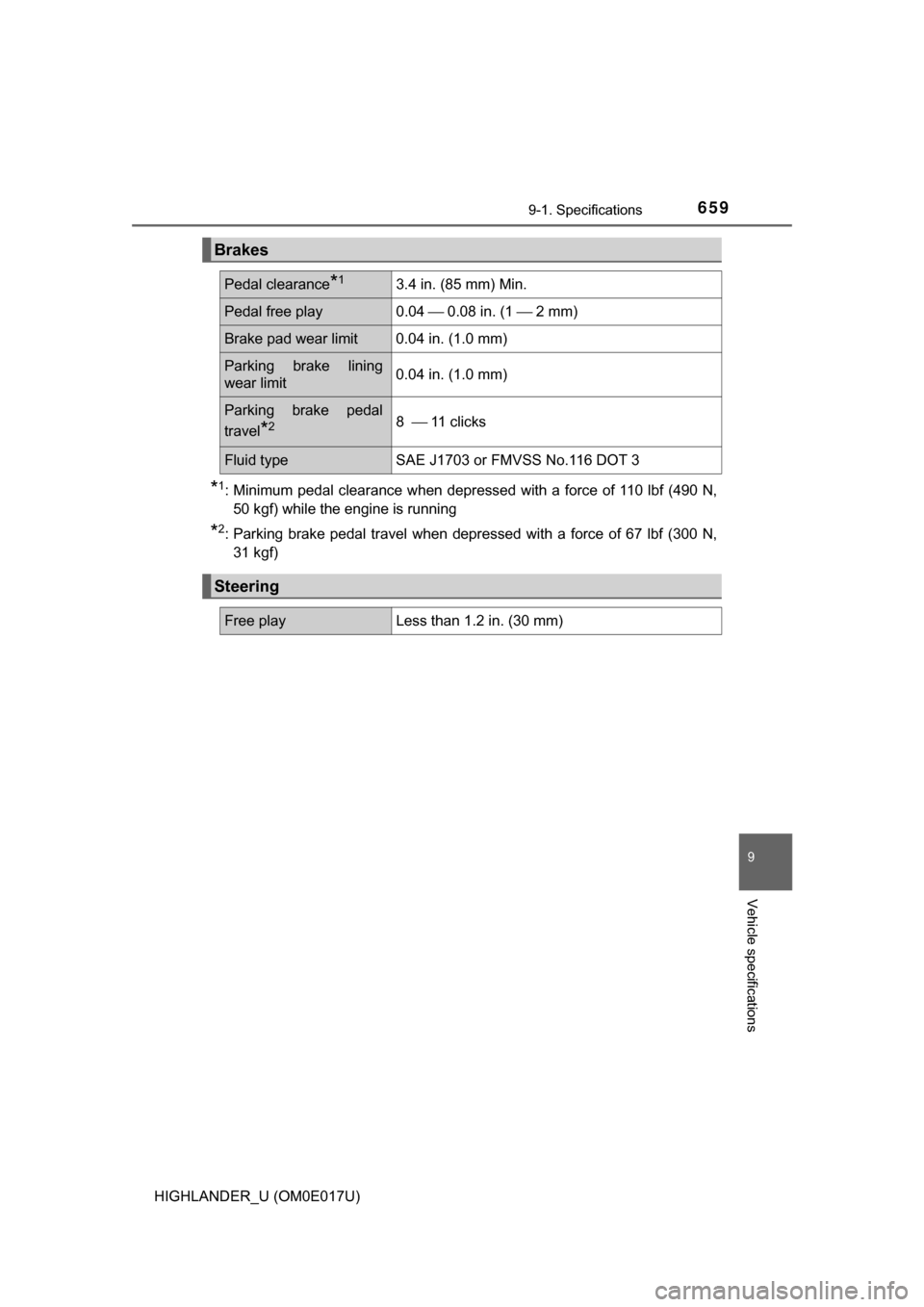
*1: Minimum pedal clearance when depressed with a force of 110 lbf (490 N,50 kgf) while the engine is running
*2: Parking brake pedal travel when depre ssed with a force of 67 lbf (300 N,
31 kgf)
Brakes
Pedal clearance*13.4 in. (85 mm) Min.
Pedal free play 0.04 ⎯ 0.08 in. (1 ⎯ 2 mm)
Brake pad wear limit 0.04 in. (1.0 mm)
Parking brake lining
wear limit 0.04 in. (1.0 mm)
Parking brake pedal
travel
*28 ⎯
11 clicks
Fluid type SAE J1703 or FMVSS No.116 DOT 3
Steering
Free playLess than 1.2 in. (30 mm)
Page 674 of 732
6749-1. Specifications
HIGHLANDER_U (OM0E017U)
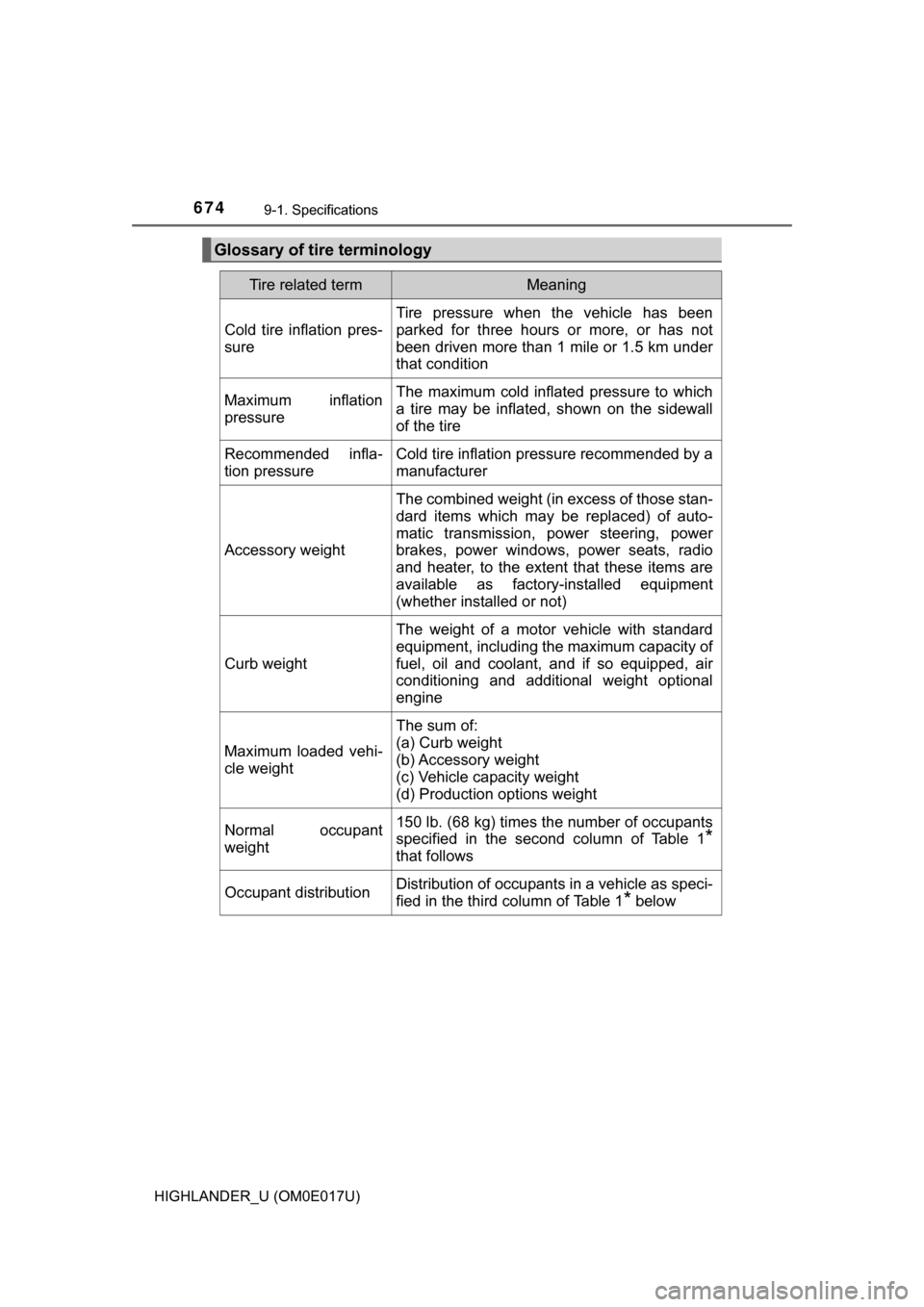
Glossary of tire terminology
Tire related termMeaning
Cold tire inflation pres-
sure
Tire pressure when the vehicle has been
parked for three hours or more, or has not
been driven more than 1 mile or 1.5 km under
that condition
Maximum inflation
pressureThe maximum cold inflated pressure to which
a tire may be inflated, shown on the sidewall
of the tire
Recommended infla-
tion pressureCold tire inflation pressure recommended by a
manufacturer
Accessory weight
The combined weight (in excess of those stan-
dard items which may be replaced) of auto-
matic transmission, power steering, power
brakes, power windows, power seats, radio
and heater, to the extent that these items are
available as factory-installed equipment
(whether installed or not)
Curb weight
The weight of a motor vehicle with standard
equipment, including the maximum capacity of
fuel, oil and coolant, and if so equipped, air
conditioning and additional weight optional
engine
Maximum loaded vehi-
cle weight
The sum of:
(a) Curb weight
(b) Accessory weight
(c) Vehicle capacity weight
(d) Production options weight
Normal occupant
weight150 lb. (68 kg) times the number of occupants
specified in the second column of Table 1
*
that follows
Occupant distributionDistribution of occupants in a vehicle as speci-
fied in the third column of Table 1
* below