2017 TOYOTA COROLLA tires
[x] Cancel search: tiresPage 6 of 612

TABLE OF CONTENTS6
COROLLA_TMMMS_TMMC_U (OM02494U)7-1. Maintenance and care
Cleaning and protecting
the vehicle exterior .......... 412
Cleaning and protecting
the vehicle interior ........... 415
7-2. Maintenance
Maintenance
requirements ................... 418
General maintenance ........ 421
Emission inspection and
maintenance (I/M)
programs ......................... 425
7-3. Do-it-yourself
maintenance
Do-it-yourself service
precautions ..................... 426
Hood.................................. 429
Positioning a floor jack ...... 431
Engine compartment ......... 433
Tires .................................. 444
Tire inflation pressure........ 452
Wheels .............................. 455
Air conditioning filter .......... 457
Wireless remote control/
electronic key
battery ............................. 459
Checking and replacing
fuses ............................... 462
Light bulbs ......................... 4658-1. Essential information
Emergency flashers ........... 474
If your vehicle has to be
stopped in an
emergency....................... 475
8-2. Steps to take in an
emergency
If your vehicle needs
to be towed ...................... 477
If you think something is
wrong............................... 482
Fuel pump shut off
system ............................. 483
If a warning light turns
on or a warning buzzer
sounds ............................. 484
If a warning message or
indicator is displayed ....... 493
If you have a flat tire .......... 513
If the engine will not
start ................................. 525
If the electronic key does
not operate properly ........ 527
If the vehicle battery is
discharged ....................... 530
If your vehicle
overheats......................... 535
If the vehicle becomes
stuck ................................ 539
7Maintenance and care8When trouble arises
Page 15 of 612

15Pictorial index
COROLLA_TMMMS_TMMC_U (OM02494U)Windshield wipers . . . . . . . . . . . . . . . . . . . . . . . . . . . . . . . . . P. 204
Precautions against winter season . . . . . . . . . . . . . . . . . . . . . P. 268
To prevent freezing (windshield wiper de-icer)
* . . . . . . . . . . . P. 380
Fuel filler door . . . . . . . . . . . . . . . . . . . . . . . . . . . . . . . . . . . . P. 206
Refueling method . . . . . . . . . . . . . . . . . . . . . . . . . . . . . . . . . . . P. 206
Fuel type/fuel tank capacity . . . . . . . . . . . . . . . . . . . . . . . . . . . P. 544
Tires . . . . . . . . . . . . . . . . . . . . . . . . . . . . . . . . . . . . . . . . . . P. 444
Tire size/inflation pressure . . . . . . . . . . . . . . . . . . . . . . . . . P. 550
Winter tires/tire chain . . . . . . . . . . . . . . . . . . . . . . . . . . . . . P. 268
Checking/rotation/tire pressure warning system
*. . . . . . . . P. 444
Coping with flat tires . . . . . . . . . . . . . . . . . . . . . . . . . . . . . . P. 513
Hood . . . . . . . . . . . . . . . . . . . . . . . . . . . . . . . . . . . . . . . . . . . . P. 429
Opening . . . . . . . . . . . . . . . . . . . . . . . . . . . . . . . . . . . . . . . . . . P. 429
Engine oil . . . . . . . . . . . . . . . . . . . . . . . . . . . . . . . . . . . . . . . . . P. 544
Coping with overheat . . . . . . . . . . . . . . . . . . . . . . . . . . . . . . . . P. 535
Headlights/daytime running lights
*. . . . . . . . . . . . . . . . . . . P. 195
Front turn signal/parking lights . . . . . . . . . . . . . . . . . . . . . . P. 195
Daytime running lights
* . . . . . . . . . . . . . . . . . . . . . . . . . . . . P. 195
Front side marker lights . . . . . . . . . . . . . . . . . . . . . . . . . . . . P. 195
Turn signal lights
*. . . . . . . . . . . . . . . . . . . . . . . . . . . . . . . . . P. 193
Stop/tail lights/rear side marker lights . . . . . . . . . . . . . . . . P. 195
Back-up lights
Shifting the shift lever to R . . . . . . . . . . . . . . . . . . . . P. 183, 186, 191
License plate lights . . . . . . . . . . . . . . . . . . . . . . . . . . . . . . . . P. 195
4
5
6
7
Light bulbs of the exterior lights for driving
(Replacing method: P. 465, Watts: P. 551)
*: If equipped
8
9
10
11
12
13
14
15
Page 157 of 612

1574-1. Before driving
4
Driving
COROLLA_TMMMS_TMMC_U (OM02494U)
■When starting off on an uphill
The hill-start assist control will activate. (→P. 262)
■Driving in the rain
●Drive carefully when it is raining, because visibility will be reduced, the win-
dows may become fogged-up, and the road will be slippery.
●Drive carefully when it starts to rain, because the road surface will be espe-
cially slippery.
●Refrain from high speeds when driving on an expressway in the rain,
because there may be a layer of water between the tires and the road sur-
face, preventing the steering and brakes from operating properly.
■Engine speed while driving (vehicles with a continuously variable trans-
mission)
In the following conditions, the engine speed may become high while driving.
This is due to automatic up-shifting control or down-shifting implementation to
meet driving conditions. It does not indicate sudden acceleration.
●The vehicle is judged to be driving uphill or downhill
●When the accelerator pedal is released
●When the brake pedal is depressed while sport mode is selected (if
equipped)
●When the brake pedal is depressed suddenly and vehicle speed is reduced
sharply
■Breaking in your new Toyota
To extend the life of the vehicle, observing the following precautions is recom-
mended:
●For the first 186 miles (300 km):
Avoid sudden stops.
●For the first 621 miles (1000 km):
• Do not drive at extremely high speeds.
• Avoid sudden acceleration.
• Do not drive continuously in low gears.
• Do not drive at a constant speed for extended periods.
■Operating your vehicle in a foreign country
Comply with the relevant vehicle registration laws and confirm the availability
of the correct fuel. (→P. 544)
WARNING
Observe the following precautions.
Failure to do so may result in death or serious injury.
■When starting the vehicle (vehicles with a continuously variable trans-
mission)
Always keep your foot on the brake pedal while stopped with the engine
running. This prevents the vehicle from creeping.
Page 158 of 612

1584-1. Before driving
COROLLA_TMMMS_TMMC_U (OM02494U)
WARNING
Observe the following precautions.
Failure to do so may result in death or serious injury.
■When driving the vehicle
●Do not drive if you are unfamiliar with the location of the brake and accel-
erator pedals to avoid depressing the wrong pedal.
• Accidentally depressing the accelerator pedal instead of the brake
pedal will result in sudden acceleration that may lead to an accident.
• When backing up, you may twist your body around, leading to a diffi-
culty in operating the pedals. Make sure to operate the pedals properly.
• Make sure to keep a correct driving posture even when moving the
vehicle only slightly. This allows you to depress the brake and accelera-
tor pedals properly.
• Depress the brake pedal using your right foot. Depressing the brake
pedal using your left foot may delay response in an emergency, result-
ing in an accident.
●Do not drive the vehicle over or stop the vehicle near flammable materials.
The exhaust system and exhaust gases can be extremely hot. These hot
parts may cause a fire if there is any flammable material nearby.
●During normal driving, do not turn off the engine. Turning the engine off
while driving will not cause loss of steering or braking control, but the
power assist to these systems will be lost. This will make it more difficult to
steer and brake, so you should pull over and stop the vehicle as soon as it
is safe to do so.
However, in the event of an emergency, such as if it becomes impossible
to stop the vehicle in the normal way: →P. 475
●Use engine braking (downshift) to maintain a safe speed when driving
down a steep hill.
Using the brakes continuously may cause the brakes to overheat and lose
effectiveness. (→P. 183, 186, 191)
●Do not adjust the display, the positions of the steering wheel, the seat, or
the inside or outside rear view mirrors while driving.
Doing so may result in a loss of vehicle control.
●Always check that all passengers’ arms, heads or other parts of their body
are not outside the vehicle.
●Do not drive in excess of the speed limit. Even if the legal speed limit per-
mits it, do not drive over 85 mph (140 km/h) unless your vehicle has high-
speed capability tires. Driving over 85 mph (140 km/h) may result in tire
failure, loss of control and possible injury. Be sure to consult a tire dealer
to determine whether the tires on your vehicle are high-speed capability
tires or not before driving at such speeds.
Page 168 of 612

1684-1. Before driving
COROLLA_TMMMS_TMMC_U (OM02494U)
◆Total load capacity (vehicle capacity weight): (→P. 542)
Total load capacity means the combined weight of occupants, cargo
and luggage.
◆Seating capacity: 5 occupants (Front 2, Rear 3)
Seating capacity means the maximum number of occupants whose
estimated average weight is 150 lb. (68 kg) per person.
◆Towing capacity
Toyota does not recommend towing a trailer with your vehicle.
◆Cargo capacity
Cargo capacity may increase or decrease depending on the weight
and the number of occupants.
■Total load capacity and seating capacity
These details are also described on the tire and loading information label.
(→P. 452)
Vehicle load limits
Vehicle load limits include total load capacity, seating capacity,
towing capacity and cargo capacity.
WARNING
■Overloading the vehicle
Do not overload the vehicle.
It may not only cause damage to the tires, but also degrade steering
and braking ability, resulting in an accident.
Page 192 of 612
1924-2. Driving procedures
COROLLA_TMMMS_TMMC_U (OM02494U)
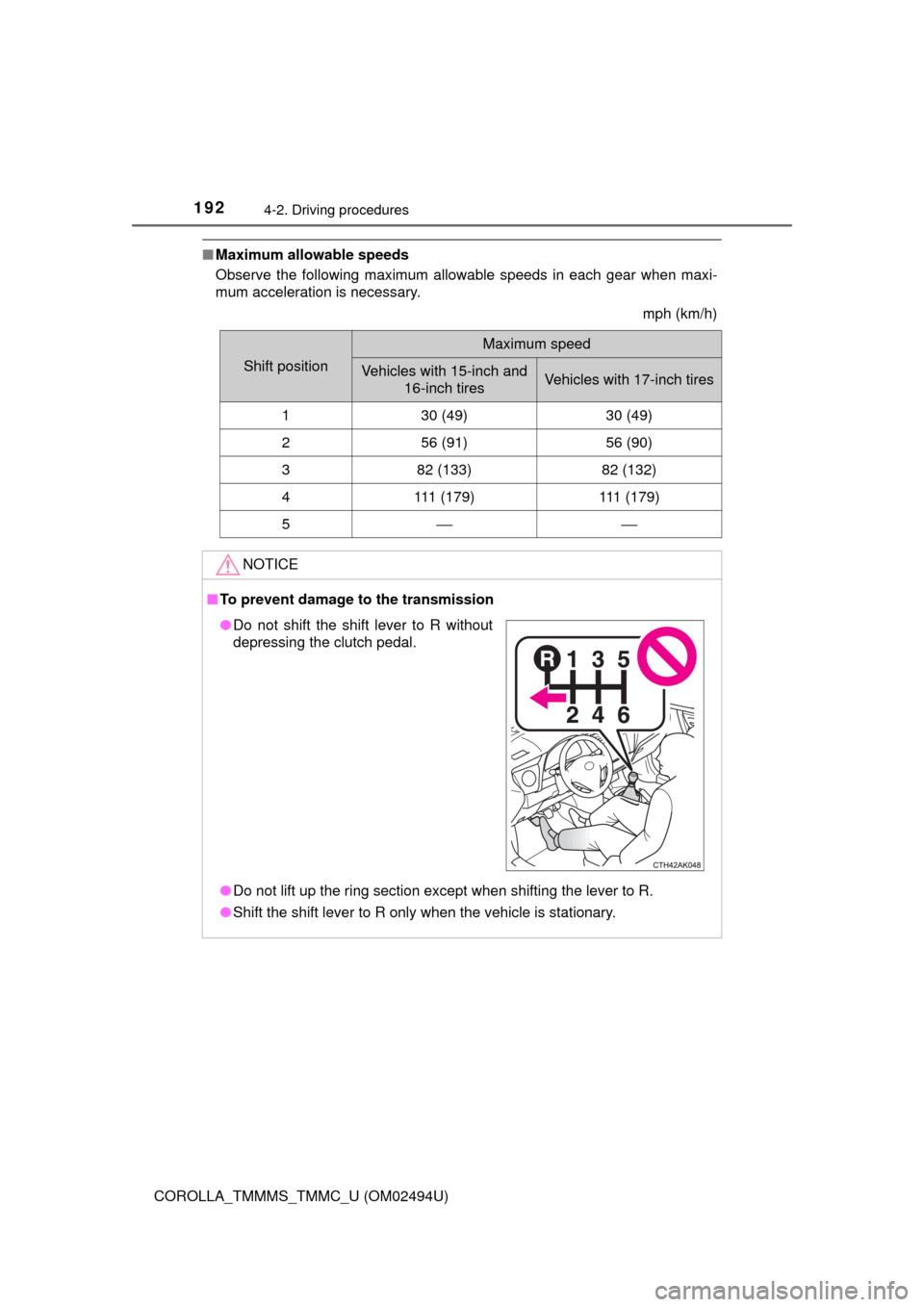
■Maximum allowable speeds
Observe the following maximum allowable speeds in each gear when maxi-
mum acceleration is necessary.
mph (km/h)
Shift position
Maximum speed
Vehicles with 15-inch and
16-inch tiresVehicles with 17-inch tires
130 (49)30 (49)
256 (91)56 (90)
382 (133)82 (132)
4111 (179)111 ( 1 7 9 )
5⎯⎯
NOTICE
■To prevent damage to the transmission
●Do not lift up the ring section except when shifting the lever to R.
●Shift the shift lever to R only when the vehicle is stationary.
●Do not shift the shift lever to R without
depressing the clutch pedal.
Page 219 of 612

2194-5. Using the driving support systems
4
Driving
COROLLA_TMMMS_TMMC_U (OM02494U)
WARNING
■When to disable the pre-collision system
In the following situations, disable the system, as it may not operate prop-
erly, possibly leading to an accident resulting in death or serious injury:
●When the vehicle is being towed
●When your vehicle is towing another vehicle
●When transporting the vehicle via truck, boat, train or similar means of
transportation
●When the vehicle is raised on a lift with the engine running and the tires
are allowed to rotate freely
●When inspecting the vehicle using a drum tester such as a chassis dyna-
mometer or speedometer tester, or when using an on vehicle wheel bal-
ancer
●When a strong impact is applied to the front bumper or front grille, due to
an accident or other reasons
●If the vehicle cannot be driven in a stable manner, such as when the vehi-
cle has been in an accident or is malfunctioning
●When the vehicle is driven in a sporty manner or off-road
●When the tires are not properly inflated
●When the tires are very worn
●When tires of a size other than specified are installed
●When tire chains are installed
●When a compact spare tire or an emergency tire puncture repair kit is used
●If equipment (snow plow, etc.) that may obstruct the radar sensor or cam-
era sensor is temporarily installed to the vehicle
Page 227 of 612
2274-5. Using the driving support systems
4
Driving
COROLLA_TMMMS_TMMC_U (OM02494U)• When driving in inclement weather such as heavy rain, fog, snow or a
sandstorm
• When the vehicle is hit by water, snow, dust, etc. from a vehicle ahead
• When driving through steam or smoke
• When driving in a place where the surrounding brightness changes sud-
denly, such as at the entrance or exit of a tunnel
• When a very bright light, such as the sun or the headlights of oncoming
traffic, shines directly into the camera sensor
• When the surrounding area is dim, such as at dawn or dusk, or while at
night or in a tunnel
• After the engine has started the vehicle has not been driven for a certain
amount of time
• While making a left/right turn and for a few seconds after making a left/
right turn
• While driving on a curve and for a few seconds after driving on a curve
• If your vehicle is skidding
• If the wheels are misaligned
• If a wiper blade is blocking the camera sensor
• The vehicle is wobbling.
• The vehicle is being driven at extremely high speeds.
• When driving on a hill
• If the radar sensor or camera sensor is misaligned
●In some situations such as the following, sufficient braking force may not be
obtained, preventing the system from performing properly:
• If the braking functions cannot operate to their full extent, such as when
the brake parts are extremely cold, extremely hot, or wet
• If the vehicle is not properly maintained (brakes or tires are excessively
worn, improper tire inflation pressure, etc.)
• When the vehicle is being driven on a gravel road or other slippery sur-
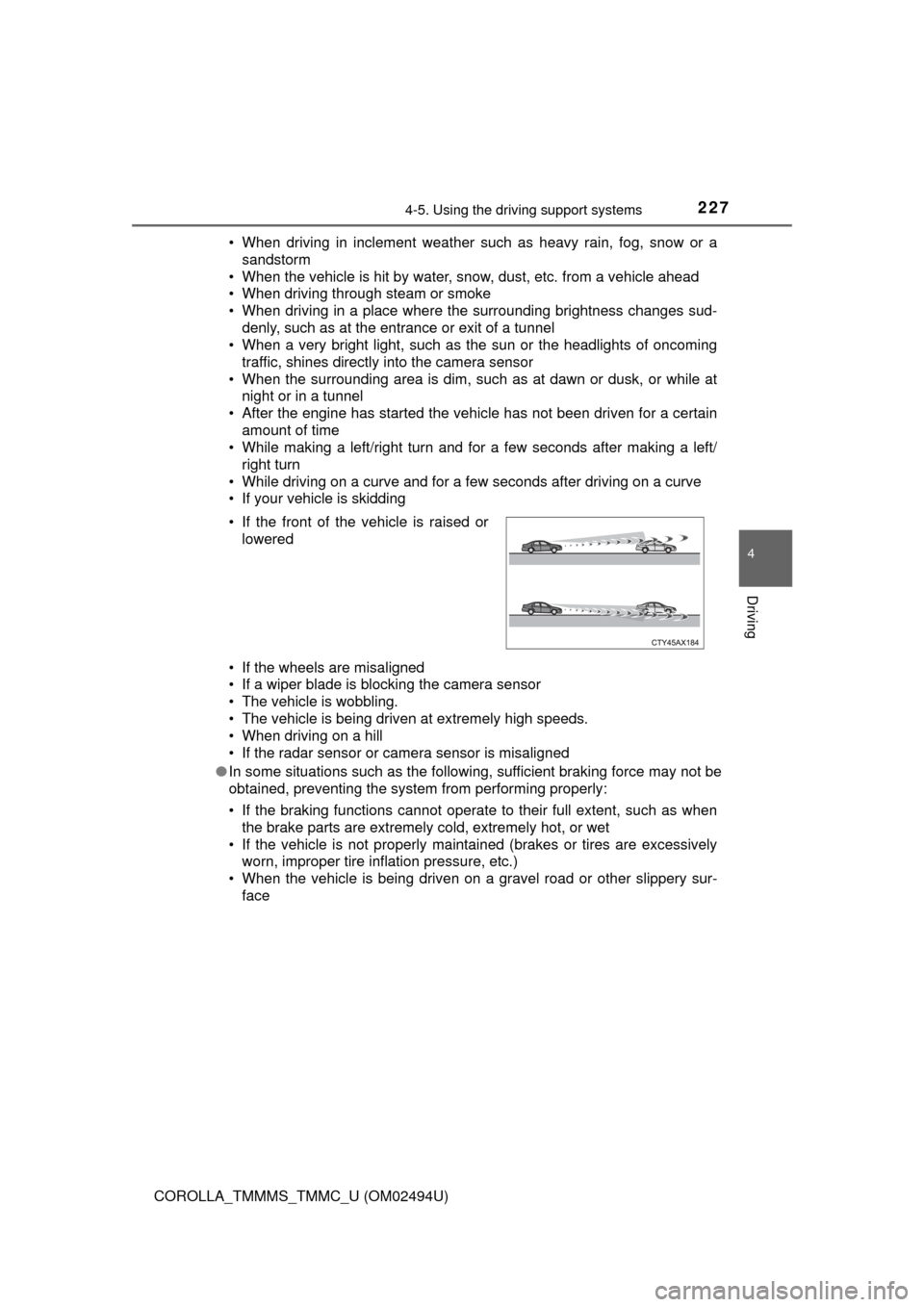
face • If the front of the vehicle is raised or
lowered