Page 480 of 612
4808-2. Steps to take in an emergency
COROLLA_TMMMS_TMMC_U (OM02494U)
WARNING
Observe the following precautions.
Failure to do so may result in death or serious injury.
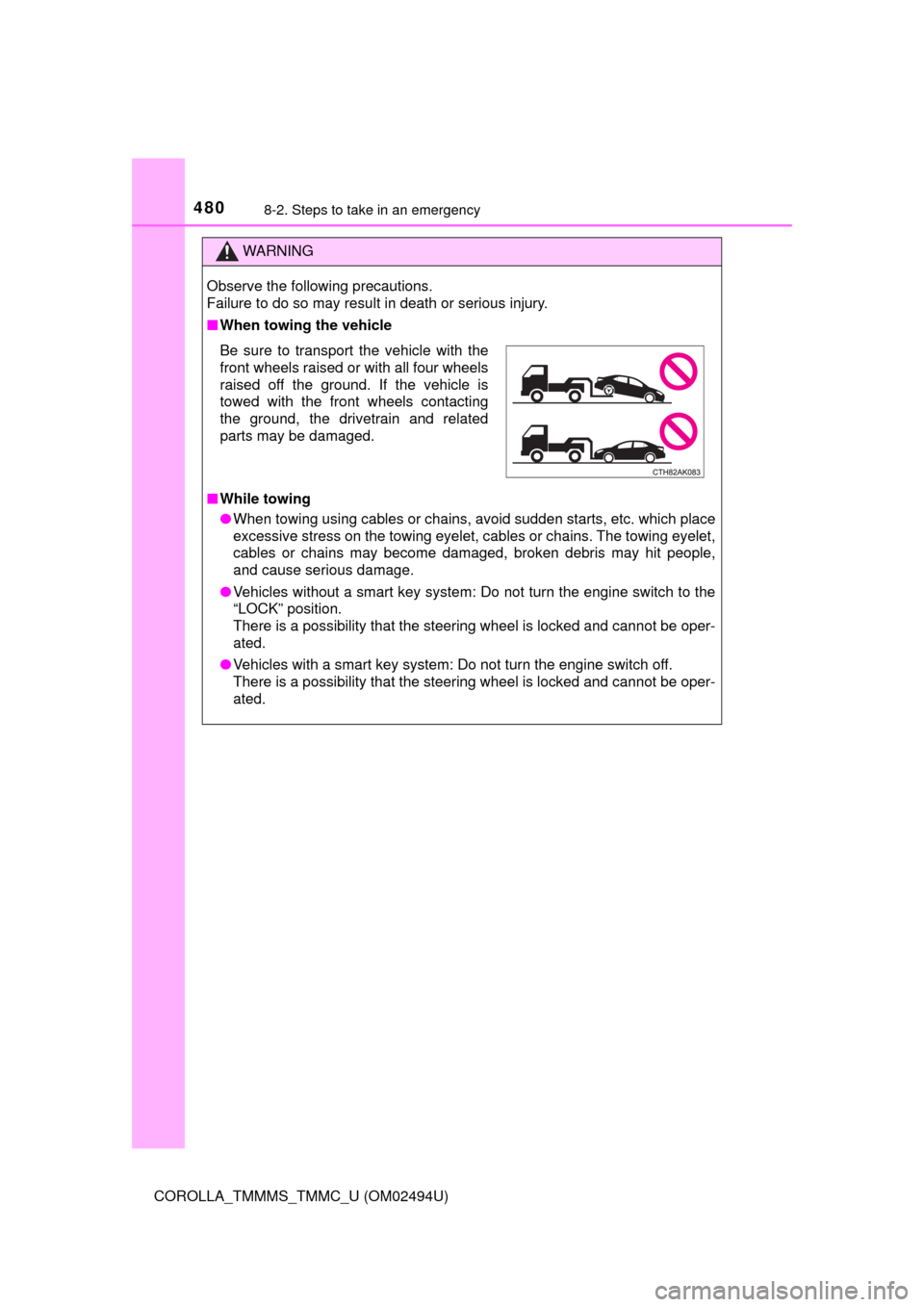
■When towing the vehicle
■While towing
●When towing using cables or chains, avoid sudden starts, etc. which place
excessive stress on the towing eyelet, cables or chains. The towing eyelet,
cables or chains may become damaged, broken debris may hit people,
and cause serious damage.
●Vehicles without a smart key system: Do not turn the engine switch to the
“LOCK” position.
There is a possibility that the steering wheel is locked and cannot be oper-
ated.
●Vehicles with a smart key system: Do not turn the engine switch off.
There is a possibility that the steering wheel is locked and cannot be oper-
ated.
Be sure to transport the vehicle with the
front wheels raised or with all four wheels
raised off the ground. If the vehicle is
towed with the front wheels contacting
the ground, the drivetrain and related
parts may be damaged.
Page 481 of 612
4818-2. Steps to take in an emergency
8
When trouble arises
COROLLA_TMMMS_TMMC_U (OM02494U)
NOTICE
■To prevent damage to the vehicle when towing using a wheel-lift type
truck
●Vehicles without a smart key system: Do not tow the vehicle from the rear
when the engine switch is in the “LOCK” position or the key is removed.
The steering lock mechanism is not strong enough to hold the front wheels
straight.
●Vehicles with a smart key system: Do not tow the vehicle from the rear
when the engine switch is off. The steering lock mechanism is not strong
enough to hold the front wheels straight.
●When raising the vehicle, ensure adequate ground clearance for towing at
the opposite end of the raised vehicle. Without adequate clearance, the
vehicle could be damaged while being towed.
■To prevent damage to the vehicle when towing with a sling-type truck
Do not tow with a sling-type truck, either from the front or rear.
■To prevent damage to the vehicle during emergency towing
Do not secure cables or chains to the suspension components.
Page 489 of 612

4898-2. Steps to take in an emergency
8
When trouble arises
COROLLA_TMMMS_TMMC_U (OM02494U)■
When a tire is replaced with a spare tire (vehicles with a tire pressure
warning system)
The compact spare tire is not equipped with a tire pressure warning valve
and transmitter. If a tire goes flat, the tire pressure warning light will not
turn off even though the flat tire has been replaced with the spare tire.
Replace the spare tire with the repaired tire and adjust the tire inflation
pressure. The tire pressure warning light will go off after a few minutes.
■Conditions that the tire pressure warning system may not function
properly (vehicles with a tire pressure warning system)
The tire pressure warning system will be disabled in the following condi-
tions:
(When the condition becomes normal, the system will work properly.)
●If tires not equipped with tire pressure warning valves and transmitters
are used
●If the ID code on the tire pressure warning valves and transmitters is not
registered in the tire pressure warning computer
●If the tire inflation pressure is 73 psi (500 kPa, 5.1 kgf/cm2 or bar) or
higher
The tire pressure warning system may be disabled in the following condi-
tions:
(When the condition becomes normal, the system will work properly.)
●If electronic devices or facilities using similar radio wave frequencies are
nearby
●If a radio set at similar frequency is in use in the vehicle
●If a window tint that affects the radio wave signals is installed
●If there is a lot of snow or ice on the vehicle, in particular around the
wheels or wheel housings
●If non-genuine Toyota wheels are used (Even if you use Toyota wheels,
the tire pressure warning system may not work properly with some types
of tires.)
●If tire chains are used
■If the tire pressure warning light frequently comes on after blinking
for 1 minute (vehicles with a tire pressure warning system)
If the tire pressure warning light frequently comes on after blinking for 1
minute when the engine switch is turned on, have it checked by your
Toyota dealer.
■Warning buzzer
In some cases, the buzzer may not be heard because of noisy place or an
audio sound.
■Electric power steering system warning light (warning buzzer)
When the battery charge becomes insufficient or the voltage temporarily
drops, the electric power steering system warning light may come on and the
warning buzzer may sound.
Page 490 of 612
4908-2. Steps to take in an emergency
COROLLA_TMMMS_TMMC_U (OM02494U)
WARNING
■If both the ABS and the brake system warning lights remain on
Stop your vehicle in a safe place immediately and contact your Toyota
dealer. The vehicle will become extremely unstable during braking, and the
ABS system may fail, which could cause an accident resulting in death or
serious injury.
■When the electric power steering system warning light comes on
The steering wheel may become extremely heavy.
When steering wheel operations are heavier than usual, grip the steering
wheel firmly and operate it using more force than usual.
■
If the tire pressure warning light comes on (vehicles with a tire
pressure warning system)
Be sure to observe the following precautions. Failure to do so could
cause a loss of vehicle control and result in death or serious injury.
●Stop your vehicle in a safe place as soon as possible. Adjust the tire
inflation pressure immediately.
●If the tire pressure warning light comes on even after tire inflation pres-
sure adjustment, it is probable that you have a flat tire. Check the tires.
If a tire is flat, change it with the spare tire and have the flat tire
repaired by the nearest Toyota dealer.
●Avoid abrupt maneuvering and braking. If the vehicle tires deteriorate,
you could lose control of the steering wheel or the brakes.
■If a blowout or sudden air leakage should occur (vehicles with a tire
pressure warning system)
The tire pressure warning system may not activate immediately.
Page 495 of 612
4958-2. Steps to take in an emergency
8
When trouble arises
COROLLA_TMMMS_TMMC_U (OM02494U)
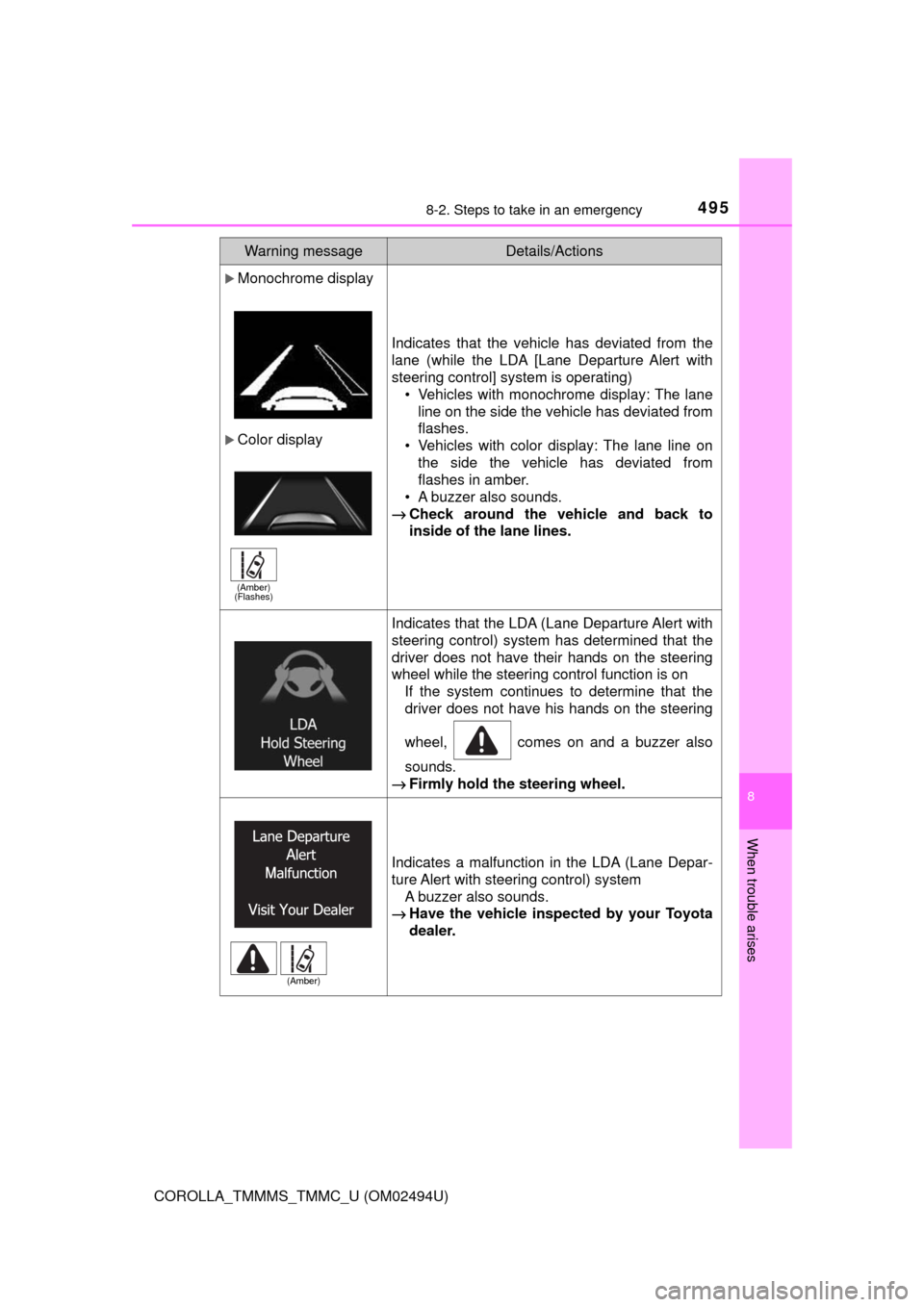
Monochrome display
Color display
Indicates that the vehicle has deviated from the
lane (while the LDA [Lane Departure Alert with
steering control] system is operating)
• Vehicles with monochrome display: The lane
line on the side the vehicle has deviated from
flashes.
• Vehicles with color display: The lane line on
the side the vehicle has deviated from
flashes in amber.
• A buzzer also sounds.
→Check around the vehicle and back to
inside of the lane lines.
Indicates that the LDA (Lane Departure Alert with
steering control) system has determined that the
driver does not have their hands on the steering
wheel while the steering control function is on
If the system continues to determine that the
driver does not have his hands on the steering
wheel, comes on and a buzzer also
sounds.
→Firmly hold the steering wheel.
Indicates a malfunction in the LDA (Lane Depar-
ture Alert with steering control) system
A buzzer also sounds.
→Have the vehicle inspected by your Toyota
dealer.
Warning messageDetails/Actions
(Amber)
(Flashes)
(Amber)
Page 508 of 612
5088-2. Steps to take in an emergency
COROLLA_TMMMS_TMMC_U (OM02494U)
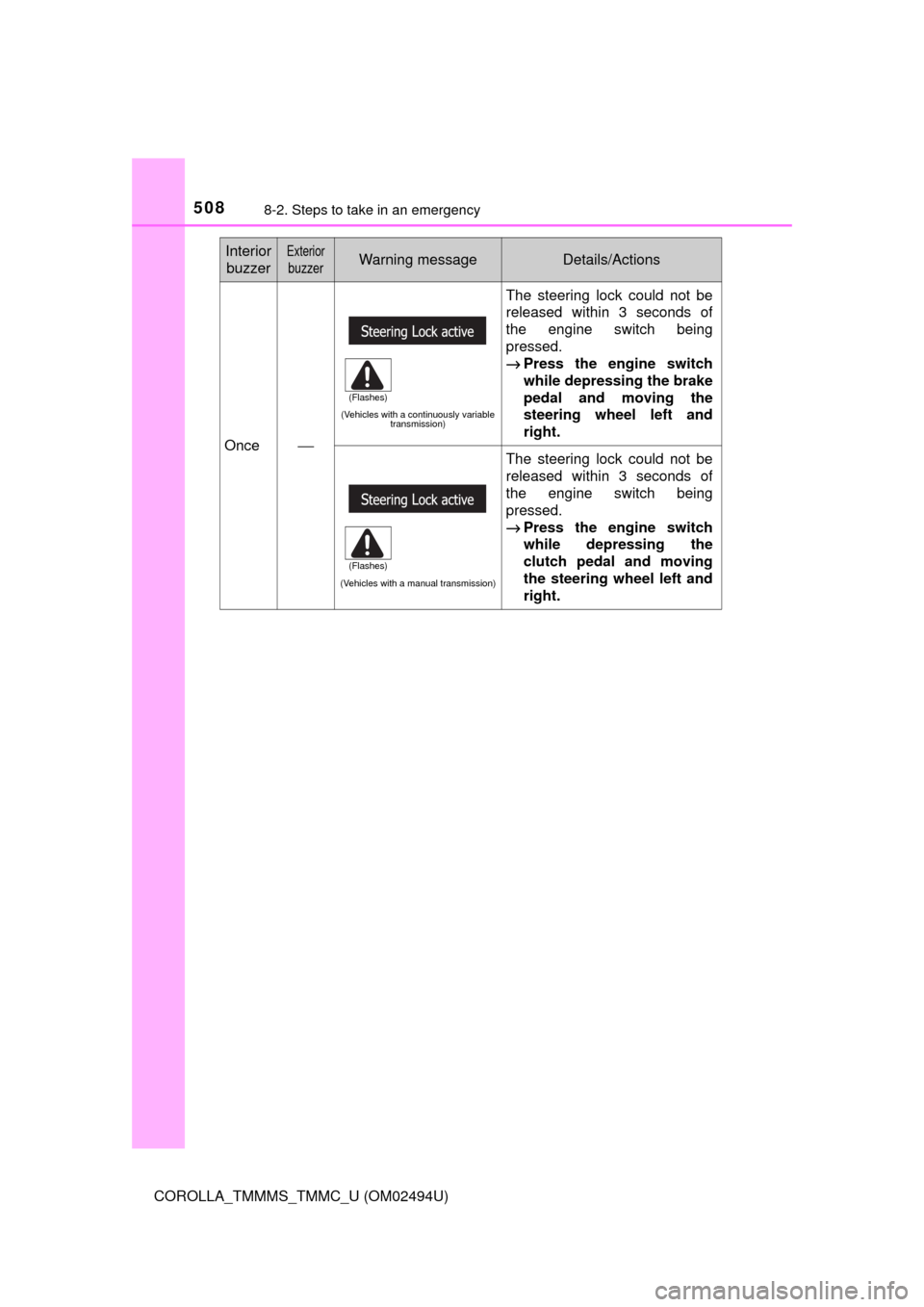
Once⎯
(Vehicles with a continuously variable
transmission)
The steering lock could not be
released within 3 seconds of
the engine switch being
pressed.
→Press the engine switch
while depressing the brake
pedal and moving the
steering wheel left and
right.
(Vehicles with a manual transmission)
The steering lock could not be
released within 3 seconds of
the engine switch being
pressed.
→Press the engine switch
while depressing the
clutch pedal and moving
the steering wheel left and
right.
Interior
buzzerExterior
buzzerWarning messageDetails/Actions
(Flashes)
(Flashes)
Page 550 of 612
5509-1. Specifications
COROLLA_TMMMS_TMMC_U (OM02494U)
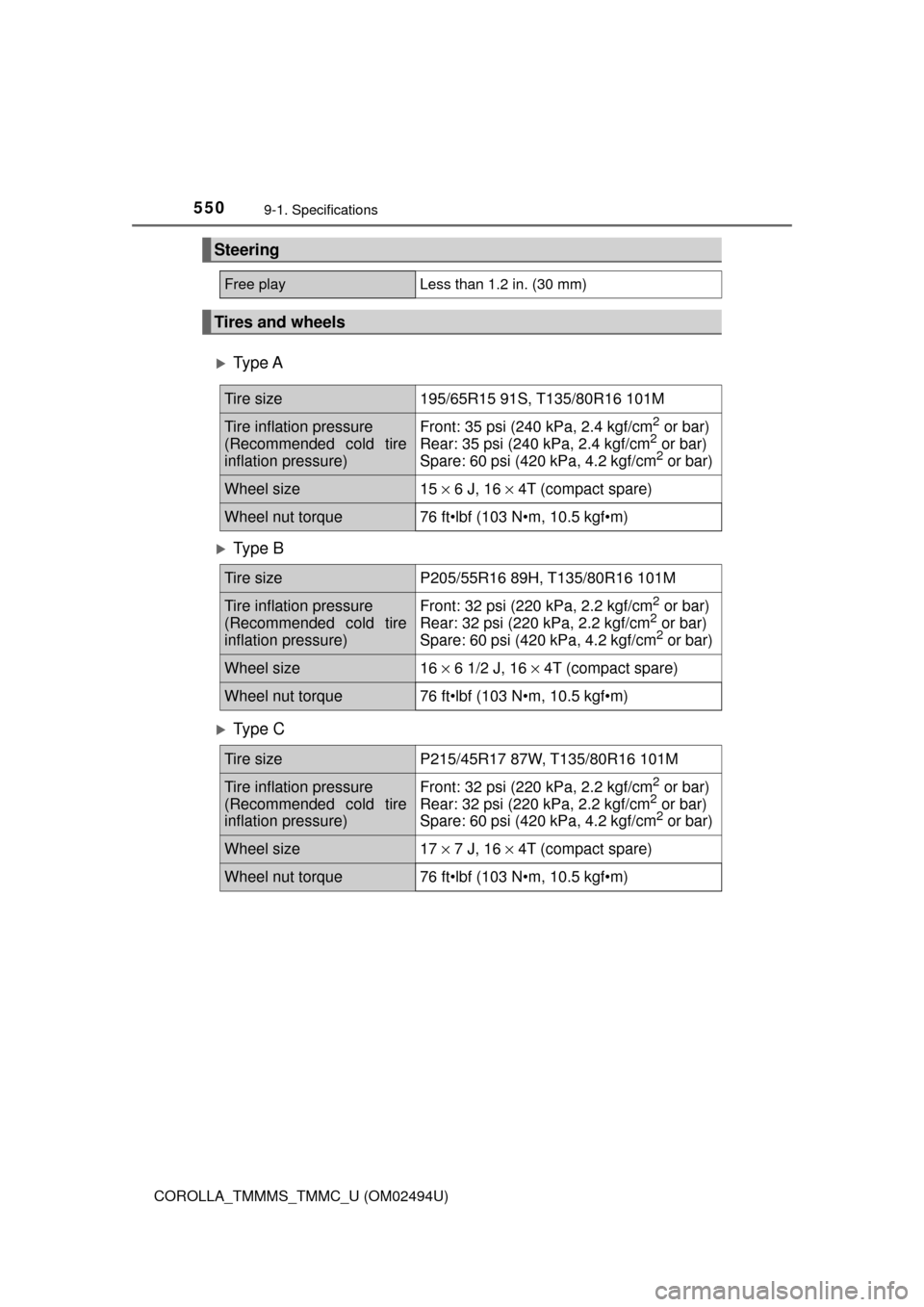
Ty p e A
Ty p e B
Ty p e C
Steering
Free play Less than 1.2 in. (30 mm)
Tires and wheels
Tire size 195/65R15 91S, T135/80R16 101M
Tire inflation pressure
(Recommended cold tire
inflation pressure)Front: 35 psi (240 kPa, 2.4 kgf/cm2 or bar)
Rear: 35 psi (240 kPa, 2.4 kgf/cm2 or bar)
Spare: 60 psi (420 kPa, 4.2 kgf/cm2 or bar)
Wheel size 15 × 6 J, 16 × 4T (compact spare)
Wheel nut torque76 ft•lbf (103 N•m, 10.5 kgf•m)
Tire size P205/55R16 89H, T135/80R16 101M
Tire inflation pressure
(Recommended cold tire
inflation pressure)Front: 32 psi (220 kPa, 2.2 kgf/cm2 or bar)
Rear: 32 psi (220 kPa, 2.2 kgf/cm2 or bar)
Spare: 60 psi (420 kPa, 4.2 kgf/cm2 or bar)
Wheel size 16 × 6 1/2 J, 16 × 4T (compact spare)
Wheel nut torque76 ft•lbf (103 N•m, 10.5 kgf•m)
Tire size P215/45R17 87W, T135/80R16 101M
Tire inflation pressure
(Recommended cold tire
inflation pressure)Front: 32 psi (220 kPa, 2.2 kgf/cm2 or bar)
Rear: 32 psi (220 kPa, 2.2 kgf/cm2 or bar)
Spare: 60 psi (420 kPa, 4.2 kgf/cm2 or bar)
Wheel size 17 × 7 J, 16 × 4T (compact spare)
Wheel nut torque76 ft•lbf (103 N•m, 10.5 kgf•m)
Page 595 of 612

595What to do if... (Troubleshooting)
COROLLA_TMMMS_TMMC_U (OM02494U)
●Vehicles with a manual transmission:
Do you turn the key with the clutch pedal depressed firmly?
(→P. 173)
●Vehicles with a continuously variable transmission:
Is the shift lever in P? (→P. 173)
●Is the steering wheel unlocked? (→P. 173)
●Is the battery discharged? (→P. 530)
●Vehicles with a continuously variable transmission:
Did you press the engine switch while firmly depressing the brake pedal?
(→P. 176)
●Vehicles with a manual transmission:
Did you press the engine switch while firmly depressing the clutch pedal?
(→P. 176)
●Vehicles with a continuously variable transmission:
Is the shift lever in P? (→P. 180)
●Is the electronic key anywhere detectable inside the vehicle?
(→P. 125)
●Is the steering wheel unlocked? (→P. 180)
●Is the electronic key battery weak or depleted?
In this case, the engine can be started in a temporary way.
(→P. 528)
●Is the battery discharged? (→P. 530)
If you think something is wrong
The engine does not start
(vehicles without a smart key system)
The engine does not start
(vehicles with a smart key system)