Page 348 of 492

3486-3. Do-it-yourself maintenance
■The initialization operation
●Make sure to carry out initialization after adjusting the tire inflation pres-
sure.
Also, make sure the tires are cold be fore carrying out initialization or tire
inflation pressure adjustment.
●If you have accidentally turned the e ngine switch to off during initializa-
tion, it is not necessary to press th e reset switch again as initialization
will restart automatically when the engine switch has been turned to
IGNITION ON mode for the next time.
●If you accidentally press the reset s witch when initialization is not neces-
sary, adjust the tire inflation pressu re to the specified level when the
tires are cold, and conduct initialization again.
●While the position of each tire is being determined and the inflation pres-
sures are not being displayed on the multi-information display, if the
inflation pressure of a ti re drops, the tire pressure warning light will come
on.
■Warning performance of the ti re pressure warning system
The warning of the tire pressure warning system will change in accor-
dance with the conditions under which it was initialized. For this reason,
the system may give a warning even if the tire pressure does not reach a
low enough level, or if the pressure is higher than the pressure that was
adjusted to when the system was initialized.
■When initialization of the tire pr essure warning system has failed
Initialization may take longer to comp lete if the vehicle is driven on an
unpaved road. When performing initialization, drive on a paved road if
possible. Depending on the driving environment and condition of the tires,
initialization will be completed in approx imately 10 minutes. If initialization
is not complete after driving approxima tely 10 minutes, continue driving
for a while.
If the inflation pressure of each tire is not displayed after driving for
approximately 1 hour, perform the following procedure.
●Park the vehicle in a safe place for approximately 20 minutes. Then
drive straight (with occasional left and right turns) at approximately 25
mph (40 km/h) or more for approximately 10 to 20 minutes.
Page 358 of 492
3586-3. Do-it-yourself maintenance
Turn the engine switch off.
Open the glove box. (→P. 276)
Remove the glove box cover.
Press the tabs and remove the
filter cover.
Remove the air conditioning fil-
ter and replace it with a new
one.
The “ ↑UP” marks shown on the fil-
ter should be pointing up.
Air conditioning filter
The air conditioning filt er must be changed regularly to maintain
air conditioning efficiency.
Removal method
1
2
3
4
5
Page 362 of 492
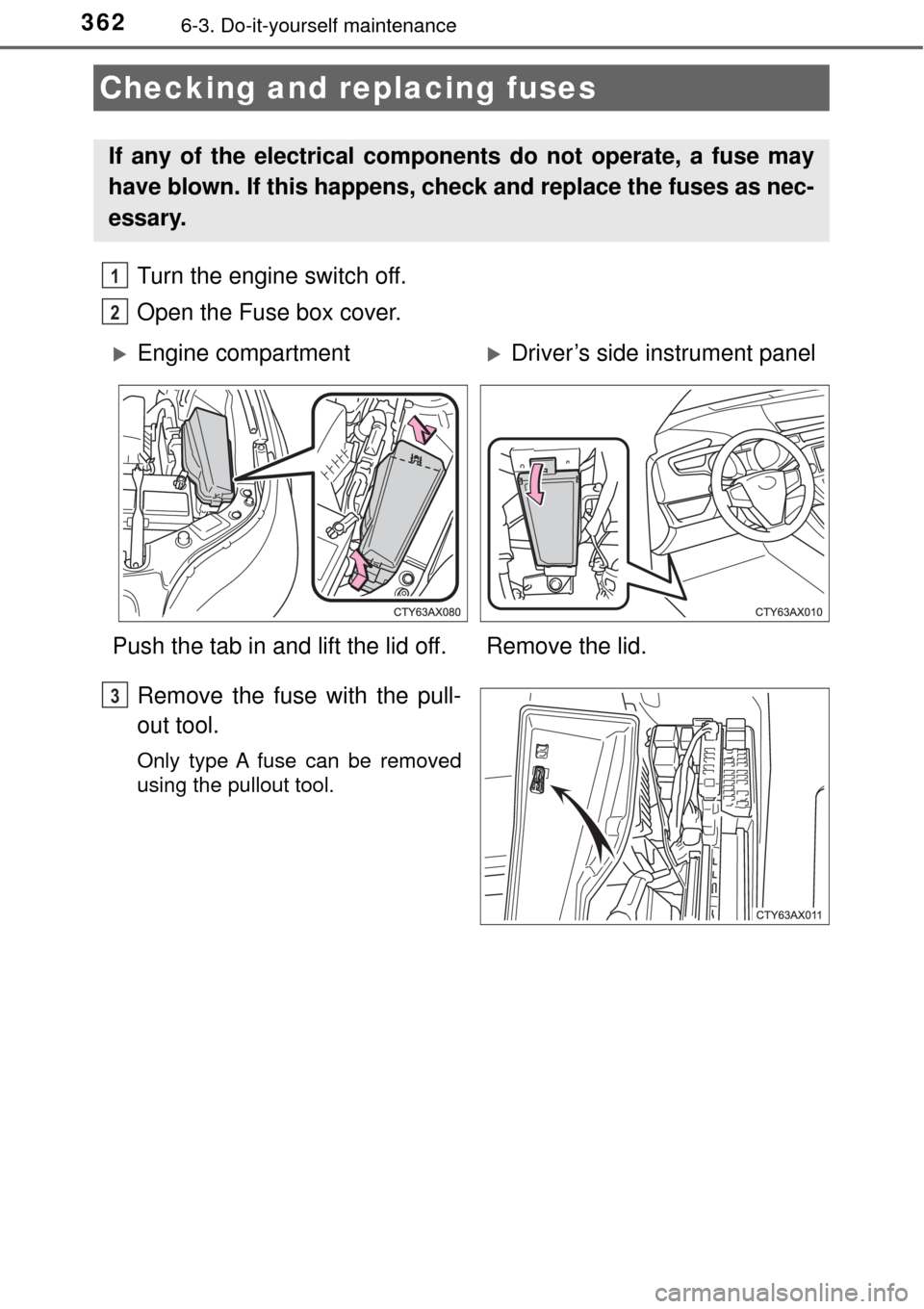
3626-3. Do-it-yourself maintenance
Turn the engine switch off.
Open the Fuse box cover.
Remove the fuse with the pull-
out tool.
Only type A fuse can be removed
using the pullout tool.
Checking and replacing fuses
If any of the electrical components do not operate, a fuse may
have blown. If this happens, check and replace the fuses as nec-
essary.
1
2
Engine compartmentDriver’s side instrument panel
Push the tab in and lift the lid off. Remove the lid.
3
Page 379 of 492
379
When trouble arises7
7-1. Essential informationEmergency flashers .......... 380
If your vehicle has to be stopped in an
emergency ...................... 381
7-2. Steps to take in an emergency
If your vehicle needs to be towed ......................... 382
If you think something is wrong .......................... 386
Fuel pump shut off system ............................ 387
If a warning light turns on or a warning buzzer
sounds ............................ 388
If a warning message is displayed......................... 396
If you have a flat tire.......... 397
If the engine will not start ................................. 409
If the electronic key does not operate
properly ........................... 411
If the vehicle battery is discharged ...................... 414
If your vehicle overheats ........................ 418
If the vehicle becomes stuck ............................... 421
Page 380 of 492
3807-1. Essential information
Press the switch.
All the turn signals will flash.
To turn them off, press the switch
once again.
■Emergency flashers
If the emergency flashers are used for a long time while the engine is not
operating, the battery may discharge.
Emergency flashers
The emergency flashers are used to warn other drivers when the
vehicle has to be stopped in th e road due to a breakdown, etc.
Page 381 of 492

3817-1. Essential information
7
When trouble arises
Steadily step on the brake pedal with both feet and firmly depress it.
Do not pump the brake pedal repeatedly as this will increase the effort
required to slow the vehicle.
Shift the shift lever to N.
If the shift lever is shifted to N
After slowing down, stop the vehicle in a safe place by the road.
Stop the engine.
If the shift lever cannot be shifted to N
Keep depressing the brake pedal with both feet to reduce vehicle
speed as much as possible.
To stop the engine, press and
hold the engine switch for 2
consecutive seconds or more,
or press it briefly 3 times or
more in succession.
Stop the vehicle in a safe place by the road.
If your vehicle has to be stopped in an
emergency
Only in an emergency, such as if it becomes impossible to stop
the vehicle in the normal way, st op the vehicle using the follow-
ing procedure:
1
2
3
4
3
Press and hold for 2 seconds or more
or press briefly 3 times or more
4
WARNING
■ If the engine has to be turned off while driving
Power assist for the brakes and steering wheel will be lost, making the
brake pedal harder to depress and the steering wheel heavier to turn.
Decelerate as much as possible before turning off the engine.
5
Page 382 of 492
3827-2. Steps to take in an emergency
The following may indicate a problem with your transmission. Contact
your Toyota dealer or commercial towing service before towing.
● The engine is running but the vehicle does not move.
● The vehicle makes an abnormal sound.
If your vehicle needs to be towed
If towing is necessary, we re commend having your vehicle
towed by your Toyota dealer or commercial towing service,
using a wheel-lift type truck or flatbed truck.
Use a safety chain system for all towing, and abide by all state/
provincial and local laws.
Situations when it is necessary to contact dealers before towing
Page 384 of 492

3847-2. Steps to take in an emergency
If your vehicle is transported by a
flatbed truck, it should be tied
down at the locations shown in the
illustration.
If you use chains or cables to tie
down your vehicle, the angles
shaded in black must be 45°.
Do not overly tighten the tie
downs or the vehicle may be dam-
aged.
Using a flatbed truck
WARNING
Observe the following precaution.
Failure to do so may result in death or serious injury.
■ When towing the vehicle
■ While towing
● When towing using cables or chains, avoid sudden starts, etc. which place
excessive stress on the towing eyelets, cables or chains. The towing eye-
lets, cables or chains may become damaged, broken debris may hit peo-
ple, and cause serious damage.
● Do not turn the engine switch off.
There is a possibility that the steering wheel is locked and cannot be oper-
ated.
Be sure to transport the vehicle with the
front wheels raised or with all four wheels
raised off the ground. If the vehicle is
towed with the front wheels contacting
the ground, the drivetrain and related
parts may be damaged.