Page 214 of 428
2143-1. Using the air cond itioning system and defogger
WARNING■ To prevent the windshield from fogging up
Do not set the air outlet selection dial to during cool air operation in
extremely humid weather. The difference between the temperature of the
outside air and that of the windshield can cause the outer surface of the
windshield to fog up, blocking your vision.
NOTICE■ To prevent battery discharge
Do not leave the air conditioning system on longer than necessary when the
engine is stopped.
Page 215 of 428
2153-1. Using the air conditioning system and defogger
3
Interior features
Rear window and outside r ear view mirror defoggers
■ The defoggers can be operated when
The engine switch is in the “ON” position.
■ The outside rear view mi rror defoggers (vehicles with outside rear view
mirror defoggers)
Turning the rear window defogger on will turn the outside rear view mirror
defoggers on.
WARNING
■ When the outside rear view mirror defoggers are on (vehicles with out-
side rear view mirror defoggers)
Do not touch the outside surface of the rear view mirrors, as they can
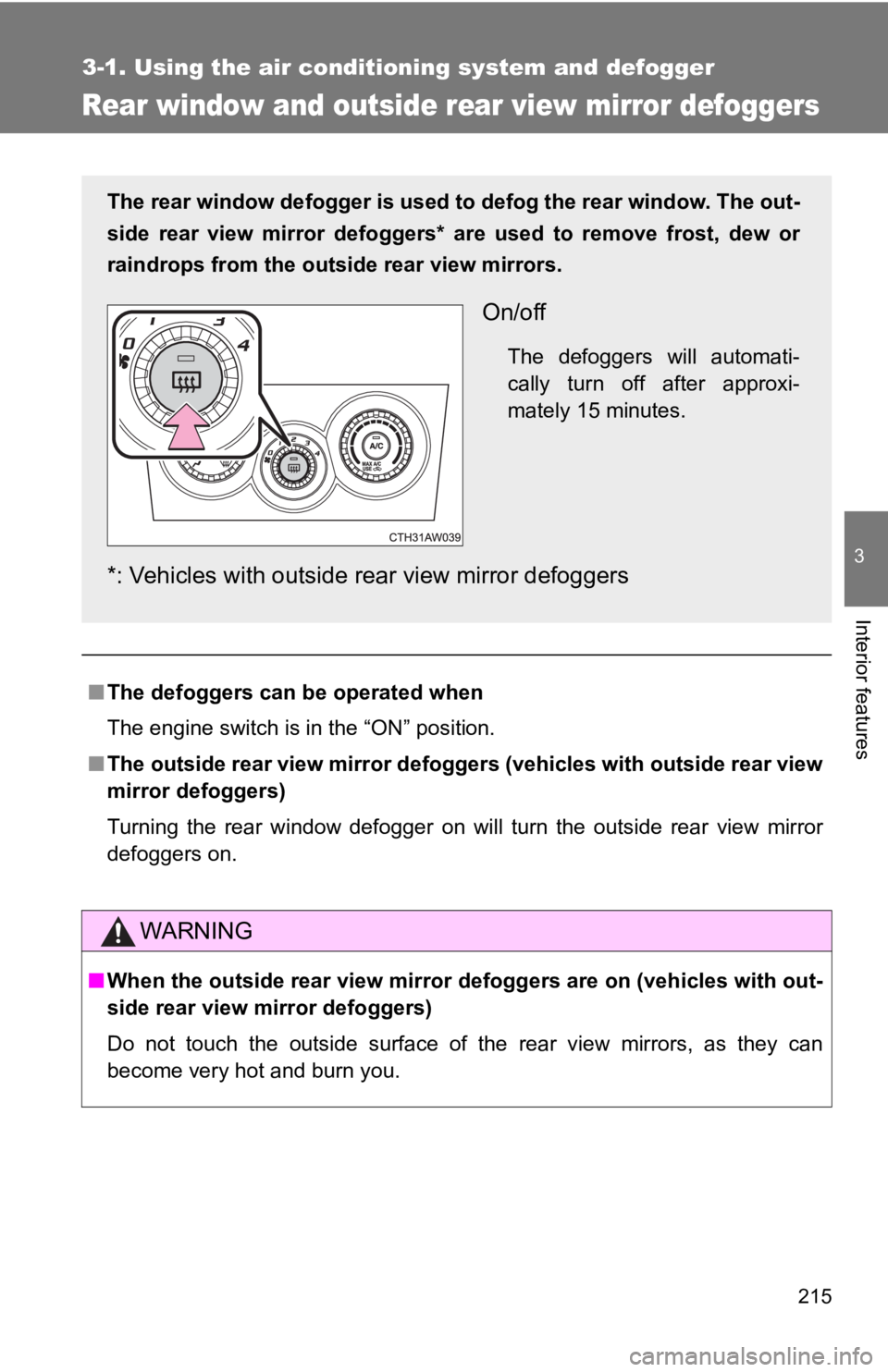
become very hot and burn you.The rear window defogger is used to defog the rear window. The out-
side rear view mirror defoggers* are used to remove frost, dew or
raindrops from the outs ide rear view mirrors.
On/off The defoggers will automati-
cally turn off after approxi-
mately 15 minutes.
*: Vehicles with outside rear view mirror defoggers
Page 235 of 428
Maintenance and care
4
2354-1. Maintenance and care
Cleaning and protecting
the vehicle exterior......... 236
Cleaning and protecting
the vehicle interior.......... 240
4-2. Maintenance
Maintenance
requirements .................. 244
General maintenance....... 246
Emission inspection and
maintenance (I/M)
programs........................ 249 4-3. Do-it-yourself
maintenance
Do-it-yourself service
precautions .................... 250
Hood ................................ 253
Positioning a floor
jack ................................ 255
Engine compartment ........ 257
Tires ................................. 270
Tire inflation pressure ...... 277
Wheels ............................. 281
Air conditioning filter......... 284
Wireless remote control
key battery ..................... 287
Checking and replacing
fuses .............................. 290
Light bulbs........................ 298
Page 238 of 428

2384-1. Maintenance and care
WARNING■ When washing the vehicle
Do not apply water to the inside of the engine compartment. Doing so may
cause the electrical components etc. to catch fire.
■ Precautions regarding the exhaust pipes
Exhaust gasses cause the exhaust pipes and rear bumper diffusers to
become quite hot.
When washing the vehicle, be careful not to touch the pipes and diffusers
until they have cooled sufficiently, as touching hot exhaust pipes and rear
bumper diffusers can cause burns.
NOTICE■ To prevent paint deterioration and corrosion on the body and compo-
nents (aluminum wheels etc.)
● Wash the vehicle immediately in the following cases:
• After driving near the sea coast
• After driving on salted roads
• If you see coal tar or tree sap on the paint surface
• If you see dead insects, insect droppings or bird droppings on the paint
• After driving in an area contaminated with soot, oily smoke, mine dust,
iron powder or chemical substances
• If the vehicle becomes heavily soiled in dust or mud
• If liquids such as benzene and gasoline are spilled on the paint surface
● If the paint is chipped or scratched, have it repaired immediately.
● To prevent the wheels from corroding, remove any dirt and store in a place
with low humidity when storing the wheels.
■ Protective film for side sill plates
Make sure to remove the protective film. Failure to do so may cause rust,
depending on conditions.
Page 242 of 428

2424-1. Maintenance and care
NOTICE■ Cleaning detergents
● Do not use organic substances such as benzene or gasoline, acidic or
alkaline solutions, dye, bleach or other detergent. Doing so may discolor
the vehicle interior or cause streaks or damage to painted surfaces.
● Do not use polish wax or polish cleaner. The instrument panel's or other
interior part’s painted surface may be damaged.
● Do not use a chemical agent containing silicone (highly-polymerized sili-
con compound) when cleaning any of the electrical appliances such as the
air conditioning, all switches and their surrounding areas.
If silicon (highly-polymerized silicon compound) contacts these compo-
nents, it may cause the electrical appliances to malfunction.
■ Preventing damage to leather surfaces
Observe the following precautions to avoid damage to and deterioration of
leather surfaces.
● Remove any dust, dirt, sand, oil spots etc. on leather surfaces immedi-
ately.
● Do not expose the vehicle to direct sunlight for extended periods of time.
Park the vehicle in the shade, especially during summer.
● Do not place items made of vinyl, plastic, or that contain wax on the uphol-
stery, as they may stick to the leather surface if the vehicle interior heats
up significantly.
■ Water on the floor
Do not wash the vehicle floor with water.
Vehicle systems such as the audio system may be damaged if water comes
into contact with electrical components under the floor of the vehicle, and
may also cause the body to rust.
Page 252 of 428

2524-3. Do-it-yourself maintenance
WARNINGThe engine compartment contains many mechanisms and fluids that may
move suddenly, become hot, or become electrically energized. To avoid death
or serious injury, observe the following precautions.
■ When working on the engine compartment
● Keep hands, clothing, and tools away from the moving fan and engine
drive belt.
● Be careful not to touch the engine, radiator, exhaust manifold, etc. right
after driving as they may be hot. Oil and other fluids may also be hot.
● Do not leave anything that may burn easily, such as paper or rags, in the
engine compartment.
● Do not smoke, cause sparks or expose an open flame to fuel or the bat-
tery. Fuel and battery fumes are flammable.
● Be extremely cautious when working on the battery. It contains poisonous
and corrosive sulfuric acid.
■ When working near the electric c ooling fans or radiator grille
Be sure the engine switch is off. With the engine switch in the “ON” position,
the electric cooling fans may automatically start to run if the air conditioning
is on and/or the coolant temperature is high. ( → P. 263)
■ Safety glasses
Wear safety glasses to prevent flying or falling material, fluid spray, etc. from
getting in the eyes.
NOTICE
■ If you remove the air cleaner filter
Driving with the air cleaner filter removed may cause excessive engine wear
due to dirt in the air.
Page 272 of 428

2724-3. Do-it-yourself maintenance
■
When to replace your vehicle’s tires
Tires should be replaced if: ●
The treadwear indicators are showing on a tire.●
You have tire damage such as cuts, splits, cracks deep enough to
expose the fabric or bulges indicating internal damage●
A tire goes flat repeatedly or ca nnot be properly repaired due to the
size or location of a cut or other damage
If you are not sure, consult with your Toyota dealer.■
Replacing tires and wheels
If the ID code of the tire pressure warning valve and transmitter is not
registered, the tire pressure warni ng system will not work properly. After
driving for about 20 minutes, the ti re pressure warning light comes on
after blinking for 1 minute to indicate a system malfunction.■
Tire life
Any tire over 6 years old must be checked by a qualified technician even
if they have seldom or never been used or damage is not obvious.
■
If the tread wears down below 0.16 in. (4 mm) on snow tires
The effectiveness of snow tires is lost.
■
Low profile tires
Generally, low profile tire s will wear more rapidly and tire gr ip perfor-
mance will be reduced on snowy and/ or icy roads when compared to
standard tires. Be sure to use snow tires or tire chains on snowy and/or
icy roads and drive carefully at a speed appropriate for road and weather
conditions.
Page 280 of 428
2804-3. Do-it-yourself maintenance
WARNING■
Proper inflation is critical to save tire performance
Keep your tires properly inflated.
If the tires are not properly inflated, the following conditions may occur
which could lead to an accident resulting in death or serious injury: ●
Excessive wear●
Uneven wear●
Poor handling●
Possibility of blowouts resulting from overheated tires●
Air leaking from between tire and wheel●
Wheel deformation and/or tire damage●
Greater possibility of tire damage while driving (due to road hazards,
expansion joints, sharp edges in the road, etc.)
NOTICE■
When inspecting and adjusting tire inflation pressure
Be sure to reinstall the tire valve caps.
If a valve cap is not installed, dirt or moisture may ge t into the valve and
cause an air leak, resulting in decreased tire inflation pressure.