Page 307 of 428
5
When trouble arises
3075-1. Essential information
If your vehicle needs to be towed
Before towing
The following may indicate a problem with your transmission. Contact
your Toyota dealer before towing.
● The engine is running, but the vehicle will not move.
● The vehicle makes an abnormal sound.
Emergency towing
If a tow truck is not available in an emergency, your vehicle may be
temporarily towed using a cable or chain secured to the emergency
towing eyelet. This should only be attempted on hard surfaced roads
for short distances at low speeds.
A driver must be in the vehicle to steer and operate the brakes. The
vehicle’s wheels, drive train, axles, steering and brakes must be in
good condition.
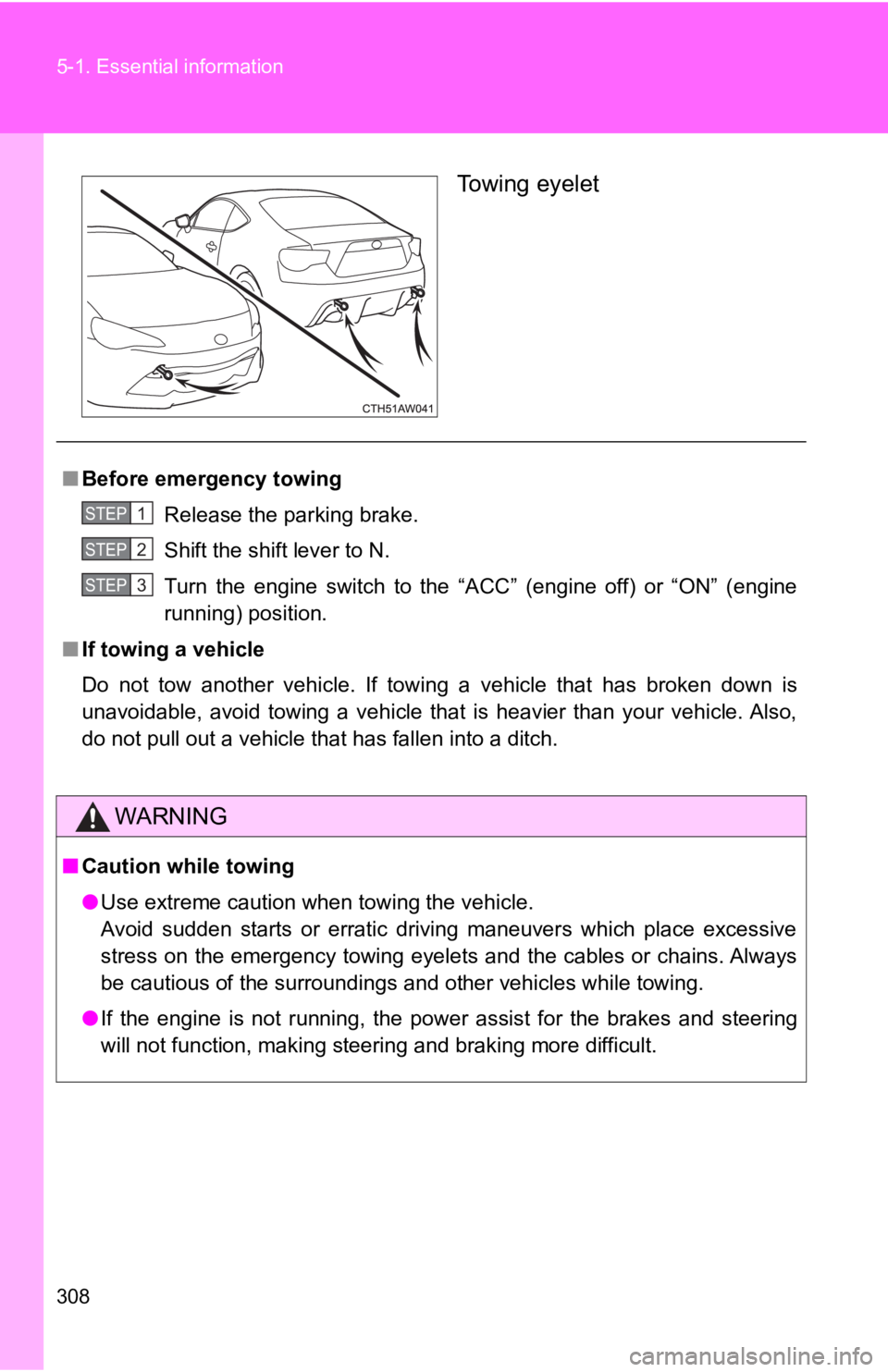
For vehicles with an automatic transmission, only the front towing
eyelet may be used. If towing is necessary, we recommen d having your vehicle towed by
your Toyota dealer or a commerci al towing service, using a lift-type
truck or a flat bed truck.
Use a safety chain system for all to wing, and abide by all state/pro-
vincial and local laws.
If towing from the rear, the vehic le's front wheels and axles must be
in good condition. ( → P. 313)
If they are damaged, use a towing dolly or flat bed truck.
Page 308 of 428
3085-1. Essential information
Towing eyelet
■ Before emergency towing
Release the parking brake.
Shift the shift lever to N.
Turn the engine switch to the “ACC” (engine off) or “ON” (engine
running) position.
■ If towing a vehicle
Do not tow another vehicle. If towing a vehicle that has broken down is
unavoidable, avoid towing a vehicle that is heavier than your vehicle. Also,
do not pull out a vehicle that has fallen into a ditch.
WARNING■ Caution while towing
● Use extreme caution when towing the vehicle.
Avoid sudden starts or erratic driving maneuvers which place excessive
stress on the emergency towing eyelets and the cables or chains. Always
be cautious of the surroundings and other vehicles while towing.
● If the engine is not running, the power assist for the brakes and steering
will not function, making steering and braking more difficult. STEP 1
STEP 2
STEP 3
Page 309 of 428
5
When trouble arises
3095-1. Essential information
NOTICE■ To prevent causing serious damage to the transmission in emergency
towing (vehicles with an automatic transmission)
Never tow a vehicle from the rear with four wheels on the ground. This may
cause serious damage to the transmission.
■ To prevent damage to the vehicle
● When towing this vehicle, make sure to observe the following:
• Do not use a wire rope
• Keep vehicle speed below 20 mph (30 km/h) and do not tow for dis-
tances over 19 miles (30 km)
• Tow the vehicle in the forward direction
• Do not apply rope to the vehicle's suspension and so forth
● Do not tow another vehicle, boat (trailer) and so forth, that is heavier than
this vehicle.
■ When towing down a long slope
Use a wheel lift-type or flat bed truck. ( → P. 313, 314)
If a wheel lift-type or flat bed truck is not used, the brakes may overheat,
leading to poor brake performance.
Page 310 of 428
3105-1. Essential information
Installing a towing eyelet
Remove the eyelet cover(s). To prevent damage to the vehicle, cover the tip of the screwdriver
with a rag.
Front
Remove the upper cover using a
flathead screwdriver and then
pull the lower cover outward by
hand to remove it.
Upper cover
Lower coverSTEP 1
Page 311 of 428
5
When trouble arises
3115-1. Essential information
Rear
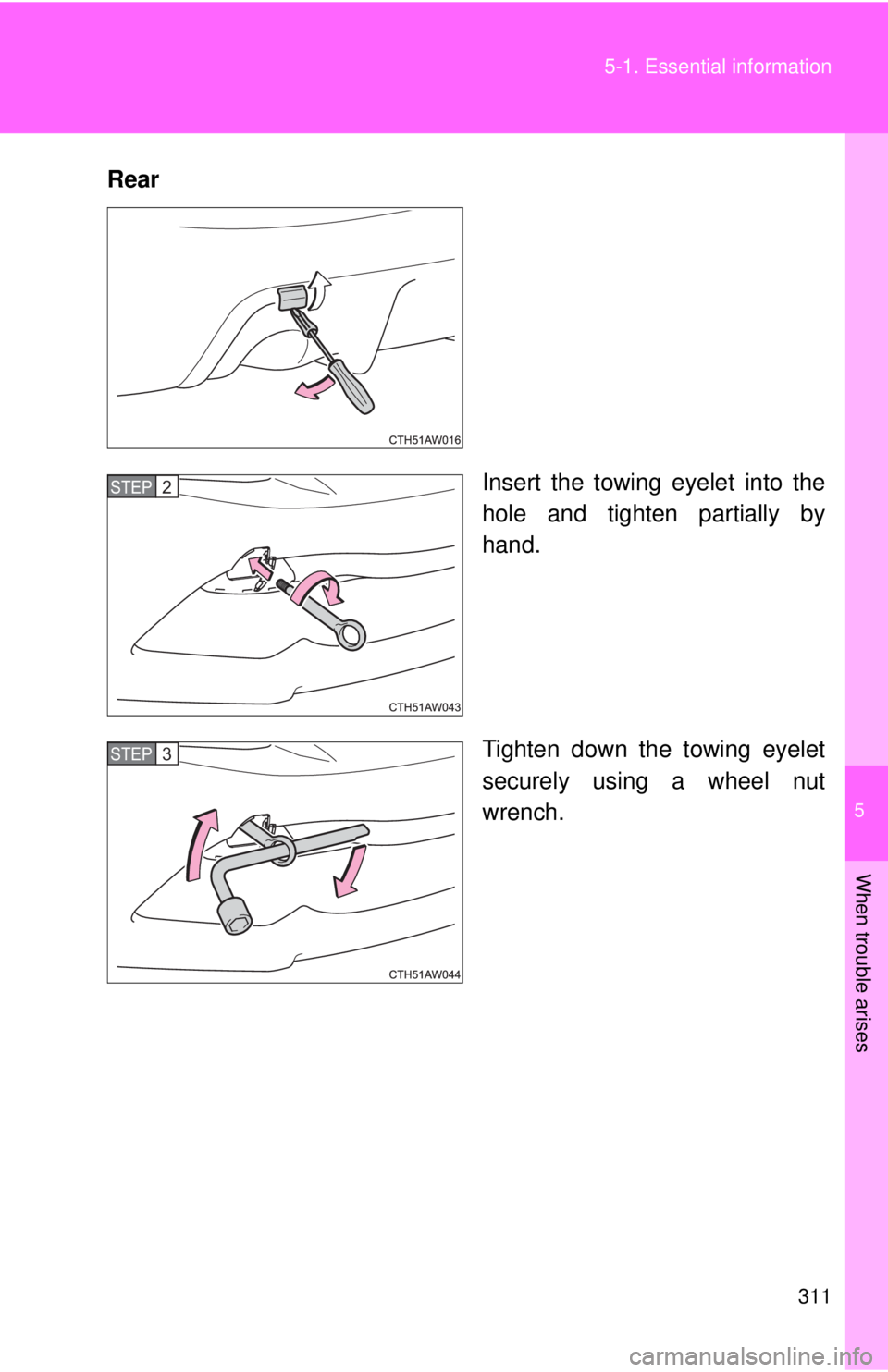
Insert the towing eyelet into the
hole and tighten partially by
hand.
Tighten down the towing eyelet
securely using a wheel nut
wrench.STEP 2
STEP 3
Page 312 of 428
3125-1. Essential information
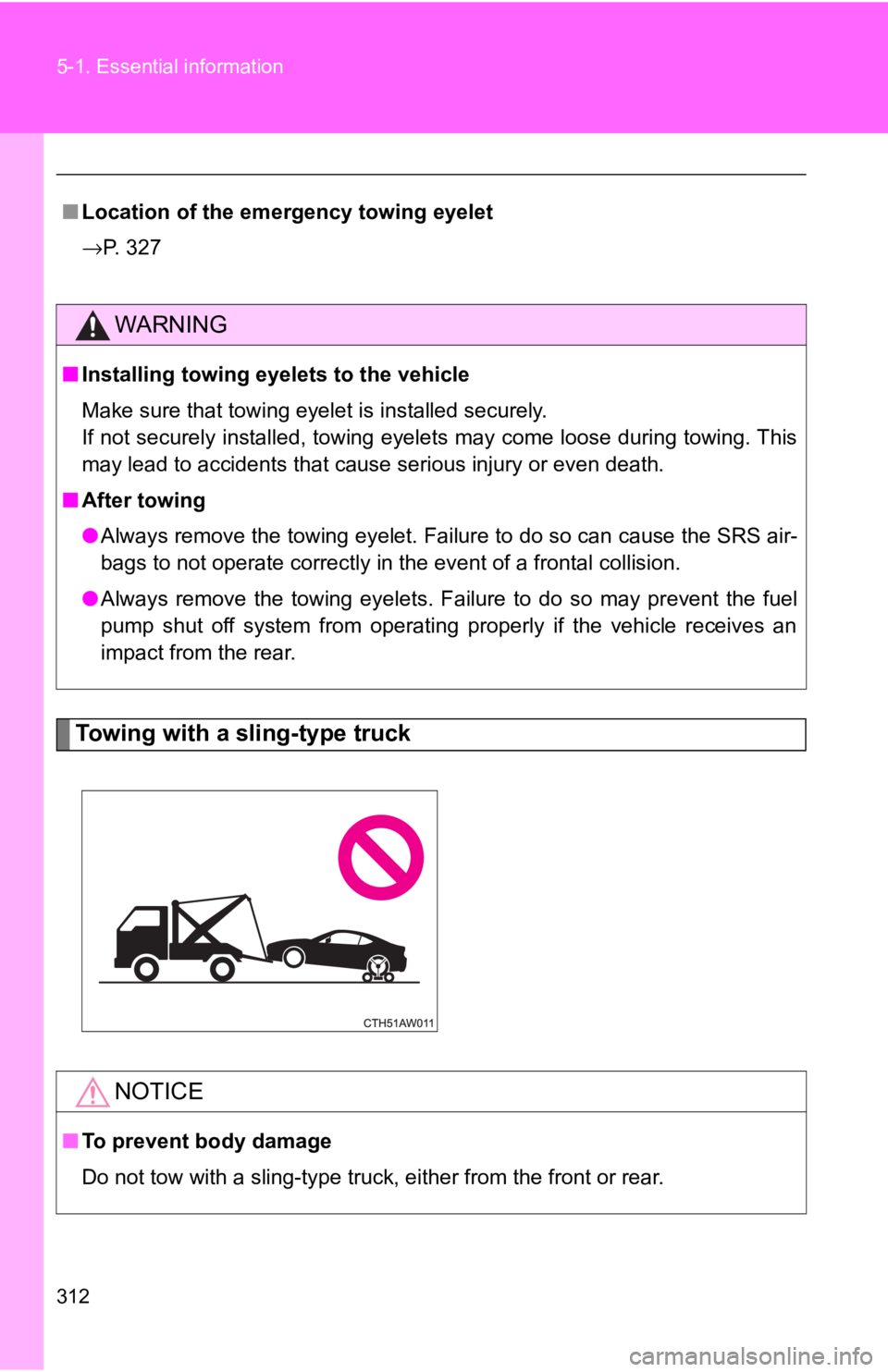
Towing with a sling-type truck■ Location of the emergency towing eyelet
→ P. 327
WARNING■ Installing towing eyelets to the vehicle
Make sure that towing eyelet is installed securely.
If not securely installed, towing eyelets may come loose during towing. This
may lead to accidents that cause serious injury or even death.
■ After towing
● Always remove the towing eyelet. Failure to do so can cause the SRS air-
bags to not operate correctly in the event of a frontal collision.
● Always remove the towing eyelets. Failure to do so may prevent the fuel
pump shut off system from operating properly if the vehicle receives an
impact from the rear.
NOTICE
■ To prevent body damage
Do not tow with a sling-type truck, either from the front or rear.
Page 313 of 428
5
When trouble arises
3135-1. Essential information
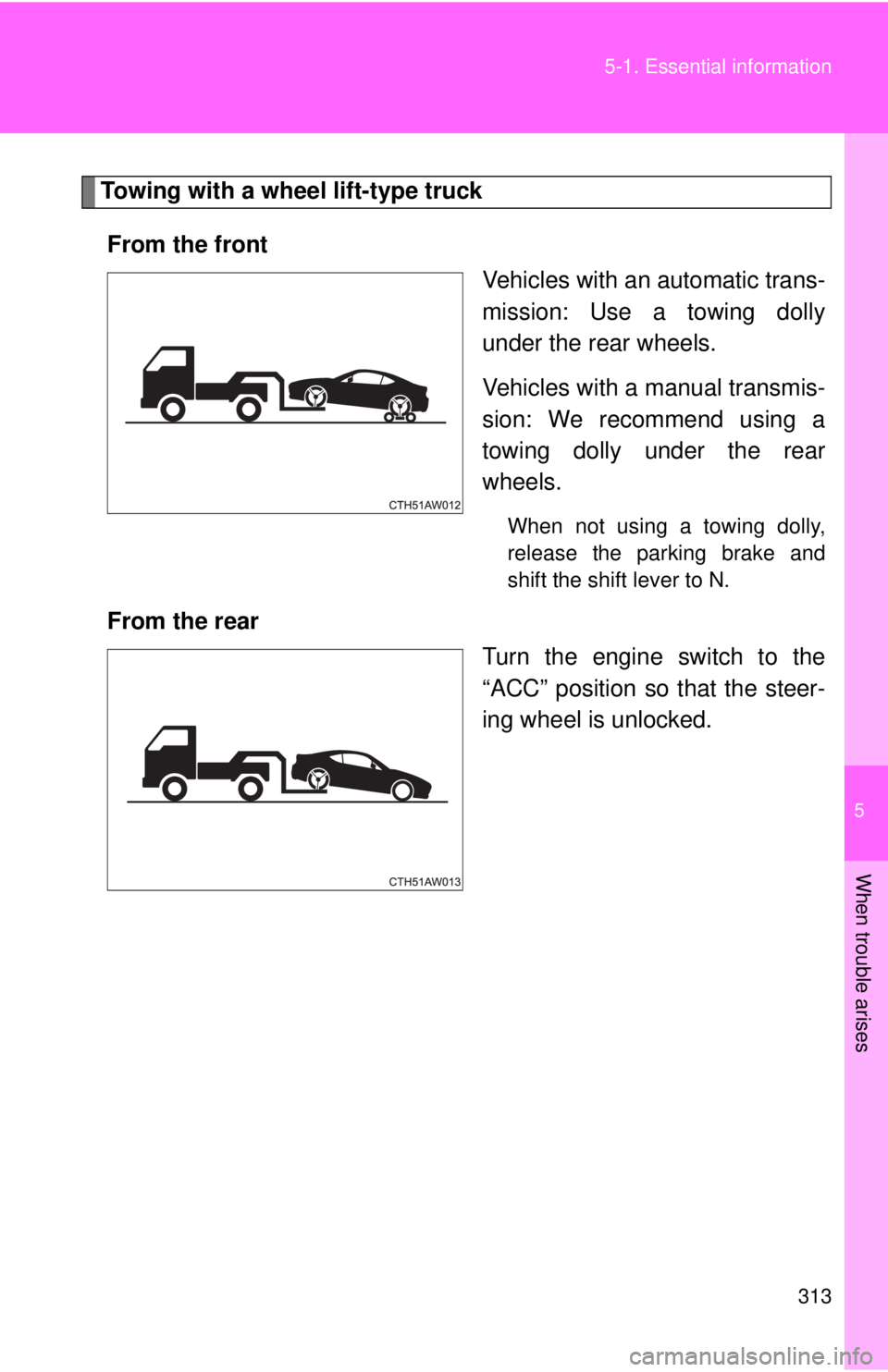
Towing with a wheel lift-type truck
From the front
Vehicles with an automatic trans-
mission: Use a towing dolly
under the rear wheels.
Vehicles with a manual transmis-
sion: We recommend using a
towing dolly under the rear
wheels. When not using a towing dolly,
release the parking brake and
shift the shift lever to N.
From the rear
Turn the engine switch to the
“ACC” position so that the steer-
ing wheel is unlocked.
Page 314 of 428
3145-1. Essential information
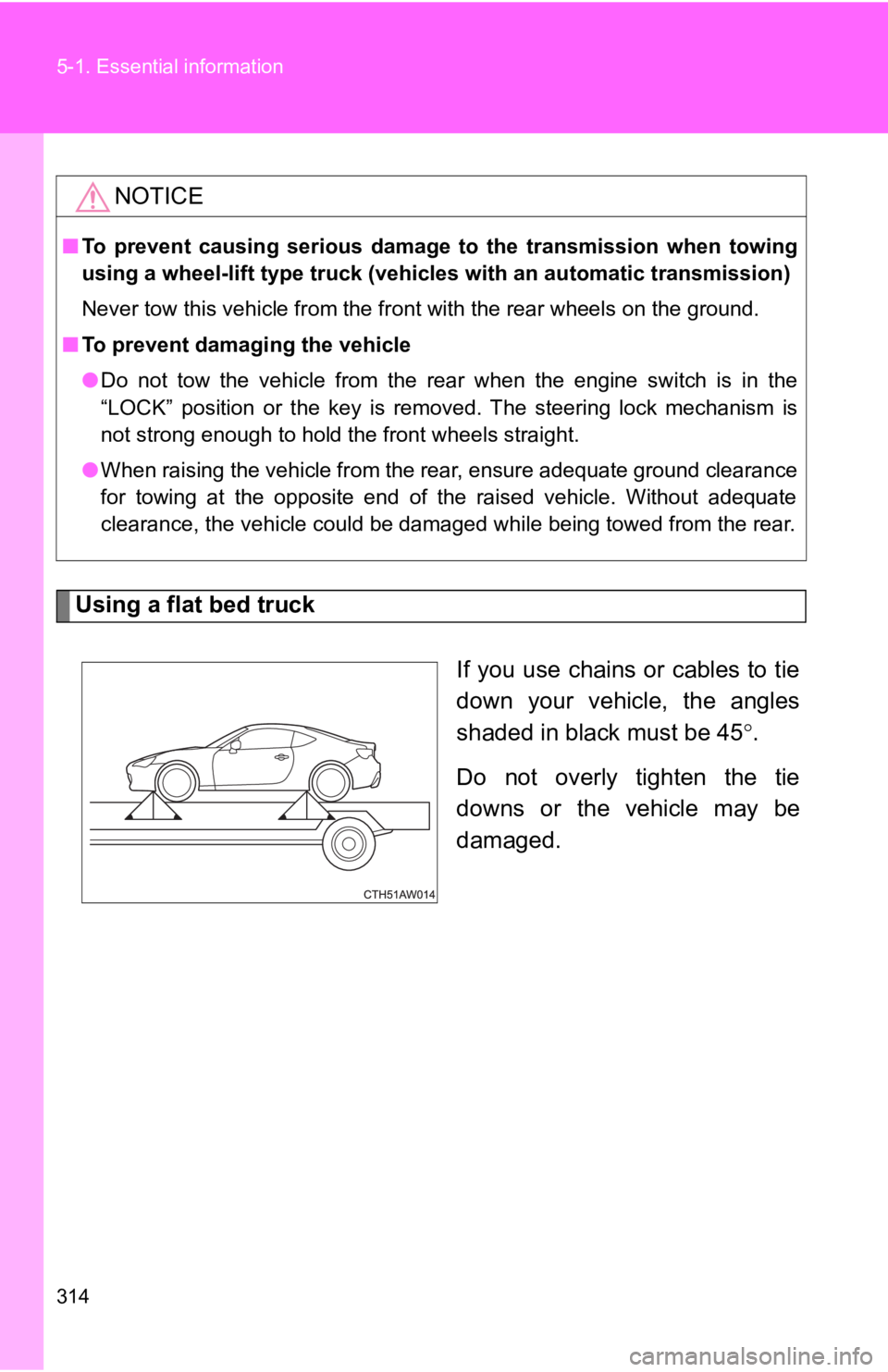
Using a flat bed truck
If you use chains or cables to tie
down your vehicle, the angles
shaded in black must be 45 ° .
Do not overly tighten the tie
downs or the vehicle may be
damaged.NOTICE■ To prevent causing serious damage to the transmission when towing
using a wheel-lift type truck (vehicles with an automatic transmission)
Never tow this vehicle from the front with the rear wheels on the ground.
■ To prevent damaging the vehicle
● Do not tow the vehicle from the rear when the engine switch is in the
“LOCK” position or the key is removed. The steering lock mechanism is
not strong enough to hold the front wheels straight.
● When raising the vehicle from the rear, ensure adequate ground clearance
for towing at the opposite end of the raised vehicle. Without adequate
clearance, the vehicle could be damaged while being towed from the rear.