Page 42 of 428
421-3. Adjustable components (seats, mirrors, steering wheel)
Seat belts Make sure that all occupants are wear ing their seat belts before driv-
ing the vehicle.
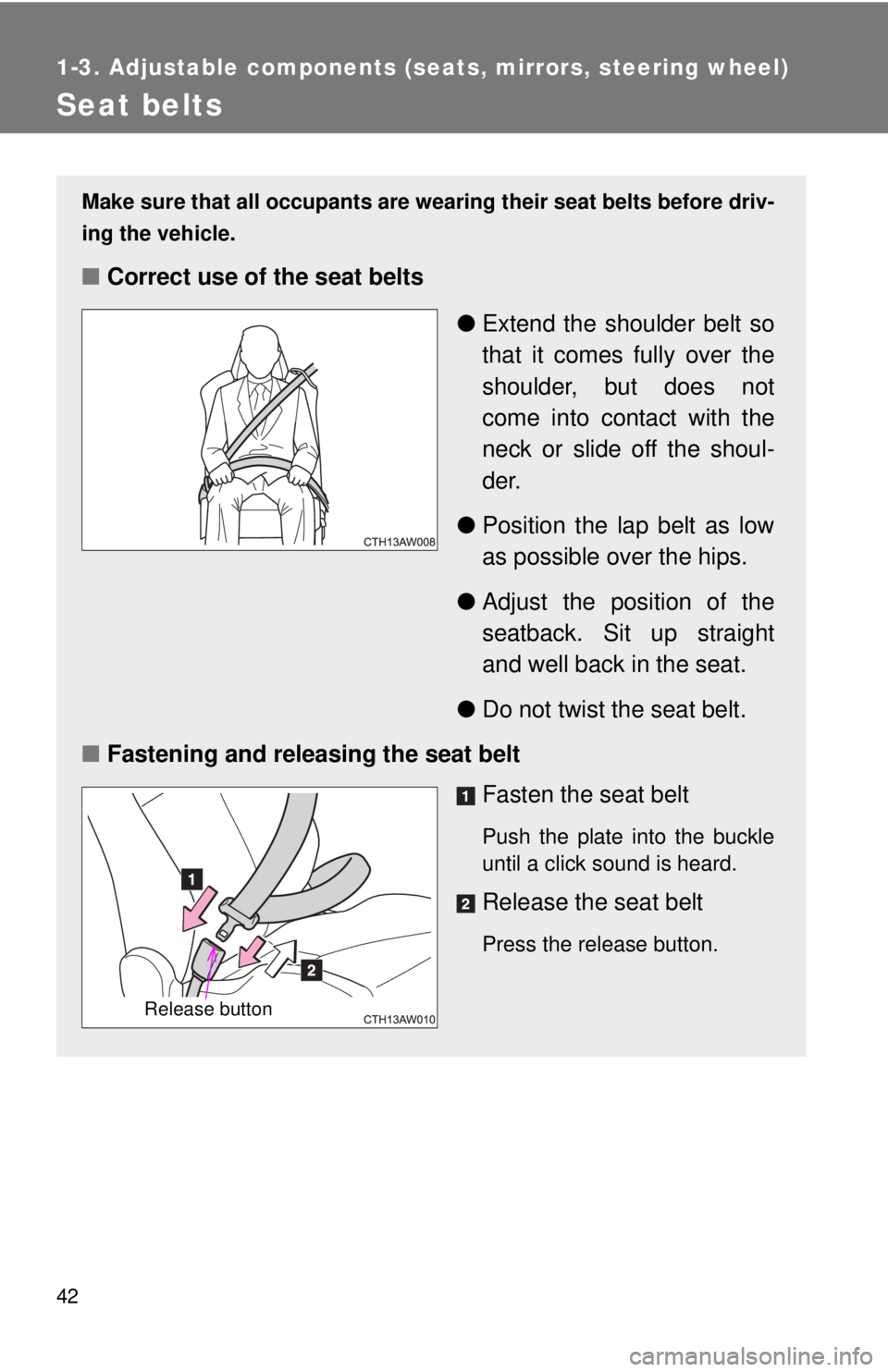
■ Correct use of the seat belts
● Extend the shoulder belt so
that it comes fully over the
shoulder, but does not
come into contact with the
neck or slide off the shoul-
der.
● Position the lap belt as low
as possible over the hips.
● Adjust the position of the
seatback. Sit up straight
and well back in the seat.
● Do not twist the seat belt.
■ Fastening and releasing the seat belt
Fasten the seat belt Push the plate into the buckle
until a click sound is heard.
Release the seat belt Press the release button.
Release button
Page 43 of 428
431-3. Adjustable components (s eats, mirrors, steering wheel)
1
Before driving Front seat belt guide
To enable the seat belt to be
easily extended, pass the seat
belt through the guide. When getting in or out of the rear
seats, release the seat belt from
the guide.
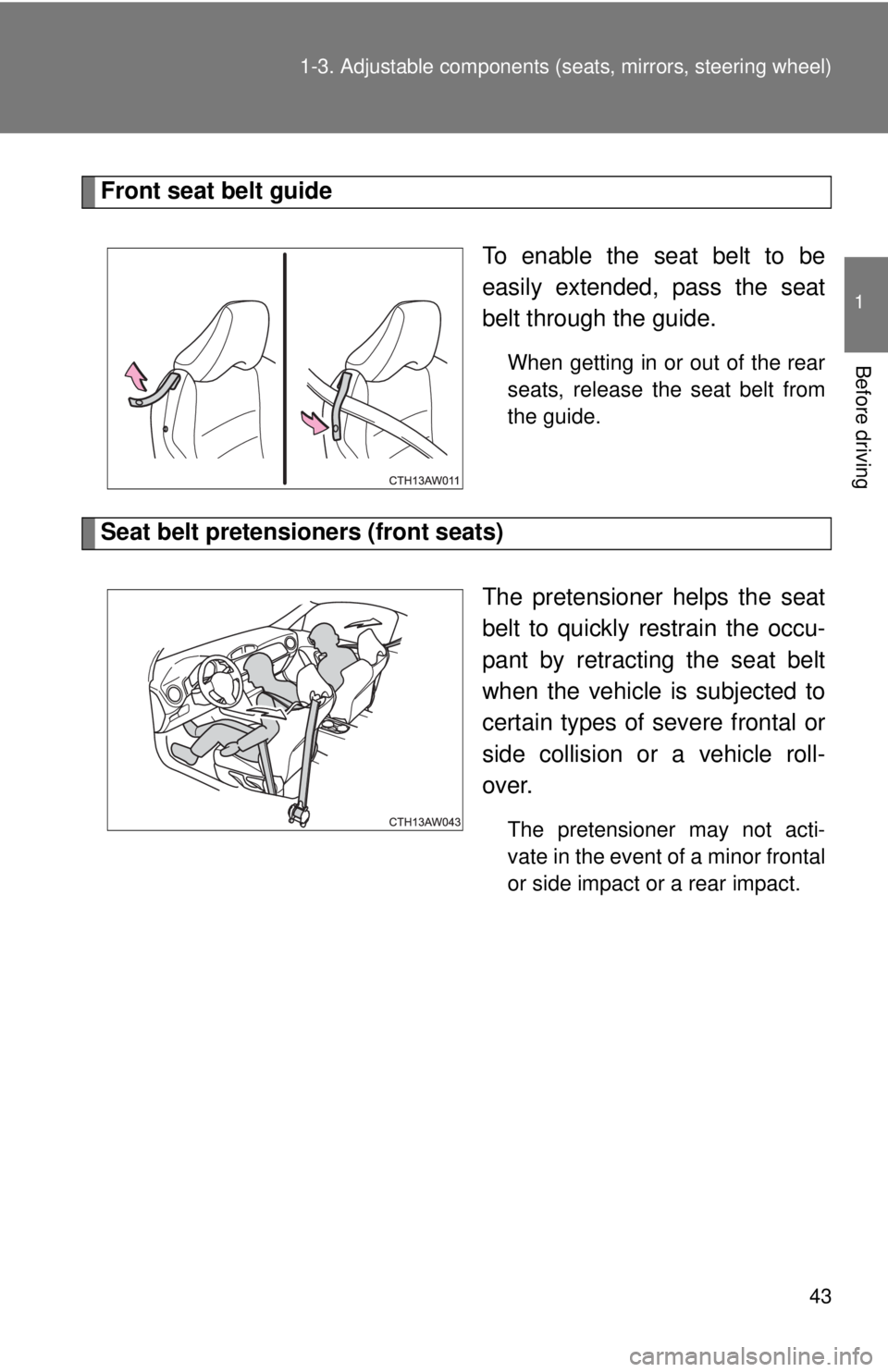
Seat belt pretensioners (front seats)
The pretensioner helps the seat
belt to quickly restrain the occu-
pant by retracting the seat belt
when the vehicle is subjected to
certain types of severe frontal or
side collision or a vehicle roll-
over. The pretensioner may not acti-
vate in the event of a minor frontal
or side impact or a rear impact.
Page 46 of 428

461-3. Adjustable components (s eats, mirrors, steering wheel)
WARNINGObserve the following precautions to reduce the risk of injury in the event of
sudden braking, sudden swerving or an accident.
Failure to do so may cause death or serious injury.
■ Wearing a seat belt
● Ensure that all passengers wear a seat belt.
● Always wear a seat belt properly.
● Each seat belt should be used by one person only. Do not use a seat belt
for more than one person at once, including children.
● Toyota recommends that children be seated in the rear seat and always
use a seat belt and/or an appropriate child restraint system.
● To achieve a proper seating position, do not recline the seat more than
necessary. The seat belt is most effective when the occupants are sitting
up straight and well back in the seats.
● Do not wear the shoulder belt under your arm.
● Always wear your seat belt low and snug across your hips.
■ Pregnant women
Obtain medical advice and wear the seat
belt in the proper way. ( → P. 42)
Women who are pregnant should position
the lap belt as low as possible over the
hips in the same manner as other occu-
pants. Extend the shoulder belt com-
pletely over the shoulder and position the
belt across the chest. Avoid belt contact
over the rounding of the abdominal area.
If the seat belt is not worn properly, not
only the pregnant woman, but also the
fetus could suffer death or serious injury
as a result of sudden braking or a colli-
sion.
Page 49 of 428
49 11-3. Adjustable components (seats, mirrors, steering wheel)
Before driving
Steering wheel
WARNING■ Caution while driving
Do not adjust the steering wheel while driving.
Doing so may cause the driver to mishandle the vehicle and an accident,
resulting in death or serious injury.
■ After adjusting the steering wheel
Make sure that the steering wheel is securely locked.
Otherwise, the steering wheel may move suddenly, possibly causing an
accident, and resulting in death or serious injury.The steering wheel can be adjust ed to a comfortable position.
Hold the steering wheel and
push the lever down.
Adjust to the ideal position by
moving the steering wheel
horizontally and vertically. After adjustment, pull the lever
up to secure the steering
wheel.STEP 1
STEP 2
Page 50 of 428
501-3. Adjustable components (seats, mirrors, steering wheel)
Anti-glare inside rear view mirror Adjusting the height of rear view mirror
Adjust the height of the rear view
mirror by moving it up and down.
Anti-glare function
Reflected light from the headlights of vehicles behind can be
reduced by operating the lever.
Normal position
Anti-glare positionThe rear view mirror’s position can be adjusted to enable sufficient
confirmation of the rear view in accordance with the driver's seating
posture.
WARNING
■ Caution while driving
Do not adjust the position of the mirror while driving.
Doing so may lead to mishandling of the vehicle and cause an accident,
resulting in death or serious injury.
Page 51 of 428
51 11-3. Adjustable components (seats, mirrors, steering wheel)
Before driving
Outside rear view mirrors Mirror angle can be adju sted using the switch.
Select a mirror to adjust.
Left
Right
Adjust the mirror.
Up
Right
Down
LeftSTEP 1
STEP 2
Page 65 of 428

651-7. Safety information
1
Before driving WARNING■ While driving
● Do not adjust the position of the driver's seat.
Doing so could cause the driver to lose control of the vehicle.
● Do not place a cushion between the driver or passenger and the seatback.
A cushion may prevent correct posture from being achieved, and reduce
the effectiveness of the seat belt and head restraint, increasing the risk of
death or serious injury to the driver or passenger.
● Do not place anything under the front seats.
Objects placed under the front seats may become jammed in the seat
tracks and stop the seat from locking in place. This may lead to an acci-
dent resulting in serious injury or death. The adjustment mechanism may
also be damaged.
■ Adjusting the seat position
● Take care when adjusting the seat position to ensure that other passen-
gers are not injured by the moving seat.
● Do not put your hands under the seat or near the moving parts to avoid
injury.
Fingers or hands may become jammed in the seat mechanism.
Page 69 of 428
691-7. Safety information
1
Before driving WARNING■ SRS airbag
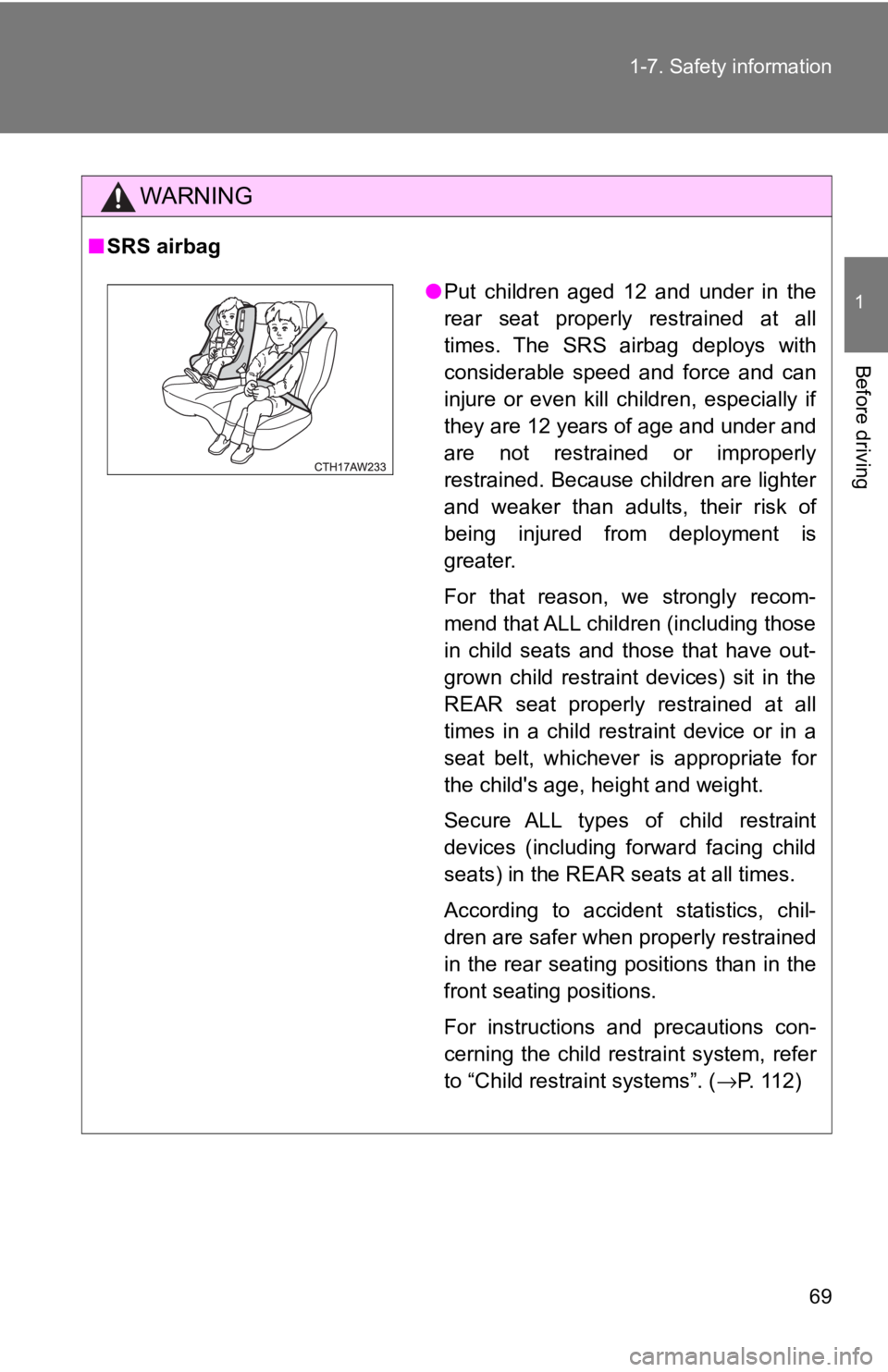
● Put children aged 12 and under in the
rear seat properly restrained at all
times. The SRS airbag deploys with
considerable speed and force and can
injure or even kill children, especially if
they are 12 years of age and under and
are not restrained or improperly
restrained. Because children are lighter
and weaker than adults, their risk of
being injured from deployment is
greater.
For that reason, we strongly recom-
mend that ALL children (including those
in child seats and those that have out-
grown child restraint devices) sit in the
REAR seat properly restrained at all
times in a child restraint device or in a
seat belt, whichever is appropriate for
the child's age, height and weight.
Secure ALL types of child restraint
devices (including forward facing child
seats) in the REAR seats at all times.
According to accident statistics, chil-
dren are safer when properly restrained
in the rear seating positions than in the
front seating positions.
For instructions and precautions con-
cerning the child restraint system, refer
to “Child restraint systems”. ( → P. 112)