Page 140 of 428

1402-1. Driving procedures
NOTICE■ Pre-driving check
Trapping small animals in the cooling fan and belts of the engine may result
in a malfunction. Check that no small animal enters the engine compartment
and under the vehicle before starting the engine.
■ When driving the vehicle
Vehicles with an automatic transmission
● Do not depress the accelerator and brake pedals at the same time during
driving, as this may restrain driving torque.
● Do not use the accelerator pedal or depress the accelerator and brake
pedals at the same time to hold the vehicle on a hill.
Vehicles with a manual transmission
● Do not depress the accelerator and brake pedals at the same time during
driving, as this may restrain driving torque.
● Do not shift gears unless the clutch pedal is fully depressed. After shifting,
do not release the clutch pedal abruptly. Doing so may damage the clutch,
transmission and gears.
● Observe the following to prevent the clutch from being damaged.
• Do not rest your foot on the clutch pedal while driving.
Doing so may cause clutch trouble.
• Do not use any gear other than the 1st gear when starting off and mov-
ing forward.
Doing so may damage the clutch.
• Do not use the clutch to hold the vehicle when stopping on an uphill
grade.
Doing so may damage the clutch.
● Do not shift the shift lever to R when the vehicle is still moving. Doing so
may damage the clutch, transmission and gears.
● Do not release the clutch pedal too quickly. Doing so may damage the
transmission.
■ When parking the vehicle (vehicles with an automatic transmission)
Always shift the shift lever to P. Failure to do so may cause the vehicle to
move or the vehicle may accelerate suddenly if the accelerator pedal is acci-
dentally depressed.
Page 142 of 428
1422-1. Driving procedures
Engine (ignition) switch ■ Starting the engine
Vehicles with an au tomatic transmission
Check that the parking brake is set.
Check that the shift lever is set in P.
Firmly depress the brake pedal.
Turn the engine switch to the “START” position to start the
engine.
Vehicles with a manual transmission
Check that the parking brake is set.
Check that the shift lever is set in N.
Firmly depress the clutch pedal.
Turn the engine switch to the “START” position to start the
engine.
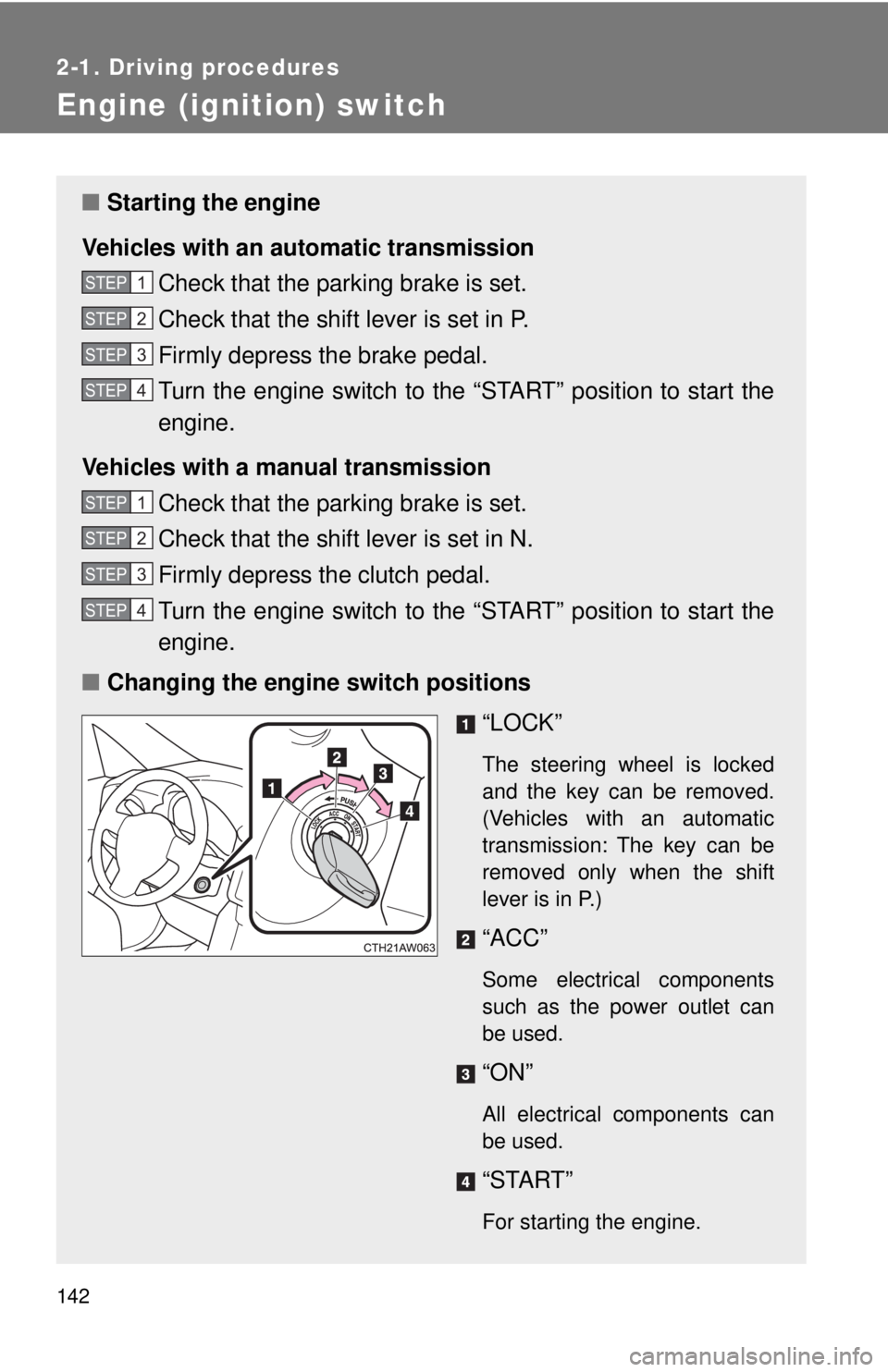
■ Changing the engine switch positions
“LOCK” The steering wheel is locked
and the key can be removed.
(Vehicles with an automatic
transmission: The key can be
removed only when the shift
lever is in P.)
“ACC” Some electrical components
such as the power outlet can
be used.
“ON”
All electrical components can
be used.
“START”
For starting the engine.STEP 1
STEP 2
STEP 3
STEP 4
STEP 1
STEP 2
STEP 3
STEP 4
Page 143 of 428

1432-1. Driving procedures
2
When driving ■ Turning the key from “ACC” to “LOCK”
Shift the shift lever to N (manual transmission) or P (automatic
transmission). ( → P. 145, 152)
■ If the engine does not start
The engine immobilizer system may not have been deactivated. ( → P. 61)
Contact your Toyota dealer.
■ When the steering lock cannot be released
■ Key reminder function
A buzzer sounds if the driver’s door is opened while the engine switch is in
the “LOCK” or “ACC” position to remind you to remove the key.
■ Immediately after reconnecting the battery terminals due to replacing
the battery and so forth
The engine may not start. If this occurs, turn the engine switch to the “ON”
position, and start the engine after waiting at least 10 seconds. Idling may be
unstable immediately after the engine starts, however, this is not a malfunc-
tion. STEP 1
Push in the key and turn to the “LOCK”
position.STEP 2
When starting the engine, the engine
switch may seem stuck in the “LOCK”
position. To free it, turn the key while turn-
ing the steering wheel slightly left and
right.
Page 150 of 428

1502-1. Driving procedures
■ Automatic gear selection when the vehicle is stopped
When the vehicle is idling at high rpm in order to warm up, and the vehicle is
on a slippery road, the transmission may automatically shift to 2 nd
gear for
stopping and starting off.
■ Temporary manual mode driving
Temporary manual mode driving will be deactivated and normal D position
driving will be returned to in the following situations:
● When driving for longer than the set time (the set time differs according
to driving conditions).
● When the vehicle comes to a stop.
● When the accelerator pedal is continually depressed for longer than the
set time.
● When the accelerator pedal is fully, or near-fully, depressed. Temporary manual mode driving can be
changed to by operating the paddle shift
switches while the shift lever is in the D
position.
When this occurs, the selected gear and
“D” are displayed on the shift position and
shift range indicator.
(When engine speed rises close to the
red zone, upshifting will be automatically
performed.)
Page 152 of 428
1522-1. Driving procedures
Manual Transmission ∗
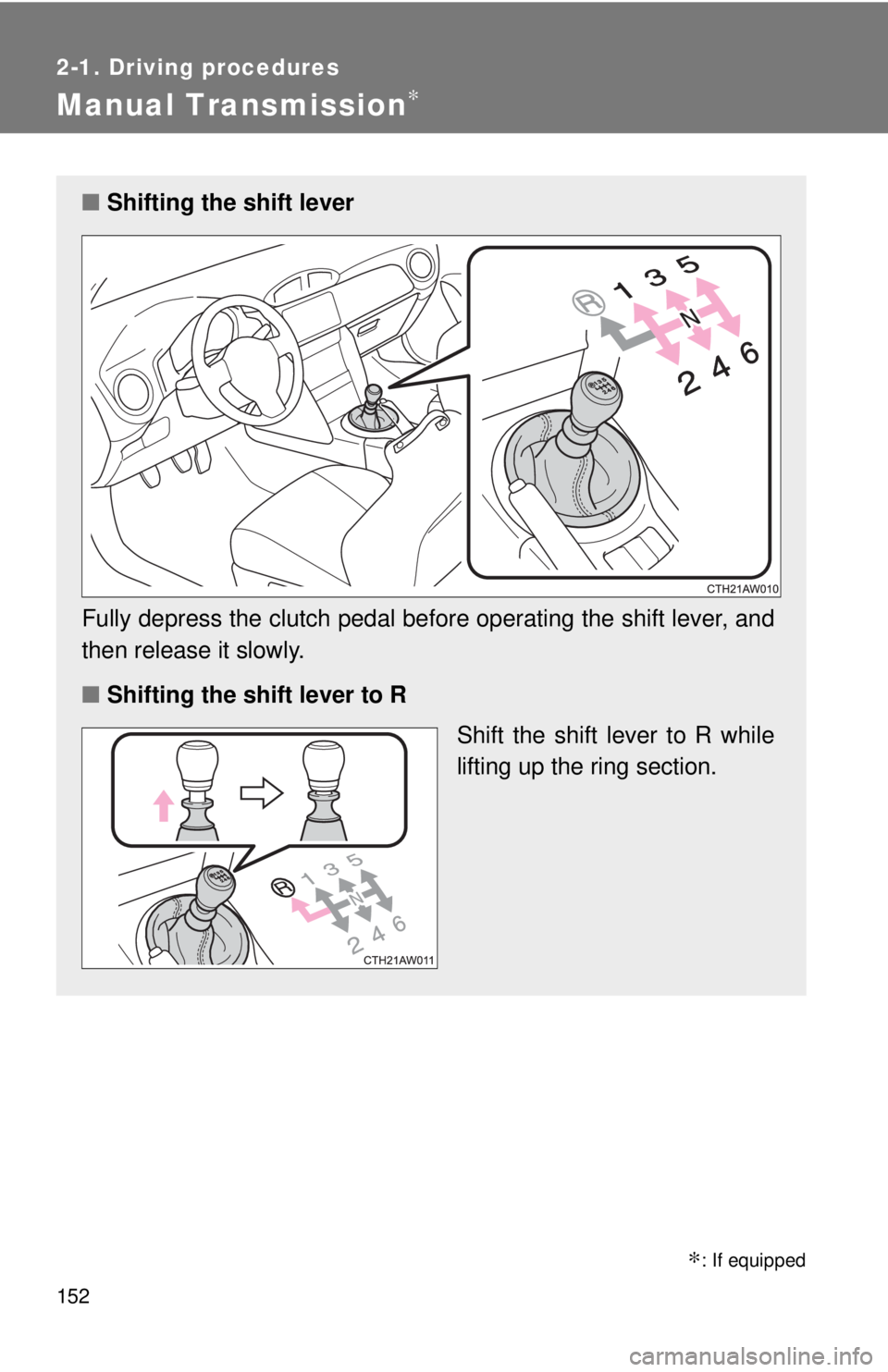
∗ : If equipped■ Shifting the shift lever
Fully depress the clutch pedal before operating the shift lever, and
then release it slowly.
■ Shifting the shift lever to R
Shift the shift lever to R while
lifting up the ring section.
Page 162 of 428

1622-2. Instrument cluster
■ Indicators
The indicators inform the driver of the operating state of the
vehicle’s various systems. Turn signal indicator
( → P. 155) Slip indicator
( → P. 185)
Headlight high beam
indicator ( → P. 173) Hill-start assist control
ON indicator
( → P. 191)
Security indicator
( → P. 61) “TRAC OFF” indicator
( → P. 185)
Shift position and shift
range indicator
( → P. 146) VSC off indicator
( → P. 186)(Vehicles with an automatic transmission)
“TRACK” indicator
( → P. 186)Upshift/downshift indi-
cator ( → P. 148, 150)(Vehicles with an automatic transmission)
REV indicator
( → P. 132)“SPORT” indicator
( → P. 147)(Vehicles with an automatic transmission)
“SNOW” indicator
( → P. 147) (Green)
Cruise control indicator
( → P. 179)(Vehicles with an automatic transmission)
Shift position indicator
( → P. 153) “SET” indicator
( → P. 179)(Vehicles with a manual transmission)
Airbag on-off indicator ( → P. 104)Shift-up indicator
( → P. 153)(Vehicles with a manual transmission) * 1, 2
* 2
* 1
* 1
Page 165 of 428
1652-2. Instrument cluster
2
When driving
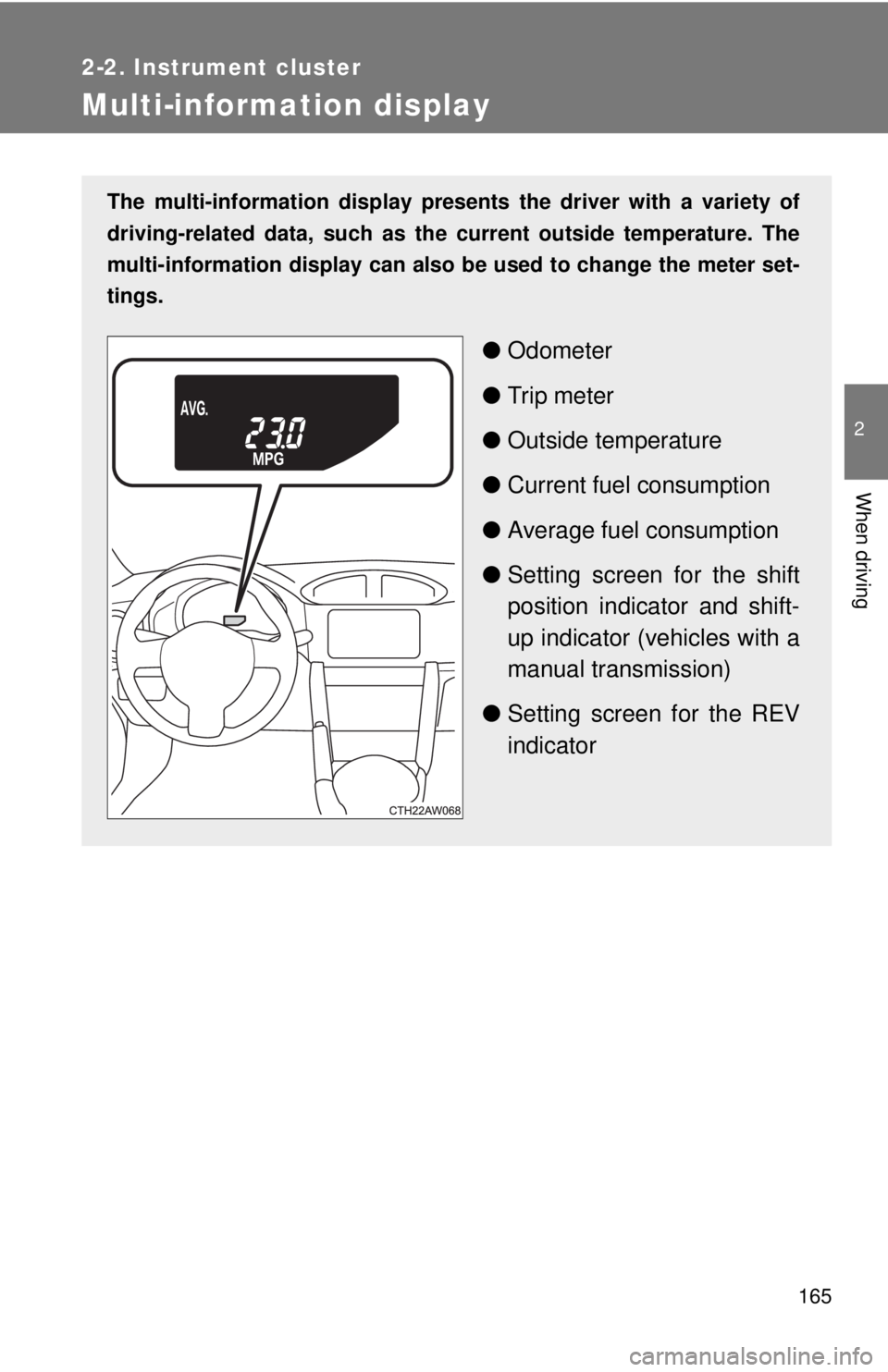
Multi-information display The multi-information display presen ts the driver with a variety of
driving-related data, such as the current outside temperature. The
multi-information display can also be used to change the meter set-
tings.
● Odometer
● Trip meter
● Outside temperature
● Current fuel consumption
● Average fuel consumption
● Setting screen for the shift
position indicator and shift-
up indicator (vehicles with a
manual transmission)
● Setting screen for the REV
indicator
Page 166 of 428
1662-2. Instrument cluster
Switch the display
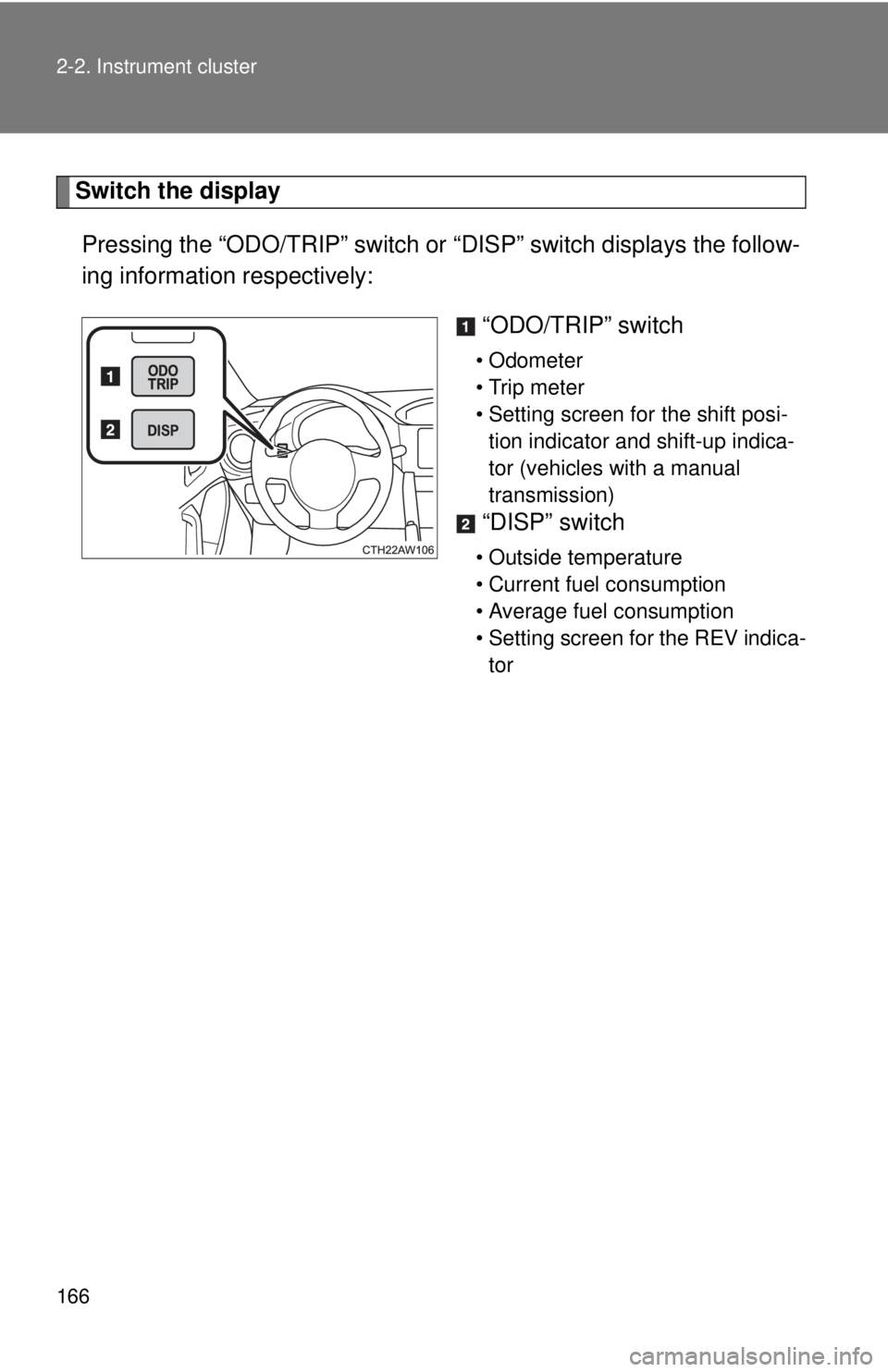
Pressing the “ODO/TRIP” switch or “DISP” switch displays the follow-
ing information respectively:
“ODO/TRIP” switch • Odometer
• Trip meter
• Setting screen for the shift posi-
tion indicator and shift-up indica-
tor (vehicles with a manual
transmission)
“DISP” switch • Outside temperature
• Current fuel consumption
• Average fuel consumption
• Setting screen for the REV indica-
tor