Page 279 of 428

2794-3. Do-it-yourself maintenance
4
Maintenance and care ■
Effects of incorrect tire inflation pressure
Driving with incorrect ti re inflation pressure ma y result in the following:●
Reduced fuel economy●
Reduced driving comfort and poor handling●
Reduced tire life due to wear●
Reduced safety●
Damage to the drive train
If a tire needs frequent re filling, have it checked by your Toyota dealer.■
Instructions for checking tire inflation pressure
When checking tire inflation pressure, observe the following: ●
Check only when the tires are cold.
If your vehicle has been parked for at least 3 hours and has not been
driven for more than 1 mile or 1.5 km, you will get an accurate cold
tire inflation pressure reading.
●
Always use a tire pressure gauge.
It is difficult to judge if a tire is properly inflated based only on its
appearance.
●
It is normal for the tire inflation pressure to be higher after driving as
heat is generated in the tire. Do not reduce tire inflation pressure after
driving.
●
Never exceed the vehicle capacity weight.
Passengers and luggage weight should be placed so that the vehicle
is balanced.
Page 319 of 428

5
When trouble arises
3195-2. Steps to take in an emergency
(Comes on in
yellow) Cruise control indicator light
Indicates a malfunction in the cruise control system.
■ If the malfunction indicator lamp comes on while driving
First check the following:
● Is the fuel tank empty?
If it is, fill the fuel tank immediately.
● Is the fuel tank cap loose?
If it is, tighten it securely.
The malfunction indicator lamp will go off after several driving trips.
If the malfunction indicator lamp does not go off even after several trips, con-
tact your Toyota dealer as soon as possible.
■ SRS warning light
→ P. 102
■ Electric power steering warning light (warning buzzer)
The electric power steering warning light may come on and the warning
buzzer may sound when the voltage is low or the voltage drops.
WARNING
■ When the electric power steering warning light comes on
The steering wheel may become extremely heavy.
If the steering wheel becomes heavier than usual when operating, hold
firmly and operate using more force than usual.Warning light Warning light/Details
Page 354 of 428
3546-1. Specifications
Maintenance data (fuel, oil level, etc.) Dimensions and weight
* : Unladen vehicle Overall length 166.7 in. (4235 mm)
Overall width 69.9 in. (1775 mm)
Overall height
* 52.0 in. (1320 mm)
Wheelbase 101.2 in. (2570 mm)
Tread Front 59.8 in. (1520 mm)
Rear 60.6 in. (1540 mm)
Vehicle capacity weight
(Occupants + luggage) Details are described on the tire and load-
ing information label. ( → P. 277)
Page 357 of 428
3576-1. Specifications
6
Vehicle specifications Engine
Fuel
* : If unleaded gasoline with an octane rating of 93 (98 RON) is not available,
unleaded gasoline with an octane rating of 91 (95 RON) may be used with
no detriment to engine durability or driveability.Model FA20
Ty p e Horizontally opposed, liquid cooled 4 cylinder, 4-
stroke gasoline
Bore and stroke 3.39 × 3.39 in. (86.0 × 86.0 mm)
Displacement 121.93 cu.in. (1998 cm 3
)
Drive belt tension Automatic adjustment
Fuel type Unleaded gasoline only
Octane rating 93 (Research octane number 98) or higher
*Fuel tank capacity
(Reference) 13.2 gal. (50 L, 11.0 Imp. gal.)
Page 358 of 428
3586-1. Specifications
Lubrication system
* : The engine oil capacity is a reference quantity to be used when changing
the engine oil. Warm up and turn off the engine, wait more than 5 minutes,
and check the oil level on the dipstick.
■ Engine oil selection
“Toyota Genuine Motor Oil” is used in your Toyota vehicle. Use
Toyota approved “Toyota Genuine Motor Oil” or equivalent to satisfy
the following grade and viscosity.
Oil grade: ILSAC GF-5 multigrade engine oil
Recommended viscosity: SAE 0W-20
SAE 0W-20 is the best choice for
good fuel economy and good
starting in cold weather.
If SAE 0W-20 is not available,
SAE 5W-20 oil may be used.
However, it must be replaced
with SAE 0W-20 at the next oil
change.Oil capacity
(Drain and refill ⎯
reference*)
Without filter
With filter 5.5 qt. (5.2 L, 4.6 Imp. qt.)
5.7 qt. (5.4 L, 4.8 Imp. qt.)
Outside temperature
Page 361 of 428
3616-1. Specifications
6
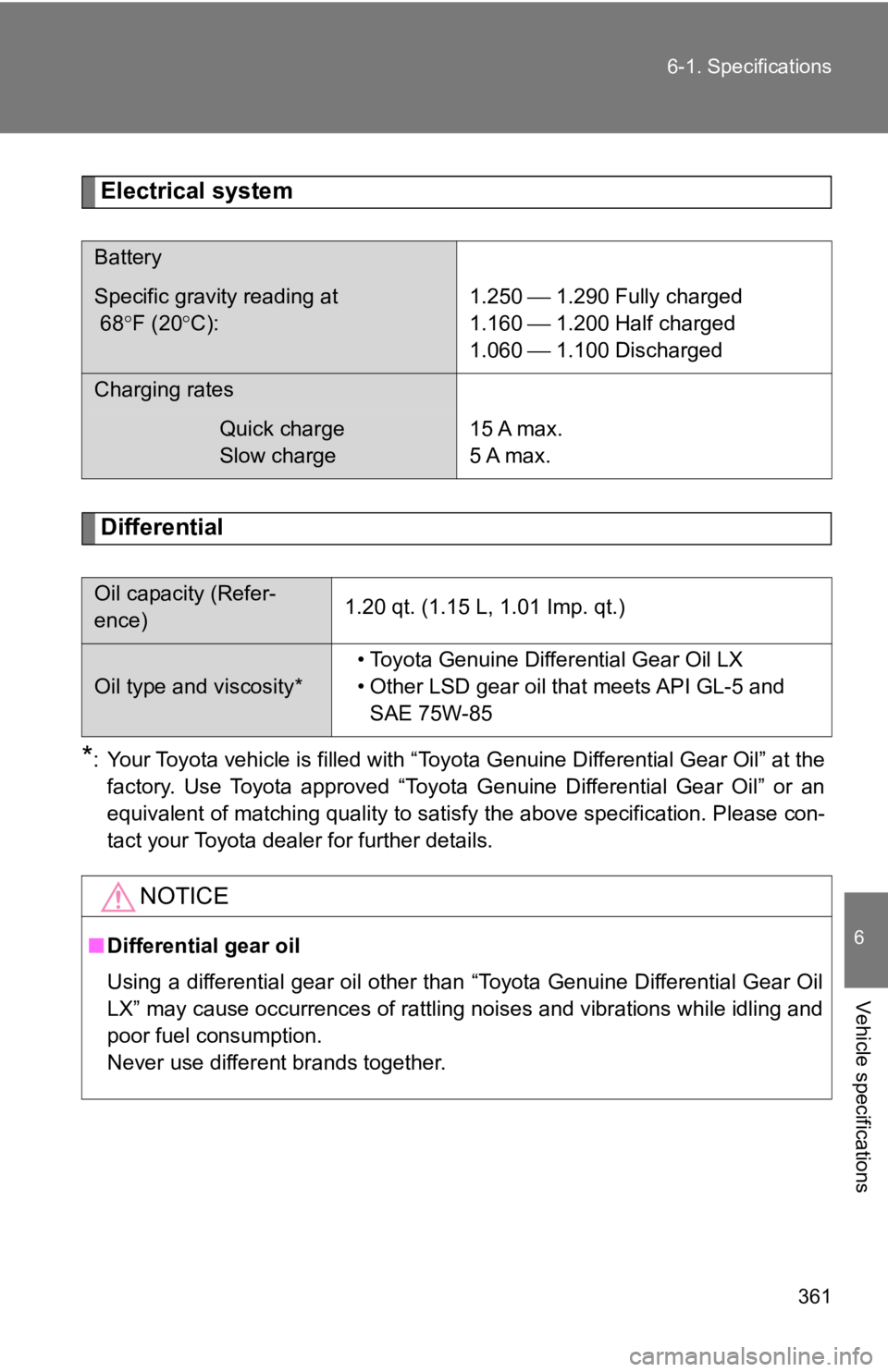
Vehicle specifications Electrical system
Differential
* : Your Toyota vehicle is filled with “Toyota Genuine Differential Gear Oil” at the
factory. Use Toyota approved “Toyota Genuine Differential Gear Oil” or an
equivalent of matching quality to satisfy the above specification. Please con-
tact your Toyota dealer for further details.Battery
Specific gravity reading at
68 ° F (20 ° C): 1.250 ⎯ 1.290 Fully charged
1.160 ⎯ 1.200 Half charged
1.060 ⎯ 1.100 Discharged
Charging rates
Quick charge
Slow charge 15 A max.
5 A max.
Oil capacity (Refer-
ence) 1.20 qt. (1.15 L, 1.01 Imp. qt.)
Oil type and viscosity* • Toyota Genuine Differential Gear Oil LX
• Other LSD gear oil that meets API GL-5 and
SAE 75W-85
NOTICE
■ Differential gear oil
Using a differential gear oil other than “Toyota Genuine Differential Gear Oil
LX” may cause occurrences of rattling noises and vibrations while idling and
poor fuel consumption.
Never use different brands together.
Page 362 of 428

3626-1. Specifications
Automatic transmission
*: The fluid capacity is provided as a reference. If replacement is necessary,
contact your Toyota dealer.
Manual transmission
*: The recommended oil grade is API GL-3. However, API GL-4 can also be
used.Fluid capac-
ity* 7.9 qt. (7.5 L, 6.6 Imp. qt.)
Fluid type TOYOTA Genuine ATF WS
NOTICEUsing automatic transmission fluid other than “TOYOTA Genuine ATF WS”
may cause deterioration in shift quality, locking up of your transmission accom-
panied by vibration, and ultimately damage the automatic transmission of your
vehicle.
Gear oil capacity (Reference) 2.3 qt. (2.2 L, 1.9 Imp. qt.)
Gear oil type and viscosity Use either of the following:
• “TOYOTA Genuine MG Gear Oil special
II”
• Other gear oil that meets API GL-3* and
SAE 75W-90 specifications
NOTICE
■ Manual transmission gear oil
Using a manual transmission gear oil other than “TOYOTA Genuine MG
Gear Oil special II” may cause occurrences of rattling noises while idling and
poor fuel consumption.
Never use different brands together.
Page 376 of 428

3766-1. Specifications
Warning: The temperature grades of a tire assume that it is properly
inflated and not overloaded.
Excessive speed, underinflation, or excessive loading, either sepa-
rately or in combinatio n, can cause heat buildup and possible tire fail-
ure.
Glossary of tire terminology
Tire related term Meaning
Cold tire inflation
pressure Tire pressure when the vehicle has been
parked for three hours or more, or has not
been driven more than 1 mile or 1.5 km under
that condition
Maximum inflation
pressure The maximum cold inflated pressure to which a
tire may be inflated, s hown on the sidewall of
the tire
Recommended
inflation pressure Cold tire inflation pressure recommended by a
manufacturer.
Accessory weight The combined weight (in excess of those stan-
dard items which may be replaced) of auto-
matic transmission, power steering, power
brakes, power windows, power seats, radio
and heater, to the extent that these items are
available as factory-installed equipment
(whether installed or not)
Curb weight The weight of a motor vehicle with standard
equipment, including the maximum capacity of
fuel, oil and coolant, and if so equipped, air
conditioning and additional weight optional
engine
Maximum loaded
vehicle weight The sum of:
(a) Curb weight
(b) Accessory weight
(c) Vehicle capacity weight
(d) Production options weight