Page 294 of 428
2944-3. Do-it-yourself maintenance
16
SPARE See note. Spare fuse17
SPARE See note. Spare fuse18
SPARE See note. Spare fuse19
SPARE See note. Spare fuse20
SPARE See note. Spare fuse21
ST 7.5 A Starting system22
ALT-S 7.5 A
⎯23
(STR LOCK) 7.5 A
⎯24
D/L 20 A Power door lock25
ETCS 15 A Engine control unit26
(AT+B) 7.5 A Transmission
27
(AM2 NO. 2) 7.5 A
⎯28
EFI (CTRL) 15 A Engine control unit
29
EFI (HTR) 15 A Multiport fuel injection system/
sequential multiport fuel injection
system
30
EFI (IGN) 15 A Starting system
31
EFI (+B) 7.5 A Engine control unit
32
HAZ 15 A Turn signal lights, emergency
flashers
33
MPX-B 7.5 A Gauge and meters
34
F/PMP 20 A Multiport fuel injection system/
sequential multiport fuel injection
system
35
IG2 MAIN 30 A SRS airbag system, engine control
unit
36
DCC 30 A Interior light, wireless remote con-
trol, main body ECUFuse Ampere Circuit
Page 295 of 428
2954-3. Do-it-yourself maintenance
4
Maintenance and care
Note
One of each of the following spare fuses are provided: 7.5 A, 10 A, 15
A, 20 A, 25 A, 30 A. 37
HORN NO. 2 7.5 A Horn38
HORN NO. 1 7.5 A Horn39
H-LP LH LO 15 A Left-hand headlight (low beam)40
H-LP RH LO 15 A Right-hand headlight (low beam)41
H-LP LH HI 10 A Left-hand headlight (high beam)42
H-LP RH HI 10 A Right-hand headlight (high beam)
43
INJ 30 A Multiport fuel injection system/
sequential multiport fuel injection
system44
H-LP WASHER 30 A
⎯45
AM2 NO. 1 40 A Starting system, engine control unit
46
EPS 80 A Electric power steering
47
A/B MAIN 15 A SRS airbag system
48
ECU-B 7.5 A Wireless remote control, main body
ECU
49
DOME 20 A Interior light
50
IG2 7.5 A Engine control unitFuse Ampere Circuit
Page 296 of 428
2964-3. Do-it-yourself maintenance
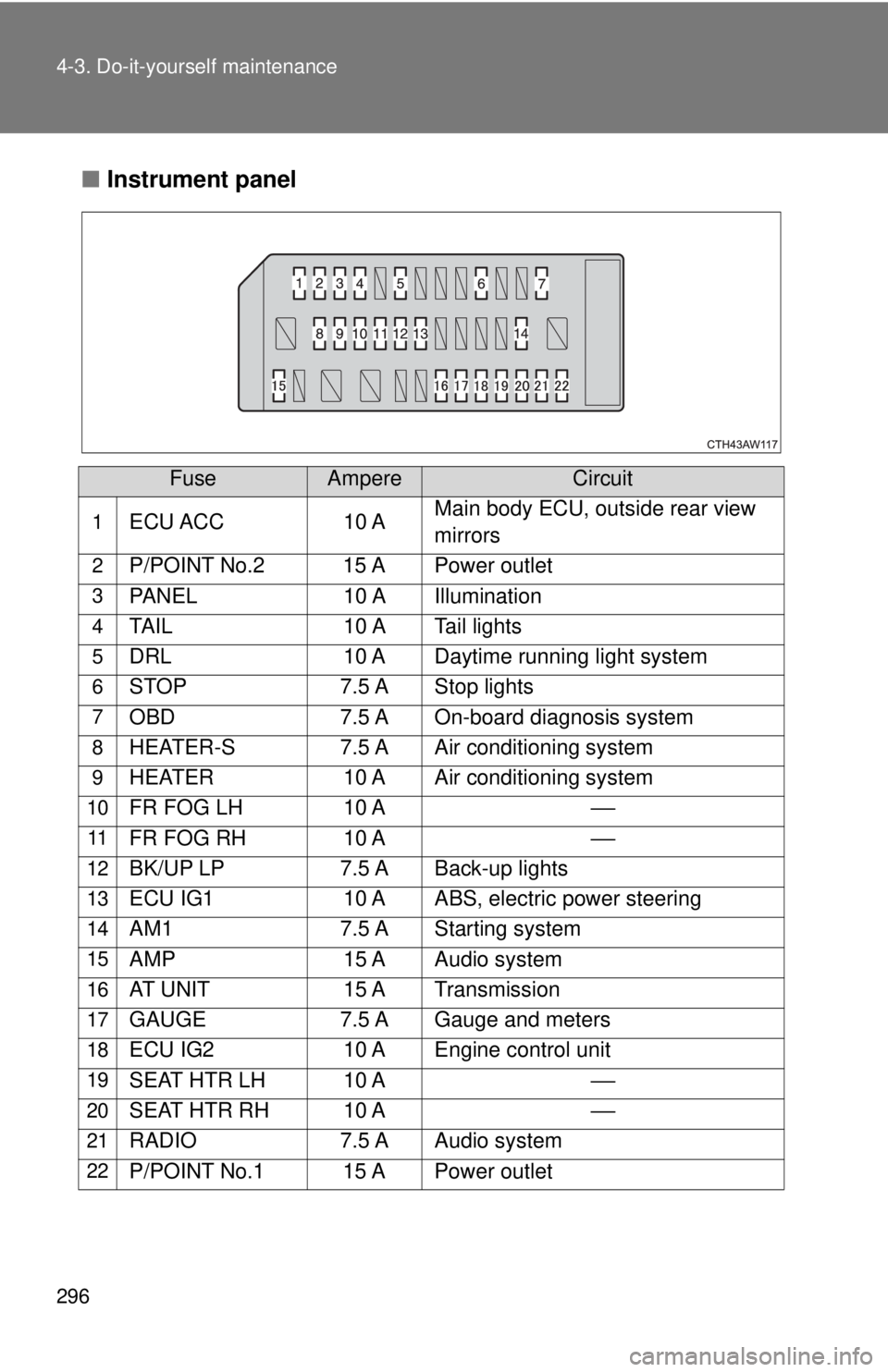
■ Instrument panel
Fuse Ampere Circuit1
ECU ACC 10 A Main body ECU, outside rear view
mirrors2
P/POINT No.2 15 A Power outlet3
PANEL 10 A Illumination4
TAIL 10 A Tail lights5
DRL 10 A Daytime running light system6
STOP 7.5 A Stop lights7
OBD 7.5 A On-board diagnosis system8
HEATER-S 7.5 A Air conditioning system9
HEATER 10 A Air conditioning system
10
FR FOG LH 10 A
⎯11
FR FOG RH 10 A
⎯12
BK/UP LP 7.5 A Back-up lights
13
ECU IG1 10 A ABS, electric power steering
14
AM1 7.5 A Starting system
15
AMP 15 A Audio system
16
AT UNIT 15 A Transmission
17
GAUGE 7.5 A Gauge and meters
18
ECU IG2 10 A Engine control unit
19
SEAT HTR LH 10 A
⎯
20
SEAT HTR RH 10 A
⎯
21
RADIO 7.5 A Audio system
22
P/POINT No.1 15 A Power outlet
Page 304 of 428

3044-3. Do-it-yourself maintenance
WARNING■ Replacing light bulbs
● Turn off the lights. Do not attempt to replace the bulb immediately after
turning off the lights.
The bulbs become very hot and may cause burns.
● Do not touch the glass portion of the light bulb with bare hands. When it is
unavoidable to hold the glass portion, use and hold with a clean dry cloth
to avoid getting moisture and oils on the bulb.
Also, if the bulb is scratched or dropped, it may blow out or crack.
● Fully install the light bulbs and any parts used to secure them. Failure to
do so may result in heat damage, fire, or water entering a light unit. This
may damage the light or cause condensation to build up on the inner side
of the lens.
■ When changing the back-up lights
Stop the engine and wait until the exhaust pipes have cooled down suffi-
ciently. The lights are located near the exhaust pipe and touching a hot
exhaust pipe can cause burns.
■ To prevent damage or fire
Make sure bulbs are fully seated and locked.
Page 305 of 428
When trouble arises
5
3055-1. Essential information
Emergency flashers ......... 306
If your vehicle needs
to be towed .................... 307
If you think something
is wrong ......................... 315
Fuel pump shut off
system ........................... 316 5-2. Steps to take in an
emergency
If a warning light turns
on or a warning
buzzer sounds... ............ 317
If you have a flat tire......... 327
If the engine will not
start ................................ 338
If the shift lever cannot be
shifted from P................. 339
If you lose your keys ........ 340
If the battery is
discharged ..................... 341
If your vehicle
overheats ....................... 345
If the vehicle becomes
stuck .............................. 348
If your vehicle has to be
stopped in an
emergency ..................... 350
Page 306 of 428
3065-1. Essential information
Emergency flashers
■ Emergency flashers
If the emergency flashers are used for a long time while the engine is not
operating, the battery may discharge.The emergency flashers are used to warn other drivers when the
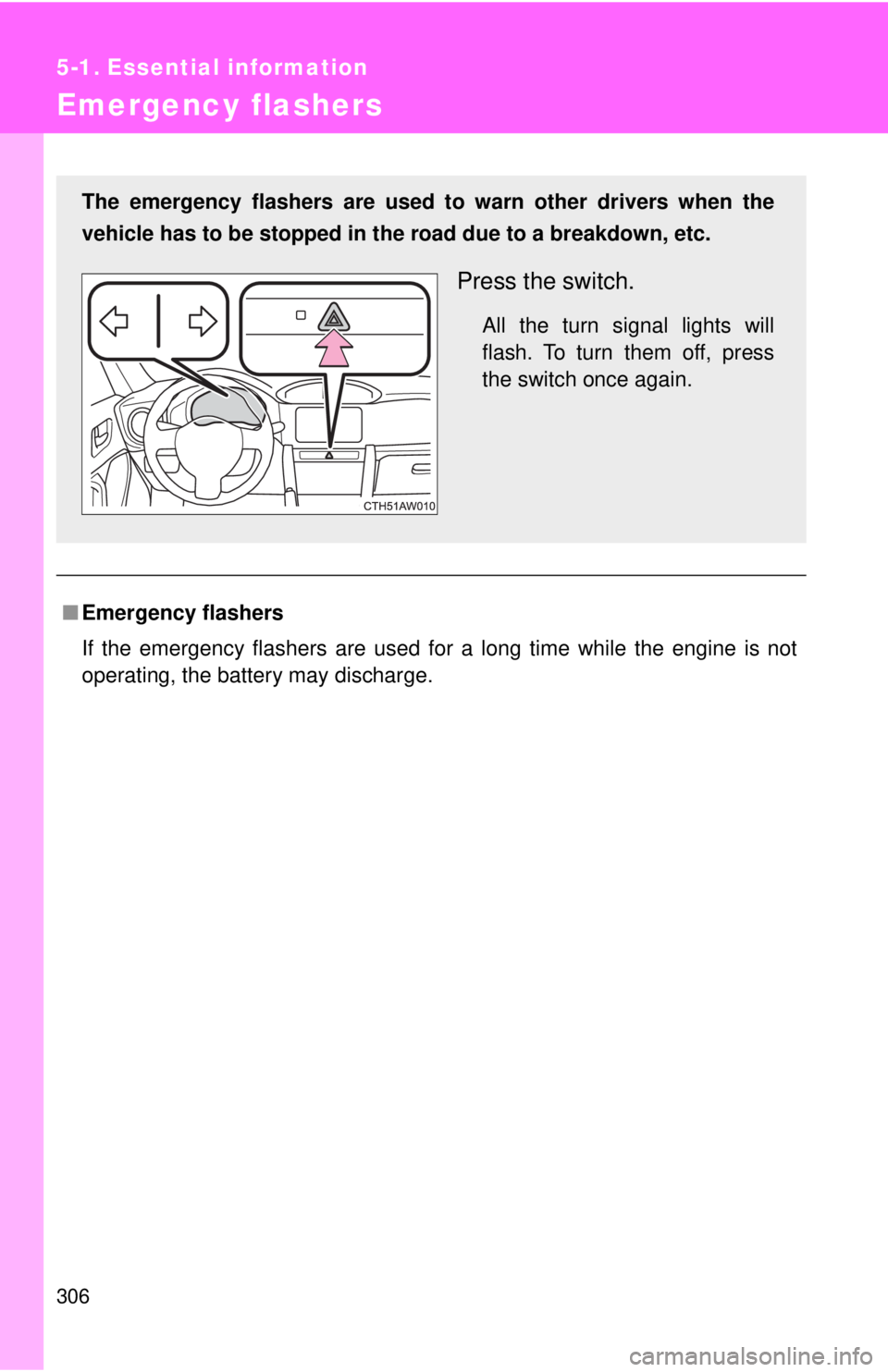
vehicle has to be stopped in the road due to a breakdown, etc.
Press the switch. All the turn signal lights will
flash. To turn them off, press
the switch once again.
Page 307 of 428
5
When trouble arises
3075-1. Essential information
If your vehicle needs to be towed
Before towing
The following may indicate a problem with your transmission. Contact
your Toyota dealer before towing.
● The engine is running, but the vehicle will not move.
● The vehicle makes an abnormal sound.
Emergency towing
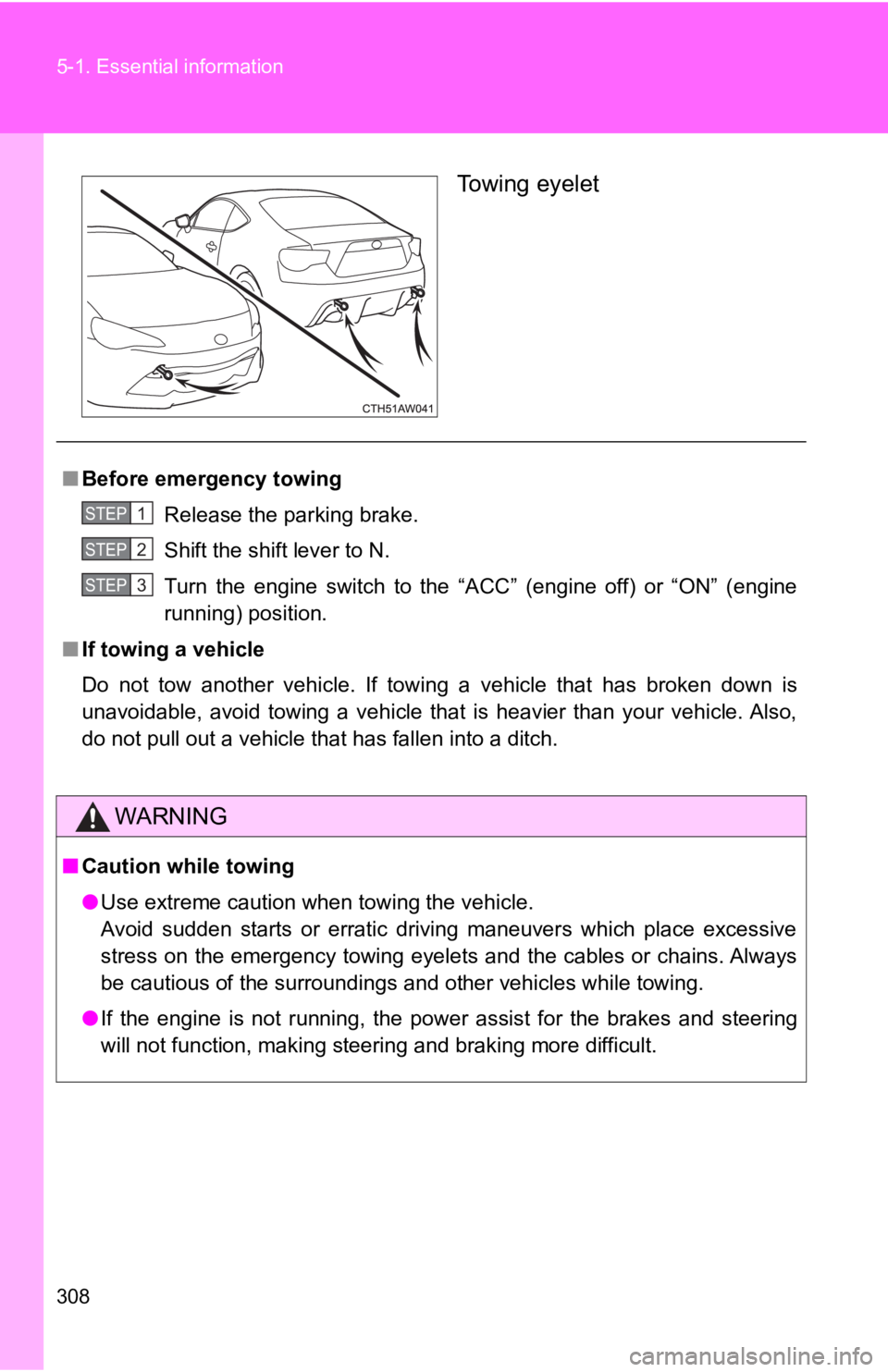
If a tow truck is not available in an emergency, your vehicle may be
temporarily towed using a cable or chain secured to the emergency
towing eyelet. This should only be attempted on hard surfaced roads
for short distances at low speeds.
A driver must be in the vehicle to steer and operate the brakes. The
vehicle’s wheels, drive train, axles, steering and brakes must be in
good condition.
For vehicles with an automatic transmission, only the front towing
eyelet may be used. If towing is necessary, we recommen d having your vehicle towed by
your Toyota dealer or a commerci al towing service, using a lift-type
truck or a flat bed truck.
Use a safety chain system for all to wing, and abide by all state/pro-
vincial and local laws.
If towing from the rear, the vehic le's front wheels and axles must be
in good condition. ( → P. 313)
If they are damaged, use a towing dolly or flat bed truck.
Page 308 of 428
3085-1. Essential information
Towing eyelet
■ Before emergency towing
Release the parking brake.
Shift the shift lever to N.
Turn the engine switch to the “ACC” (engine off) or “ON” (engine
running) position.
■ If towing a vehicle
Do not tow another vehicle. If towing a vehicle that has broken down is
unavoidable, avoid towing a vehicle that is heavier than your vehicle. Also,
do not pull out a vehicle that has fallen into a ditch.
WARNING■ Caution while towing
● Use extreme caution when towing the vehicle.
Avoid sudden starts or erratic driving maneuvers which place excessive
stress on the emergency towing eyelets and the cables or chains. Always
be cautious of the surroundings and other vehicles while towing.
● If the engine is not running, the power assist for the brakes and steering
will not function, making steering and braking more difficult. STEP 1
STEP 2
STEP 3