2017 SUBARU OUTBACK 3-1
[x] Cancel search: 3-1Page 405 of 610
Starting and operating/Electronic Brake Force Distribution (EBD) system
pump the brake pedal since
doing so may defeat the opera-
tion of the ABS.
The ABS prevents the lock-up of wheels
which may occur during sudden braking or
braking on slippery road surfaces. This
helps prevent the loss of steering control
and directional stability caused by wheel
lock-up.
When the ABS is operating, you may hear
a chattering noise or feel a slight vibration
in the brake pedal. This is normal when
the ABS operates.
The ABS will not operate when the vehicle
speed is below approximately 6 mph (10
km/h).
& ABS self-check
You may feel a slight shock in the brake
pedal and hear the operating noise of the
ABS from the engine compartment just
after the vehicle is started. This is caused
by an automatic functional test of the ABS
being carried out and does not indicate
any abnormal condition.
&ABS warning light
Refer to “ABS warning light ”F 3-19.
Electronic Brake Force Dis-
tribution (EBD) system
The EBD system maximizes the effective-
ness of the brakes by allowing the rear
brakes to supply a greater proportion of
the braking force. It functions by adjusting
the distribution of braking force to the rear
wheels in accordance with the vehicle’ s
loading condition and speed.
The EBD system is an integral part of the
ABS and uses some of the ABS compo-
nents to perform its function of optimizing
the distribution of braking force. If any of
the ABS components used by the EBD
function fails, the EBD system also stops
working.
When the EBD system is operating, you
may hear a chattering noise or feel a slight
vibration in the brake pedal. This is normal
and does not indicate a malfunction.
& Steps to take if EBD system
malfunctions
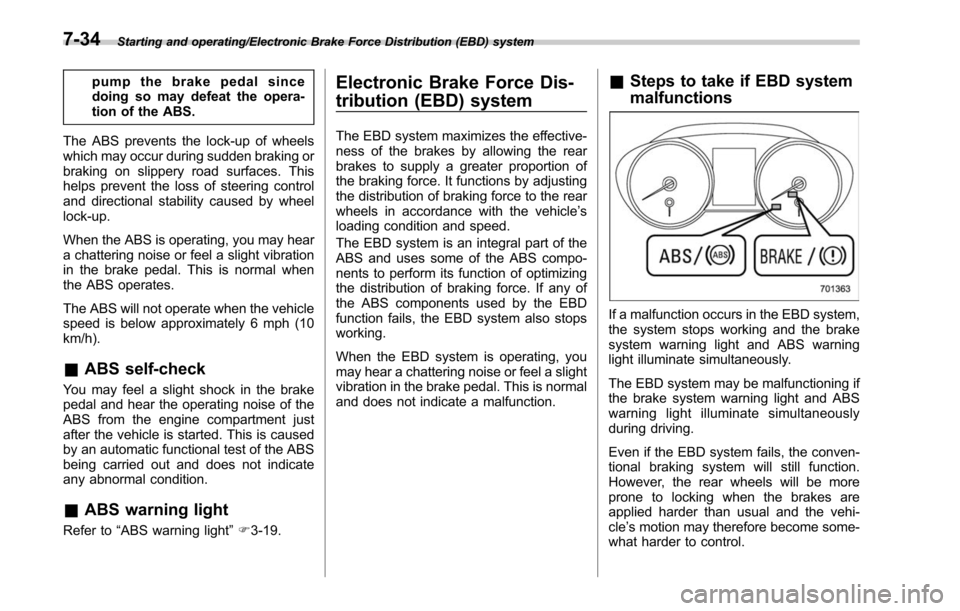
If a malfunction occurs in the EBD system,
the system stops working and the brake
system warning light and ABS warning
light illuminate simultaneously.
The EBD system may be malfunctioning if
the brake system warning light and ABS
warning light illuminate simultaneously
during driving.
Even if the EBD system fails, the conven-
tional braking system will still function.
However, the rear wheels will be more
prone to locking when the brakes are
applied harder than usual and the vehi-
cle’s motion may therefore become some-
what harder to control.
7-34
Page 445 of 610

Driving tips/New vehicle break–in driving –the first 1,000 miles (1,600 km)
New vehicle break-in driving
– the first 1,000 miles (1,600
km)
The performance and long life of your
vehicle are dependent on how you handle
and care for your vehicle while it is new.
Follow these instructions during the first
1,000 miles (1,600 km):
. Do not race the engine. And do not
allow engine speed to exceed 4,000 rpm
except in an emergency.
. Do not drive at one constant engine or
vehicle speed for a long time, either fast or
slow.
. Avoid starting suddenly and rapid
acceleration, except in an emergency.
. Avoid hard braking, except in an
emergency.
The same break-in procedures should be
applied to a newly installed or overhauled
engine or when brake pads or brake
linings are replaced with new ones.
Fuel economy hints
The following suggestions will help to save
your fuel.
. Select the proper gear position for the
speed and road conditions.
. Avoid sudden acceleration or decelera-
tion. Always accelerate gently until you
reach the desired speed. Then try to
maintain that speed for as long as
possible.
. Do not pump the accelerator and avoid
racing the engine.
. Avoid unnecessary engine idling.
. Keep the engine properly tuned.
. Keep the tires inflated to the correct
pressure shown on the tire placard, which
is located under the door latch on the
driver ’s side. Low pressure will increase
tire wear and fuel consumption.
. Use the air conditioner only when
necessary.
. Keep the front and rear wheels in
proper alignment.
. Avoid carrying unnecessary luggage or
cargo.
. The indication of the ECO gauge
shows a reference for saving fuel. For
details, refer to “ECO gauge”F 3-12.
Engine exhaust gas (carbon
monoxide)
WARNING
. Never inhale engine exhaust gas.
Engine exhaust gas contains
carbon monoxide, a colorless
and odorless gas which is dan-
gerous, or even lethal, if inhaled.
. Always properly maintain the en-
gine exhaust system to prevent
engine exhaust gas from enter-
ing the vehicle.
. Never run the engine in a closed
space, such as a garage, except
for the brief time needed to drive
the vehicle in or out of it.
. Avoid remaining in a parked
vehicle for a long time while the
engine is running. If that is
unavoidable, then use the venti-
lation fan to force fresh air into
the vehicle.
. Always keep the front ventilator
inlet grille free from snow, leaves
or other obstructions to ensure
that the ventilation system al-
ways works properly.
. If at any time you suspect that
8-2
Page 472 of 610
1) Left turn
2) Right turn
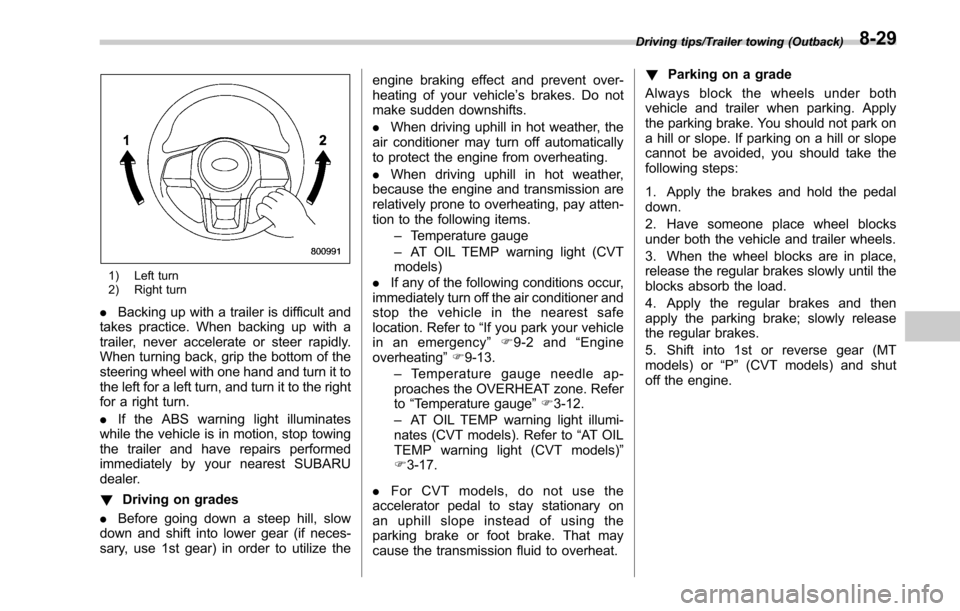
.Backing up with a trailer is difficult and
takes practice. When backing up with a
trailer, never accelerate or steer rapidly.
When turning back, grip the bottom of the
steering wheel with one hand and turn it to
the left for a left turn, and turn it to the right
for a right turn.
. If the ABS warning light illuminates
while the vehicle is in motion, stop towing
the trailer and have repairs performed
immediately by your nearest SUBARU
dealer.
! Driving on grades
. Before going down a steep hill, slow
down and shift into lower gear (if neces-
sary, use 1st gear) in order to utilize the engine braking effect and prevent over-
heating of your vehicle’
s brakes. Do not
make sudden downshifts.
. When driving uphill in hot weather, the
air conditioner may turn off automatically
to protect the engine from overheating.
. When driving uphill in hot weather,
because the engine and transmission are
relatively prone to overheating, pay atten-
tion to the following items.
–Temperature gauge
– AT OIL TEMP warning light (CVT
models)
. If any of the following conditions occur,
immediately turn off the air conditioner and
stop the vehicle in the nearest safe
location. Refer to “If you park your vehicle
in an emergency ”F9-2 and “Engine
overheating ”F 9-13.
– Temperature gauge needle ap-
proaches the OVERHEAT zone. Refer
to “Temperature gauge ”F 3-12.
– AT OIL TEMP warning light illumi-
nates (CVT models). Refer to “AT OIL
TEMP warning light (CVT models) ”
F 3-17.
. For CVT models, do not use the
accelerator pedal to stay stationary on
an uphill slope instead of using the
parking brake or foot brake. That may
cause the transmission fluid to overheat. !
Parking on a grade
Always block the wheels under both
vehicle and trailer when parking. Apply
the parking brake. You should not park on
a hill or slope. If parking on a hill or slope
cannot be avoided, you should take the
following steps:
1. Apply the brakes and hold the pedal
down.
2. Have someone place wheel blocks
under both the vehicle and trailer wheels.
3. When the wheel blocks are in place,
release the regular brakes slowly until the
blocks absorb the load.
4. Apply the regular brakes and then
apply the parking brake; slowly release
the regular brakes.
5. Shift into 1st or reverse gear (MT
models) or “P”(CVT models) and shut
off the engine.
Driving tips/Trailer towing (Outback)8-29
Page 517 of 610

Maintenance and service/Cooling system
Cooling system
WARNING
Never attempt to remove the radia-
tor cap until the engine has been
shut off and has cooled down
completely. Since the coolant is
under pressure, you may suffer
serious burns from a spray of boil-
ing hot coolant when the cap is
removed.
CAUTION
.Vehicles are filled at the factory
with SUBARU Super Coolant that
does not require the first change
for 11 years/137,500 miles (11
years/220,000 km). This coolant
should not be mixed with any
other brand or type of coolant
during this period. Mixing with a
different coolant will reduce the
life of the coolant. Should it be
necessary to top off the coolant
for any reason, use only
SUBARU Super Coolant.
If the SUBARU Super Coolant is
diluted with another brand or type, the maintenance interval is
shortened to that of the mixing
coolant.
. Do not splash the engine coolant
over painted parts. The alcohol
contained in the engine coolant
may damage the paint surface.
& Cooling fan, hose and con-
nections
Your vehicle employs an electric cooling
fan which is thermostatically controlled to
operate when the engine coolant reaches
a specific temperature.
1) Normal operating range
If the radiator cooling fan does not operate
even when the engine coolant tempera- ture gauge exceeds the normal operating
range, the cooling fan circuit may be
defective. Refer to
“Temperature gauge ”
F 3-12.
Check the fuse and replace it if necessary.
Refer to “Fuses”F 11-38 and “Fuses and
circuits ”F 12-10. If the fuse is not blown,
have the cooling system checked by your
SUBARU dealer.
If frequent addition of coolant is neces-
sary, there may be a leak in the engine
cooling system. It is recommended that
the cooling system and connections be
checked for leaks, damage, or looseness.
11-14
Page 574 of 610

For U.S.A............................................................ 13-2
Tire information .................................................. 13-2
Tire labeling....................................................... 13-2
Recommended tire inflation pressure .................. 13-4
Glossary of tire terminology ............................... 13-5
Tire care –maintenance and safety practices ...... 13-9
Vehicle load limit –how to determine ................ 13-10
Determining compatibility of tire and vehicle load capacities ............................................... 13-13 Adverse safety consequences of overloading
on handling and stopping and on tires ........... 13-13
Steps for Determining Correct Load Limit ......... 13-14Uniform tire quality grading standards.......... 13-14Treadwear....................................................... 13-15
Traction AA, A, B, C ......................................... 13-15
Temperature A, B, C ......................................... 13-15
Reporting safety defects (USA) ...................... 13-16
Consumer information and Reporting safety defects
13
Page 577 of 610

Consumer information and Reporting safety defects/Tire information
!Maximum load rating
The load rating at the maximum
permissible weight load for this tire.
For example, “MAX. LOAD 615 kg
(1,356 LBS) @ 350 kPa (51 PSI)
MAX. PRESS. ”
WARNING
Maximum load rating applies
only to the tire, not to the
vehicle. Putting a load rated
tire on any vehicle does not
mean the vehicle can be
loaded up to the tire ’s rated
load.
! Construction type
Applicable construction of this tire.
For example, “TUBELESS STEEL
BELTED RADIAL”
! Construction
The generic name of each cord
material used in the plies (both
sidewall and tread area) of this tire.
For example, “PLIES: TREAD 2 STEEL + 2 POLYESTER + 1
NYLON SIDEWALL 2 POLYE-
STER
”
!Uniform Tire Quality Grading
(UTQG)
For details, refer to “Uniform tire
quality grading standards ”F 13-14.
& Recommended tire inflation
pressure
! Recommended cold tire infla-
tion pressure
For the recommended cold tire
inflation pressure for your vehicle ’s
tires, refer to “Tires ”F 12-9.
! Vehicle placard
The vehicle placard is affixed to the
driver ’s side B-pillar.
Example:
13-4
Page 583 of 610

Consumer information and Reporting safety defects/Tire information
.To maximize the life of each tire
and ensure that the tires wear
uniformly, it is best to rotate the
tires every 7,500 miles (12,000 km).
Rotating the tires involves switch-
ing the front and rear tires on the
right-hand side of the vehicle and
similarly switching the front and
rear tires on the left-hand side of
the vehicle. (Each tire must be kept
on its original side of the vehicle.)
Replace any damaged or unevenly
worn tire at the time of rotation.
After tire rotation, adjust the tire
pressures and make sure the wheel
nuts are correctly tightened. For
information about the tightening
torque and tightening sequence
for the wheel nuts, refer to “Flat
tires ”F 9-5.
& Vehicle load limit –how to
determine
The load capacity of your vehicle is
determined by weight, not by avail-
able cargo space. The load limit of
your vehicle is shown on the
vehicle placard attached to the driver
’s side B-pillar. Locate the
statement “The combined weight
of occupants and cargo should
never exceed XXX kg or XXX lbs ”
on your vehicle ’s placard.
Thevehicleplacardalsoshows
seating capacity of your vehicle.
The total load capacity includes the
total weight of driver and all pas-
sengers and their belongings, any
cargo, any optional equipment such
as a trailer hitch, roof rack or bike
carrier, etc., and the tongue load of
a trailer. Therefore cargo capacity
can be calculated by the following
method.
Cargo capacity = Load limit −(total
weight of occupants + total weight
of optional equipment + tongue
load of a trailer (if applicable))
For towing capacity information and
weight limits, refer to “Trailer towing
(Outback) ”F 8-22.
! Calculating total and load ca-
pacities varying seating con-
figurations
Calculate the available load capa-
city as shown in the following
examples:
Example 1A
Vehicle capacity weight of the
vehicle is 800 lbs (363 kg), which
is indicated on the vehicle placard
with the statement “The combined
weight of occupants and cargo
should never exceed 363 kg or
800 lbs ”.
For example, if the vehicle has one
13-10
Page 584 of 610

occupant weighing 154 lbs (70 kg)
plus cargo weighing 551 lbs (250
kg).
1.Calculate the total weight.
2.Calculate the available load ca-
pacity by subtracting the total
weight from the vehicle capacity
weight of 800 lbs (363 kg).
3.The result of step 2 shows that a
further 95 lbs (43 kg) of cargo can
be carried.
Example 1B
For example, if a person weighing
176 lbs (80 kg) now enters the
same vehicle (bringing the number
of occupants to two), the calcula-
tions are as follows:
1.Calculate the total weight.
2.Calculate the available load ca-
pacity.
3.The total weight now exceeds
the capacity weight by 81 lbs (37
kg), so the cargo weight must be
reduced by 81 lbs (37 kg) or more.
Example 2A (Outback only)
CAUTION
Legacy: Your vehicle is neither
designed nor intended to be
used for trailer towing. There-
fore, never tow a trailer with
your vehicle.
Consumer information and Reporting safety defects/Tire information
–CONTINUED –13-11