Page 552 of 610
&Door step light
CAUTION
Replacing the bulb could cause a
short circuit. Have the bulb replaced
by your SUBARU dealer.
&Cargo area light (Outback)
1. Remove the lens by prying the edge of
the lens with a flat-head screwdriver.
2. Pull the bulb out of the socket.
3. Install a new bulb.
4. Reinstall the lens.
&Trunk light (Legacy)
CAUTION
Replacing the bulb could cause
burns since the bulb may be very
hot. Have the bulb replaced by your
SUBARU dealer.
&Other bulbs
It may be difficult to replace the bulbs.
We recommend that you have the bulbs
replaced by your SUBARU dealer if
necessary.
Maintenance and service/Replacing bulbs11-49
Page 554 of 610
2. Wrap a flat-head screwdriver with vinyl
tape or a cloth, and insert it in the gap to
remove the cover.
3. Take out the battery using a flat-head
screwdriver with vinyl tape or a cloth.
4. Insert a new battery with its positive (+)
side facing upward as shown in the figure.
5. Attach the cover to the access key by
fitting the projections and recesses to-
gether.
&Replacing battery of trans-
mitter
1. Open the key head using a flat-head
screwdriver.
2. Remove the transmitter case from the
Maintenance and service/Replacing battery
–CONTINUED –11-51
Page 557 of 610
Specifications/Specifications
Specifications
These specifications are subject to change without notice.
&Dimensions
in (mm)
Item Legacy Outback
2.5 L 3.6 L 2.5 L
3.6 L
Drive system AWD
Transmission type MT CVT CVT MT CVT CVT
Overall length 188.8 (4,796) 189.6 (4,817)
Overall width 72.4 (1,840) 72.4 (1,840)
Overall height 59.0 (1,500) 66.1 (1,680)
*2
65.2 (1,655)*3
64.0 (1,625)*4
Wheelbase
108.3 (2,750) 108.1 (2,745)
Tread Front 62.2 (1,580) 61.8 (1,570)
Rear 62.8 (1,595) 62.2 (1,580)
Ground clearance
*15.9 (150) 8.7 (220)
*1: Measured with vehicle empty
*2: Models with high profile roof rails
*3: Models with low profile roof rails (U.S.-spec. models)
*4: Models with low profile roof rails (except U.S.-spec. models)
MT: Manual transmission
CVT: Continuously variable transmission
AWD: All-Wheel Drive
12-2
Page 562 of 610

&Manual transmission, front differential and rear differential gear oil
Oil Manual transmission oil Front differential gear oil (CVT models) Rear differential gear oil
Oil grade .
SUBARU Extra MT*3
.API classification GL-5 (75W-90)*4API classification GL-5
SAE viscosity
No. and applic-
able tempera-
ture — .
75W-90*
. 90
*: Recommended
Oil capacity*
13.5 US qt
(3.3 liters, 2.9 Imp qt) 2.5 L models: 1.3 US qt (1.2 liters, 1.1 Imp qt)
3.6 L models: 1.5 US qt (1.4 liters, 1.2 Imp qt)
0.8 US qt (0.8 liters, 0.7 Imp qt)
Remarks*
2“ Manual transmission
oil ”F 11-19 “
Front differential gear oil (CVT models) and
rear differential gear oil ”F 11-19 “
Front differential gear oil (CVT models) and rear differ-
ential gear oil ”F 11-19
*1: The indicated oil quantity is only a guideline. The necessary quantity for replacement may differ slightly depending on the temperature and other
factors. After refilling the gearbox with oil, the oil level should be checked.
*2: For more details about maintenance and service, refer to the indicated section.
*3: The vehicle is filled at the factory with this type of manual transmission oil/front differential gear oil.
*4: You may use this type of manual transmission oil/front differential gear oil. However, using this type of oil will detract from driveability and fuel
efficiency. Specifications/Specifications
–CONTINUED –
12-7
Page 577 of 610

Consumer information and Reporting safety defects/Tire information
!Maximum load rating
The load rating at the maximum
permissible weight load for this tire.
For example, “MAX. LOAD 615 kg
(1,356 LBS) @ 350 kPa (51 PSI)
MAX. PRESS. ”
WARNING
Maximum load rating applies
only to the tire, not to the
vehicle. Putting a load rated
tire on any vehicle does not
mean the vehicle can be
loaded up to the tire ’s rated
load.
! Construction type
Applicable construction of this tire.
For example, “TUBELESS STEEL
BELTED RADIAL”
! Construction
The generic name of each cord
material used in the plies (both
sidewall and tread area) of this tire.
For example, “PLIES: TREAD 2 STEEL + 2 POLYESTER + 1
NYLON SIDEWALL 2 POLYE-
STER
”
!Uniform Tire Quality Grading
(UTQG)
For details, refer to “Uniform tire
quality grading standards ”F 13-14.
& Recommended tire inflation
pressure
! Recommended cold tire infla-
tion pressure
For the recommended cold tire
inflation pressure for your vehicle ’s
tires, refer to “Tires ”F 12-9.
! Vehicle placard
The vehicle placard is affixed to the
driver ’s side B-pillar.
Example:
13-4
Page 578 of 610
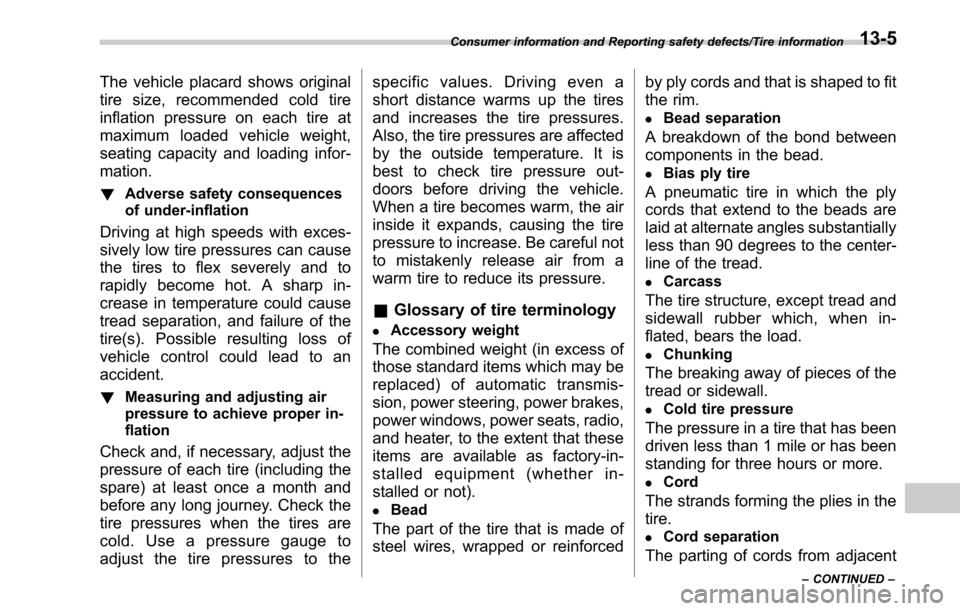
The vehicle placard shows original
tire size, recommended cold tire
inflation pressure on each tire at
maximum loaded vehicle weight,
seating capacity and loading infor-
mation.
!Adverse safety consequences
of under-inflation
Driving at high speeds with exces-
sively low tire pressures can cause
the tires to flex severely and to
rapidly become hot. A sharp in-
crease in temperature could cause
tread separation, and failure of the
tire(s). Possible resulting loss of
vehicle control could lead to an
accident.
!Measuring and adjusting air
pressure to achieve proper in-
flation
Check and, if necessary, adjust the
pressure of each tire (including the
spare) at least once a month and
before any long journey. Check the
tire pressures when the tires are
cold. Use a pressure gauge to
adjust the tire pressures to the specific values. Driving even a
short distance warms up the tires
and increases the tire pressures.
Also, the tire pressures are affected
by the outside temperature. It is
best to check tire pressure out-
doors before driving the vehicle.
When a tire becomes warm, the air
inside it expands, causing the tire
pressure to increase. Be careful not
to mistakenly release air from a
warm tire to reduce its pressure.
&
Glossary of tire terminology
.Accessory weight
The combined weight (in excess of
those standard items which may be
replaced) of automatic transmis-
sion, power steering, power brakes,
power windows, power seats, radio,
and heater, to the extent that these
items are available as factory-in-
stalled equipment (whether in-
stalled or not).
.Bead
The part of the tire that is made of
steel wires, wrapped or reinforced by ply cords and that is shaped to fit
the rim.
.Bead separation
A breakdown of the bond between
components in the bead.
.Bias ply tire
A pneumatic tire in which the ply
cords that extend to the beads are
laid at alternate angles substantially
less than 90 degrees to the center-
line of the tread.
.Carcass
The tire structure, except tread and
sidewall rubber which, when in-
flated, bears the load.
.Chunking
The breaking away of pieces of the
tread or sidewall.
.Cold tire pressure
The pressure in a tire that has been
driven less than 1 mile or has been
standing for three hours or more.
.Cord
The strands forming the plies in the
tire.
.Cord separation
The parting of cords from adjacent
Consumer information and Reporting safety defects/Tire information
–CONTINUED –13-5
Page 583 of 610

Consumer information and Reporting safety defects/Tire information
.To maximize the life of each tire
and ensure that the tires wear
uniformly, it is best to rotate the
tires every 7,500 miles (12,000 km).
Rotating the tires involves switch-
ing the front and rear tires on the
right-hand side of the vehicle and
similarly switching the front and
rear tires on the left-hand side of
the vehicle. (Each tire must be kept
on its original side of the vehicle.)
Replace any damaged or unevenly
worn tire at the time of rotation.
After tire rotation, adjust the tire
pressures and make sure the wheel
nuts are correctly tightened. For
information about the tightening
torque and tightening sequence
for the wheel nuts, refer to “Flat
tires ”F 9-5.
& Vehicle load limit –how to
determine
The load capacity of your vehicle is
determined by weight, not by avail-
able cargo space. The load limit of
your vehicle is shown on the
vehicle placard attached to the driver
’s side B-pillar. Locate the
statement “The combined weight
of occupants and cargo should
never exceed XXX kg or XXX lbs ”
on your vehicle ’s placard.
Thevehicleplacardalsoshows
seating capacity of your vehicle.
The total load capacity includes the
total weight of driver and all pas-
sengers and their belongings, any
cargo, any optional equipment such
as a trailer hitch, roof rack or bike
carrier, etc., and the tongue load of
a trailer. Therefore cargo capacity
can be calculated by the following
method.
Cargo capacity = Load limit −(total
weight of occupants + total weight
of optional equipment + tongue
load of a trailer (if applicable))
For towing capacity information and
weight limits, refer to “Trailer towing
(Outback) ”F 8-22.
! Calculating total and load ca-
pacities varying seating con-
figurations
Calculate the available load capa-
city as shown in the following
examples:
Example 1A
Vehicle capacity weight of the
vehicle is 800 lbs (363 kg), which
is indicated on the vehicle placard
with the statement “The combined
weight of occupants and cargo
should never exceed 363 kg or
800 lbs ”.
For example, if the vehicle has one
13-10
Page 586 of 610

2.Calculate the available load ca-
pacity.
3.The total weight now exceeds
the capacity weight by 22 lbs (10
kg), so the cargo weight must be
reduced by 22 lbs (10 kg) or more.
& Determining compatibility of
tire and vehicle load capaci-
ties
The sum of four tires ’maximum
load ratings must exceed the max-
imum loaded vehicle weight
( “ GVWR ”). In addition, sum of the
maximum load ratings of two front
tires and of two rear tires must
exceed each axle ’smaximum
loaded capacity ( “GAWR ”). Original
equipment tires are designed to
fulfill those conditions.
The maximum loaded vehicle
weight is referred to Gross Vehicle
Weight Rating (GVWR). And each
axle ’s maximum loaded capacity is
referred to Gross Axle Weight Rat-
ing (GAWR). The GVWR and each
axle ’s GAWR are shown on the
vehicle certification label affixed to
the driver ’s door.
The GVWR and front and rear
GAWRs are determined by not only
the maximum load rating of tires but
also loaded capacities of the vehi-
cle ’s suspension, axles and other parts of the body.
Therefore, this means that the
vehicle cannot necessarily be
loaded up to the tire
’s maximum
load rating on the tire sidewall.
& Adverse safety conse-
quences of overloading on
handling and stopping and
on tires
Overloading could affect vehicle
handling, stopping distance, vehicle
and tire as shown in the following.
This could lead to an accident and
possibly result in severe personal
injury.
.Vehicle stability will deteriorate.
.Heavy and/or high-mounted
loads could increase the risk of
rollover.
.Stopping distance will increase.
.Brakes could overheat and fail.
.Suspension, bearings, axles and
other parts of the body could break
or experience accelerated wear
that will shorten vehicle life.
.Tires could fail.
.Tread separation could occur.
Consumer information and Reporting safety defects/Tire information
–CONTINUED –13-13


