2017 SUBARU OUTBACK engine overheat
[x] Cancel search: engine overheatPage 403 of 610

Starting and operating/Braking
assist limitation to occur too fre-
quently, this may result in a malfunc-
tion of the power steering control
system.Braking
&Braking tips
WARNING
Never rest your foot on the brake
pedal while driving. This can cause
dangerous overheating of the
brakes and needless wear on the
brake pads and linings.
! When the brakes get wet
When driving in rain or after washing the
vehicle, the brakes may get wet. As a
result, brake stopping distance will be
longer. To dry the brakes, drive the vehicle
at a safe speed while lightly depressing
the brake pedal to heat up the brakes.
! Use of engine braking
Remember to make use of engine braking
in addition to foot braking. When descend-
ing a grade, if only the foot brake is used,
the brakes may start working improperly
because of brake fluid overheating,
caused by overheated brake pads. To
help prevent this, shift into a lower gear to
get stronger engine braking.
! Braking when a tire is punctured
Do not depress the brake pedal suddenly
when a tire is punctured. This could cause a loss of control of the vehicle. Keep
driving straight ahead while gradually
reducing speed. Then slowly pull off the
road to a safe place.&
Brake system
! Two separate circuits
Your vehicle has a dual circuit brake
system. Each circuit works diagonally
across the vehicle. If one circuit of the
brake system should fail, the other half of
the system still works. If one circuit fails,
the brake pedal will go down much closer
to the floor than usual and you will need to
press it down much harder. And a much
longer distance will be needed to stop the
vehicle.
! Brake booster
The brake booster uses engine manifold
vacuum to assist braking force. Do not
turn off the engine while driving because
that will turn off the brake booster, result-
ing in poor braking power.
The brakes will continue to work even
when the brake booster completely stops
functioning. If this happens, however, you
will have to depress the pedal much
harder than normal and the braking dis-
tance will increase.
7-32
Page 411 of 610

Starting and operating/X–mode (Outback CVT models)
(40 km/h) or more while the X-mode is
activated, a buzzer will sound once and
the X-mode will be deactivated.
. While the engine is running, if any of
the following conditions is met, the X-
mode will be deactivated. In this case, it
is not possible to activate the X-mode.
–The CHECK ENGINE warning
light/malfunction indicator light illu-
minates.
– The AT OIL TEMP warning light
flashes.
– The ABS warning light illumi-
nates.
– The Vehicle Dynamics Control
warning light illuminates.
. If the engine could overheat be-
cause of a temperature increase of the
engine coolant, it may not be possible
to activate the X-mode. Even while the
X-mode is activated, the X-mode will be
deactivated when the engine coolant
temperature increases.
& Hill descent control function
The hill descent control function will be in
standby mode when the X-mode is acti-
vated and the vehicle speed is less than
approximately 12 mph (20 km/h).
The function will operate when the vehicle
speed is less than approximately 12 mph (20 km/h) and the accelerator ratio is less
than approximately 10%.
The function will turn off when the vehicle
speed is more than approximately 12 mph
(20 km/h) and the accelerator pedal is
depressed.
CAUTION
The braking power of the hill des-
cent control function may not be
sufficient when strong braking
power is needed (e.g., when towing
a trailer (Outback)).
NOTE
.
Even while the hill descent control
function is operating, you can vary the
vehicle speed by using the brake pedal
or accelerator pedal.
. During braking by the hill descent
control function, the hill descent con-
trol indicator will flash.
. The hill descent control function is
operable regardless of the gradient of
the road.
. The hill descent control function
may be considered normal when the
following conditions occur.
–An operating sound is heard
briefly from the engine compart-
ment while the hill descent control function is operating.
–
The sensation of depressing the
brake pedal is different, (harder
than usual etc.) when the brake
pedal is depressed during hill des-
cent control function operation.
! Hill descent control indicator
This indicator appears while the hill
descent control function is in the standby
mode. It flashes while the function is
operating. It will disappear when the
function is in the disabled mode. When
this function is changed from operational
to non-operational, it will disappear when
the vehicle speed reaches more than
approximately 18 mph (30 km/h).
7-40
Page 414 of 610

&Electronic parking brake
CVT models
1) Parking brake switch
2) Indicator light
3) Release the electronic parking brake
4) Apply the electronic parking brake
MT models
1) Parking brake switch
2) Indicator light
3) Release the electronic parking brake
4) Apply the electronic parking brake
WARNING
. Before exiting the vehicle, make
sure that you turn off the engine.
Otherwise, the parking brake
may be released and an accident
may occur.
. If the brake system warning light
turns on, the electronic parking
brake system may be malfunc-
tioning. Immediately stop your
vehicle in a safe location, use
tire stops under the tires to prevent the vehicle from moving
and contact your SUBARU deal-
er.
. If the electronic parking brake is
operated under the following
conditions, the electronic park-
ing brake indicator light may
flash.
– the brake is overheated
– the vehicle is on a steep slope
In such cases, the vehicle may
start to move which may lead to
an accident. Always use the tire
stops.
CAUTION
. When the electronic parking
brake cannot be applied due to
a malfunction, contact your
SUBARU dealer immediately for
an inspection. If you have to park
your vehicle in such conditions,
perform the following procedure.
– Stop your vehicle in a flat
location.
– Shift the shift lever in the “1 ”
or reverse position (MT mod-
els).
– Shift the select lever in the “P ”
Starting and operating/Parking your vehicle
–CONTINUED –7-43
Page 418 of 610

system ignores any further pressing of
the switch. To activate the switch again,
turn the ignition switch to the“LOCK ”/
“ OFF ”position and restart the engine.
. When the Hill Holder function is
deactivated while the Hill Holder func-
tion has a malfunction, if you press the
Hill Holder switch, a chirp sounds.
!Hill Holder indicator light
When the Hill Holder function is activated,
the Hill Holder indicator light illuminates.
Refer to “Hill Holder indicator light ”F 3-22. !
Emergency brake
CAUTION
Use the emergency brake only in
case of an emergency. If the emer-
gency brake is excessively used,
the brake parts will wear down
faster or the brake may not work
sufficiently due to brake overheat-
ing.
NOTE
.While using the emergency brake,
the electronic parking brake indicator
light and the indicator light on the
parking brake switch illuminate and a
chirp sounds.
. While using the emergency brake, a
sound may be heard from the engine
compartment. This is the operating
sound of the brake that is activated by
the Vehicle Dynamics Control system,
and does not indicate a malfunction.
If the foot brake has a malfunction, you
can stop the vehicle by pulling the parking
brake switch continuously.
While applying the emergency brake, the
electronic parking brake indicator light and
the indicator light on the parking brake
switch illuminate and a chirp sounds. !
Electronic parking brake system
warning
CAUTION
If the brake system warning light
turns on, the electronic parking
brake system may be malfunction-
ing. Immediately stop your vehicle
in the nearest safe location and
contact your SUBARU dealer.
If a malfunction occurs in the electronic
parking brake system, the brake system
warning light turns on. Refer to “Electronic
parking brake system warning ”F 3-21.
& Parking tips
When parking your vehicle, always per-
form the following items.
. Apply the parking brake.
. For MT models, place the shift lever in
the “1”(1st) for upgrade or “R”(Reverse)
for a downgrade.
. For CVT models, place the select lever
in the “P ”(Park) position.
Never rely on the transmission alone to
hold the vehicle.
Starting and operating/Parking your vehicle
–CONTINUED –7-47
Page 472 of 610
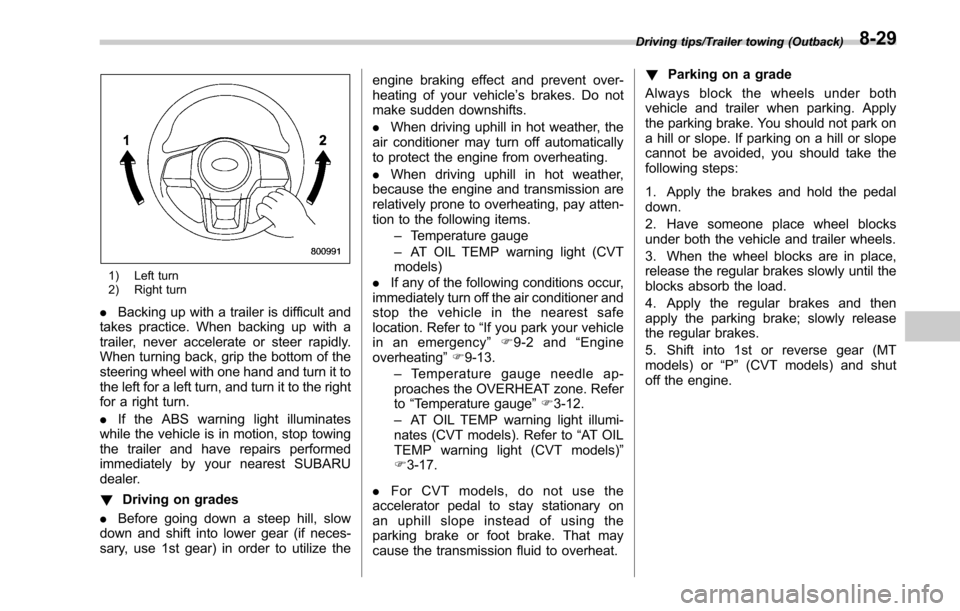
1) Left turn
2) Right turn
.Backing up with a trailer is difficult and
takes practice. When backing up with a
trailer, never accelerate or steer rapidly.
When turning back, grip the bottom of the
steering wheel with one hand and turn it to
the left for a left turn, and turn it to the right
for a right turn.
. If the ABS warning light illuminates
while the vehicle is in motion, stop towing
the trailer and have repairs performed
immediately by your nearest SUBARU
dealer.
! Driving on grades
. Before going down a steep hill, slow
down and shift into lower gear (if neces-
sary, use 1st gear) in order to utilize the engine braking effect and prevent over-
heating of your vehicle’
s brakes. Do not
make sudden downshifts.
. When driving uphill in hot weather, the
air conditioner may turn off automatically
to protect the engine from overheating.
. When driving uphill in hot weather,
because the engine and transmission are
relatively prone to overheating, pay atten-
tion to the following items.
–Temperature gauge
– AT OIL TEMP warning light (CVT
models)
. If any of the following conditions occur,
immediately turn off the air conditioner and
stop the vehicle in the nearest safe
location. Refer to “If you park your vehicle
in an emergency ”F9-2 and “Engine
overheating ”F 9-13.
– Temperature gauge needle ap-
proaches the OVERHEAT zone. Refer
to “Temperature gauge ”F 3-12.
– AT OIL TEMP warning light illumi-
nates (CVT models). Refer to “AT OIL
TEMP warning light (CVT models) ”
F 3-17.
. For CVT models, do not use the
accelerator pedal to stay stationary on
an uphill slope instead of using the
parking brake or foot brake. That may
cause the transmission fluid to overheat. !
Parking on a grade
Always block the wheels under both
vehicle and trailer when parking. Apply
the parking brake. You should not park on
a hill or slope. If parking on a hill or slope
cannot be avoided, you should take the
following steps:
1. Apply the brakes and hold the pedal
down.
2. Have someone place wheel blocks
under both the vehicle and trailer wheels.
3. When the wheel blocks are in place,
release the regular brakes slowly until the
blocks absorb the load.
4. Apply the regular brakes and then
apply the parking brake; slowly release
the regular brakes.
5. Shift into 1st or reverse gear (MT
models) or “P”(CVT models) and shut
off the engine.
Driving tips/Trailer towing (Outback)8-29
Page 474 of 610

If you park your vehicle in an emergency......... 9-2
Temporary spare tire ........................................... 9-2
Maintenance tools ............................................... 9-3
Legacy................................................................ 9-4
Outback .............................................................. 9-5
Flat tires ............................................................... 9-5Changing a flat tire .............................................. 9-5
Storing a flat tire ................................................. 9-8
Tire pressure monitoring system (TPMS) (if equipped) ......................................................... 9-10
Jump starting ..................................................... 9-11How to jump start ............................................... 9-11
Engine overheating ............................................ 9-13
If steam is coming from the engine
compartment .................................................... 9-13
If no steam is coming from the engine compartment .................................................... 9-13
Towing................................................................. 9-13Towing hook and tie-down hooks/holes .. ............ 9-14
Using a flat-bed truck ......................................... 9-16 Towing with all wheels on the ground
................. 9-17
Electronic parking brake–if the electronic
parking brake cannot be released ................. 9-17
Access key –if access key does not
operate properly ............................................. 9-18
Locking and unlocking ....................................... 9-18
Switching power status ...................................... 9-18
Starting engine .................................................. 9-19
Trunk lid (Legacy) –if the trunk lid cannot
be opened ....................................................... 9-19
Rear gate (Outback) –if the rear gate
cannot be opened ........................................... 9-20
Power rear gate - if power rear gate does not operate properly ....................................... 9-21
When the power rear gate is deactivated ............ 9-21
When the rear gate cannot be opened ................ 9-22
When the rear gate cannot be closed ................. 9-22
If your vehicle is involved in an accident ........ 9-22
In case of emergency
9
Page 486 of 610

Engine overheating
WARNING
Never attempt to remove the radia-
tor cap until the engine has been
shut off and has fully cooled down.
When the engine is hot, the coolant
is under pressure. Removing the
cap while the engine is still hot
could release a spray of boiling hot
coolant, which could burn you very
seriously.
If the engine overheats, pull off the road
safely and stop the vehicle in a safe place.
& If steam is coming from the
engine compartment
Turn off the engine and get everyone
away from the vehicle until it cools down.
&If no steam is coming from
the engine compartment
NOTE
For details about how to check the
coolant level or how to add coolant,
refer to “Engine coolant ”F 11-15.
1. Keep the engine running at idling
speed. 2. Open the hood to ventilate the engine
compartment. Refer to
“Engine hood ”
F 11-7.
Confirm that the cooling fan is turning. If
the fan is not turning, immediately turn off
the engine and contact your authorized
dealer for repair.
3. After the engine coolant temperature
has dropped, turn off the engine.
If the temperature gauge stays in the
overheated zone, turn off the engine.
4. After the engine has fully cooled down,
check the coolant level in the reserve
tank.
If the coolant level is below the “LOW”
mark, add coolant up to the “FULL ”mark.
5. If there is no coolant in the reserve
tank, add coolant to the reserve tank.
Then remove the radiator cap and fill the
radiator with coolant.
If you remove the radiator cap from a hot
radiator, first wrap a thick cloth around the
radiator cap, then turn the cap counter-
clockwise slowly without pressing down
until it stops. Release the pressure from
the radiator. After the pressure has been
fully released, remove the cap by pressing
down and turning it.
Towing
WARNING
Never tow AWD vehicles with the
front wheels raised off the ground
while the rear wheels are on the
ground, or with the rear wheels
raised off the ground while the front
wheels are on the ground. This will
cause the vehicle to spin away due
to the operation or deterioration of
the center differential.
If towing is necessary, SUBARU recom-
mends it be done by your SUBARU dealer
or a commercial towing service.
In case of emergency/Engine overheating
–CONTINUED –9-13
Page 594 of 610

Winter.................................................................... 8-8
E
ECO gauge ............................................................... 3-12
Electrical system ........................................................ 12-9
Electronic Brake Force Distribution (EBD) system .......... 7-34
Warning ................................................................ 3-20
Electronic parking brake. ............................................. 7-43
Automatic release function by accelerator pedal ......... 7-45
Hill Holder ............................................................. 7-45
Indicator light ......................................................... 3-21
Warning ........................................................ 3-21, 7-47
Emergency Locking Retractor (ELR) ............................. 1-17
Engine Compartment overview ........................................... 11-9
Coolant ........................................................ 11-15, 12-8
Exhaust gas (carbon monoxide) ............................. 6, 8-2
Hood .................................................................... 11-7
Low oil level warning indicator ................................. 3-17
Oil............................................................... 11-11, 12-4
Overheating .......................................................... 9-13
Starting & stopping ........................................... 7-9, 7-12
Event data recorder ......................................................... 9
Exterior care .............................................................. 10-2
F
Flat tires ..................................................................... 9-5
Floor mat .................................................................. 6-15
Fluid level Brake .................................................................. 11-20
Clutch .................................................................. 11-21 Continuously variable transmission
......................... 11-19
Fog light Bulb .......................................................... 11-42, 12-14
Indicator light ......................................................... 3-32
Steering responsive fog lights system ....................... 3-56
Switch ................................................................... 3-56
Front Differential gear oil ........................................ 11-19, 12-7
Seatbelt pretensioners ............................................ 1-24
Side marker light .................................................. 11-42
Turn signal light .................................................... 11-42
Front seats ................................................................. 1-2
Forward and backward adjustment ............................ 1-4
Head restraint adjustment ......................................... 1-8
Memory function ...................................................... 1-6
Power seat ............................................................. 1-5
Reclining ................................................................ 1-4
Seat height adjustment (driver ’s seat) ........................ 1-4
Fuel ........................................................................\
... 7-3
Consumption indicator ............................................. 3-38
Economy hints ........................................................ 8-2
Filler lid and cap ...................................................... 7-4
Gauge ................................................................... 3-11
Requirements ................................................. 7-3, 12-3
Fuses .....................................................................
11-38
Fuses and circuits .................................................... 12-10
G
GAWR (Gross Axle Weight Rating) .. ............................. 8-14
Glove box ................................................................... 6-6
GVWR (Gross Vehicle Weight Rating) ........................... 8-14
Index14-5