Page 348 of 540

346 4-3. Do-it-yourself maintenance
■Before recharging
When recharging, the battery produces hydrogen gas which is flammable
and explosive. Therefore, before recharging:
●If recharging with the battery installed on the vehicle, be sure to discon-
nect the ground cable.
●Make sure the power switch on the charger is off when connecting and
disconnecting the charger cables to the battery.
■After recharging/reconnecting the battery (vehicles with a keyless
access with push button start system)
●Unlocking the doors using the keyless access with push button start sys-
tem may not be possible immediately after reconnecting the battery. If
this happens, use the remote keyless entry system or the mechanical
key to lock/unlock the doors.
●Start the engine with the push-button ignition switch in “ACC” mode. The
engine may not start with the push-button ignition switch turned off. How-
ever, the engine will operate normally from the second attempt.
●The push-button ignition switch mode is recorded by the vehicle. If the
battery is reconnected, the vehicle will return the push-button ignition
switch mode to the status it was in before the battery was disconnected.
Make sure to turn off the engine before disconnect the battery. Take extra
care when connecting the battery if the push-button ignition switch mode
prior to discharge is unknown.
If the engine will not start even after multiple attempts, contact your
SUBARU dealer.
Page 349 of 540
347 4-3. Do-it-yourself maintenance
4
Maintenance and care
WARNING
■Chemicals in the battery
A battery contains poisonous and corrosive sulfuric acid and may produce
hydrogen gas which is flammable and explosive. To reduce the risk of death
or serious injury, take the following precautions while working on or near the
battery:
●Do not cause sparks by touching the battery terminals with tools.
●Do not smoke or light a match near the battery.
●Avoid contact with eyes, skin and clothes.
●Never inhale or swallow electrolyte.
●Wear protective safety glasses when working near the battery.
●Keep children away from the battery.
■Where to safely charge the battery
Always charge the battery in an open area. Do not charge the battery in a
garage or closed room where there is not sufficient ventilation.
■Emergency measures regarding electrolyte
●If electrolyte gets in your eyes
Flush your eyes with clean water for at least 15 minutes and get immedi-
ate medical attention. If possible, continue to apply water with a sponge or
cloth while traveling to the nearest medical facility.
●If electrolyte gets on your skin
Wash the affected area thoroughly. If you feel pain or burning, get medical
attention immediately.
●If electrolyte gets on your clothes
It can soak through clothing on to your skin. Immediately take off the cloth-
ing and follow the procedure above if necessary.
●If you accidentally swallow electrolyte
Drink a large quantity of water or milk. Get emergency medical attention
immediately.
Page 350 of 540
348 4-3. Do-it-yourself maintenance
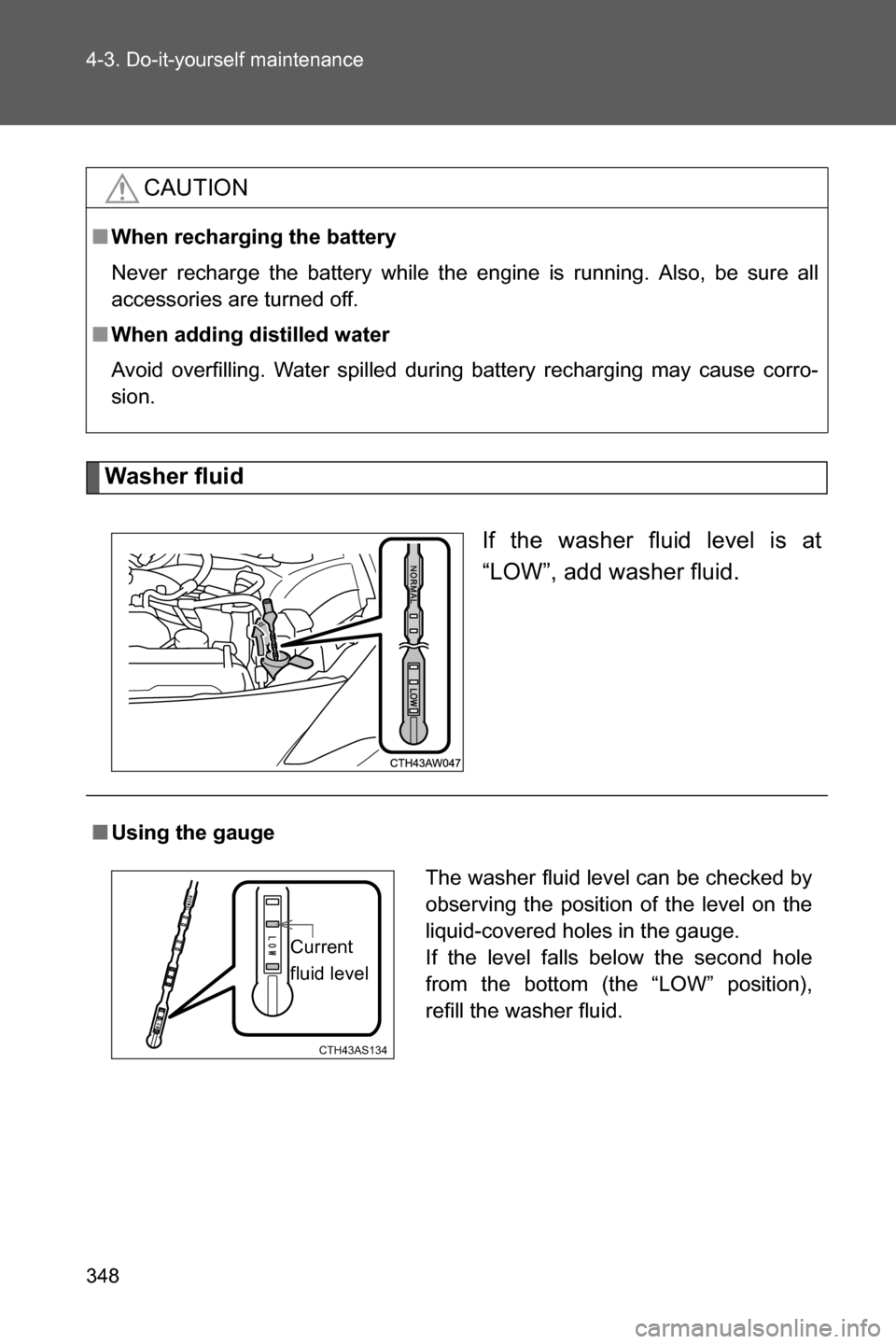
Washer fluid
If the washer fluid level is at
“LOW”, add washer fluid.
CAUTION
■When recharging the battery
Never recharge the battery while the engine is running. Also, be sure all
accessories are turned off.
■When adding distilled water
Avoid overfilling. Water spilled during battery recharging may cause corro-
sion.
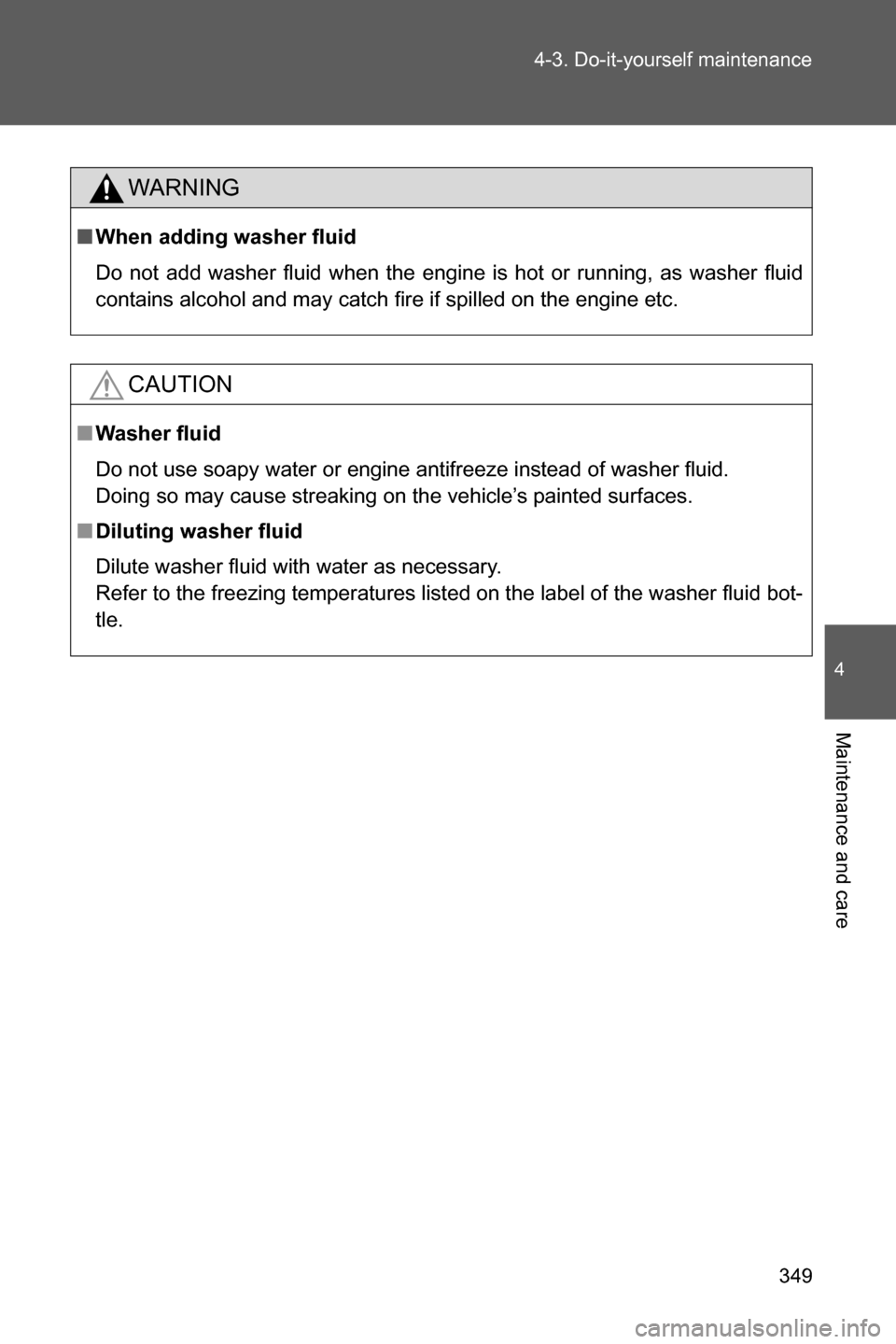
■Using the gauge
The washer fluid level can be checked by
observing the position of the level on the
liquid-covered holes in the gauge.
If the level falls below the second hole
from the bottom (the “LOW” position),
refill the washer fluid.
CTH43AS134
Current
fluid level
Page 351 of 540
349 4-3. Do-it-yourself maintenance
4
Maintenance and care
WARNING
■When adding washer fluid
Do not add washer fluid when the engine is hot or running, as washer fluid
contains alcohol and may catch fire if spilled on the engine etc.
CAUTION
■Washer fluid
Do not use soapy water or engine antifreeze instead of washer fluid.
Doing so may cause streaking on the vehicle’s painted surfaces.
■Diluting washer fluid
Dilute washer fluid with water as necessary.
Refer to the freezing temperatures listed on the label of the washer fluid bot-
tle.
Page 352 of 540
350
4-3. Do-it-yourself maintenance
Tires
Replace or rotate tires in accordance with maintenance sched-
ules and treadwear.
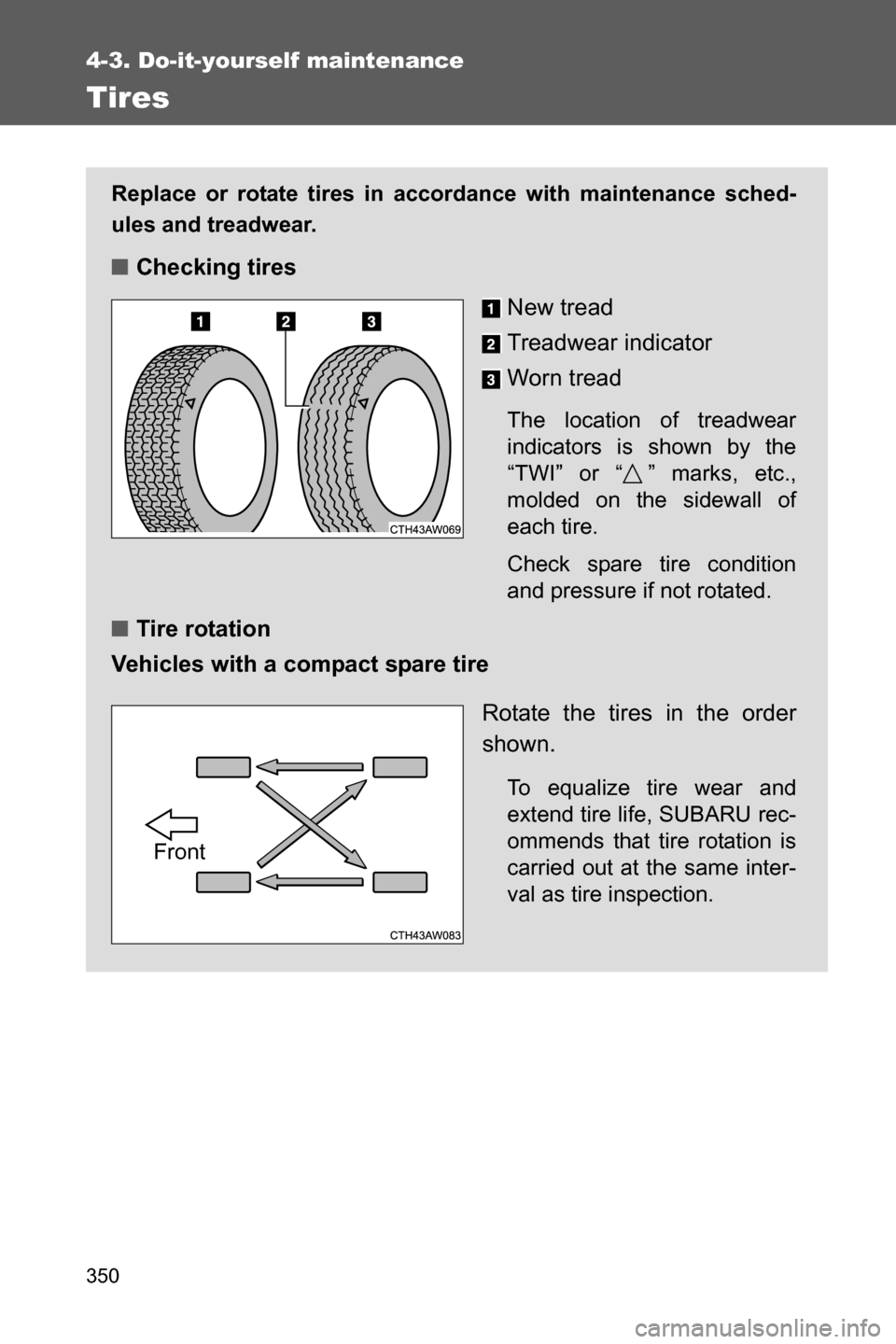
■Checking tires
New tread
Treadwear indicator
Worn tread
The location of treadwear
indicators is shown by the
“TWI” or “ ” marks, etc.,
molded on the sidewall of
each tire.
Check spare tire condition
and pressure if not rotated.
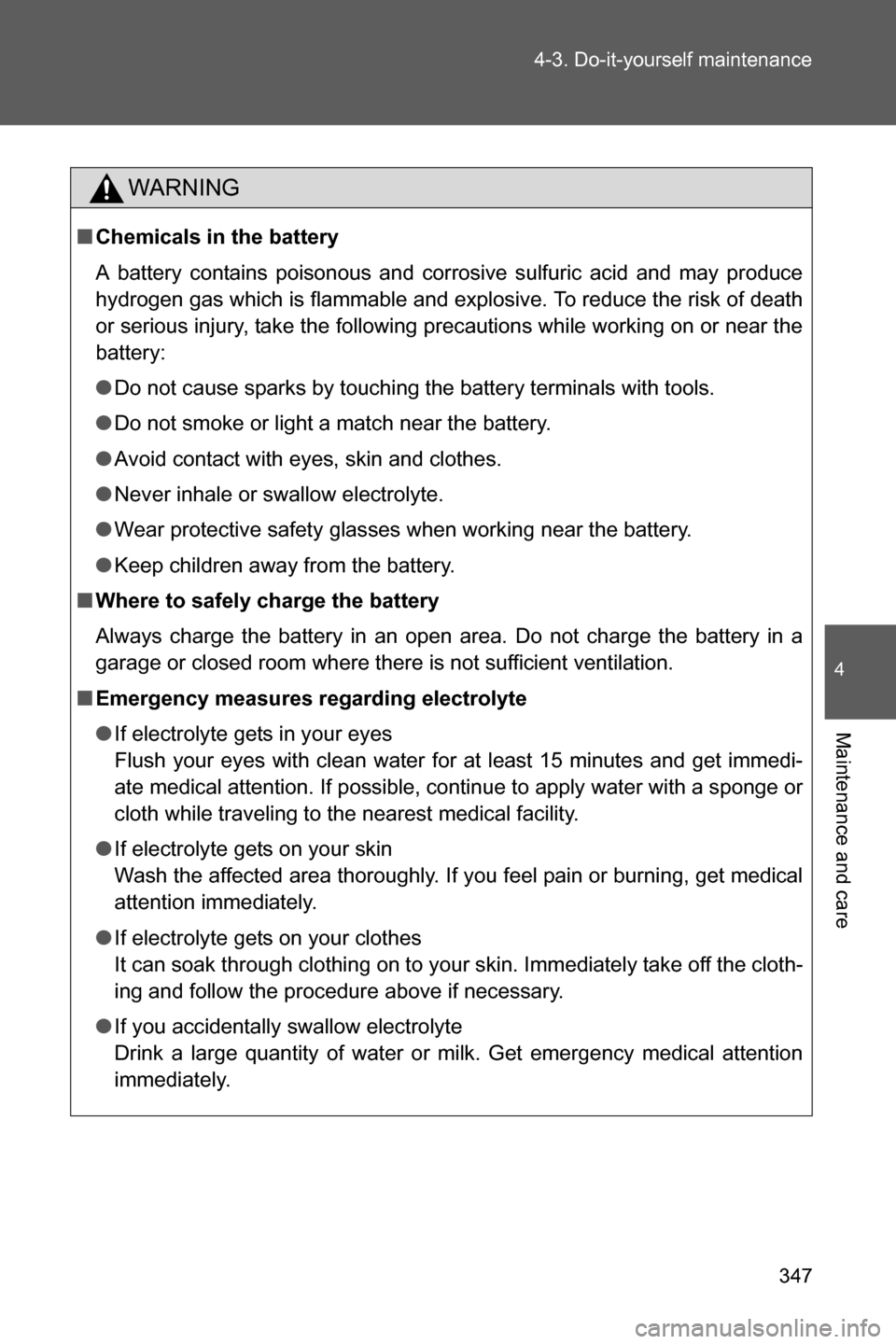
■Tire rotation
Vehicles with a compact spare tire
Rotate the tires in the order
shown.
To equalize tire wear and
extend tire life, SUBARU rec-
ommends that tire rotation is
carried out at the same inter-
val as tire inspection.
Front
Page 353 of 540

351 4-3. Do-it-yourself maintenance
4
Maintenance and care
Installing tire pressure warning valves and transmitters (vehicles
with a tire pressure monitoring system)
When replacing tires or wheels, tire pressure warning valves and
transmitters must also be installed.
When new tire pressure warning valves and transmitters are
installed, new tire pressure warning valve and transmitter ID codes
must be registered in the tire pressure warning computer and tire
pressure monitoring system must be initialized. Have tire pressure
warning valve and transmitter ID codes registered by your SUBARU
dealer. (oP. 352)
Vehicles with a spare tire of the same wheel type as the
installed tires
Rotate the tires in the order
shown.
To equalize tire wear and
extend tire life, SUBARU rec-
ommends that tire rotation is
carried out at the same inter-
val as tire inspection.
■The tire pressure monitoring system (if equipped)
Your SUBARU is equipped with a tire pressure monitoring sys-
tem that uses tire pressure warning valves and transmitters to
detect low tire inflation pressure before serious problems arise.
(oP. 406)
Front
Page 354 of 540

352 4-3. Do-it-yourself maintenance
Registering ID codes (vehicles with a tire pressure monitoring
system)
The tire pressure warning valve and transmitter is equipped with a
unique ID code. When replacing a tire pressure warning valve and
transmitter, it is necessary to register the ID code. Have the ID code
registered by your SUBARU dealer.
■When to replace your vehicle’s tires
Tires should be replaced if:
●You have tire damage such as cuts, splits, cracks deep enough to
expose the fabric or bulges indicating internal damage
●A tire goes flat repeatedly or cannot be properly repaired due to the
size or location of a cut or other damage
If you are not sure, consult with your SUBARU dealer.
■Replacing tires and wheels (vehicles with a tire pressure monitor-
ing system)
If the ID code of the tire pressure warning valve and transmitter is not
registered, the tire pressure monitoring system will not work properly.
After driving for about 20 minutes, the tire pressure warning light comes
on after blinking for 1 minute to indicate a system malfunction.
■Tire life
Any tire over 6 years old must be checked by a qualified technician even
if they have seldom or never been used or damage is not obvious.
■If the tread wears down below 0.16 in. (4 mm) on snow tires
The effectiveness of snow tires is lost.
■Low profile tires
Generally, low profile tires will wear more rapidly and tire grip perfor-
mance will be reduced on snowy and/or icy roads when compared to
standard tires. Be sure to use snow tires or tire chains on snowy and/or
icy roads and drive carefully at a speed appropriate for road and weather
conditions.
Page 355 of 540

353 4-3. Do-it-yourself maintenance
4
Maintenance and care
■Maximum load of tire
Check that the maximum load of the replacement tire is greater than 1/2
of the Gross Axle Weight Ratings (GAWR) of either the front axle or the
rear axle, whichever is greater.
■Tire types
1Summer tires
Summer tires are high-speed performance tires best suited to highway
driving under dry conditions. Since summer tires do not have the same
traction performance as snow tires, summer tires are inadequate for
driving on snow-covered or icy roads. For driving on snow-covered
roads or icy roads, the use of snow tires is recommended. When
installing snow tires, be sure to replace all four tires.
2 All season tires
All season tires are designed to provide better traction in snow and to
be adequate for driving in most winter conditions, as well as for use
year round. All season tires, however, do not have adequate traction
performance compared with snow tires in heavy or loose snow. Also,
all season tires fall short in acceleration and handling performance
compared with summer tires in highway driving.
3 Snow tires
For driving on snow-covered roads or icy roads, we recommend using
snow tires. If you need snow tires, select tires of the same size, con-
struction and load capacity as the originally installed tires. Since your
vehicle has radial tires as original equipment, make sure your snow
tires also have radial construction. Do not install studded tires without
first checking local regulations for possible restriction. Snow tires
should be installed on all wheels. (oP. 2 6 8 ) For the GAWR, see the Certification
Label. For the maximum load of the
tire, see the load limit at maximum cold
tire inflation pressure mentioned on the
sidewall of the tire. (oP. 4 8 0 )