Page 346 of 540
344 4-3. Do-it-yourself maintenance
Battery
Check the battery as follows.
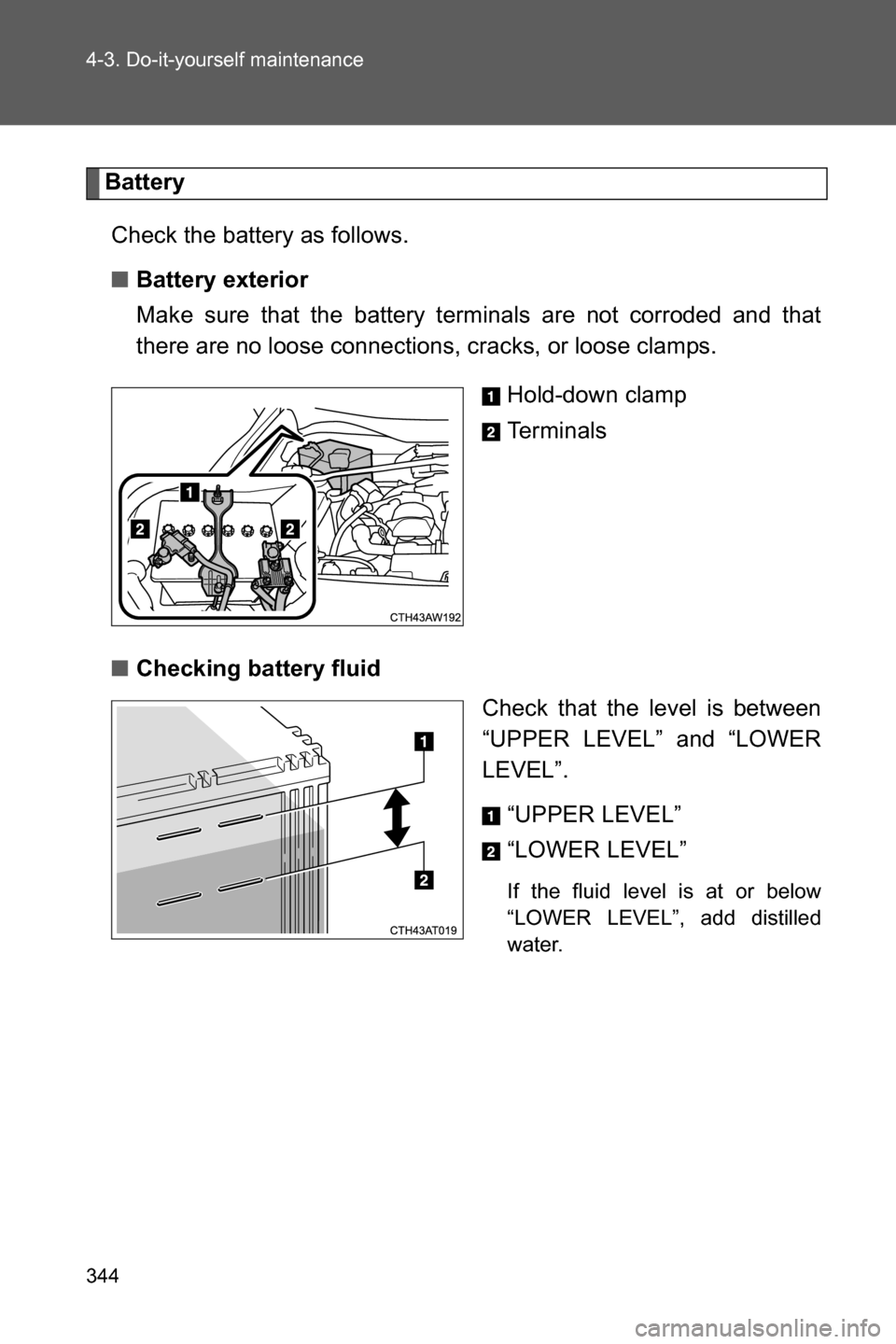
■Battery exterior
Make sure that the battery terminals are not corroded and that
there are no loose connections, cracks, or loose clamps.
Hold-down clamp
Te r m i n a l s
■Checking battery fluid
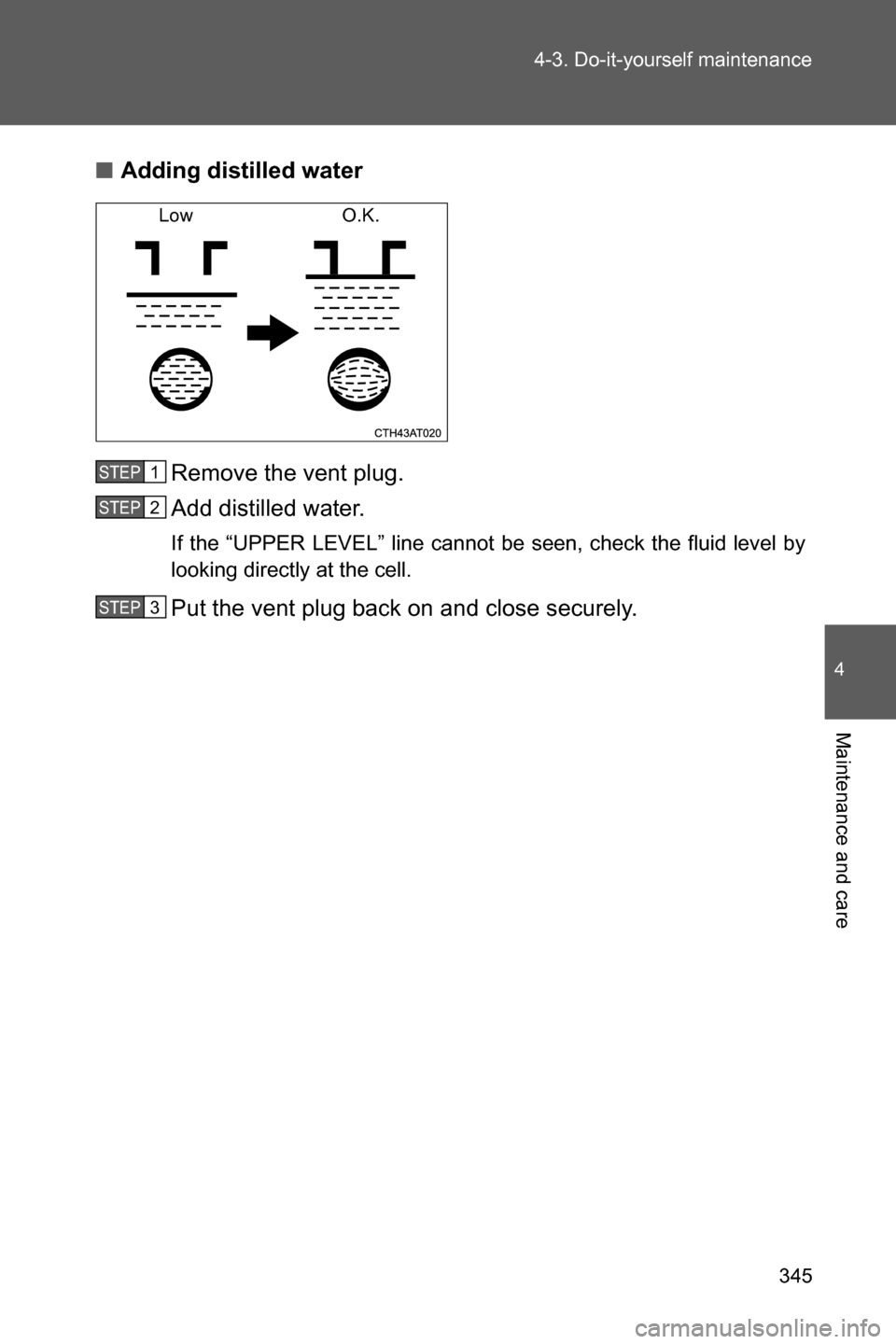
Check that the level is between
“UPPER LEVEL” and “LOWER
LEVEL”.
“UPPER LEVEL”
“LOWER LEVEL”
If the fluid level is at or below
“LOWER LEVEL”, add distilled
water.
Page 347 of 540
345 4-3. Do-it-yourself maintenance
4
Maintenance and care
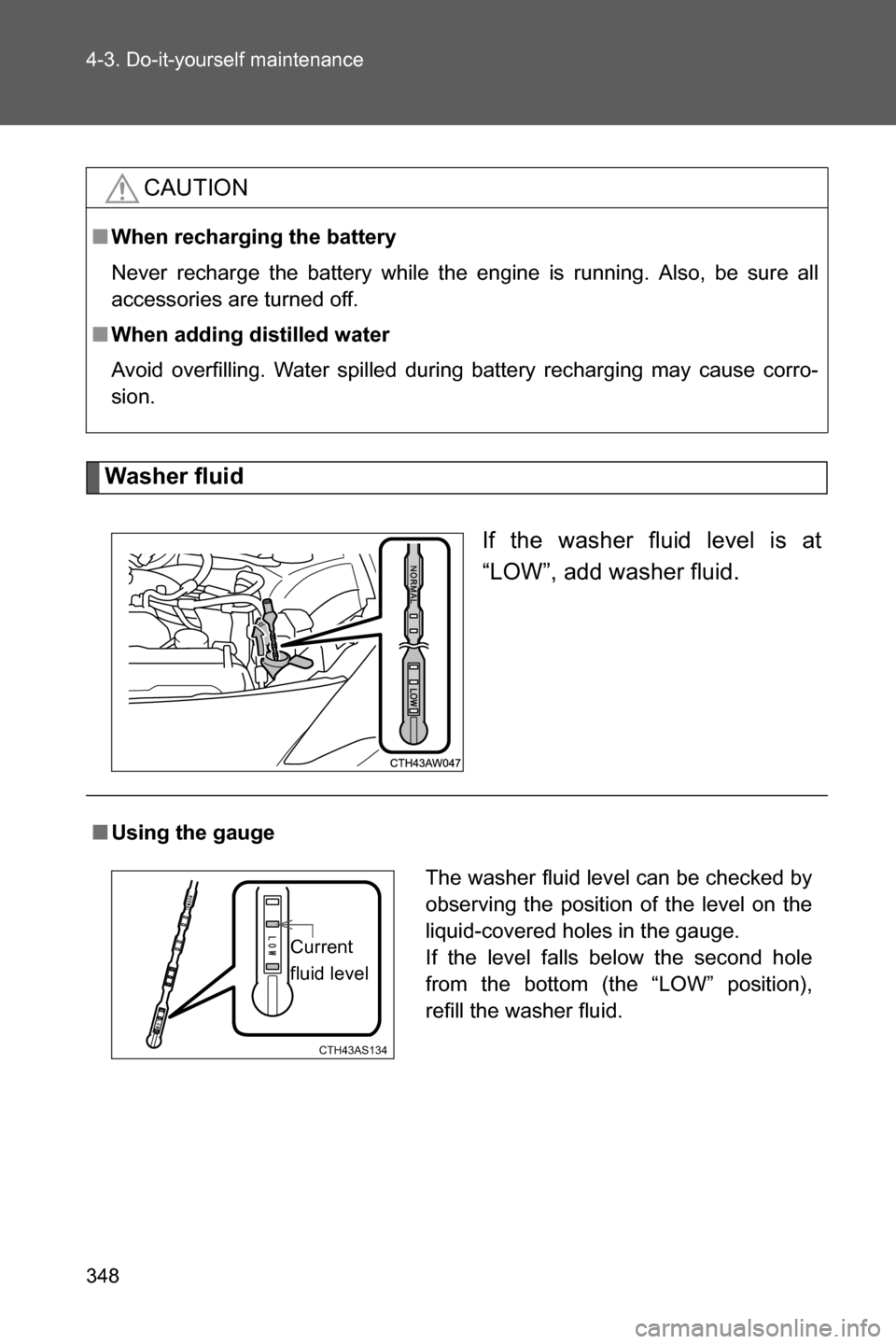
■Adding distilled water
Remove the vent plug.
Add distilled water.
If the “UPPER LEVEL” line cannot be seen, check the fluid level by
looking directly at the cell.
Put the vent plug back on and close securely.
Low O.K.
STEP 1
STEP 2
STEP 3
Page 350 of 540
348 4-3. Do-it-yourself maintenance
Washer fluid
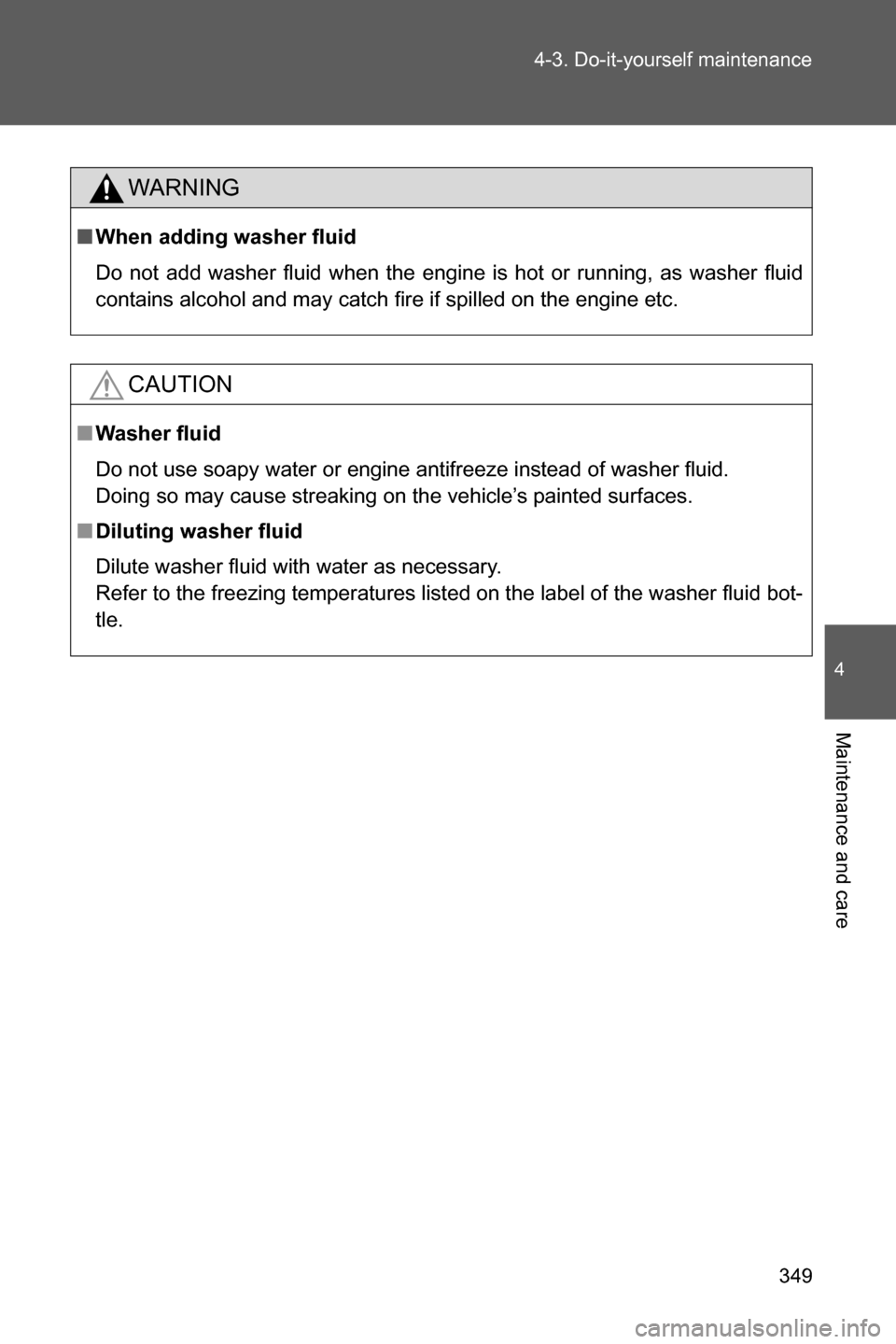
If the washer fluid level is at
“LOW”, add washer fluid.
CAUTION
■When recharging the battery
Never recharge the battery while the engine is running. Also, be sure all
accessories are turned off.
■When adding distilled water
Avoid overfilling. Water spilled during battery recharging may cause corro-
sion.
■Using the gauge
The washer fluid level can be checked by
observing the position of the level on the
liquid-covered holes in the gauge.
If the level falls below the second hole
from the bottom (the “LOW” position),
refill the washer fluid.
CTH43AS134
Current
fluid level
Page 351 of 540
349 4-3. Do-it-yourself maintenance
4
Maintenance and care
WARNING
■When adding washer fluid
Do not add washer fluid when the engine is hot or running, as washer fluid
contains alcohol and may catch fire if spilled on the engine etc.
CAUTION
■Washer fluid
Do not use soapy water or engine antifreeze instead of washer fluid.
Doing so may cause streaking on the vehicle’s painted surfaces.
■Diluting washer fluid
Dilute washer fluid with water as necessary.
Refer to the freezing temperatures listed on the label of the washer fluid bot-
tle.
Page 402 of 540
400
5-1. Essential information
If you think something is wrong
If you notice any of the following symptoms, your vehicle probably
needs adjustment or repair. Contact your SUBARU dealer as soon as
possible.
■Visible symptoms
●Fluid leaks under the vehicle
(Water dripping from the air conditioning after use is normal.)
●Flat-looking tires or uneven tire wear
●Vehicles with a monochrome multi-information display: The
engine coolant temperature gauge needle continually points
higher than normal
●Vehicles with a color multi-information display: The high
engine coolant temperature warning light flashes or illumi-
nates
■Audible symptoms
●Changes in exhaust sound
●Excessive tire squeal when cornering
●Strange noises related to the suspension system
●Pinging or other noises related to the engine
■Operational symptoms
●Engine missing, stumbling or running rough
●Appreciable loss of power
●Vehicle pulls heavily to one side when braking
●Vehicle pulls heavily to one side when driving on a level road
●Loss of brake effectiveness, spongy feeling, pedal almost
touches the floor
Page 404 of 540
402
5-2. Steps to take in an emergency
If a warning light turns on or a war ning buzzer sounds...
Stop the vehicle immediately. Continuing to drive the vehicle
may be dangerous.
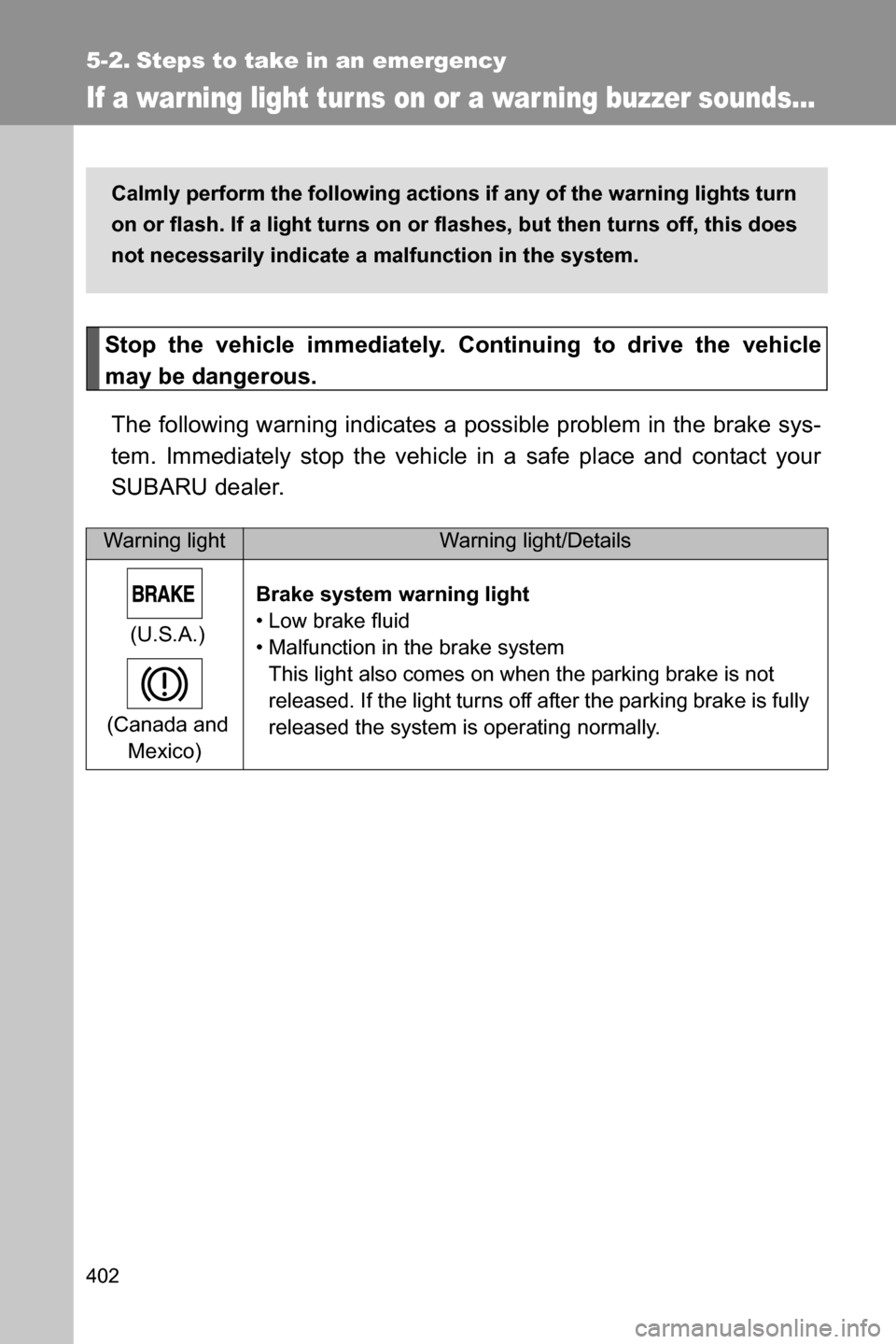
The following warning indicates a possible problem in the brake sys-
tem. Immediately stop the vehicle in a safe place and contact your
SUBARU dealer.
Warning lightWarning light/Details
(U.S.A.)
(Canada and
Mexico)Brake system warning light
• Low brake fluid
• Malfunction in the brake system
This light also comes on when the parking brake is not
released. If the light turns off after the parking brake is fully
released the system is operating normally.
Calmly perform the following actions if any of the warning lights turn
on or flash. If a light turns on or flashes, but then turns off, this does
not necessarily indicate a malfunction in the system.
Page 409 of 540
5
When trouble arises
407 5-2. Steps to take in an emergency
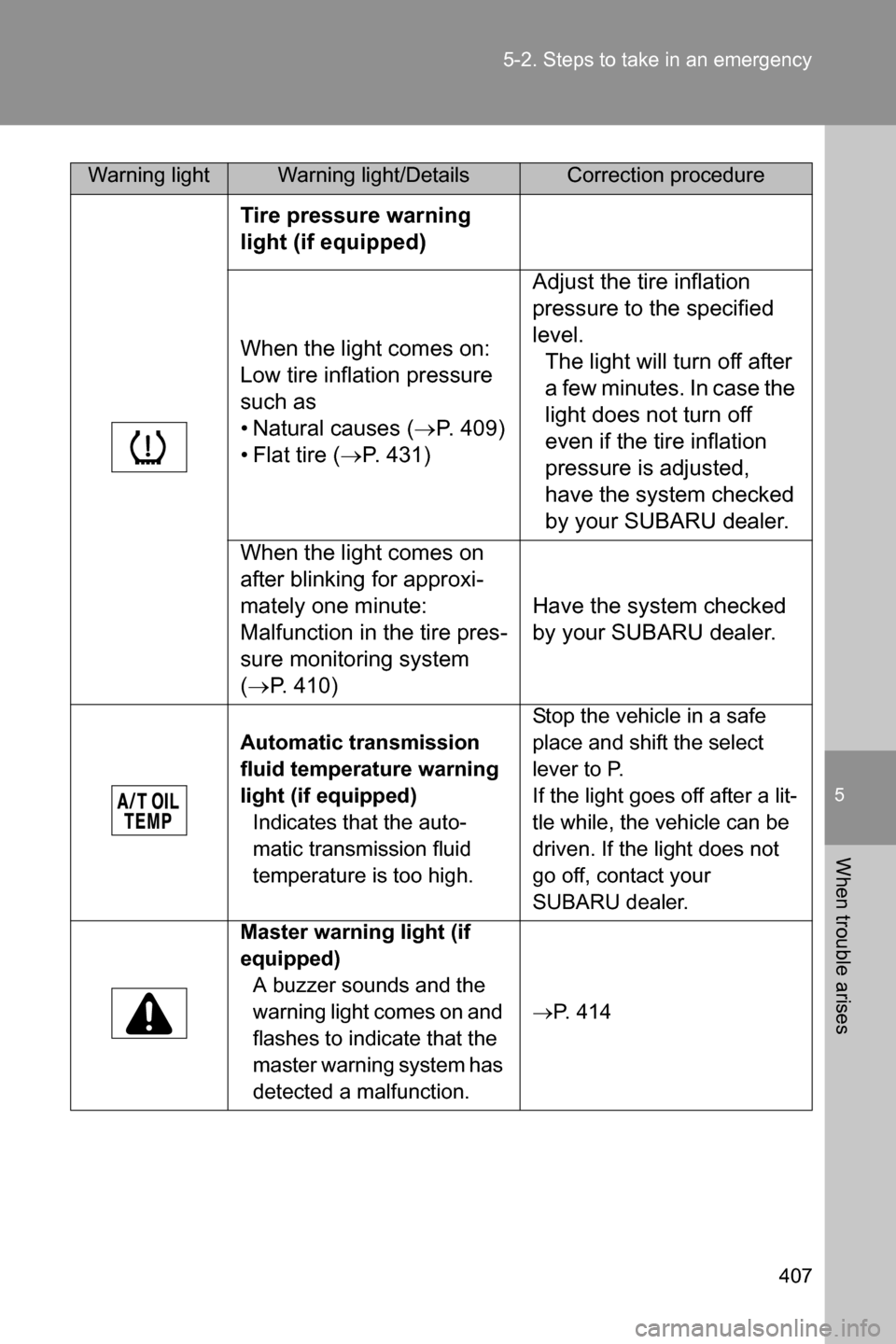
Tire pressure warning
light (if equipped)
When the light comes on:
Low tire inflation pressure
such as
• Natural causes (oP. 409)
• Flat tire (oP. 431)Adjust the tire inflation
pressure to the specified
level.
The light will turn off after
a few minutes. In case the
light does not turn off
even if the tire inflation
pressure is adjusted,
have the system checked
by your SUBARU dealer.
When the light comes on
after blinking for approxi-
mately one minute:
Malfunction in the tire pres-
sure monitoring system
(oP. 410)Have the system checked
by your SUBARU dealer.
Automatic transmission
fluid temperature warning
light (if equipped)
Indicates that the auto-
matic transmission fluid
temperature is too high.Stop the vehicle in a safe
place and shift the select
lever to P.
If the light goes off after a lit-
tle while, the vehicle can be
driven. If the light does not
go off, contact your
SUBARU dealer.
Master warning light (if
equipped)
A buzzer sounds and the
warning light comes on and
flashes to indicate that the
master warning system has
detected a malfunction.oP. 414
Warning lightWarning light/DetailsCorrection procedure
Page 416 of 540
414
5-2. Steps to take in an emergency
If a warning message is displayed (vehicles with a color multi-infor mation display)
Stop the vehicle immediately. Continuing to drive the vehicle
may be dangerous.
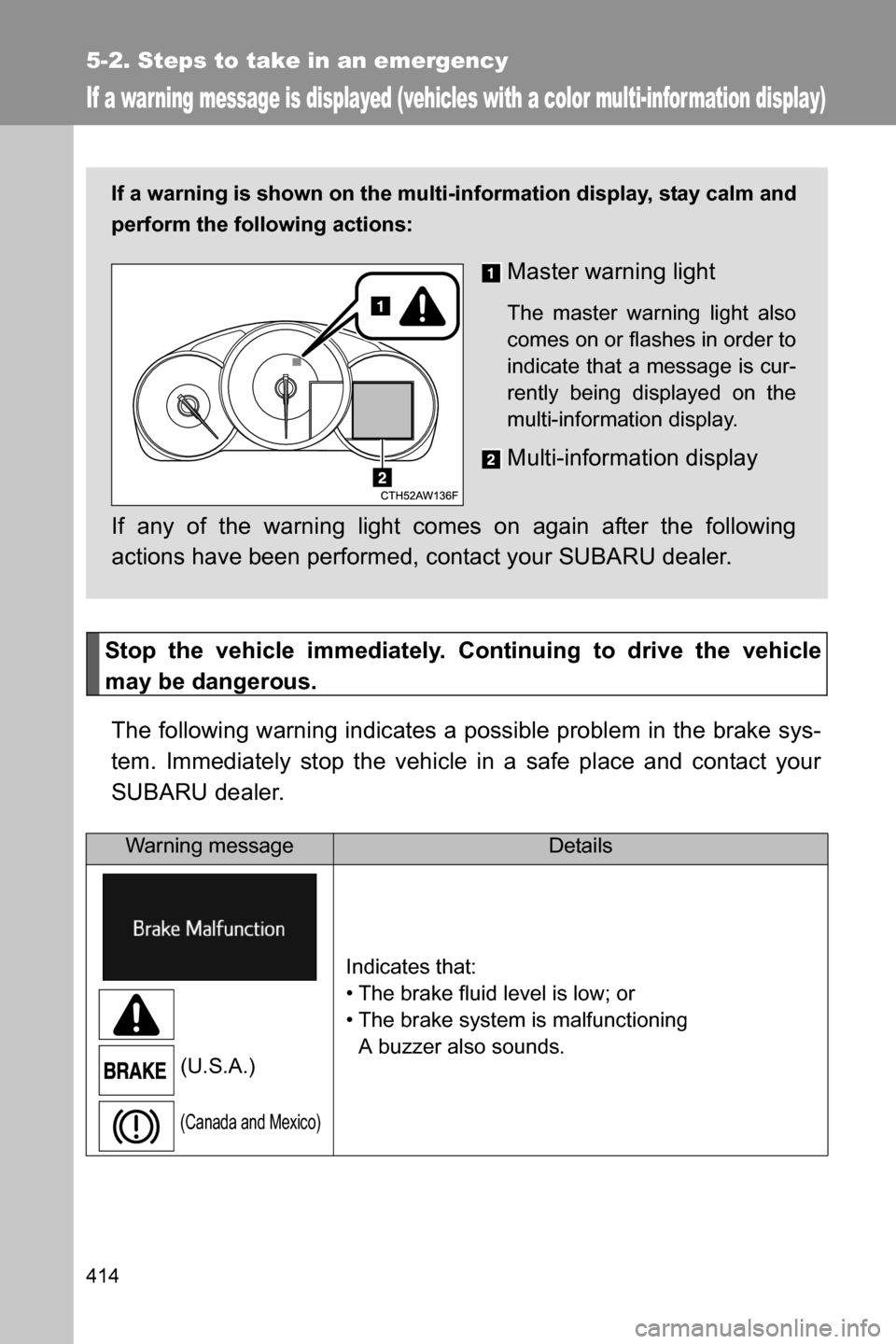
The following warning indicates a possible problem in the brake sys-
tem. Immediately stop the vehicle in a safe place and contact your
SUBARU dealer.
Warning messageDetails
(U.S.A.)
(Canada and Mexico)
Indicates that:
• The brake fluid level is low; or
• The brake system is malfunctioning
A buzzer also sounds.
If a warning is shown on the multi-information display, stay calm and
perform the following actions:
Master warning light
The master warning light also
comes on or flashes in order to
indicate that a message is cur-
rently being displayed on the
multi-information display.
Multi-information display
If any of the warning light comes on again after the following
actions have been performed, contact your SUBARU dealer.