Page 380 of 540
378 4-3. Do-it-yourself maintenance
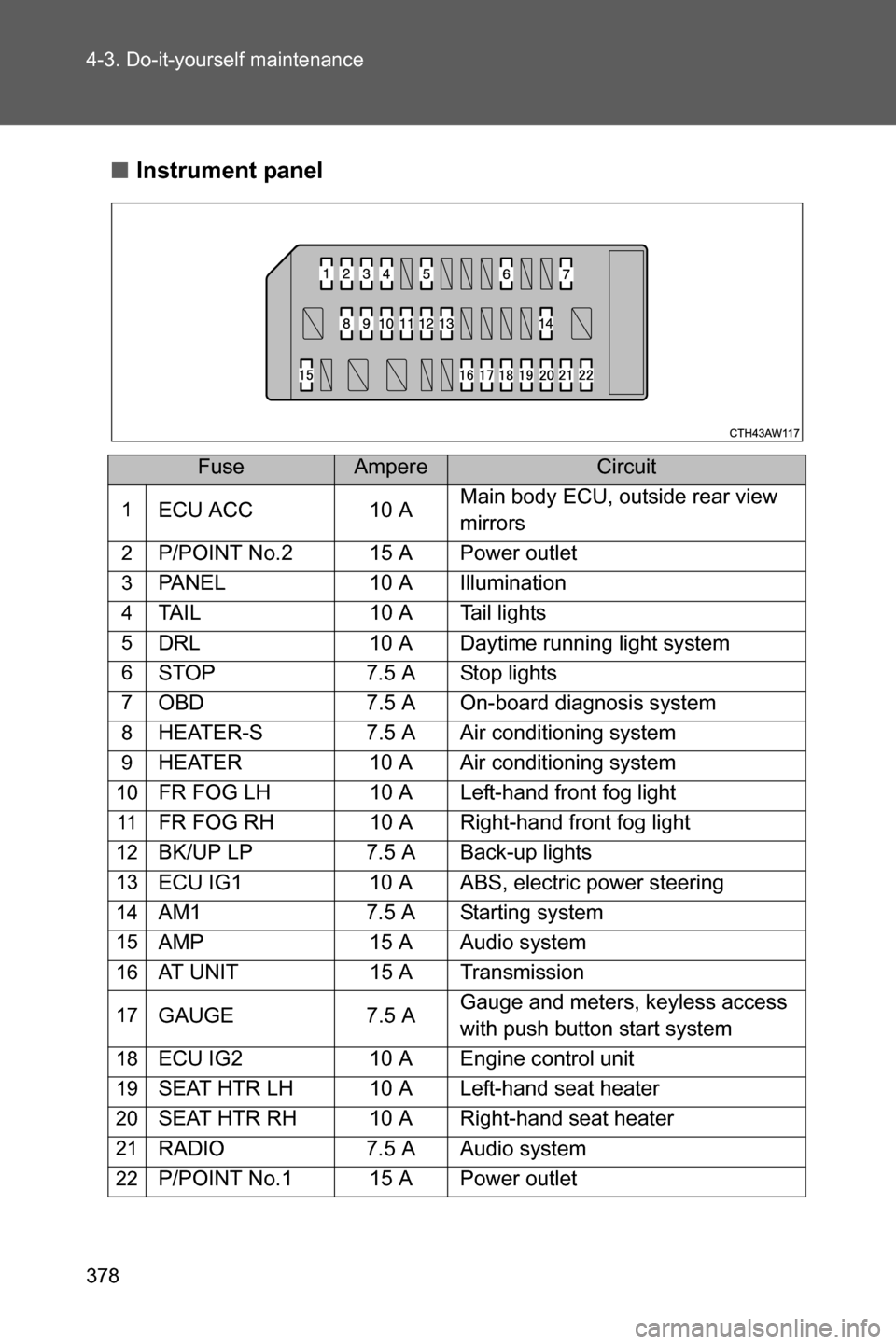
■Instrument panel
FuseAmpereCircuit
1ECU ACC 10 AMain body ECU, outside rear view
mirrors
2P/POINT No.2 15 A Power outlet
3PANEL 10 A Illumination
4TAIL 10 A Tail lights
5DRL 10 A Daytime running light system
6STOP 7.5 A Stop lights
7OBD 7.5 A On-board diagnosis system
8HEATER-S 7.5 A Air conditioning system
9HEATER 10 A Air conditioning system
10FR FOG LH 10 A Left-hand front fog light
11FR FOG RH 10 A Right-hand front fog light
12BK/UP LP 7.5 A Back-up lights
13ECU IG1 10 A ABS, electric power steering
14AM1 7.5 A Starting system
15AMP 15 A Audio system
16AT UNIT 15 A Transmission
17GAUGE 7.5 AGauge and meters, keyless access
with push button start system
18ECU IG2 10 A Engine control unit
19SEAT HTR LH 10 A Left-hand seat heater
20SEAT HTR RH 10 A Right-hand seat heater
21RADIO 7.5 A Audio system
22P/POINT No.1 15 A Power outlet
Page 396 of 540

394 5-1. Essential information
■Before emergency towing
Release the parking brake.
Shift the select lever to N (vehicles with an automatic transmission)
or shift lever to neutral (vehicles with a manual transmission).
Vehicles without a keyless access with push button start system:
Turn the engine switch to the “ACC” (engine off) or “ON” (engine
running) position.
Vehicles with a keyless access with push button start system: Turn
the push-button ignition switch to “ACC” (engine off) or “ON”
(engine running) mode.
■If towing a vehicle
Do not tow another vehicle. If towing a vehicle that has broken down is
unavoidable, avoid towing a vehicle that is heavier than your vehicle. Also,
do not pull out a vehicle that has fallen into a ditch.
WARNING
■Caution while towing
●Use extreme caution when towing the vehicle.
Avoid sudden starts or erratic driving maneuvers which place excessive
stress on the emergency towing eyelets and the cables or chains. Always
be cautious of the surroundings and other vehicles while towing.
●If the engine is not running, the power assist for the brakes and steering
will not function, making steering and braking more difficult.
STEP 1
STEP 2
STEP 3
Page 400 of 540
398 5-1. Essential information
CAUTION
■To prevent body damage
Do not tow with a sling-type truck, either from the front or rear.
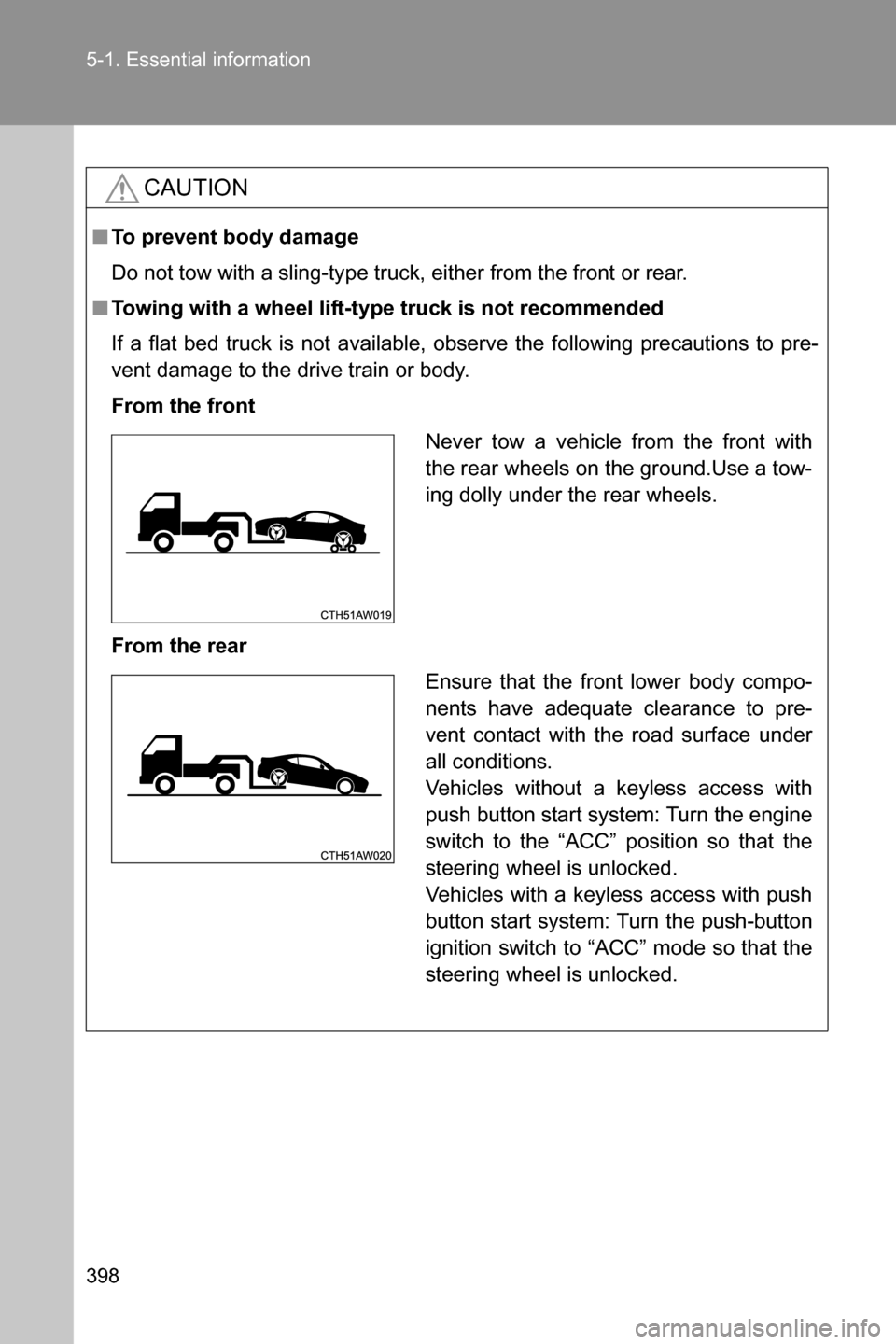
■Towing with a wheel lift-type truck is not recommended
If a flat bed truck is not available, observe the following precautions to pre-
vent damage to the drive train or body.
From the front
From the rear
Never tow a vehicle from the front with
the rear wheels on the ground.Use a tow-
ing dolly under the rear wheels.
Ensure that the front lower body compo-
nents have adequate clearance to pre-
vent contact with the road surface under
all conditions.
Vehicles without a keyless access with
push button start system: Turn the engine
switch to the “ACC” position so that the
steering wheel is unlocked.
Vehicles with a keyless access with push
button start system: Turn the push-button
ignition switch to “ACC” mode so that the
steering wheel is unlocked.
Page 403 of 540
5
When trouble arises
401
5-1. Essential information
Fuel pump shut off system
Follow the procedure below to restart the engine after the system is
activated.
Vehicles without a keyless access with push button start system
Turn the engine switch to the “ACC” or “LOCK” position.
Restart the engine.
Vehicles with a keyless access with push button start system
Turn the push-button ignition switch to “ACC” mode or turn it off.
Restart the engine.
CAUTION
■Before starting the engine
Inspect the ground under the vehicle.
If you find that fuel has leaked on to the ground, the fuel system has been
damaged and is in need of repair. Do not restart the engine.
When the vehicle sustains an impact in an accident, etc., the fuel
pump shut off system operates to stop supplying fuel in order to
minimize fuel leakage.
STEP 1
STEP 2
STEP 1
STEP 2
Page 410 of 540

408 5-2. Steps to take in an emergency
*1: Driver’s seatbelt buzzer:
Vehicles without a keyless access with push button start system
The driver’s seatbelt buzzer sounds to alert the driver that his or her seatbelt
is not fastened. Once the engine switch is turned to the “ON” position, the
buzzer sounds for 6 seconds. If the vehicle reaches a speed of 12 mph (20
km/h), the buzzer sounds once. If the seatbelt is still unfastened after 24
seconds, the buzzer will sound intermittently for 10 seconds. Then, if the
seatbelt is still unfastened, the buzzer will sound in a different tone for 20
more seconds.
Vehicles with a keyless access with push button start system
The driver’s seatbelt buzzer sounds to alert the driver that his or her seatbelt
is not fastened. Once the
push-button ignition switch is turned to “ON”
mode
, the buzzer sounds for 6 seconds. If the vehicle reaches a speed of
12 mph (20 km/h), the buzzer sounds once. If the seatbelt is still unfastened
after 24 seconds, the buzzer will sound intermittently for 10 seconds. Then,
if the seatbelt is still unfastened, the buzzer will sound in a different tone for
20 more seconds.
*2: Front passenger’s seatbelt buzzer:
The front passenger’s seatbelt buzzer sounds to alert the front passenger
that his or her seatbelt is not fastened. The buzzer sounds once if the vehi-
cle reaches a speed of 12 mph (20 km/h). If the seatbelt is still unfastened
after 24 seconds, the buzzer will sound intermittently for 10 seconds. Then,
if the seatbelt is still unfastened, the buzzer will sound in a different tone for
20 more seconds.
Page 412 of 540

410 5-2. Steps to take in an emergency
■If the tire pressure monitoring system is inoperative (if equipped)
The tire pressure monitoring system will be disabled in the following con-
ditions:
(When the condition becomes normal, the system will work properly.)
●If tires not equipped with tire pressure warning valves and transmit-
ters are used.
●If the ID code on the tire pressure warning valves and transmitters is
not registered in the tire pressure warning computer.
●If the tire inflation pressure is 55 psi (380 kPa, 3.87 kgf/cm2 or bar) or
higher.
The tire pressure monitoring system may be disabled in the following
conditions:
(When the condition becomes normal, the system will work properly.)
●If electronic devices or facilities using similar radio wave frequencies
are nearby.
●If a radio set at similar frequencies is in use in the vehicle.
●If a window tint that affects the radio wave signals is installed.
●If there is a lot of snow or ice on the vehicle, in particular around the
wheels or wheel housings.
●If non-genuine SUBARU wheels are used. (Even if you use SUBARU
wheels, the tire pressure monitoring system may not work properly
with some types of tires.)
●If tire chains are used.
●If a large metallic object which can interfere with signal reception is
put in the trunk.
■If the tire pressure warning light frequently comes on after blinking
for approximately one minute (if equipped)
If the tire pressure warning light frequently comes on after blinking for
approximately one minute when the push-button ignition switch is turned
to “ON” mode (vehicles with a keyless access with push button start sys-
tem) or the engine switch is turned to the “ON” position (vehicles without
a keyless access with push button start system), have it checked your
SUBARU dealer.
Page 419 of 540
5
When trouble arises
417 5-2. Steps to take in an emergency
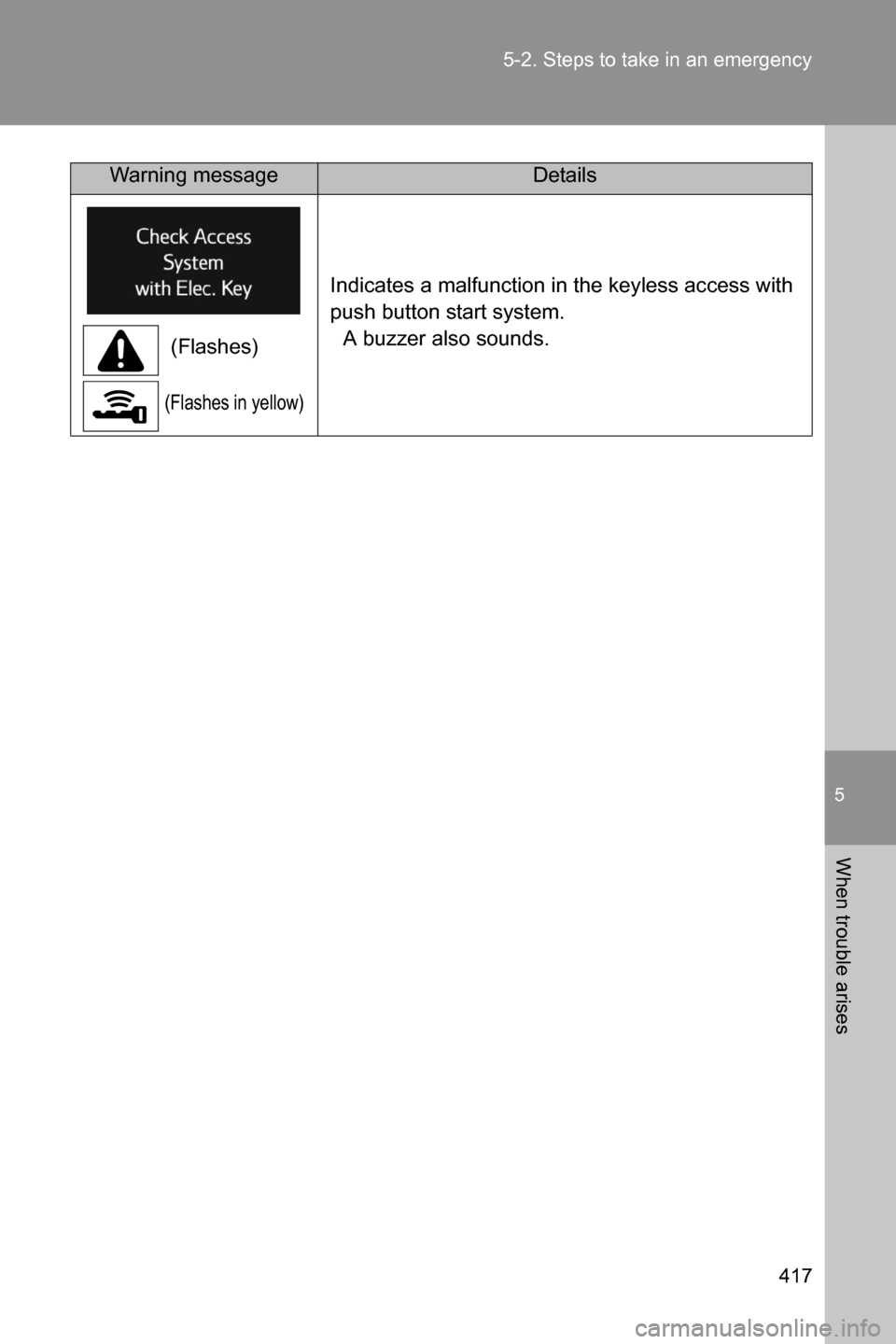
(Flashes)
(Flashes in yellow)
Indicates a malfunction in the keyless access with
push button start system.
A buzzer also sounds.
Warning messageDetails
Page 426 of 540
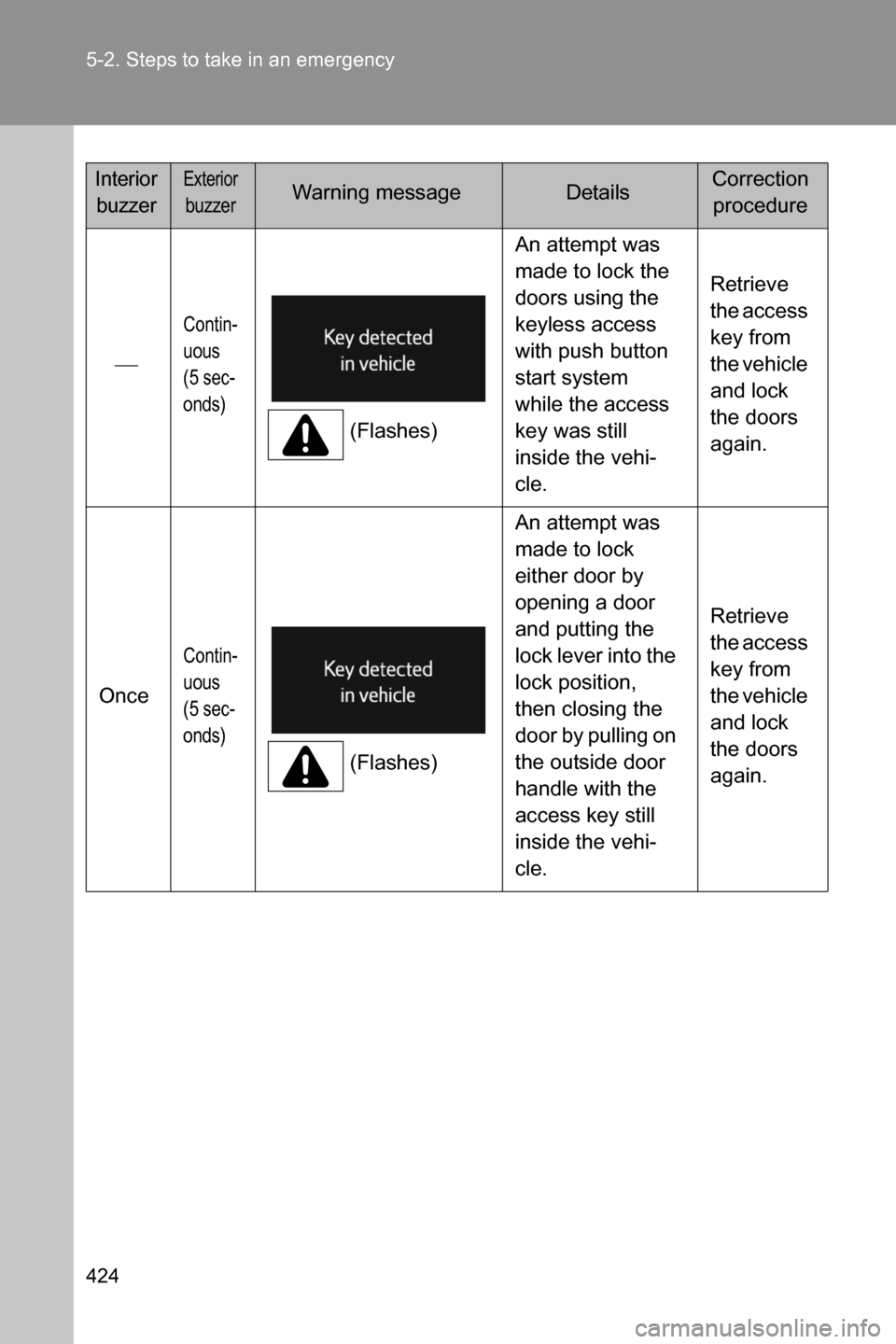
424 5-2. Steps to take in an emergency
Contin-
uous
(5 sec-
onds)
(Flashes)An attempt was
made to lock the
doors using the
keyless access
with push button
start system
while the access
key was still
inside the vehi-
cle.Retrieve
the access
key from
the vehicle
and lock
the doors
again.
Once
Contin-
uous
(5 sec-
onds)
(Flashes)An attempt was
made to lock
either door by
opening a door
and putting the
lock lever into the
lock position,
then closing the
door by pulling on
the outside door
handle with the
access key still
inside the vehi-
cle.Retrieve
the access
key from
the vehicle
and lock
the doors
again.
Interior
buzzerExterior
buzzerWarning messageDetailsCorrection
procedure