2017 Seat Alhambra open bonnet
[x] Cancel search: open bonnetPage 250 of 320

Advice
equipment at the workshop. If this is the
c a
se, the inf
ormation and descriptions given
in the Instruction Manual will not match the
original functions. Therefore, SEAT recom-
mends that any modifications be recorded in
the section “Other workshop notes” in the
Maintenance Programme.
The technical service centre must have a re-
cord of any modification to the programming.
Reading the vehicle fault memory
There is a diagnostics connector in the vehi-
cle interior for reading the vehicle fault mem-
ory. The fault memory documents errors and
deviations from the theoretical values of the
electronic control units.
The diagnostics connector is in the driver
side footwell area, next to the lever for open-
ing the bonnet, below a cover.
The fault memory should only be read and re-
set by a specialised workshop.
Using a mobile telephone in a vehicle
without c
onnection to an exterior aer-
ial Mobile telephones transmit and receive radio
w
av
e
s, both when in use and when on stand-
by. Scientific studies state that radio waves
exceeding certain values may be harmful to
the human body. International committees and authorities have established limits and
directive
s in order to ensure electromagnetic
radiation from mobile phones remains within
certain limits that do not endanger health.
Nevertheless, there is no conclusive scientif-
ic evidence that wireless telephones are to-
tally safe.
Therefore, some experts recommend that use
of mobile phone be kept to a minimum until
the results of current research are published.
When a mobile phone not connected to an
exterior aerial is used inside the vehicle, the
electromagnetic radiation may be greater
than if the mobile phone were connected to a
built-in aerial or to another exterior aerial.
If the vehicle is fitted with a suitable hands-
free device, it will comply with the legislation
in many countries which only permits the use
of mobile phones inside vehicles using a
hands-free device.
The hands-free system mounted at the facto-
ry has been designed for use with conven-
tional mobile phones and phones with Blue-
tooth technology. Mobile phones should be
placed on a suitable phone cradle. In addi-
tion, the cradle should always be correctly fit-
ted into the base plate. This ensures that the
mobile phone is securely attached to the
dash panel, it is always within reach of the
driver and is connected to the vehicle exterior
aerial. If the mobile phone is connected to an aerial
incorporat
ed into the vehicle or an exterior
aerial connected to the vehicle, it will help re-
duce the electromagnetic radiation transmit-
ted and the risk to human health. It will also
improve the quality of the connection.
If the phone is used inside the vehicle with-
out the hands-free system, it will not be se-
curely fastened and will not be connected to
the exterior aerial of the vehicle telephone.
Nor will the telephone charge if it is not on
the support. In addition, some calls may
break off and the quality of the connection
will be affected.
Mobile phones should only be used inside
the vehicle if they are connected to a hands-
free system with an exterior aerial. WARNING
If the mobile phone is not securely fastened
in pos ition, it
could be sent flying around the
vehicle in the event of sharp braking, sudden
manoeuvres or accident, causing injury.
● While driving, mobile phones must be se-
curely
fastened in position, outside the radi-
us of action of the airbags, or safely stowed
away. WARNING
When using a mobile phone without a con-
nection to an e xt
erior aerial, the maximum
permitted levels of electromagnetic radiation 248
Page 253 of 320

Care and maintenance
Automatic car washes
A lw
a
ys observe the instructions provided at
the automatic car wash. The standard pre-
cautionary measures prior to entering the car
wash should be taken to avoid damage to
the vehicle (close all windows, fold in exterior
mirrors). If the vehicle is fitted with additional
components (spoiler, roof-rack, aerial, etc.),
check with the car wash supervisor whether
these can enter the car wash ››› .
The v
ehic
le paintwork is so durable that the
vehicle can normally be washed without
problems in an automatic car wash tunnel.
However, wear and damage to the paintwork
will depend on the type of car wash used.
SEAT recommends the use of car washes
without brushes.
To remove traces of wax on windows and to
prevent wiper blades from scratching, please
observe the following ››› page 252, Cleaning
windows and exterior mirrors .
Washing the car by hand
When washing the car by hand, use plenty of
water to soften the dirt first, and rinse off as
well as possible.
Then clean the vehicle with a soft sponge,
glove or brush using only slight pressure.
Start at the roof and work downwards. Spe-
cial car shampoo should only be used for
very persistent dirt. Rinse the sponge or glove thoroughly and of-
ten.
Wheels, s
ills and similar should be cleaned
last. Use a second sponge for this. WARNING
Sharp components on the vehicle may cause
injury .
● Pr
otect arms and hands from sharp edges
when cle
aning the vehicle undercarriage or
the interior of the wheel hubs. WARNING
After the vehicle has been washed, the brak-
ing eff ect
will be reduced (and the braking
distance increased) due to moisture (and ice
in winter) on the brakes.
● “Dry the brakes and remove ice” by braking
caref
ully. Ensure that you are not endanger-
ing other road-users or breaking traffic regu-
lations in the process. CAUTION
● The temper at
ure of the water must not ex-
ceed +60°C (+140°F).
● To avoid damage to the paintwork, do not
wash the
vehicle in full sun.
● Do not use rough sponges or similar which
coul
d damage the surface to clean away the
traces of insects. ●
Never w ipe the he
adlights with a dry cloth
or sponge, always moisten first. It is best to
use soapy water.
● Washing the vehicle in low temperatures:
When washin
g the vehicle with a hose, do
not direct water into the lock cylinders or the
gaps around the doors or roof. Locks and
seals could freeze! CAUTION
To avoid any risk of damage to the vehicle,
p le
ase check the following points before us-
ing an automatic car wash:
● Compare the distance between the vehicle
wheels and the di
stance between the guide-
rails of the car wash to prevent damage to the
wheels and tyres!
● Switch off the rain sensor and the Au-
to Hol
d function before entering a car wash.
● Compare the height and width of your vehi-
cle w
ith the available height and width when
entering and driving through the car wash.
● Fold in exterior mirrors Electrically retracta-
ble e
xterior mirrors must not be folded in or
out by hand. Always use the electrical power
control.
● To avoid damaging the bonnet paintwork,
res
t the wipers on the windscreen after dry-
ing them. Do not let them fall!
● Lock the rear lid to prevent it from opening
unexpect
edly while inside the car wash. 251
Technical data
Advice
Operation
Emergencies
Safety
Page 271 of 320

Checking and refilling levels
Working incorrectly can cause serious
injuries.
● Nev er open the bonnet
if you see steam or
cool
ant escaping from the engine compart-
ment. This may cause serious burns. Always
wait until you cannot see or hear the sound of
steam or coolant coming from the engine
compartment.
● Always allow the engine to cool down be-
fore openin
g the bonnet.
● Contact with hot elements of the engine
and the exhau
st system can cause burns.
● Once the engine has cooled, follow the in-
structions
below before opening the bonnet:
– Turn on the electronic parking brake and
place the gear selector lever in P or the
gearbox lever in neutral.
– Remove the key from the ignition.
– Keep children away from the engine com-
partment and never leave them unsuper-
vised.
● When the engine is warm or hot, the cool-
ing sys
tem is pressurised. Do not unscrew
the cap on the expansion tank when the en-
gine is hot. Otherwise, coolant may spray out
under pressure causing burns and serious in-
jury.
– Carefully and slowly unscrew the cap an-
ticlockwise, gently pressing down on it.
– Always protect your face, hands and arms
from hot coolant and steam using a large,
thick cloth. ●
When refi l
ling liquids, avoid spilling them
on parts of the engine and the exhaust sys-
tem. Spilled liquids could cause a fire. WARNING
The high voltages of the electrical system can
giv e el ectric
shocks as well as causing burns
and serious injury and possibly even death!
● Never cause short circuits in the electrical
syst
em. The battery could explode.
● To minimise the risk of electric shock and
serious c
onsequences while the engine is
running or starting the engine, note the fol-
lowing:
– Never touch the electrical wiring of the
ignition system.
– Never touch electric cables or the gas dis-
charge lamps. WARNING
In the engine compartment, there are rotat-
ing p ar
ts that could cause serious injury.
● Never place your hands on or near the radi-
ator fan.
Touching the rotor blades could seri-
ously harm you. The ventilator works accord-
ing to the engine temperature and could start
suddenly even when the ignition is turned off
and the key is removed.
● If any work has to be performed when the
engine is
started or with the engine running,
there is an additional, potentially fatal, safety
risk from rotating parts, such as the drive belts, alternator, radiator fan, etc., as well as
from the high-
v
oltage ignition system. Al-
ways work with the utmost caution.
– Always make sure that no parts of your
body, jewellery, ties, loose clothing and
long hair can be trapped by the rotating
parts of the engine. Before any work, re-
move ties and jewellery (necklaces, etc),
tie long hair back and tie all items of
loose clothing to your body to make sure
that they cannot be trapped by engine
components.
– Take extreme caution when operating the
accelerator and remain attentive. The ve-
hicle could move, even with the electron-
ic parking brake activated.
● Always make sure you have not left any ob-
jects, s
uch as cleaning cloths and tools, in
the engine compartment. If any object is left
in the engine compartment, this could cause
malfunctions, engine faults and even a fire. WARNING
Refill liquids and certain materials can catch
fire e a
sily in the engine compartment, caus-
ing a fire and serious injury!
● Never smoke.
● Never work close to places exposed to
flames
or sparks.
● Never pour service fluids over the engine.
These fluid ma
y ignite hot engine parts and
cause injuries. » 269
Technical data
Advice
Operation
Emergencies
Safety
Page 272 of 320

Advice
●
If it i
s necessary to work on the fuel system
or the electrical system, please follow the in-
structions below:
–Always disconnect the vehicle battery.
When disconnecting the battery, ensure
that the vehicle is unlocked otherwise
the anti-theft alarm will be triggered.
– Never work close to heaters, heat sources
or places exposed to flames or sparks.
● Always keep a recently serviced and per-
fectly w
orking fire extinguisher close by.
● Never cover the engine with additional in-
sul
ating materials such as a blanket. Risk of
fire! CAUTION
When refilling or changing service liquids,
ens ur
e that you put the liquids into the right
tank. Making a mistake when refilling could
cause serious malfunctions and damage the
engine! For the sake of the environment
Service fluids leaks are harmful to the envi-
ronment . F
or this reason you should make
regular checks on the ground underneath
your vehicle. Take the vehicle to a specialised
workshop to be checked if you see stains, oil
or other fluids on the ground. Collect any
spilt service fluids and allow a professional to
dispose of them. Opening and closing the bonnet
Fig. 238
In the footwell on the driver side:
L ev
er f
or unlocking the bonnet Fig. 239
Release lever to open the bonnet in
the r a
di
ator grille Opening the bonnet
The l
ev
er t
o open the bonnet can only be
used if the driver door is open. ●
Befor
e opening the bonnet, make sure that
the windscreen wiper arms are in place
against the windscreen ››› .
● Open the driver door.
● Pull the release lever ››
›
Fig. 238 in the di-
rection of the arrow. The bonnet is released
from the lock carrier by a spring mechanism
››› .
● Lift the bonnet using the release lever
› ›
›
Fig. 239 (arrow) and open the bonnet fully.
The bonnet is held open thanks to the gas
strut.
Closing the bonnet
● To close the bonnet, pull it down to over-
come the ga
s strut pressure ››› .
● Allow the bonnet to fall into the lock carrier.
Do not pr
e
ss down.
If the bonnet is not correctly closed, open it
once again and close it correctly.
The bonnet is correctly closed when it is flush
with the corresponding parts on the body-
work. WARNING
If the bonnet is not correctly closed, it could
sud den
ly open while driving leaving the driv-
er without visibility. This could result in a se-
rious accident. 270
Page 273 of 320

Checking and refilling levels
●
Aft er c
losing the bonnet, always check that
it is properly secured by the locking mecha-
nism in the lock carrier. The bonnet must be
flush with the surrounding body panels.
● While driving, if you notice that the bonnet
is not
correctly closed then stop immediately
and close it correctly.
● Only open and close the bonnet when there
is no
body within its range. CAUTION
● To av oid d
amage to the bonnet and to the
windscreen wiper arms, only open it when
the windscreen wipers are in place against
the windscreen.
● Before driving, always lower the wiper
arms. Checking fluid levels
Fig. 240
Diagram for the location of the vari-
ou s
el
ements. From time to time, the levels of the different
fluid
s
in the
vehicle must be checked. Never
fill with incorrect fluids, otherwise serious
damage to the engine may be caused.
Coolant fluid deposit
Engine oil dipstick
Oil filler neck
Brake fluid reservoir
Vehicle battery (underneath a cover)
Windscreen washer fluid reservoir
The checking and refilling of service fluids
are carried out on the components men- 1 2
3
4
5
6 tioned above. These operations are descri-
bed in
››
›
page 268.
Overview
Further explanations, instructions and restric-
tions on the technical data are contained as
of ››› page 294
Engine oil Introduction WARNING
Incorrectly handling engine oil can cause in-
jury and seriou
s burns.
● Always protect your eyes when handling
engine oil
.
● Oil is toxic and must be kept out of the
reac
h of children.
● Engine oil should only be kept in its origi-
nal
packaging; the same goes for used oil un-
til it is disposed of.
● Never store engine oil in empty food con-
tainers
or bottles as other people may acci-
dentally drink it.
● Regular contact with engine oil can be bad
for the skin. If
you come into contact with en-
gine oil, wash your skin with soap and water.
● With the engine running, the engine oil
gets
extremely hot and can cause severe skin » 271
Technical data
Advice
Operation
Emergencies
Safety
Page 275 of 320

Checking and refilling levels
Checking engine oil level Fig. 241
Marked engine oil dipstick Fig. 242
In the engine compartment: Engine
oi l
fi
ller cap. Read the additional information carefully
› ›
›
page 39
Preparations ● Park the vehicle on flat ground so that the
engine oil
reading is correct. ●
Stop the engine and w
ait a few minutes for
the oil to drain back into the sump. When the
engine has cooled down, immediately check
the oil level and top up if necessary.
● Open the bonnet ›››
page 268.
● The engine oil filler neck can be recognised
by the symbo
l on the cap ››› Fig. 242 and
the dipstick by its coloured handle.
Checking the engine oil level
● Pull out the dipstick and wipe it on a clean
cloth.
● Rep
lace the dipstick, pushing it in as far as
it wi
ll go. If the dipstick has a mark, when you
reintroduce it this mark should slot into the
corresponding groove located on the upper
end of the tube.
● Remove the oil dipstick again and check
the engine oil
level.
● After reading the oil level, replace the dip-
stick
in the tube completely.
Adding oil after checking the level
Only add engine oil in small quantities and in
steps:
● Unscrew the cap from engine oil filler neck
on the cylinder head ›
›› Fig. 242. If you are
not sure where the cap is, request help from
a specialist. ●
Only r
efill using approved SEAT engine oil
in small quantities (no more than 0.5 l)
››› page 272.
● To avoid adding too much oil, each time
you ad
d a quantity, wait until the oil has flow-
ed into the crankcase so that it can be meas-
ured with the dipstick.
● Check the oil level before adding any more
oil. Do not
top up with too much engine oil
››› .
● When the oil level is at least in the
› ›
›
Fig. 241 B zone, insert the dipstick into
the t ube f
u
lly to avoid engine oil escaping
when the engine is running.
● After topping up the oil, ensure that the
cap is
screwed on to the filler neck correctly. WARNING
Oil could catch fire if it comes into contact
with hot en
gine components. This could lead
to a fire, explosion and severe injuries.
● Always ensure that after topping of oil, the
engine oil
filler cap is correctly tightened.
This will avoid engine oil spilling onto hot en-
gine parts when the engine is running. CAUTION
● If the en gine oi
l level is above the area
››› Fig. 241 A do not start the engine. Seek
spec i
alist assistance. Otherwise catalytic
converter and engine damage may occur. » 273
Technical data
Advice
Operation
Emergencies
Safety
Page 279 of 320

Checking and refilling levels
Checking the coolant level and top-
pin g up Fig. 244
In the engine compartment: Marking
on c oo
l
ant expansion tank Fig. 245
In the engine compartment: coolant
e xp
an
sion tank cap If the coolant level is low, the coolant warn-
in
g indic
at
or will light. Preparations
● Park the vehicle on even, flat and firm
ground.
● A
llow the engine to cool ›››
.
● Open the bonnet › ›
›
page 268.
● The coolant expansion tank is easily recog-
nisab
le because of the symbol on the cap
››› Fig. 245.
Checking the engine coolant level ● When the engine is cold, check the coolant
level
using the side marking on the expan-
sion tank ››› Fig. 244.
● If the level is below the “MIN” mark, top up
with coo
lant. When the engine is hot it may
be slightly above the marked area.
Topping up the engine coolant level
● Always protect your face, hands and arms
from hot c
oolant and steam using a large,
thick cloth over the coolant expansion tank
cap.
● Remove the cap very carefully ›››
.
● Only refill using new engine c
oo
lant ac-
cording to SEAT specifications ( ››› page 276)
››› .
● The engine coolant level should be be-
tw een the m
ark
s on the coolant expansion
tank ››› Fig. 244. Do not exceed the top level
of the marked area ››› .
● Screw on the cap tightly. ●
If, in the ev
ent
of an emergency, you have
no coolant that is compliant to the required
specifications ( ››› page 276), do not use an-
other type of additive. Instead, top up with
distilled water only ››› . Then re-establish
the c orr
ect
proportion of the mixture with the
correct additive as soon as possible
››› page 276. WARNING
Hot vapours and coolant can cause serious
burn s.
● Nev
er open the coolant expansion tank if
ste
am or coolant is coming from the engine
compartment. Wait until you cannot see or
hear any steam or coolant escaping.
● Always wait until the engine has complete-
ly coo
led before very carefully opening the
expansion tank cap. Contact with hot ele-
ments of the engine can cause skin burns.
● When the engine is warm or hot, the cool-
ing sys
tem is pressurised. Do not unscrew
the cap on the expansion tank when the en-
gine is hot. Otherwise, coolant may spray out
under pressure causing burns and serious in-
jury.
– Carefully and slowly unscrew the cap an-
ti-clockwise, gently pressing down on it.
– Always protect your face, hands and arms
from hot coolant and steam using a large,
thick cloth. » 277
Technical data
Advice
Operation
Emergencies
Safety
Page 282 of 320
Advice
Windscreen washer reservoir Chec k
in
g and topping up the wind-
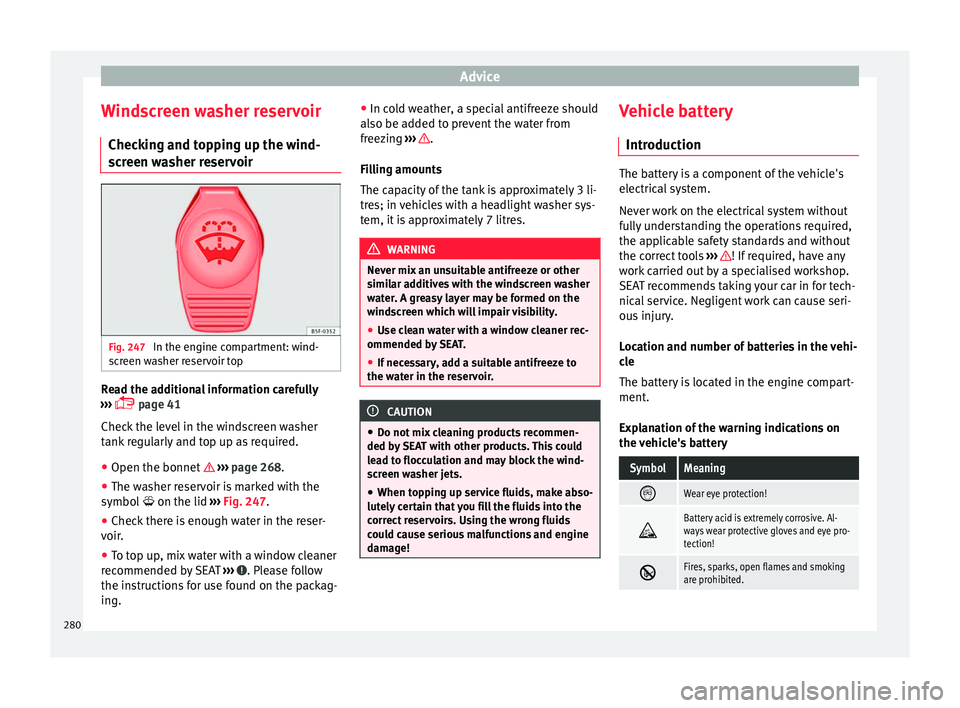
screen washer reservoir Fig. 247
In the engine compartment: wind-
s c
r
een washer reservoir top Read the additional information carefully
› ›
›
page 41
Check the level in the windscreen washer
tank regularly and top up as required.
● Open the bonnet ›››
page 268.
● The washer reservoir is marked with the
symbol
on the lid ››› Fig. 247.
● Check there is enough water in the reser-
voir.
● T
o top up, mix water with a window cleaner
recommended b
y SEAT ››› . Please follow
the in struction
s for use found on the packag-
ing. ●
In col
d weather, a special antifreeze should
also be added to prevent the water from
freezing ››› .
Fi l
lin
g amounts
The capacity of the tank is approximately 3 li-
tres; in vehicles with a headlight washer sys-
tem, it is approximately 7 litres. WARNING
Never mix an unsuitable antifreeze or other
simi l
ar additives with the windscreen washer
water. A greasy layer may be formed on the
windscreen which will impair visibility.
● Use clean water with a window cleaner rec-
ommended by
SEAT.
● If necessary, add a suitable antifreeze to
the water in the r
eservoir. CAUTION
● Do not mi x
cleaning products recommen-
ded by SEAT with other products. This could
lead to flocculation and may block the wind-
screen washer jets.
● When topping up service fluids, make abso-
lutely c
ertain that you fill the fluids into the
correct reservoirs. Using the wrong fluids
could cause serious malfunctions and engine
damage! Vehicle battery
Intr oduction The battery is a component of the vehicle's
electric
al
system.
Never work on the electrical system without
fully understanding the operations required,
the applicable safety standards and without
the correct tools ››› ! If required, have any
work c
arried out by a specialised workshop.
SEAT recommends taking your car in for tech-
nical service. Negligent work can cause seri-
ous injury.
Location and number of batteries in the vehi-
cle
The battery is located in the engine compart-
ment.
Explanation of the warning indications on
the vehicle's battery
SymbolMeaning
Wear eye protection!
Battery acid is extremely corrosive. Al-
ways wear protective gloves and eye pro-
tection!
Fires, sparks, open flames and smoking
are prohibited.
280