2017 Seat Alhambra alarm
[x] Cancel search: alarmPage 237 of 320

Towing bracket device
Note
● Alw a
ys turn off the anti-theft alarm system
before connecting or disconnecting a trailer
››› page 117. Otherwise, the tilt sensor may
erroneously activate the alarm.
● Never use a trailer with a new engine (for
the first
1,000 km or 600 miles) ››› page 244.
● At SEAT, we recommend folding in the tow
hitch b
all when a trailer is not being used. In
case of a rear collision, the damage caused to
the vehicle with the extended tow hitch ball
could be more extensive.
● In some models, a tow hitch is necessary
for to
wing vehicles. For this reason, you
should store the tow hitch in the vehicle at all
times. Technical requirements
If the car is supplied with a
fact
or
y-fitted tow-
ing bracket it will already have the necessary
technical modifications and meet the statuto-
ry requirements for towing a trailer.
Only use an approved tow hitch for the gross
trailer weight rating. The tow hitch must be
suitable for both the vehicle and trailer and
must be securely fitted to the vehicle chassis.
Only use a tow hitch with a removable ball
joint. Always check and take into account the
tow hitch manufacturer's instructions. Never
fit a trailer tow hitch “that distributes the
load” or “balances the load”. Bumper mounted tow hitch
Never fit a t
ow hitch or its attachments to the
bumper. A tow hitch should never interfere
with the bumper performance. Do not modify
the exhaust system and brake system. Regu-
larly check the tow hitch to ensure it is firmly
fitted.
Engine cooling system
Driving with a trailer increases the load on
the engine and cooling system. The cooling
system should always have sufficient coolant
and to be able to cope with the vehicle and
trailer.
Electric trailer brake
If the trailer has its own braking system,
please note the relevant legal requirements.
The trailer braking system should never be
connected to the vehicle braking system.
Trailer cable
Always use a cable between the vehicle and
the trailer ››› page 237.
Trailer rear lights
The rear lights of a trailer must fulfil the cor-
responding standards ››› page 237.
Never connect the trailer's rear lights directly
to the vehicle electric system. In case of any
doubt about the electrical connection of the trailer, ask a specialised workshop. SEAT rec-
ommends
visiting a technical service.
Wing mirrors
When the field of vision behind the trailer
cannot be seen using the standard wing mir-
rors of the towing vehicle, additional wing
mirrors are required according to the legal re-
quirements of each country. The wing mirrors
must be fitted before driving and must pro-
vide a sufficient field of vision behind.
Trailer electricity consumption
Never exceed the specifications:
DevicesMaximum power
Side lights and rear lights50 Watts
Turn signal (each side)54 Watts
Brake lights (total)84 Watts
Reversing lights (total)42 Watts
Rear fog light42 Watts WARNING
If the tow hitch is badly fitted or unsuitable,
the trai l
er may separate from the vehicle
causing an accident with serious consequen-
ces. » 235
Technical data
Advice
Operation
Emergencies
Safety
Page 240 of 320
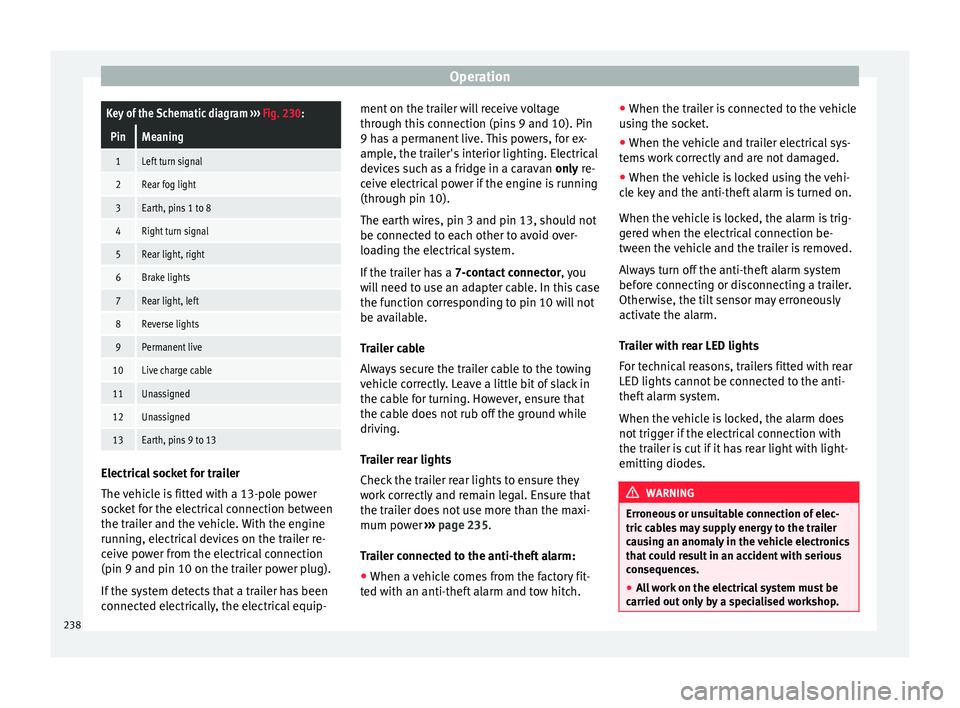
OperationKey of the Schematic diagram
››› Fig. 230:
PinMeaning
1Left turn signal
2Rear fog light
3Earth, pins 1 to 8
4Right turn signal
5Rear light, right
6Brake lights
7Rear light, left
8Reverse lights
9Permanent live
10Live charge cable
11Unassigned
12Unassigned
13Earth, pins 9 to 13 Electrical socket for trailer
The
v
ehic
le is fitted with a 13-pole power
socket for the electrical connection between
the trailer and the vehicle. With the engine
running, electrical devices on the trailer re-
ceive power from the electrical connection
(pin 9 and pin 10 on the trailer power plug).
If the system detects that a trailer has been
connected electrically, the electrical equip- ment on the trailer will receive voltage
through this
connection (pins 9 and 10). Pin
9 has a permanent live. This powers, for ex-
ample, the trailer's interior lighting. Electrical
devices such as a fridge in a caravan only re-
ceive electrical power if the engine is running
(through pin 10).
The earth wires, pin 3 and pin 13, should not
be connected to each other to avoid over-
loading the electrical system.
If the trailer has a 7-contact connector , you
will need to use an adapter cable. In this case
the function corresponding to pin 10 will not
be available.
Trailer cable
Always secure the trailer cable to the towing
vehicle correctly. Leave a little bit of slack in
the cable for turning. However, ensure that
the cable does not rub off the ground while
driving.
Trailer rear lights
Check the trailer rear lights to ensure they
work correctly and remain legal. Ensure that
the trailer does not use more than the maxi-
mum power ››› page 235.
Trailer connected to the anti-theft alarm:
● When a vehicle comes from the factory fit-
ted w ith an anti-thef
t alarm and tow hitch. ●
When the trai l
er is connected to the vehicle
using the socket.
● When the vehicle and trailer electrical sys-
tems w
ork correctly and are not damaged.
● When the vehicle is locked using the vehi-
cle k
ey and the anti-theft alarm is turned on.
When the vehicle is locked, the alarm is trig-
gered when the electrical connection be-
tween the vehicle and the trailer is removed.
Always turn off the anti-theft alarm system
before connecting or disconnecting a trailer.
Otherwise, the tilt sensor may erroneously
activate the alarm.
Trailer with rear LED lights
For technical reasons, trailers fitted with rear
LED lights cannot be connected to the anti-
theft alarm system.
When the vehicle is locked, the alarm does
not trigger if the electrical connection with
the trailer is cut if it has rear light with light-
emitting diodes. WARNING
Erroneous or unsuitable connection of elec-
tric c ab
les may supply energy to the trailer
causing an anomaly in the vehicle electronics
that could result in an accident with serious
consequences.
● All work on the electrical system must be
carried out on
ly by a specialised workshop.238
Page 241 of 320

Towing bracket device
●
Never c onnect
the trailer's electric system
to the electrical connections of the rear lights
or any other power sources. CAUTION
Do not leave the trailer connected to the vehi-
c le when p
arked; places on its support wheel
or its supports. For example, when changing
the load or a puncture, the vehicle will be
pushed up or down. The force acting on the
tow hitch and the trailer could damage the
vehicle or the trailer. Note
● In the event of
a fault in the vehicle or trail-
er electrical system or in the event of prob-
lems with the anti-theft alarm system, have
the system checked by a specialised work-
shop.
● If the trailer accessories use energy from
the power soc
ket when the engine is stop-
ped, the battery will be discharged.
● For technical reasons, trailers fitted with
rear LED light
s cannot be connected to the
anti-theft alarm system.
● If the vehicle battery is running low, the
electrica
l connection with the trailer is auto-
matically cut.
● With the engine running, the electrical
equipment on the trai
ler will be supplied with
power. Loading the trailer
Trailer weight / drawbar load
The trai
l
er weight is the load that the vehicle
can pull ››› . The drawbar load is the vertical
weight of
the tow hitch on the tow hitch ball
››› page 242.
The figures for trailer weights and drawbar
load weights given on the data plate of the
tow hitch are for values of this model only.
The correct figures for your specific vehicle,
which may be lower than these figures for the
tow hitch, are given in the vehicle documen-
tation. The instructions in the official vehicle
documents take precedence.
For the sake of road safety, SEAT recom-
mends using the maximum allowed drawbar
load. The handling of the combined vehicle
and trailer will be poor if the drawbar load is
too low.
The drawbar load increases the weight on the
rear axle, reducing the vehicle carrying ca-
pacity.
Gross combination weight
This figure refers to the combined weight of
the loaded vehicle and loaded trailer.
Loading the trailer
The combined vehicle and trailer must be
balanced. Use the maximum drawbar load authorised and do not overload the front or
the re
ar of
the trailer:
● Distribute loads in the trailer so that heavy
obj
ects are as near to the axle as possible or
above it.
● Correctly secure the trailer load.
Tyr
e pressure
Inflate the trailer tyres according to the man-
ufacturer's instructions.
Inflate the towing vehicles tyres to the maxi-
mum ››› page 284. WARNING
Exceeding the maximum authorised axle
loa d, dr
awbar load or the gross combination
weight of the towing vehicle and trailer could
cause a serious accident with severe conse-
quences.
● Never exceed the specifications.
● With the actual load on the front and rear
axle
s, the maximum axle load should never
be exceeded. The weight on the front and rear
should never exceed the gross vehicle
weight. WARNING
If the load moves, the stability and safety of
the v ehic
le and trailer combination will be se-
riously affected and this could result in a seri-
ous accident. » 239
Technical data
Advice
Operation
Emergencies
Safety
Page 272 of 320

Advice
●
If it i
s necessary to work on the fuel system
or the electrical system, please follow the in-
structions below:
–Always disconnect the vehicle battery.
When disconnecting the battery, ensure
that the vehicle is unlocked otherwise
the anti-theft alarm will be triggered.
– Never work close to heaters, heat sources
or places exposed to flames or sparks.
● Always keep a recently serviced and per-
fectly w
orking fire extinguisher close by.
● Never cover the engine with additional in-
sul
ating materials such as a blanket. Risk of
fire! CAUTION
When refilling or changing service liquids,
ens ur
e that you put the liquids into the right
tank. Making a mistake when refilling could
cause serious malfunctions and damage the
engine! For the sake of the environment
Service fluids leaks are harmful to the envi-
ronment . F
or this reason you should make
regular checks on the ground underneath
your vehicle. Take the vehicle to a specialised
workshop to be checked if you see stains, oil
or other fluids on the ground. Collect any
spilt service fluids and allow a professional to
dispose of them. Opening and closing the bonnet
Fig. 238
In the footwell on the driver side:
L ev
er f
or unlocking the bonnet Fig. 239
Release lever to open the bonnet in
the r a
di
ator grille Opening the bonnet
The l
ev
er t
o open the bonnet can only be
used if the driver door is open. ●
Befor
e opening the bonnet, make sure that
the windscreen wiper arms are in place
against the windscreen ››› .
● Open the driver door.
● Pull the release lever ››
›
Fig. 238 in the di-
rection of the arrow. The bonnet is released
from the lock carrier by a spring mechanism
››› .
● Lift the bonnet using the release lever
› ›
›
Fig. 239 (arrow) and open the bonnet fully.
The bonnet is held open thanks to the gas
strut.
Closing the bonnet
● To close the bonnet, pull it down to over-
come the ga
s strut pressure ››› .
● Allow the bonnet to fall into the lock carrier.
Do not pr
e
ss down.
If the bonnet is not correctly closed, open it
once again and close it correctly.
The bonnet is correctly closed when it is flush
with the corresponding parts on the body-
work. WARNING
If the bonnet is not correctly closed, it could
sud den
ly open while driving leaving the driv-
er without visibility. This could result in a se-
rious accident. 270
Page 285 of 320

Checking and refilling levels
and they must be charged in a controlled en-
v ir
onment
››› . SEAT recommends taking
y our c
ar in f
or technical service.
Replacing a vehicle battery
The battery has been developed to suit the
conditions of its location and has special
safety features. If the battery must be re-
placed, consult a technical service for infor-
mation on electromagnetic compatibility, the
size and maintenance, performance and
safety requirements of the new battery in
your vehicle before you purchase one. SEAT
recommends you have the battery replaced
by a technical service.
Use only maintenance-free genuine batteries
conforming to TL 825 06 and VW 7 50 73
Standards. These standards must be dated
April 2008 or later.
Start-Stop systems ( ››› page 207) are equip-
ped with a special battery. Therefore, it must
only be replaced with a battery of the same
specifications.
Disconnecting the vehicle's battery
If you must disconnect the battery from the
electrical system, please note the following:
● Switch off the ignition and all electrical
equipment. ●
The vehic le must be unlocked before dis-
connecting the battery, otherwise the alarm
will be triggered.
● First disconnect the negative cable and
then the positiv
e ››› .
C onnectin
g the
vehicle's battery
● Before reconnecting the battery, switch off
the engine and all
electrical devices.
● First reconnect the positive cable and then
the negativ
e ››› .
Diff er
ent
control lamps may light up after
connecting the battery and switching the ig-
nition on. They will be turned off after a short
trip at a speed of between 15-20 km/h
(10-12 mph). If the warning indicators remain
lit, please visit a specialised workshop to
have the vehicle checked.
If the battery has been disconnected for a
long time, it is possible that the next service
date is not displayed or calculated correctly
››› page 100. Respect the maximum service
intervals permitted ››› Booklet Maintenance
Programme.
Vehicles with Keyless Access (››› page 115):
if, after connecting the battery, the ignition
cannot be switched on, lock and unlock the
vehicle from outside. Then try to switch on
the ignition again. If the ignition does not
work, seek professional assistance. Automatically disconnecting devices
The intellig
ent vehicle electrical system auto-
matically implements a range of measures to
prevent the battery from discharging when
high demands are made on it:
● the idling speed is increased so that the al-
ternat
or provides more electricity.
● where necessary, the power of the most
power
ful devices is reduced or even com-
pletely disconnected.
● On starting the engine, the power supply
from the 12-v
olt power sockets and the ciga-
rette lighter may be interrupted for a short
time.
The on-board management program cannot
always prevent the battery from running flat.
For example, if the ignition is left on for a
long period with the engine off or if the side
lights or parking lights are left on while the
vehicle is stationary.
Why does the battery run flat?
● When stationary for a long time without
star
ting the engine, particularly if the ignition
is switched on.
● Use of electrical devices with the engine
switc
hed off.
● If the auxiliary heater is running
›››
page 177. »
283
Technical data
Advice
Operation
Emergencies
Safety
Page 305 of 320

Index
Index
A
Abr o
a
d
extended stay abroad with your vehicle . . . . . 260
sale of vehicle . . . . . . . . . . . . . . . . . . . . . . . . . . 260
ABS see Anti-lock brake system . . . . . . . . . . . . . . . 203
Accessories . . . . . . . . . . . . . . . . . . . . . . . . . . . . . . 244
Acoustic alarm control and warning lamps . . . . . . . . . . . . . . . . 32
seatbelt unfastened . . . . . . . . . . . . . . . . . . . . . . 62
Adaptive headlights dynamic . . . . . . . . . . . . . . . . . . . . . . . . . . . . . . . 130
AdBlue control and warning lamps . . . . . . . . . . . . . . . 266
information . . . . . . . . . . . . . . . . . . . . . . . . . . . . 266
minimum quantity for a refill . . . . . . . . . . . . . . 266
refilling . . . . . . . . . . . . . . . . . . . . . . . . . . . . . . . 267
specifications . . . . . . . . . . . . . . . . . . . . . . . . . . 267
tank filling capacity . . . . . . . . . . . . . . . . . . . . . 265
Additional heater see "Auxiliary heater" . . . . . . . . . . . . . . . . . . . . 177
Adjusting folding the backrest of the front passengerseat . . . . . . . . . . . . . . . . . . . . . . . . . . . . . . . . 148
front seats . . . . . . . . . . . . . . . . . . . . . . . . . . . . . 140
lights . . . . . . . . . . . . . . . . . . . . . . . . . . . . . . . . . 133
rear head restraints . . . . . . . . . . . . . . . . . 15, 142
seats . . . . . . . . . . . . . . . . . . . . . . . . . . . . . . . . . . 57
seat with position memory . . . . . . . . . . . . . . . 146
Adjusting the head restraint rear head restraints . . . . . . . . . . . . . . . . . . . . . . 15
Adjusting the head restraints rear head restraints . . . . . . . . . . . . . . . . . . . . . 142 Adjusting the seats
front se ats . . . . . . . . . . . . . . . . . . . . . . . . . . . . . 140
rear seats . . . . . . . . . . . . . . . . . . . . . . . . . . . . . 141
AFS . . . . . . . . . . . . . . . . . . . . . . . . . . . . . . . . . . . . 130
Air-conditioning malfunctions . . . . . . . . . . . . . . . . . . . . . . . . . . . 175
Airbag covers . . . . . . . . . . . . . . . . . . . . . . . . . . . . . 17
Airbags see Airbag system . . . . . . . . . . . . . . . . . . . . . . . 18
Airbag system . . . . . . . . . . . . . . . . . . . . . . . . . . 17, 68 activation . . . . . . . . . . . . . . . . . . . . . . . . . . . . . . 70
cleaning dash panel . . . . . . . . . . . . . . . . . . . . . 259
control lamp . . . . . . . . . . . . . . . . . . . . . . . . . . . . 72
description . . . . . . . . . . . . . . . . . . . . . . . . . . . . . 69
front airbags . . . . . . . . . . . . . . . . . . . . . . . . . 17, 71
functioning . . . . . . . . . . . . . . . . . . . . . . . . . . . . . 70
head-protection airbag . . . . . . . . . . . . . . . . . . . 20
knee airbag . . . . . . . . . . . . . . . . . . . . . . . . . . . . . 18
locking the vehicle after deployment . . . . . . . 113
repairs . . . . . . . . . . . . . . . . . . . . . . . . . . . . . . . . 246
side airbags . . . . . . . . . . . . . . . . . . . . . . . . . . . . 19
use of child seats . . . . . . . . . . . . . . . . . . . . . 18, 73
vehicle care . . . . . . . . . . . . . . . . . . . . . . . . . . . . 259
Air conditioning . . . . . . . . . . . . . . . . . . . . . . . . . . 173 air recirculation . . . . . . . . . . . . . . . . . . . . . . . . . 176
air vents . . . . . . . . . . . . . . . . . . . . . . . . . . . . . . 176
climatronic . . . . . . . . . . . . . . . . . . . . 36, 173, 174
controls . . . . . . . . . . . . . . . . . . . . . . . . . . . 36, 174
electronic manual air conditioning . . . . . . . . . 174
indirect ventilation . . . . . . . . . . . . . . . . . . . . . . 176
rear seats . . . . . . . . . . . . . . . . . . . . . . . . . . . . . 174
special features . . . . . . . . . . . . . . . . . . . . . . . . 175
user instructions . . . . . . . . . . . . . . . . . . . . . . . . 174
Air recirculation . . . . . . . . . . . . . . . . . . . . . . . . . . 176
Air vents . . . . . . . . . . . . . . . . . . . . . . . . . . . . . . . . 176
Alcantara . . . . . . . . . . . . . . . . . . . . . . . . . . . . . . . . 257 All-wheel drive
snow c hains . . . . . . . . . . . . . . . . . . . . . . . . . . . . 49
winter tyres . . . . . . . . . . . . . . . . . . . . . . . . . . . . 293
Ambient lighting . . . . . . . . . . . . . . . . . . . . . . . . . 134
Anodized surfaces . . . . . . . . . . . . . . . . . . . . . . . . 254
Antenna . . . . . . . . . . . . . . . . . . . . . . . . . . . 246, 260
Anti-freeze . . . . . . . . . . . . . . . . . . . . . . . . . . . . . . . 40
Anti-lock brake system . . . . . . . . . . . . . . . . . . . . . 203
Anti-lock system . . . . . . . . . . . . . . . . . . . . . . . . . . 203
Anti-puncture . . . . . . . . . . . . . . . . . . . . . . . . . . 44, 85
Anti-puncture kit . . . . . . . . . . . . . . . . . . . . . . . . 44, 85
Anti-puncture set . . . . . . . . . . . . . . . . . . . . . . . . . . 85
Anti-theft alarm . . . . . . . . . . . . . . . . . . . . . . . . . . 117 false alarms . . . . . . . . . . . . . . . . . . . . . . . . . . . 118
trailer . . . . . . . . . . . . . . . . . . . . . . . . . . . . . . . . . 238
Anti-theft alarm system anti-tow system . . . . . . . . . . . . . . . . . . . . . . . . 118
vehicle interior monitoring . . . . . . . . . . . . . . . 118
Anti-theft security system . . . . . . . . . . . . . . . . . . 117
Anti-tow system . . . . . . . . . . . . . . . . . . . . . . . . . . 118
Anti-trap function panoramic sunroof . . . . . . . . . . . . . . . . . . . . . . 127
sun blind . . . . . . . . . . . . . . . . . . . . . . . . . . . . . . 127
Antifreeze . . . . . . . . . . . . . . . . . . . . . . . . . . . 40, 276
Armrests . . . . . . . . . . . . . . . . . . . . . . . . . . . . . . . . 149
Ashtray . . . . . . . . . . . . . . . . . . . . . . . . . . . . . . . . . 170
ASR see Brake assist systems . . . . . . . . . . . . . . . . . 204
see Braking assist systems . . . . . . . . . . . . . . . 205
switching on and off . . . . . . . . . . . . . . . . . . . . . 205
see also Traction control system . . . . . . . . . . . 203
Assistance call . . . . . . . . . . . . . . . . . . . . . . . . . . . 109
Assistance systems electronic differential lock system (EDS) . . . . 204
electronic drive torque management (XDS) . . 204
launch-Control programme . . . . . . . . . . . . . . . 196
303
Page 307 of 320

Index
Card compartment . . . . . . . . . . . . . . . . . . . . . . . . 165
C arin
g f
or paintwork . . . . . . . . . . . . . . . . . . . . . . . 253
Caring for the vehicle exterior . . . . . . . . . . . . . . . . . . . . . . . . . . . . . . . 250
Catalytic converter . . . . . . . . . . . . . . . . . . . . . . . . 201 control and warning lamps . . . . . . . . . . . . . . . 200
malfunction . . . . . . . . . . . . . . . . . . . . . . . . . . . . 201
CCS . . . . . . . . . . . . . . . . . . . . . . . . . . . . . . . . . . . . 219 see cruise control . . . . . . . . . . . . . . . . . . . . . . . . 32
CD changer . . . . . . . . . . . . . . . . . . . . . . . . . 163, 168
Central locking . . . . . . . . . . . . . . . . . . . . . . . . . . . 112 anti-theft alarm . . . . . . . . . . . . . . . . . . . . . . . . . 117
keyless Access . . . . . . . . . . . . . . . . . . . . . . . . . 115
manual locking . . . . . . . . . . . . . . . . . . . . . . . . . . . 9
opening doors individually . . . . . . . . . . . . . . . 113
Central locking system after airbag deployment . . . . . . . . . . . . . . . . . 113
description . . . . . . . . . . . . . . . . . . . . . . . . . . . . 113
remote control key . . . . . . . . . . . . . . . . . . . . . . 113
Centre armrest . . . . . . . . . . . . . . . . . . . . . . . . . . . 149
Cetane number (diesel fuel) . . . . . . . . . . . . . . . . 265
Changing a bulb control lamp . . . . . . . . . . . . . . . . . . . . . . . . . . . . 92
Changing a wheel . . . . . . . . . . . . . . . . . . . . . . 45, 84 subsequent work . . . . . . . . . . . . . . . . . . . . . . . . 49
wheel bolts . . . . . . . . . . . . . . . . . . . . . . . . . . . . . 46
Changing bulbs . . . . . . . . . . . . . . . . . . . . . . . . . . . 91 body . . . . . . . . . . . . . . . . . . . . . . . . . . . . . . . . . . 95
front bumper . . . . . . . . . . . . . . . . . . . . . . . . . . . . 94
halogen headlights . . . . . . . . . . . . . . . . . . . . . . 92
number plate light . . . . . . . . . . . . . . . . . . . . . . . 97
rear lid . . . . . . . . . . . . . . . . . . . . . . . . . . . . . . . . . 95
rear lights . . . . . . . . . . . . . . . . . . . . . . . . . . . . . . 95
xenon headlights . . . . . . . . . . . . . . . . . . . . . . . . 93
Changing gear control and warning lamps . . . . . . . . . . . . . . . 192
Changing the blades . . . . . . . . . . . . . . . . . . . . . . . 87 Changing windscreen wipers . . . . . . . . . . . . . . . . 54
Chargin
g the battery . . . . . . . . . . . . . . . . . . . . . . . 51
Checking tyre pressures . . . . . . . . . . . . . . . . . . . . . . . . . . 288
Checking fluid levels . . . . . . . . . . . . . . . . . . . . . . 271
Child safety . . . . . . . . . . . . . . . . . . . . . . . . . . . . . . . 74
Child seat . . . . . . . . . . . . . . . . . . . . . . . . . . . . . . . . 21 deactivating the passenger front airbag . . . . . . 18
integrated child seat . . . . . . . . . . . . . . . . . . . . . 78
in the passenger seat . . . . . . . . . . . . . . . . . . . . . 76
ISOFIX system . . . . . . . . . . . . . . . . . . . . . . . . . . . 77
mounting systems . . . . . . . . . . . . . . . . . . . . . . . 22
on rear seats . . . . . . . . . . . . . . . . . . . . . . . . . . . . 77
regulations . . . . . . . . . . . . . . . . . . . . . . . . . . . . . 76
safety instructions . . . . . . . . . . . . . . . . . . . . 21, 75
securing with seat belt . . . . . . . . . . . . . . . . . . . . 22
Top Tether system . . . . . . . . . . . . . . . . . . . . . . . . 23
transporting children in the vehicle . . . . . . . . . 75
weight categories . . . . . . . . . . . . . . . . . . . . . . . . 76
Child seats . . . . . . . . . . . . . . . . . . . . . . . . . . . . . . . 75 disabling the front passenger front airbag . . . . 73
Chrome parts . . . . . . . . . . . . . . . . . . . . . . . . . . . . 254
Cigarette lighter . . . . . . . . . . . . . . . . . . . . . . . . . . 170
Cleaning . . . . . . . . . . . . . . . . . . . . . . . . . . . . . . . . 250 compartments . . . . . . . . . . . . . . . . . . . . . . . . . 259
dash panel . . . . . . . . . . . . . . . . . . . . . . . . . . . . 259
engine compartment . . . . . . . . . . . . . . . . . . . . 255
fabrics . . . . . . . . . . . . . . . . . . . . . . . . . . . . . . . . 256
folding the rear view mirrors . . . . . . . . . . . . . . 140
natural leather . . . . . . . . . . . . . . . . . . . . . . . . . 258
seatbelts . . . . . . . . . . . . . . . . . . . . . . . . . . . . . . 259
stickers . . . . . . . . . . . . . . . . . . . . . . . . . . . . . . . 252
synthetic leather . . . . . . . . . . . . . . . . . . . . . . . . 258
textile covers . . . . . . . . . . . . . . . . . . . . . . . . . . . 257
trims . . . . . . . . . . . . . . . . . . . . . . . . . . . . . . . . . 257
washing the vehicle . . . . . . . . . . . . . . . . . . . . . 250
washing the vehicle with high pressure clean-ers . . . . . . . . . . . . . . . . . . . . . . . . . . . . . . . . . 252 wheels . . . . . . . . . . . . . . . . . . . . . . . . . . . . . . . . 254
window
s . . . . . . . . . . . . . . . . . . . . . . . . . . . . . . 252
Cleaning the vehicle high pressure cleaners . . . . . . . . . . . . . . . . . . . 252
Climatronic . . . . . . . . . . . . . . . . . . . . . . . . . . 36, 173
Close . . . . . . . . . . . . . . . . . . . . . . . . . . . . . . . . . . . 110 bonnet . . . . . . . . . . . . . . . . . . . . . . . . . . . . . . . . . 11
Closing . . . . . . . . . . . . . . . . . . . . . . . . . . . . . . . . . 110 bonnet . . . . . . . . . . . . . . . . . . . . . . . . . . . . . . . . . 11
electric windows . . . . . . . . . . . . . . . . . . . . . . . . . 11
luggage compartment . . . . . . . . . . . . . . . 10, 123
panoramic sunroof . . . . . . . . . . . . . . . . . . . . . . . 12
Clothes hook . . . . . . . . . . . . . . . . . . . . . . . . . . . . 168
Code number . . . . . . . . . . . . . . . . . . . . . . . . . . 45, 83
Combined weight rating . . . . . . . . . . . . . . . . . . . 242
Coming Home . . . . . . . . . . . . . . . . . . . . . . . . . . . . 131
Compartment for (sun)glasses . . . . . . . . . . . . . . 164
Compartments centre console . . . . . . . . . . . . . . . . . . . . . . . . . 165
front central armrest . . . . . . . . . . . . . . . . . . . . . 165
Compass . . . . . . . . . . . . . . . . . . . . . . . . . . . . . . . . 103
Connectors faults . . . . . . . . . . . . . . . . . . . . . . . . . . . . . . . . . 172
Control and warning lamps ABS . . . . . . . . . . . . . . . . . . . . . . . . . . . . . . . . . . 187
adBlue . . . . . . . . . . . . . . . . . . . . . . . . . . . . . . . . 266
airbag system . . . . . . . . . . . . . . . . . . . . . . . . . . . 72
blind spot detector (BSD) . . . . . . . . . . . . . . . . 222
brake system . . . . . . . . . . . . . . . . . . . . . . . . . . . 187
catalytic converter . . . . . . . . . . . . . . . . . . . . . . 200
changing bulbs . . . . . . . . . . . . . . . . . . . . . . . . . . 92
changing gear . . . . . . . . . . . . . . . . . . . . . . . . . . 192
coolant . . . . . . . . . . . . . . . . . . . . . . . . . . . . . . . 275
door . . . . . . . . . . . . . . . . . . . . . . . . . . . . . . . . . . 119
emission control system . . . . . . . . . . . . . . . . . 200
engine management . . . . . . . . . . . . . . . . . . . . 200
engine oil sensor . . . . . . . . . . . . . . . . . . . . . . . 272
305
Page 316 of 320

Index
special Characteristics . . . . . . . . . . . . . . . . . . . 227
thin g
s
to note . . . . . . . . . . . . . . . . . . . . . . . . . . . 51
Towing a trailer . . . . . . . . . . . . . . . . . . . . . . . . . . . 295
Towing bracket . . . . . . . . . . . . . . . . . . . . . . . . . . . 234 optical parking system . . . . . . . . . . . . . . . . . . . 211
Towing the vehicle . . . . . . . . . . . . . . . . . 50, 87, 182 driving tips . . . . . . . . . . . . . . . . . . . . . . . . . . . . . 89
front towline anchorage . . . . . . . . . . . . . . . . . . . 88
rear towline anchorage . . . . . . . . . . . . . . . . . . . 88
Towline anchorages . . . . . . . . . . . . . . . . . . . . . . . . 50
Traction . . . . . . . . . . . . . . . . . . . . . . . . . . . . . . . . . 292
Traction control system . . . . . . . . . . . . . . . . . . . . 203
Traction control (ASR) . . . . . . . . . . . . . . . . . 204, 205
Traffic signal detection . . . . . . . . . . . . . . . . . . . . 227
Trailer . . . . . . . . . . . . . . . . . . . . . . . . . . . . . . . . . . 234 adjusting the headlights . . . . . . . . . . . . . . . . . 240
anti-theft alarm . . . . . . . . . . . . . . . . . . . . . . . . . 238
connecting . . . . . . . . . . . . . . . . . . . . . . . . . . . . 237
drawbar load . . . . . . . . . . . . . . . . . . . . . . . . . . . 234
driving with a trailer . . . . . . . . . . . . . . . . . . . . . 240
electrically releasing the hitch ball . . . . . . . . . 236
electrical socket . . . . . . . . . . . . . . . . . . . . . . . . 238
fitting a tow hitch . . . . . . . . . . . . . . . . . . . . . . . 241
function control . . . . . . . . . . . . . . . . . . . . . . . . 239
hitch ball . . . . . . . . . . . . . . . . . . . . . . . . . . . . . . 236
hitching . . . . . . . . . . . . . . . . . . . . . . . . . . . . . . . 237
loading . . . . . . . . . . . . . . . . . . . . . . . . . . . . . . . 239
rear LED lights . . . . . . . . . . . . . . . . . . . . . 235, 238
rear lights . . . . . . . . . . . . . . . . . . . . . . . . 235, 238
stabilising the vehicle and trailer combina-tion . . . . . . . . . . . . . . . . . . . . . . . . . . . . . . . . 241
trailer cable . . . . . . . . . . . . . . . . . . . . . . . 235, 238
trailer weights . . . . . . . . . . . . . . . . . . . . . . . . . . 242
wing mirrors . . . . . . . . . . . . . . . . . . . . . . . . . . . 235
Trailer cable . . . . . . . . . . . . . . . . . . . . . . . . 235, 238
Trailer weight permitted maximum . . . . . . . . . . . . . . . . . . . . . 242
Trailer weights . . . . . . . . . . . . . . . . . . . . . . . . . . . 295 Transport
fol ding the backrest of the front passenger
seat . . . . . . . . . . . . . . . . . . . . . . . . . . . . . . . . 148
Transportation baggage net . . . . . . . . . . . . . . . . . . . . . . . . . . . 161
retaining hooks . . . . . . . . . . . . . . . . . . . . . . . . 160
Transporting driving with a trailer . . . . . . . . . . . . . . . . . . . . . 240
driving with the rear lid open . . . . . . . . . . . . . . 151
load . . . . . . . . . . . . . . . . . . . . . . . . . . . . . . . . . . 151
loading the trailer . . . . . . . . . . . . . . . . . . . . . . . 239
net partition . . . . . . . . . . . . . . . . . . . . . . . . . . . 156
rails and attachment system . . . . . . . . . . . . . . 158
vehicle loaded . . . . . . . . . . . . . . . . . . . . . . . . . 151
Transporting children . . . . . . . . . . . . . . . . . . . . . . . 74
Transporting items fastening rings . . . . . . . . . . . . . . . . . . . . . . . . . 157
roof carrier . . . . . . . . . . . . . . . . . . . . . . . . . . . . . 161
roof carrier system . . . . . . . . . . . . . . . . . . . . . . 161
Transporting objects roof carrier system . . . . . . . . . . . . . . . . . . . . . . 162
trailer weights . . . . . . . . . . . . . . . . . . . . . . . . . . 242
Treadwear . . . . . . . . . . . . . . . . . . . . . . . . . . . . . . . 292
Turn signal convenience function . . . . . . . . . . . . 129
Turn signal lever . . . . . . . . . . . . . . . . . . . . . . . . . . 129
Tyre control systems tyre pressures . . . . . . . . . . . . . . . . . . . . . . . . . . 288
Tyre load rating . . . . . . . . . . . . . . . . . . . . . . . . . . . 292
Tyre mobility set . . . . . . . . . . . . . . . . . . . . . . . . . . . 44 components . . . . . . . . . . . . . . . . . . . . . . . . . . . . 86
more than one damaged tyre . . . . . . . . . . . . . . 85
sealing a tyre . . . . . . . . . . . . . . . . . . . . . . . . . . . 86
Tyre Mobility Set inflating a tyre . . . . . . . . . . . . . . . . . . . . . . . . . . . 86
Tyre mobility system cases where it should not be used . . . . . . . . . . 85
check after 10 minutes . . . . . . . . . . . . . . . . . . . . 86 Tyre Mobility System
see Anti-puncture kit . . . . . . . . . . . . . . . . . . . . . 85
Tyre monitoring systems . . . . . . . . . . . . . . 231, 233 control lamp . . . . . . . . . . . . . . . . . . . . . . . . . . . 232
Tyre pressure . . . . . . . . . . . . . . . . . . . . . . . . . . . . 288
Tyre pressures . . . . . . . . . . . . . . . . . . . . . . . . . . . . 296
Tyre profile . . . . . . . . . . . . . . . . . . . . . . . . . . . . . . 289
Tyre repair . . . . . . . . . . . . . . . . . . . . . . . . . . . . . . . . 85
Tyre repair kit see Anti-puncture kit . . . . . . . . . . . . . . . . . . . . . 85
Tyres avoiding damage . . . . . . . . . . . . . . . . . . . . . . . 285
changing . . . . . . . . . . . . . . . . . . . . . . . . . . . . . . . 45
changing wheels . . . . . . . . . . . . . . . . . . . . . . . 286
code . . . . . . . . . . . . . . . . . . . . . . . . . . . . . . . . . . 291
deterioration . . . . . . . . . . . . . . . . . . . . . . . . . . . 290
errors in wheel alignment . . . . . . . . . . . . . . . . 290
foreign bodies in the tyres . . . . . . . . . . . . . . . . 290
handling . . . . . . . . . . . . . . . . . . . . . . . . . . . . . . 285
new . . . . . . . . . . . . . . . . . . . . . . . . . . . . . . . . . . 287
old . . . . . . . . . . . . . . . . . . . . . . . . . . . . . . . . . . . 286
pressure . . . . . . . . . . . . . . . . . . . . . . . . . . . . . . 288
replacing . . . . . . . . . . . . . . . . . . . . . . . . . . . . . . 287
run-flat tyre codes . . . . . . . . . . . . . . . . . . . . . . . 291
run-out . . . . . . . . . . . . . . . . . . . . . . . . . . . . . . . . 290
serial number . . . . . . . . . . . . . . . . . . . . . . . . . . 291
snow chains . . . . . . . . . . . . . . . . . . . . . . . . . . . . 49
speed rating . . . . . . . . . . . . . . . . . . . . . . . . . . . 292
storing . . . . . . . . . . . . . . . . . . . . . . . . . . . . . . . . 286
technical details . . . . . . . . . . . . . . . . . . . . . . . . 291
tyre code . . . . . . . . . . . . . . . . . . . . . . . . . . . . . . 291
tyre identification number (TIN) . . . . . . . . . . . . 291
tyre load rating . . . . . . . . . . . . . . . . . . . . . . . . . 292
tyre pressure sensor . . . . . . . . . . . . . . . . . . . . . 289
tyres with directional tread pattern . . . . . . . . . 292
tyre wear . . . . . . . . . . . . . . . . . . . . . . . . . . . . . . 290
valve caps . . . . . . . . . . . . . . . . . . . . . . . . . . . . . 289
314