2017 RENAULT ZOE belt
[x] Cancel search: beltPage 63 of 220

1.57
CHILD SAFETY: deactivating, activating the front passenger airbag (3/3)
Activating the front
passenger air bags
You should reactivate the airbags as
soon as you remove the child seat from
the front passenger seat to ensure the
protection of the front passenger in the
event of an impact.
To reactivate the airbags : when the
vehicle is stationary , push and turn
lock 1 to position ON.
With the ignition switched on, you must
check on the display 2 that the warning
light
] is out and that the warning
light
comes on after each start-
up for around 60 seconds. The front passenger seat belt additional
restraint systems are activated.
Operating faults
It is forbidden to fit a rear-facing child
seat to the front passenger seat if the
airbags activation/deactivation system
is faulty.
Allowing any other passenger to sit in
that seat is not recommended.
Contact your approved dealer as soon
as possible.The passenger airbag must
only be deactivated or acti-
vated when the vehicle is
stationary.
If it is interfered with when the ve-
hicle is being driven, indicator lights
å and © will come on.
Switch the ignition off then on again
to reset the airbag in accordance
with the lock position.
1
2
DANGER
Since operation of the front
passenger airbag is not
compatible with the position
of a rear-facing child seat, NEVER
fit a restraint system for a rear-fac-
ing child in a seat protected by an
ACTIVATED front AIRBAG . This
can cause the CHILD’S DEATH or
SERIOUS INJURY.
Page 69 of 220
1.63
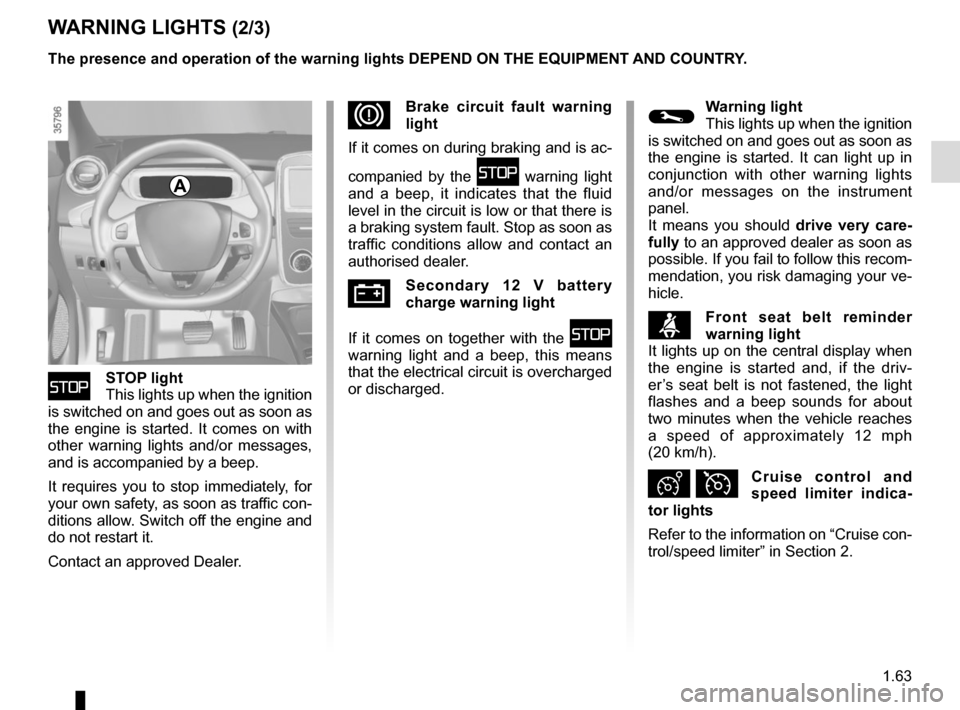
WARNING LIGHTS (2/3)
ûSTOP light
This lights up when the ignition
is switched on and goes out as soon as
the engine is started. It comes on with
other warning lights and/or messages,
and is accompanied by a beep.
It requires you to stop immediately, for
your own safety, as soon as traffic con-
ditions allow. Switch off the engine and
do not restart it.
Contact an approved Dealer.
DBrake circuit fault warning
light
If it comes on during braking and is ac-
companied by the
û warning light
and a beep, it indicates that the fluid
level in the circuit is low or that there is
a braking system fault. Stop as soon as
traffic conditions allow and contact an
authorised dealer.
ÚSecondary 12 V battery
charge warning light
If it comes on together with the
û
warning light and a beep, this means
that the electrical circuit is overcharged
or discharged.
The presence and operation of the warning lights DEPEND ON THE EQUIPMENT\
AND COUNTRY.
©Warning light
This lights up when the ignition
is switched on and goes out as soon as
the engine is started. It can light up in
conjunction with other warning lights
and/or messages on the instrument
panel.
It means you should drive very care-
fully to an approved dealer as soon as
possible. If you fail to follow this recom-
mendation, you risk damaging your ve-
hicle.
ßFront seat belt reminder
warning light
It lights up on the central display when
the engine is started and, if the driv-
er’s seat belt is not fastened, the light
flashes and a beep sounds for about
two minutes when the vehicle reaches
a speed of approximately 12 mph
(20 km/h).
Ð ÏCruise control and
speed limiter indica-
tor lights
Refer to the information on “Cruise con-
trol/speed limiter” in Section 2.
A
Page 79 of 220

1.73
TRIP COMPUTER AND WARNING SYSTEM: operating fault messages
These appear with the © warning light and mean that you should drive very carefully to an author\
ised dealer as
soon as possible. If you fail to follow this recommendation, you risk da\
maging your vehicle.
They disappear when the display selection key is pressed or after severa\
l seconds and are stored in the computer log. The
©
warning light stays on. Examples of operating fault messages are given i\
n the following pages.
Examples of messages Interpreting the display selected
«Check airbag» Indicates a fault in the restraint system in addition to the seat belts.\
In the event of an
accident, it is possible that they may not be triggered.
«Elec. System to check» Indicates a fault on one of the pedal sensors or in the 12 V battery man\
agement
system.
«Check braking system» Indicates wear or the need to check the braking system.
«Vehicle plug to be checked» Indicates overheating at the vehicle-side charging socket. Wait for about 20 minutes
and try again. If this does not work, contact an authorised dealer.
«Elec. System to check» Indicates a fault in the traction system.
«Always charging» Indicates a fault on the traction battery recharge system.
Page 150 of 220

3.24
Before moving the seatback, put
the seat belt in belt guide A to avoid
damaging it.
For safety reasons, carry
out any adjustments when
the vehicle is not being
driven.
The configuration of the two-seat
bench with the small seatback B
pulled down, does not allow the
central seat to be used as it would
be impossible to buckle the seat belt
(belt buckles inaccessible).
The seatback may be folded down to
allow bulky objects to be transported.
To fold down the seatback
Ensure that the front seats are far
enough forward.
Lower the headrests fully.
Place the seat belts in their guides A.
Press button 1 and lower the seat-
back B.
REAR BENCH SEAT: functions
B
A
1
To replace the seatback, proceed in
the reverse order to removal.
Refit the seatback and click it back into
place.
When moving the rear
seats, ensure that nothing
obstructs the anchorage
points (passenger’s arm or
leg, a pet, gravel, cloth, toys, etc.).
When refitting the seat-
back, make sure it is cor-
rectly locked in place.
If seat covers are fitted ,
make sure these do not prevent the
seatback latch from locking in.
Make sure that the seat belts are
positioned correctly.
Reposition the headrests.
Page 154 of 220

3.28
TRANSPORTING OBJECTS IN THE LUGGAGE COMPARTMENT
Always position the heavi-
est items directly on the
floor. Use the lashing
points 1 on the boot floor, if
these are fitted to the vehicle. The
luggage should be loaded in such a
way that no items will be thrown for-
ward and strike the occupants if the
driver has to brake suddenly. Fasten
the rear seat belts, even if the seats
are not occupied.
1
Always position the objects transported
so that the largest surface is against:
– The rear bench seatback for normal loads (example A).
– The front seatbacks with the rear
seatbacks folded down, as is the case
for maximum loads (example B).
If you have to place objects on the folded
seatback, it is necessary that you lower
the headrests before folding the seat-
back so that it can be folded as flat as
possible against the seat.
A
B
Page 167 of 220

4.11
Glass instrument panel(e.g.: instrument panel, clock, exterior
temperature display, radio display, mul-
timedia or multifunction display etc.)
Use a soft cloth (or cotton wool).
If this does not clean them properly,
use a soft cloth (or cotton wool) slightly
moistened with soapy water and then
wipe clean with another soft damp cloth
or cotton wool.
Finally, carefully dry off with a soft dry
cloth.
Do not use products containing alco-
hol and/or spray fluids on the area.
Seat belts
These must be kept clean.
Use products selected by our Technical
Department (Approved outlets) or
warm, soapy water and a sponge and
wipe with a dry cloth.
Detergents or dyes must not be used
under any circumstances.
INTERIOR TRIM MAINTENANCE (1/2)
Textiles (seats, door trim, etc)
Vacuum-clean the textiles regularly.
Liquid stain
Use soapy water.
Dab lightly (never rub) with a soft cloth,
rinse and remove the excess.
Solid or pasty stain
Carefully remove the excess solid or
pasty material immediately with a
spatula (working from the edges to the
centre to avoid spreading the stain).
Clean as for a liquid stain.
Special instructions for sweets or
chewing gum
Put an ice cube on the stain to solidify
it, then proceed as for a solid stain.
A well-maintained vehicle will last
longer. It is therefore recommended to
maintain the interior of the vehicle regu-
larly.
A stain should always be dealt with
swiftly.
Whatever type of stain is on the trim,
use
cold (or warm) soapy water with
natural soap.
Detergents (washing-up liquid, pow-
dered products, alcohol-based prod-
ucts) should not be used.
Use a soft cloth.
Rinse and soak up the excess.
For further recommendations for
maintaining the interior, and/or for
any unsatisfactory results, please
see an authorised dealer.
Page 213 of 220

A
ABS ....................................................................\
...2.16 → 2.20
accessories...................................................................")
7.1
ALPHABETICAL INDEX (1/5)
A
ABS ....................................................................\
...2.16 → 2.20
accessories........................................................................\
5.17
accessories socket ............................................................ 3.22
additional methods of restraint .....................1.37 → 1.40, 1.43
side protection ............................................................. 1.42
to the front seat belts .......................................1.37 → 1.40
to the rear seat belts ........................................1.37 → 1.41
adjusting your driving position ........................................... 1.33
air bag....................................................................1.37 → 1.43
activating the front passenger air bags ........................ 1.57
deactivating the front passenger air bags .................... 1.55
air conditioning .............................1.20 – 1.21, 3.4 → 3.8, 3.15
air vents ...................................................................... 3.2 – 3.3
anti-corrosion check ..............................................6.13 → 6.17
anti-corrosion protection ...................................................... 4.9
anti-lock braking system: ABS ...............................2.16 → 2.20
armrest: front ..................................................................\
............ 3.20
ashtray ................................................................\
............... 3.22
audible and visual signals.................................................. 1.79
B
battery........................................................................\
........ 1.63
12 volt battery maintenance ......................................................... 4.6 – 4.7
12 volt battery ............................................1.2 → 1.6, 4.6 – 4.7
bonnet........................................................................\
. 4.2 – 4.3
brake fluid ........................................................................\
.... 4.5
bulbs changing ........................................................... 5.10 – 5.11
C
central door locking ......................................1.26, 1.29 → 1.31
changing a bulb ...................................................... 5.10 – 5.11
changing gear ............................................................. 2.5 – 2.6 charge meter .............................................................. 1.66, 2.7
charging cord .......................................1.8
→ 1.15, 1.20 – 1.21
charging flap ............................................................1.8 → 1.15
charging socket ..................................... 1.2 → 1.6, 1.8 → 1.15
child restraint/seat .............................1.44 – 1.45, 1.47 → 1.57
child safety..1.18 – 1.19, 1.24, 1.28, 1.44 – 1.45, 1.47 → 1.57,
3.16 – 3.17
child seats..........................................1.44 – 1.45, 1.47 → 1.54
children ........................... 1.18 – 1.19, 1.27 – 1.28, 1.44 – 1.45
children (safety) ............................................. 1.24, 3.16 – 3.17
cleaning: inside the vehicle .............................................. 4.11 – 4.12
clock ....................................................................... 1.75 – 1.76
closing the doors ...................................................1.27 → 1.30
connected services .............................................................. 1.3
control instruments ................................................1.62 → 1.68
controls ...............................................................\
...1.58 → 1.61
coolant ................................................................\
................. 4.4
courtesy light ............................................................ 3.18, 5.12
courtesy mirrors ................................................................. 3.18
cruise control ................................................1.63, 2.21 → 2.27
cruise control-speed limiter....................................2.21 → 2.27
D
dashboard..............................................................1.58 → 1.61
daytime running lights................................................. 1.81, 5.9
deadlocking the doors ....................................................... 1.26
display .................................................1.58 → 1.66, 2.29, 3.29
doors.............................................................. 1.27 – 1.28, 1.31
doors/tailgate ................................................. 1.26 – 1.28, 1.31
driver’s position .....................................................1.58 → 1.64
driving .............................. 2.2 → 2.6, 2.10 – 2.11, 2.13 → 2.29
driving position settings ............................................................1.33 → 1.36
driving recommendations ........................................ 2.7 → 2.11
Page 215 of 220

7.3
ALPHABETICAL INDEX (3/5)
instrument panel ..............................................1.62 → 1.68
instrument panel ...........................................1.62 → 1.74, 1.81
instrument panel messages...................................1.67 → 1.74
interior trim maintenance ..................................................... 4.11 – 4.12
ionizer ................................................................\
................ 3.14
L
levels: brake fluid ...................................................................... 4.5
coolant ................................................................\
........... 4.4
windscreen washer reservoir ......................................... 4.5
lighting: exterior .............................................................1.81 → 1.83
instrument panel .......................................................... 1.81
interior ...............................................................\
.. 3.18, 5.12
lights adjustment .............................................................\
...... 1.84
lights: adjusting ..............................................................\
........ 1.84
brake lights ....................................................... 5.10 – 5.11
dipped beam headlights ............................... 1.62, 1.81, 5.9
direction indicators ............................ 1.62, 1.79, 5.9 – 5.10
fog lights .................................................... 1.62, 1.83, 5.11
hazard warning ............................................................ 1.79
indicator lights .............................................................. 5.11
main beam headlights .................................. 1.62, 1.82, 5.9
number plate lights ...................................................... 5.11
reversing lights ............................................................. 5.11
side lights ............................................................ 1.81, 5.10
locking the doors ..........................................1.18 → 1.28, 1.31
M
maintenance: bodywork ............................................................ 4.9 – 4.10
interior trim ........................................................ 4.11 – 4.12 mechanical .........................................4.2 – 4.3, 6.7
→ 6.12
map reading lights ............................................................. 3.18
methods of restraint in addition to the seat belts ...1.37 → 1.43
multimedia (equipment) ..................................................... 3.29
multimedia equipment .............................................. 3.29, 5.16
N
navigation .............................................................\
............. 3.29
navigation system .............................................................. 3.29
O
opening the doors ..................................................1.27 → 1.30
operating faults .............................................1.73, 5.22 → 5.25
P
paintwork maintenance ....................................................... 4.9 – 4.10
parking distance control.........................................2.28 → 2.31
pedestrian warning system ................................................ 1.80
power-assisted steering..................................................... 1.77
practical advice ....................................................... 2.10 – 2.11
presentation of the electric vehicle important recommendations .......................................... 1.7
pretensioners .........................................................1.37 → 1.40
R
radio........................................................................\
........... 3.29
range of the traction battery.......................................2.7 → 2.9
rear bench seat.................................................................. 3.24
rear parcel shelf ................................................................. 3.25
rear seats functions ..............................................................\
........ 3.24
rear view camera .................................................... 2.30 – 2.31
rear view mirrors ................................................................ 1.78
RENAULT ANTI-INTRUDER DEVICE (RAID) ................... 1.31