2017 RENAULT TRAFIC passenger airbag
[x] Cancel search: passenger airbagPage 7 of 294

1.1
Section 1: Getting to know your vehicle
Key, remote controls . . . . . . . . . . . . . . . . . . . . . . . . . . . . . . . . . . . .\
. . . . . . . . . . . . . . . . . . . . . . . . . 1.2
RENAULT card: General information, use, deadlocking . . . . . . . . . . . . . . . . . . . . . . . . . . . . . . . . . . 1.7
Opening and closing the doors . . . . . . . . . . . . . . . . . . . . . . . . . . . . . . . . . . . .\
. . . . . . . . . . . . . . . . . 1.14
Tailgate . . . . . . . . . . . . . . . . . . . . . . . . . . . . . . . . . . . .\
. . . . . . . . . . . . . . . . . . . . . . . . . . . . . . . . . . . 1.22
Locking, unlocking the opening elements . . . . . . . . . . . . . . . . . . . . . . . . . . . . . . . . . . . .\
. . . . . . . . . 1.23
Automatic locking when driving . . . . . . . . . . . . . . . . . . . . . . . . . . . . . . . . . . . . \
. . . . . . . . . . . . . . . . . 1.27
Headrests - Seats . . . . . . . . . . . . . . . . . . . . . . . . . . . . . . . . . . . .\
. . . . . . . . . . . . . . . . . . . . . . . . . . . 1.28
Steering wheel/Power-assisted steering . . . . . . . . . . . . . . . . . . . . . . . . . . . . . . . . . . . . \
. . . . . . . . . . 1.31
Seat belts. . . . . . . . . . . . . . . . . . . . . . . . . . . . . . . . . . . . \
. . . . . . . . . . . . . . . . . . . . . . . . . . . . . . . . . . 1.32
Additional methods of restraint . . . . . . . . . . . . . . . . . . . . . . . . . . . . . . . . . . . .\
. . . . . . . . . . . . . . . . . 1.37in addition to the front seat belts . . . . . . . . . . . . . . . . . . . . . . . . . . . . . . . . . . . .\
. . . . . . . . . . 1.37
to the rear seatbelt . . . . . . . . . . . . . . . . . . . . . . . . . . . . . . . . . . . . \
. . . . . . . . . . . . . . . . . . . . . 1.41
side . . . . . . . . . . . . . . . . . . . . . . . . . . . . . . . . . . . . \
. . . . . . . . . . . . . . . . . . . . . . . . . . . . . . . . . 1.42
Child safety: General information . . . . . . . . . . . . . . . . . . . . . . . . . . . . . . . . . . . .\
. . . . . . . . . . . . . . . 1.44 Choosing a child seat mounting . . . . . . . . . . . . . . . . . . . . . . . . . . . . . . . . . . . . \
. . . . . . . . . . . 1.47
fitting a child seat, general information . . . . . . . . . . . . . . . . . . . . . . . . . . . . . . . . . . . . \
. . . . . . 1.49
Child seats: attachment by seat belt or by Isofix system . . . . . . . . . . . . . . . . . . . . . . . . . . . . . . . . . . 1.51
Child safety: deactivating/activating the front passenger airbag . . . . . . . . . . . . . . . . . . . . . . . . . . . . 1.77
Driving position . . . . . . . . . . . . . . . . . . . . . . . . . . . . . . . . . . . .\
. . . . . . . . . . . . . . . . . . . . . . . . . . . . . 1.80
Instrument panel . . . . . . . . . . . . . . . . . . . . . . . . . . . . . . . . . . . .\
. . . . . . . . . . . . . . . . . . . . . . . . . . . . 1.84 Trip computer and warning system . . . . . . . . . . . . . . . . . . . . . . . . . . . . . . . . . . . .\
. . . . . . . . 1.90
Clock and outdoor temperature . . . . . . . . . . . . . . . . . . . . . . . . . . . . . . . . . . . . \
. . . . . . . . . . . . . . . . . 1.99
Rear view mirrors . . . . . . . . . . . . . . . . . . . . . . . . . . . . . . . . . . . .\
. . . . . . . . . . . . . . . . . . . . . . . . . . . 1.101
Exterior lighting and signals. . . . . . . . . . . . . . . . . . . . . . . . . . . . . . . . . . . . \
. . . . . . . . . . . . . . . . . . . . 1.103
Headlight beam adjustment . . . . . . . . . . . . . . . . . . . . . . . . . . . . . . . . . . . . \
. . . . . . . . . . . . . . . . . . . . 1.107
Audible and visual signals . . . . . . . . . . . . . . . . . . . . . . . . . . . . . . . . . . . . \
. . . . . . . . . . . . . . . . . . . . . 1.109
Washers, wipers . . . . . . . . . . . . . . . . . . . . . . . . . . . . . . . . . . . .\
. . . . . . . . . . . . . . . . . . . . . . . . . . . . 1.110
Fuel tank (filling with fuel) . . . . . . . . . . . . . . . . . . . . . . . . . . . . . . . . . . . .\
. . . . . . . . . . . . . . . . . . . . . 1.113
Additive tank . . . . . . . . . . . . . . . . . . . . . . . . . . . . . . . . . . . .\
. . . . . . . . . . . . . . . . . . . . . . . . . . . . . . . 1.116
Page 44 of 294
1.38
Load limiter
Above a certain severity of impact, this
mechanism is used to limit the force of
the belt against the body so that it is at
an acceptable level.
Airbags for driver and front
passenger
Fitted to the driver and passenger
sides.
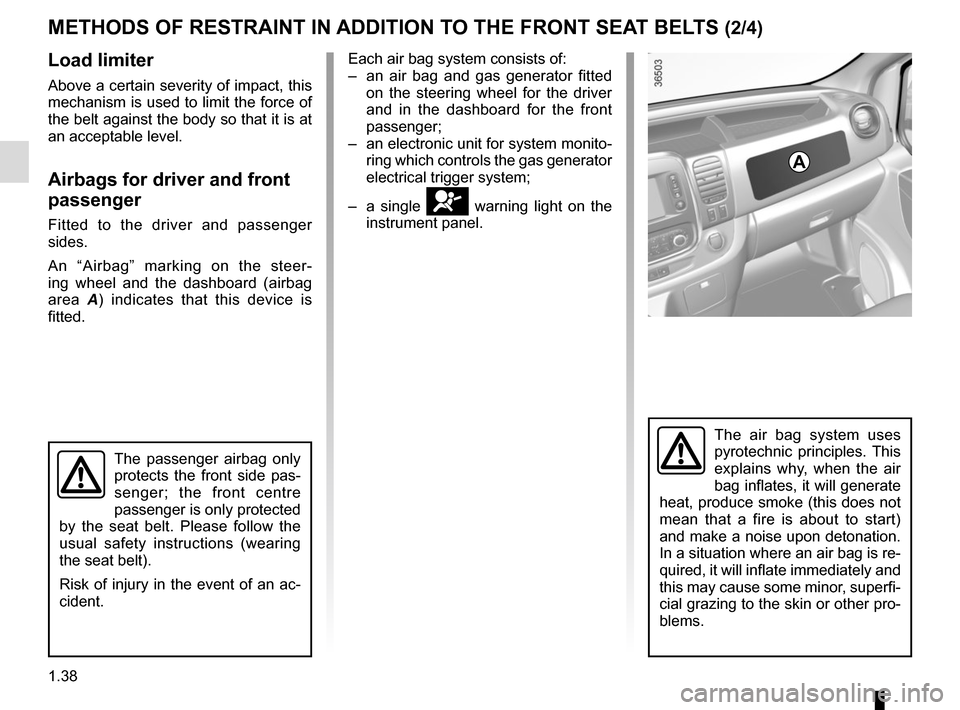
An “Airbag” marking on the steer-
ing wheel and the dashboard (airbag
area A) indicates that this device is
fitted.
Each air bag system consists of:
– an air bag and gas generator fitted on the steering wheel for the driver
and in the dashboard for the front
passenger;
– an electronic unit for system monito- ring which controls the gas generator
electrical trigger system;
– a single
å warning light on the
instrument panel.
METHODS OF RESTRAINT IN ADDITION TO THE FRONT SEAT BELTS (2/4)
The air bag system uses
pyrotechnic principles. This
explains why, when the air
bag inflates, it will generate
heat, produce smoke (this does not
mean that a fire is about to start)
and make a noise upon detonation.
In a situation where an air bag is re-
quired, it will inflate immediately and
this may cause some minor, superfi-
cial grazing to the skin or other pro-
blems.
A
The passenger airbag only
protects the front side pas-
senger; the front centre
passenger is only protected
by the seat belt. Please follow the
usual safety instructions (wearing
the seat belt).
Risk of injury in the event of an ac-
cident.
Page 55 of 294

1.49
CHILD SAFETY: fitting a child seat, general information (1/2)
Some seats are not suitable for fitting
child seats. The diagram on the follow-
ing page shows you how to attach a
child seat.
The types of child seat indicated may
not be available. Before using a differ-
ent child seat, check with the manufac-
turer that it can be fitted.
Ensure that the child seat
or the child’s feet do not
prevent the front seat from
locking correctly. Refer to
the information on the “Front seat”
in Section 1.
Check that when installing the child
seat in the vehicle it is not at risk of
coming loose from its base.
If you have to remove the headrest,
check that it is correctly stored so
that it does not come loose under
harsh braking or impact.
Always attach the child seat to the
vehicle even if it is not in use so that
it does not come loose under harsh
braking or impact.
RISK OF DEATH OR
SERIOUS INJURY: Before
installing a child seat on the
front passenger seat, check
that the airbag has been deacti-
vated (please refer to “Child safety:
front passenger airbag deactivation
and activation” in Section 1).
In the front seat
The laws concerning children travel-
ling in the front passenger seat differ in
every country. Consult the legislation in
force and follow the indications on the
diagram on the following page.
Before fitting a child seat in this seat (if
authorised):
– lower the seat belt as far as possible;
– move the seat as far back as possi- ble;
– gently tilt the seatback away from vertical (approximately 25°);
– on equipped vehicles, raise the seat base as far as possible.
In all situations, reinsert the headrest to
its full extent so that it does not interfere
with the child seat (see the information
on “Front headrests” in Section 1); After installing the child seat, if neces-
sary, the seat may be advanced (so as
to leave enough space in the rear seats
for passengers or other child seats).
For a rear-facing child seat, do not let
it touch the dashboard or move it to the
furthest forward position.
Do not change other settings after in-
stalling the child seat.
Page 58 of 294

1.52
CHILD SEATS: attachment by seat belt (2/14)
Two or three-seater van versions
Type of child seat Weight of the childFront passenger seat(s) (2)
With single
passenger seat (1) With two-seater bench seat
Centre seat Side seat
Shell seat/rear-facing seat
Groups 0, 0+ and 1 < 13 kg and 9 to 18 kg U X U
Forward-facing seat
Group 1 9 to 18 kg U X U
Booster seat
Groups 2 and 3 15 to 25 kg and 22 to
36 kg
UXU
X Seat which does not allow a child seat to be fitted.
U Seat which allows a child seat with “Universal” approval to be ins\
talled using a seat belt; check that it can be fitted.
(1) Forward-facing child seat; position the seatback of the child seat in co\
ntact with the seatback of the vehicle seat. Raise the
headrest. Raise the seat to the maximum and position it as far back as p\
ossible, tilting the seatback slightly (approximately
25°).
(2) RISK OF DEATH OR SERIOUS INJURY: before fitting a rear-facing child seat on the front passenger seat, ch\
eck
that the airbag has been deactivated (please refer to the information o\
n “Child safety: front passenger airbag deactiva-
tion/activation” in Section 1).
The table below summarises the information already shown on the diagram \
on the previous page, to ensure the applica-
ble regulations are respected.
Page 59 of 294
1.53
CHILD SEATS: attachment by seat belt (3/14)
Using a child safety system
which is not approved for
this vehicle will not correctly
protect the baby or child.
They risk serious or even fatal injury.
RISK OF DEATH OR
SERIOUS INJURY: before
fitting a rear-facing child
seat on the front passenger
seat, check that the airbag has been
deactivated (please refer to the in-
formation on “Child safety: front
passenger airbag deactivation, acti-
vation” in Section 1).
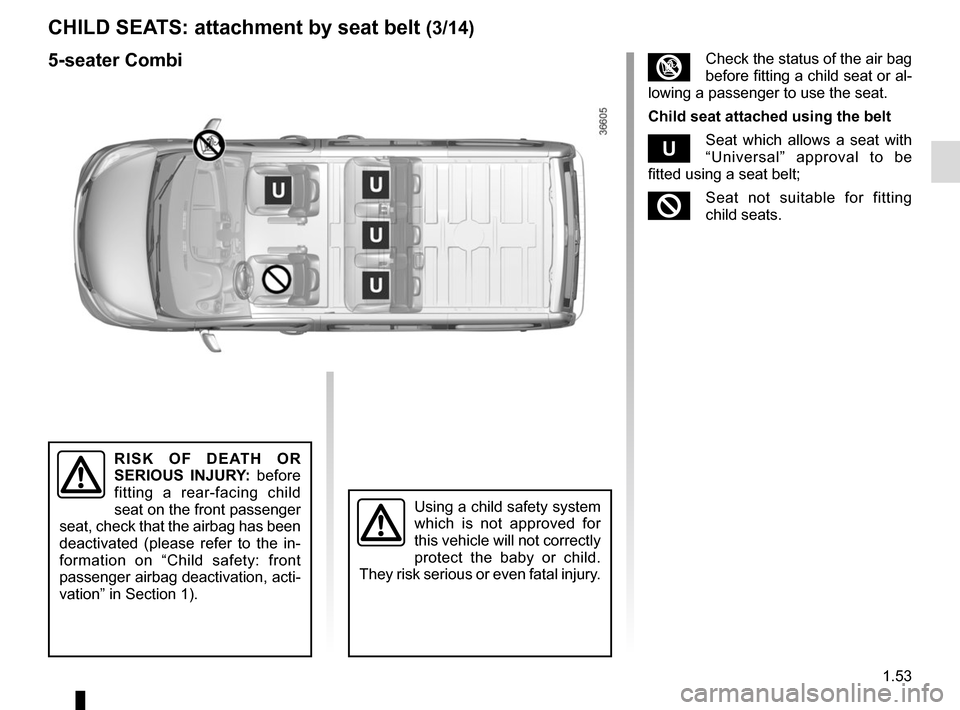
³Check the status of the air bag
before fitting a child seat or al-
lowing a passenger to use the seat.
Child seat attached using the belt
¬Seat which allows a seat with
“Universal” approval to be
fitted using a seat belt;
²Seat not suitable for fitting
child seats.
5-seater Combi
Page 60 of 294

1.54
CHILD SEATS: attachment by seat belt (4/14)
5-seater Combi version
Type of child seat Weight of the child Front passenger
seat (1) (2) Rear side
seat Rear centre
seat
Carrycot fitted across
the vehicle
Group 0 < 10 kg X U (3)
U (3)
U (3)
Rear-facing shell seat
Groups 0 and 0+ < 13 kg U U (4) U (4)
Rear-facing seat
Groups 0+ and 1 < 13 kg and 9 to 18 kg U U (4) U (4)
Forward-facing seat
Group 1 9 to 18 kg X U (5) U (5)
Booster seat
Groups 2 and 3 15 to 25 kg and 22 to
36 kg
X U (5) U (5)
(1) RISK OF DEATH OR SERIOUS INJURY:
before fitting a rear-facing child seat on the front passenger seat, ch\
eck
that the airbag has been deactivated (please refer to the information o\
n “Child safety: front passenger airbag deactiva-
tion/activation” in Section 1).
The table below summarises the information already shown on the diagram \
on the previous page, to ensure the applica-
ble regulations are respected.
Page 62 of 294

1.56
6-seater Combi version
Type of child seat Weight of the child Front seat Rear seat
centre
passenger side
passenger (1) side centre
Carrycot fitted across the
vehicle
Group 0 < 10 kg X X U (2) U (2)
Rear-facing shell seat
Groups 0 and 0+ < 13 kg X U U (3) U (3)
Rear-facing seat
Groups 0+ and 1 < 13 kg and 9 to 18 kg X U U (3) U (3)
Forward-facing seat
Group 1 9 to 18 kg X X U (4) U (4)
Booster seat
Groups 2 and 3 15 to 25 kg and 22 to
36 kg
X X U (4) U (4)
CHILD SEATS: attachment by seat belt (6/14)
(1) RISK OF DEATH OR SERIOUS INJURY:
before fitting a rear-facing child seat on the front passenger seat, ch\
eck
that the airbag has been deactivated (please refer to the information o\
n “Child safety: front passenger airbag deactiva-
tion/activation” in Section 1).
The table below summarises the information already shown in the diagram \
on the following pages, to ensure the appli-
cable regulations are respected.
Page 64 of 294
1.58
CHILD SEATS: attachment by seat belt (8/14)
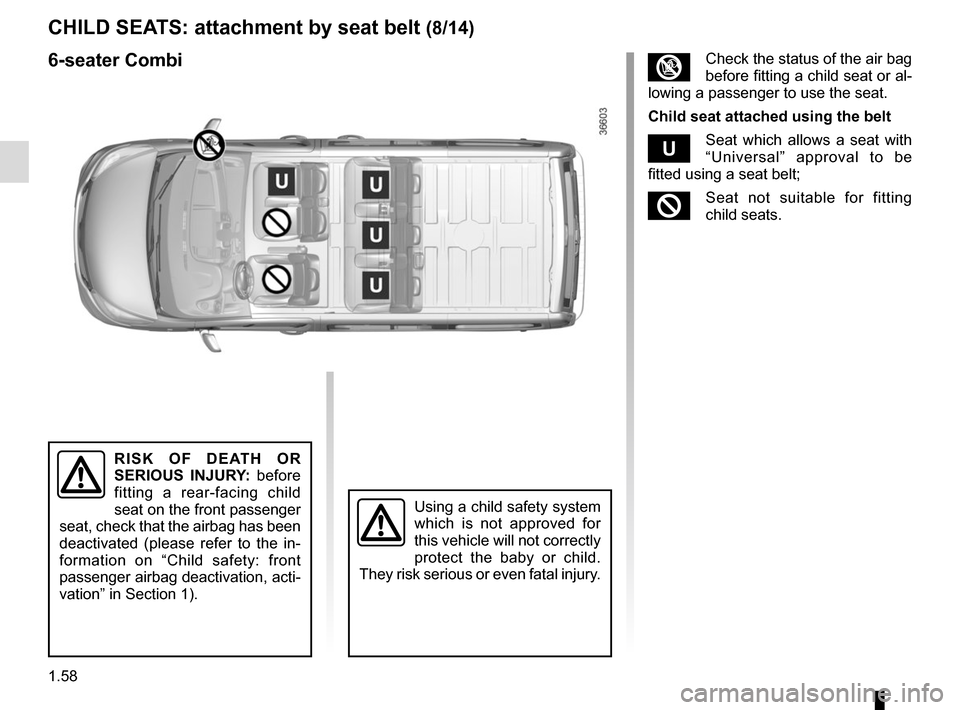
³Check the status of the air bag
before fitting a child seat or al-
lowing a passenger to use the seat.
Child seat attached using the belt
¬Seat which allows a seat with
“Universal” approval to be
fitted using a seat belt;
²Seat not suitable for fitting
child seats.
Using a child safety system
which is not approved for
this vehicle will not correctly
protect the baby or child.
They risk serious or even fatal injury.
RISK OF DEATH OR
SERIOUS INJURY: before
fitting a rear-facing child
seat on the front passenger
seat, check that the airbag has been
deactivated (please refer to the in-
formation on “Child safety: front
passenger airbag deactivation, acti-
vation” in Section 1).
6-seater Combi