2017 RENAULT TRAFIC maximum
[x] Cancel search: maximumPage 211 of 294

4.5
ENGINE OIL LEVEL: topping up/filling (1/2)
The engine must be
stopped before any action
(and not on standby): stop
the engine (please refer
to the information on “Starting and
stopping the engine” in Section 2).
Never run the engine in an
enclosed space as exhaust
gases are poisonous.
Engine oil change : if you
are changing the oil when
the engine is hot, be careful
not to scald yourself if the
oil overflows.
When working in the engine
compartment, ensure that
the windscreen wiper stalk
is in the park position.
Risk of injury.
The engine may be hot
when carrying out opera-
tions in close proximity. In
addition, the engine cooling
fan can come on at any moment.
Risk of injury.
Filling: take care when
topping up the oil that
no oil drips onto engine
components - risk of fire.
Remember to refit the cap securely
as there is a risk of fire if oil splashes
onto hot engine components.
Exceeding the maximum
engine oil level
Under no circumstances
must the maximum fill level
be exceeded: risk of damage to the
engine and catalytic converter.
If the oil level exceeds the maximum
level, do not start your vehicle and
contact an approved Dealer.
Page 212 of 294

4.6
ENGINE OIL LEVEL: topping up, filling (2/2) OIL CHANGE
Oil change
Service interval: refer to the
Maintenance Service Booklet for your
vehicle.
Oil change capacity
Please refer to the maintenance docu-
ment for your vehicle, or contact an au-
thorised dealer.
Always check the engine oil level using
the dipstick, as explained previously (it
should never fall below the minimum
level, or be over the maximum level on
the dipstick).
Engine oil grade
Refer to the Maintenance Service
Booklet for your vehicle.
Consult your approved dealer at
once if you notice an abnormal or
repeated drop in any of the fluid
levels.
1
2
Topping up/filling
The vehicle must be parked on level
ground and the engine should be cold
(for instance, before the engine is
started up for the first time in the day).– Unscrew cap
1;
– top up the level (as a guide, the ca- pacity between the minimum and
maximum reading on the dipstick 2
is between 1.5 and 2 litres, depend-
ing on the engine);
– wait for approximately 10 minutes to allow the oil to flow into the engine;
– check the level using the dipstick 2
(as described above).
Once the operation has been com-
pleted, ensure that the dipstick is
pushed in as far as it will go and that
the cap is completely screwed in.
In order to prevent splashback, it is
recommended that a funnel be used
when topping up/filling with oil.
Do not exceed the max level and
do not forget to refit cap 1 and dip-
stick 2.
Page 217 of 294
4.11
TYRE PRESSURE (2/2)
C
DE
B
A
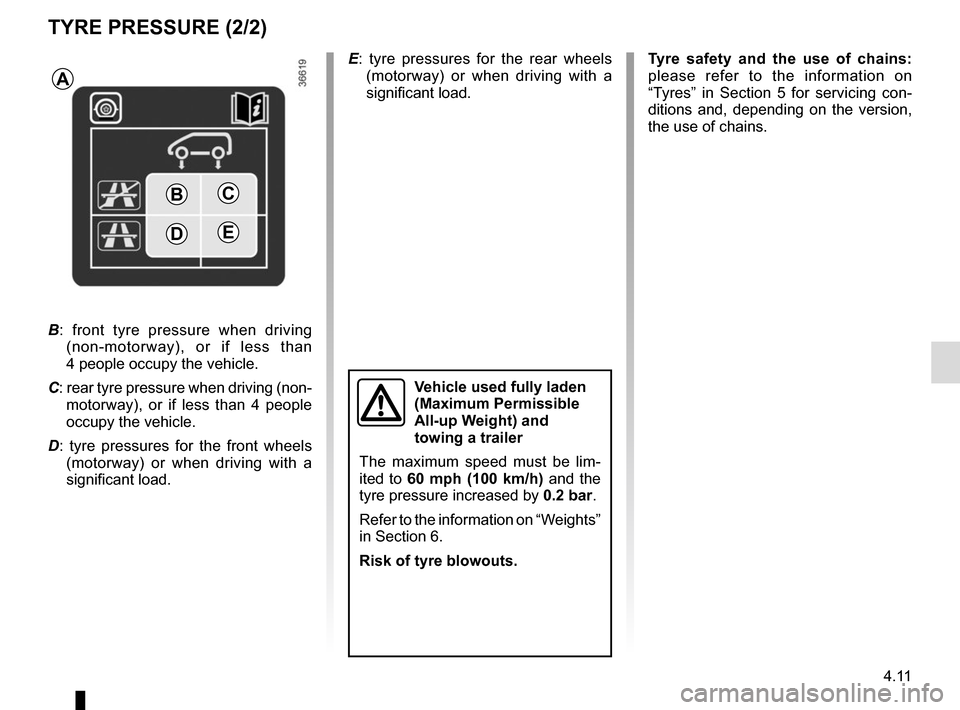
B: front tyre pressure when driving
(non-motorway), or if less than
4 people occupy the vehicle.
C: rear tyre pressure when driving (non- motorway), or if less than 4 people
occupy the vehicle.
D : tyre pressures for the front wheels
(motorway) or when driving with a
significant load. E
: tyre pressures for the rear wheels
(motorway) or when driving with a
significant load.
Vehicle used fully laden
(Maximum Permissible
All-up Weight) and
towing a trailer
The maximum speed must be lim-
ited to 60 mph (100 km/h) and the
tyre pressure increased by 0.2 bar.
Refer to the information on “Weights”
in Section 6.
Risk of tyre blowouts.
Tyre safety and the use of chains:
please refer to the information on
“Tyres” in Section 5 for servicing con-
ditions and, depending on the version,
the use of chains.
Page 228 of 294

5.6
With the engine running and the
parking brake applied,
– unroll the hose from the container;
– connect the compressor hose 3 to
the container’s inlet 8;
– depending on the vehicle, connect the container 8 to the compressor
from the container recess 7;
– unscrew the valve cap on the rel- evant wheel and screw on the con-
tainer’s inflation adapter 1;
45
1
TYRE PRESSURE KIT (3/3)
Once the tyre is correctly inflated,
remove the kit: slowly unscrew the in-
flation adapter 1 to prevent any repair
product from escaping and store the
container in plastic packaging to pre-
vent the product from escaping.
– Affix the driving recommendation label to the dashboard where it can
easily be seen by the driver;
– Store the kit in the toolkit and re- insert it properly under the driver’s
seat.
– At the end of this initial inflation op- eration, air will still escape from the
tyre. You must drive a short distance
in order to seal the hole.
– Start immediately and drive at be- tween 12 and 40 mph (20 and
60 km/h) in order to distribute the
product evenly in the tyre and, after
driving for 2 miles (3 km), stop and
check the pressure.
– If the pressure is greater than 1.3 bar but less than the recommended
pressure (refer to the label affixed to
the edge of the driver’s door), read-
just it. Otherwise, please contact an
authorised dealer: the tyre cannot be
repaired.
8
– disconnect any accessories previ-ously connected to the vehicle’s ac-
cessories sockets;
– adapter 2 must be connected to the
vehicle accessories socket;
– press switch 4 to inflate the tyre to
the recommended pressure (please
refer to the information on “Tyre infla-
tion pressure” in Section 4);
– after a maximum of 15 minutes, stop inflating and read the pressure (on
pressure gauge 5).
Note: while the container is empty-
ing (approximately 30 seconds), the
pressure gauge 5 will briefly indicate
a pressure of up to 6 bar. The pres-
sure will then drop.
– adjust the pressure: to increase it, continue inflation with the kit; to
reduce it, press button 6.
If a minimum pressure of 1.8 bar is
not reached after 15 minutes, repair
is not possible; do not drive the ve-
hicle but contact an approved dealer.
2
3
7
6
Page 235 of 294

5.13
Use in winter
Chains
For safety reasons, fitting snow
chains to the rear axle is strictly for-
bidden.
Chains cannot be fitted to tyres which
are larger than those originally fitted to
the vehicle.
Snow or Winter tyres
We would recommend that these be
fitted to all four wheels to ensure that
your vehicle retains maximum adhe-
sion.
Warning : These tyres sometimes have
a specific direction of rotation and a
maximum speed index which may be
lower than the maximum speed of your
vehicle.
TYRES (3/3)
Studded tyres
This type of equipment may only be
used for a limited period and as laid
down by local legislation. It is neces-
sary to observe the speed specified by
current legislation.
These tyres must, at a minimum, be
fitted to the two front wheels.
In all cases, we would recommend
that you contact an approved dealer
who will be able to advise you on
the choice of equipment which is
most suitable for your vehicle.
Emergency spare wheel
Refer to the information on the
“Emergency spare wheel” and in-
structions on “Changing a wheel” in
Section 5.
Changing wheels around
This practice is not recommended.
17” wheels cannot be
fitted with chains.
If you wish to fit snow
chains, you must use spe-
cial equipment.
Consult an approved Dealer.
Chains may only be fitted
to tyres of the same size
as those originally fitted to
your vehicle.
Page 252 of 294

5.30
ACCESSORIES
Electrical and electronic accessories
Before installing this type of accessory (particularly for transmitters\
/receivers: frequency bandwidth, power level, po-
sition of the aerial, etc.), make sure it is compatible with your vehic\
le. You can get advice from an authorised dealer.
Connect accessories with a maximum power of 120 Watts only. Fire hazard. When several accessory sockets are
used at the same time, the total power of the connected accessories must\
not exceed 180 watts.
No work may be carried out on the vehicle’s electrical or radio circuits, except by authorised dealers: an incorre\
ctly connecte d
system may result in damage being caused to the electrical equipment and\
/or the components connected to it.
If the vehicle is fitted with any aftermarket electrical equipment, make\
sure that the installation is correctly protected by a fuse.
Establish the rating and position of this fuse.
Using the diagnostic socket
The use of electronic accessories on the diagnostic socket may cause ser\
ious disturbance to the vehicle’s electronic systems.
For your safety we recommend that you use only electronic accessories ap\
proved by the manufacturer, consult an Approved
Dealer. Serious accident risk.
Use of transmitting/receiving devices (telephones, CB equipment etc.).\
Telephones and CB equipment with integrated aerials may cause interferenc\
e to the electronic systems originally fitted to the
vehicle: it is advisable only to use equipment with an external aerial. \
Furthermore, we remind you of the need to conform
to the legislation in force concerning the use of such equipment.
Fitting aftermarket accessories
If you wish to install accessories on the vehicle: please contact an aut\
horised dealer. Also, to ensure the correct operation o f
your vehicle, and to avoid any risk to your safety, we recommend that you use only accessories specifically designed for y\
our
vehicle, which are the only accessories for which the manufacturer will \
provide a warranty.
If you are using an anti-theft device, only attach it to the brake pedal\
.
Obstructions to the driver
On the driver’s side, only use mats suitable for the vehicle, attached with the pre-fi\
tted components, and check the fitting re gu-
larly. Do not lay one mat on top of another. There is a risk of wedging the pedals.
Page 266 of 294
6.2
VEHICLE IDENTIFICATION PLATES
The information shown on the ve-
hicle identification plate should be
quoted on all correspondence or
orders.
The presence and location of the in-
formation depends on the vehicle.
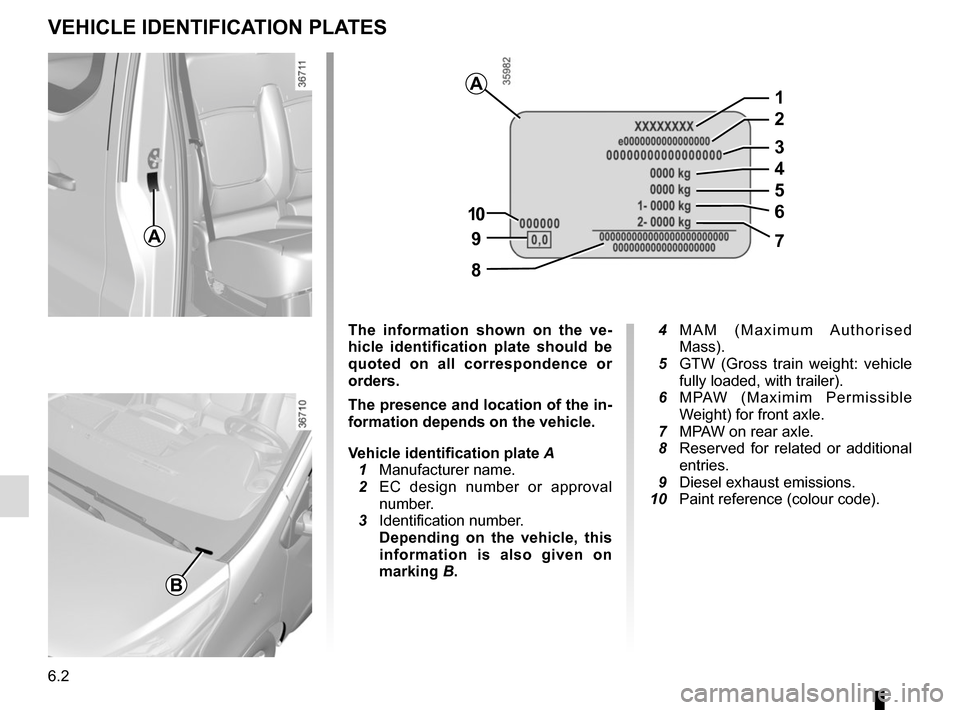
Vehicle identification plate A
1 Manufacturer name.
2 EC design number or approval
number.
3 Identification number.
Depending on the vehicle, this
information is also given on
marking B.
4 MAM (Maximum Authorised
Mass).
5 GTW (Gross train weight: vehicle
fully loaded, with trailer).
6 MPAW (Maximim Permissible
Weight) for front axle.
7 MPAW on rear axle.
8 Reserved for related or additional
entries.
9 Diesel exhaust emissions.
10 Paint reference (colour code).
A
97
8
10
5
1
2
3
4
6
B
A
Page 273 of 294
6.9
WEIGHTS (in kg) (1/2)
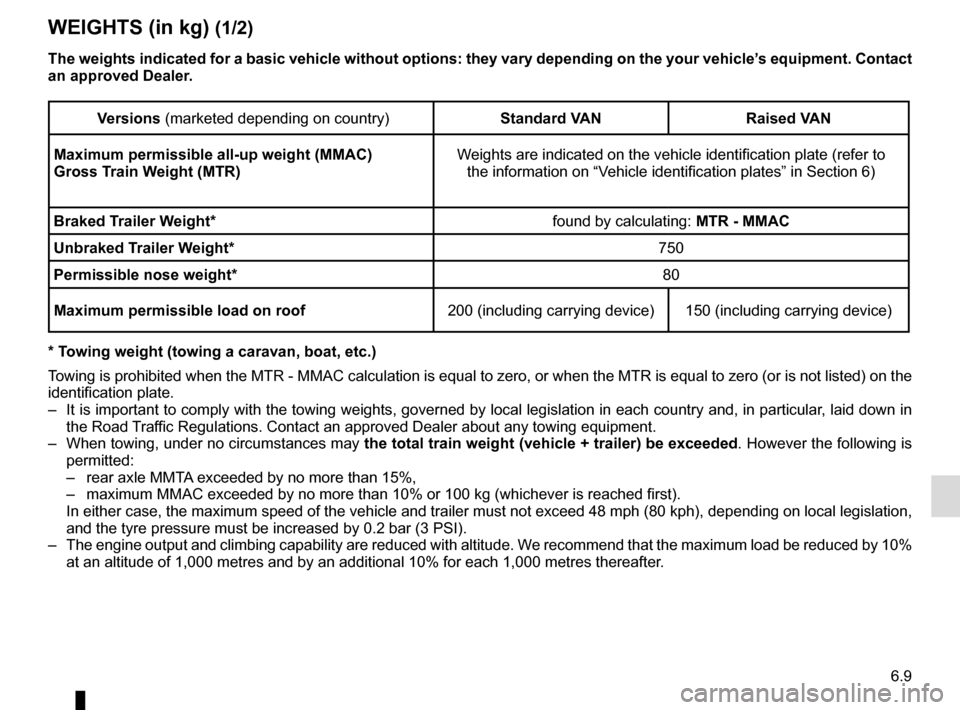
Versions (marketed depending on country)Standard VAN Raised VAN
Maximum permissible all-up weight (MMAC)
Gross Train Weight (MTR) Weights are indicated on the vehicle identification plate (refer to
the information on “Vehicle identification plates” in Section 6)
Braked Trailer Weight* found by calculating: MTR - MMAC
Unbraked Trailer Weight* 750
Permissible nose weight* 80
Maximum permissible load on roof 200 (including carrying device) 150 (including carrying device)
* Towing weight (towing a caravan, boat, etc.)
Towing is prohibited when the MTR - MMAC calculation is equal to zero, or\
when the MTR is equal to zero (or is not listed) on t he
identification plate.
– It is important to comply with the towing weights, governed by local leg\
islation in each country and, in particular, laid down in the Road Traffic Regulations. Contact an approved Dealer about any towing equipment.
– When towing, under no circumstances may the total train weight (vehicle + trailer) be exceeded . However the following is
permitted:
– rear axle MMTA exceeded by no more than 15%,
– maximum MMAC exceeded by no more than 10% or 100 kg (whichever is reach\
ed first).
In either case, the maximum speed of the vehicle and trailer must not ex\
ceed 48 mph (80 kph), depending on local legislation, and the tyre pressure must be increased by 0.2 bar (3 PSI).
– The engine output and climbing capability are reduced with altitude. We recommend that the maximum load be reduced by 10% at an altitude of 1,000 metres and by an additional 10% for each 1,000 m\
etres thereafter.
The weights indicated for a basic vehicle without options: they vary dep\
ending on the your vehicle’s equipment. Contact
an approved Dealer.