2017 RENAULT MEGANE Egr
[x] Cancel search: EgrPage 235 of 346
3.41
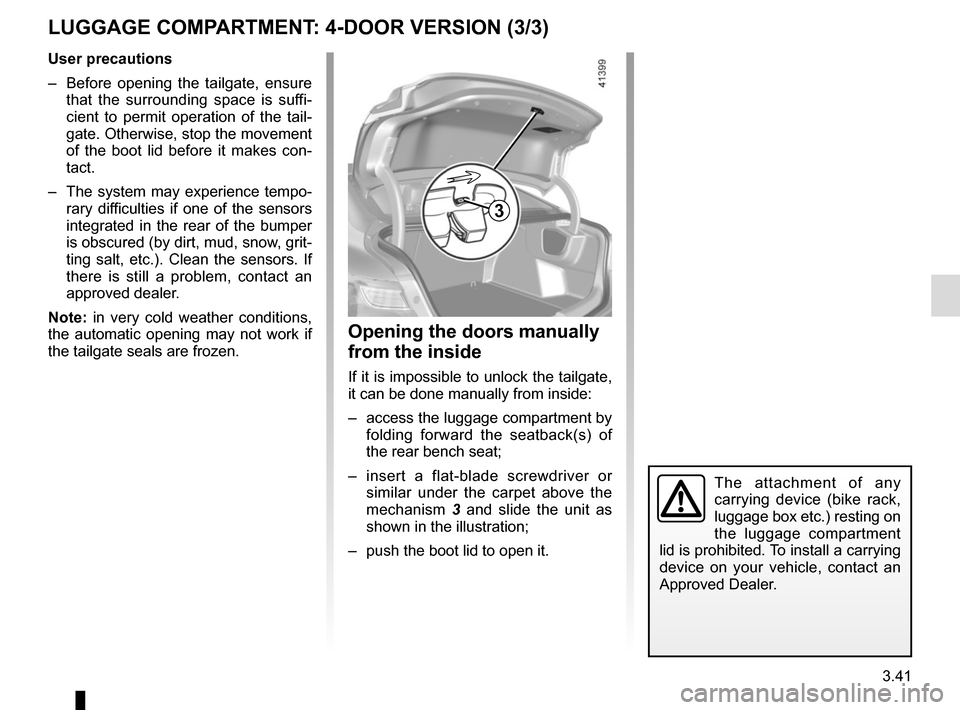
Opening the doors manually
from the inside
If it is impossible to unlock the tailgate,
it can be done manually from inside:
– access the luggage compartment by folding forward the seatback(s) of
the rear bench seat;
– insert a flat-blade screwdriver or similar under the carpet above the
mechanism 3 and slide the unit as
shown in the illustration;
– push the boot lid to open it.
3
User precautions
– Before opening the tailgate, ensure that the surrounding space is suffi-
cient to permit operation of the tail-
gate. Otherwise, stop the movement
of the boot lid before it makes con-
tact.
– The system may experience tempo- rary difficulties if one of the sensors
integrated in the rear of the bumper
is obscured (by dirt, mud, snow, grit-
ting salt, etc.). Clean the sensors. If
there is still a problem, contact an
approved dealer.
Note: in very cold weather conditions,
the automatic opening may not work if
the tailgate seals are frozen.
LUGGAGE COMPARTMENT: 4-DOOR VERSION (3/3)
The attachment of any
carrying device (bike rack,
luggage box etc.) resting on
the luggage compartment
lid is prohibited. To install a carrying
device on your vehicle, contact an
Approved Dealer.
Page 250 of 346

3.56
MULTIMEDIA EQUIPMENT (1/2)
Using the telephone
We remind you of the need
to conform to the legislation
in force concerning the use
of such equipment.
4
Hands-free telephone
integrated control
For equipped vehicles, use the steering
wheel controls 3.
Multimedia settings
1 Multimedia touchscreen display;
2 Steering column controls;
3 Steering wheel controls;
4 Microphone.
1
3
Refer to the equipment instructions
for information on how to operate
this equipment.
2
Page 267 of 346
4.15
BODYWORK MAINTENANCE (1/2)
You should
Wash your car frequently, with the
engine off, with cleaning products rec-
ommended by the manufacturer (never
use abrasive products). Rinse thor-
oughly beforehand with a jet:
– spots of tree resin and industrial
grime;
– mud in the wheel arches and under-
neath the body which forms damp
patches;
– bird droppings , which cause a
chemical reaction with the paint that
rapidly discolours paintwork and
may even cause the paint to peel
off;
wash the vehicle immediately to
remove these marks since it is im-
possible to remove them by polish-
ing;
– salt, particularly in the wheel arches
and underneath the body after driv-
ing in areas where the roads have
been gritted.
Remove any plant matter (resin, leaves,
etc.) from the vehicle regularly.
What you should not doDo not degrease or clean mechani-
cal components (e.g. the engine com-
partment), underneath the body, parts
with hinges (e.g. inside the doors) and
painted plastic external fittings (e.g.
bumpers) using high-pressure clean-
ing equipment or by spraying on prod-
ucts not approved by our Technical
Department. Doing this could give rise
to corrosion or operational faults.
Wash the vehicle in bright sunlight or
freezing temperatures.
Do not scrape off mud or dirt without
pre-wetting.
Allow dirt to accumulate on the exterior.
Allow rust to form following minor im-
pacts.
Do not use solvents not approved by
our Technical Department to remove
stains as this could damage the paint-
work.
Do not drive in snow or muddy condi-
tions without washing the vehicle, par-
ticularly under the wheel arches and
body.
A well-maintained vehicle will last
longer. It is therefore recommended to
maintain the exterior of the vehicle reg-
ularly.
Your vehicle has been treated with very
effective anti-corrosion products. It is
nevertheless subject to various outside
influences.
Corrosive agents in the atmosphere
–
atmospheric pollution (built-up and
industrial areas),
– saline atmospheres (near the sea,
particularly in hot weather),
– seasonal and damp weather condi-
tions (e.g. road salt in winter, water
from road cleaners, etc.).
Minor impacts
Abrasive action
Dust and sand in the air, mud, road grit
thrown up by other vehicles, etc.
You should take a number of minor pre-
cautions in order to safeguard your ve-
hicle against such risks.
Page 304 of 346

5.34
ACCESSORIES
Electrical and electronic accessories
Before installing this type of accessory (particularly for transmitters\
/receivers: frequency bandwidth, power level, po-
sition of the aerial, etc.), make sure it is compatible with your vehic\
le. You can get advice from an authorised dealer.
Connect accessories with a maximum power of 120 Watts only. Fire hazard. When several accessory sockets are
used at the same time, the total power of the connected accessories must\
not exceed 180 watts.
No work may be carried out on the vehicle’s electrical or radio circuits, except by authorised dealers: an incorre\
ctly connecte d
system may result in damage being caused to the electrical equipment and\
/or the components connected to it.
If the vehicle is fitted with any aftermarket electrical equipment, make\
sure that the installation is correctly protected by a fuse.
Establish the rating and position of this fuse.
Using the diagnostic socket
The use of electronic accessories on the diagnostic socket may cause ser\
ious disturbance to the vehicle’s electronic systems.
For your safety we recommend that you use only electronic accessories ap\
proved by the manufacturer, consult an Approved
Dealer. Serious accident risk.
Use of transmitting/receiving devices (telephones, CB equipment etc.).\
Telephones and CB equipment with integrated aerials may cause interferenc\
e to the electronic systems originally fitted to the
vehicle: it is advisable only to use equipment with an external aerial. \
Furthermore, we remind you of the need to conform
to the legislation in force concerning the use of such equipment.
Fitting aftermarket accessories
If you wish to install accessories on the vehicle: please contact an aut\
horised dealer. Also, to ensure the correct operation o f
your vehicle, and to avoid any risk to your safety, we recommend that you use only accessories specifically designed for y\
our
vehicle, which are the only accessories for which the manufacturer will \
provide a warranty.
If you are using an anti-theft device, only attach it to the brake pedal\
.
Obstructions to the driver
On the driver’s side, only use mats suitable for the vehicle, attached with the pre-fi\
tted components, and check the fitting re gu-
larly. Do not lay one mat on top of another. There is a risk of wedging the pedals.
Page 309 of 346

The following advice will enable you to carry out quick, temporary repai\
rs. For safety reasons you should always contact
an approved Dealer as soon as possible.
Using th")
5.39
OPERATING FAULTS (1/7)
The following advice will enable you to carry out quick, temporary repai\
rs. For safety reasons you should always contact
an approved Dealer as soon as possible.
Using the RENAULT cardPOSSIBLE CAUSES WHAT TO DO
The RENAULT card does not lock or
unlock the doors. Card battery is flat.
Replace the battery. You can still lock/
unlock and start your vehicle (refer to the in-
formation on “Locking, unlocking the open-
ing elements” in Section 1 and “Starting,
stopping the engine” in Section 2).
Use of appliances operating on the
same frequency as the card (mobile
phone, etc.). Stop using the equipment or use the in-
tegrated key (refer to the information on
“Locking, unlocking the opening elements”
in Section 1).
Vehicle located in a high electromag-
netic radiation zone.
Vehicle battery flat. Use the key integrated in the card (refer to
the information on “Locking, unlocking the
opening elements” in Section 1).
The vehicle is started. With the engine running, the card’s locking/
unlocking device is blocked. Turn off the ig-
nition.
Page 340 of 346

7.2
ALPHABETICAL INDEX (2/5)
display .................................... 1.58 → 1.69, 1.66 → 1.69, 3.56
doors......................................................................1.16 → 1.19
doors/tailgate .........................................................\
..... 1.4, 1.12
driver’s position .....................................................1.54 → 1.63
driving ....... 2.2 → 2.7, 2.14 – 2.15, 2.17 → 2.24, 2.27 → 2.39,
2.51 → 2.53, 2.57 → 2.72, 2.79 → 2.81
driving aids ............................................................. 2.49 – 2.50
driving position settings ............................................................1.24 → 1.27
driving recommendations ......................................2.20 → 2.24
E
ECO driving ...........................................................2.20 → 2.24
ECO mode ........................................................................\
. 2.22
electric beam height adjustment ............................. 1.87 – 1.88
electric windows ..................................................... 3.21 – 3.22
electronic parking brake ........................................2.17 → 2.19
electronic stability control: ESC .............................2.30 → 2.39
emergency active braking.................................................. 2.34
emergency brake assist.........................................2.30 → 2.39
emergency braking ................................................2.30 → 2.39
emergency key ........................................................... 1.6 – 1.7
emergency spare wheel ............................................. 5.2 – 5.3
engine technical specifications .................................................. 6.8
engine oil ...................................................4.4 → 4.7, 4.6 – 4.7
engine oil level ...........................................4.5 → 4.7, 4.6 – 4.7
engine specifications ........................................................... 6.8
engine standby ......................................................2.10 → 2.13
engine start/stop button .............................................2.5 → 2.7
environment ............................................................\
........... 2.26
ESC: electronic stability control .............................2.30 → 2.39
external temperature ......................................................... 1.84 F
faults
operating faults ................................................5.39 → 5.45
filter air filter ........................................................................\
. 4.10
diesel filter .................................................................... 4.10
oil filter ........................................................................\
. 4.10
passenger compartment filter ...................................... 4.10
fittings ...............................................................\
.....3.29 → 3.32
freewheel ..............................................................\
............. 2.22
front passenger air bag deactivation ................................. 1.50
front seat adjustment .............................................1.21 → 1.23
front seats adjustment .......................................................1.21 → 1.24
fuel advice on fuel economy ...................................2.20 → 2.24
capacity ...............................................................\
....... 1.103
consumption ....................................................2.20 → 2.24
filling .............................................................1.103 → 1.105
grade ............................................................1.103 → 1.105
fuel consumption ...................................................2.20 → 2.24
fuel economy .........................................................2.20 → 2.24
fuel level ................................................................... 1.64, 1.66
fuel repriming
................................................................... 1.104
fuel tank capacity ........................................................1.103 → 1.105
fuel tank capacity ...............................................1.103 → 1.105
fuses ....................................................................... 5.28 – 5.29
G
gear lever........................................................................\
... 2.16
grab handle........................................................................\
3.31
H
handbrake............................................................... 2.16 – 2.17
hands-free telephone integrated control ................. 3.56 – 3.57