2017 RENAULT KADJAR start stop fuse
[x] Cancel search: start stop fusePage 176 of 300

2.72
AUTOMATIC TRANSMISSION (2/3)
Special cases
In certain driving conditions (for exam-
ple, engine protection, operation of the
Electronic Stability Programme: the au-
tomatic system may change gear auto-
matically.
Likewise, to prevent incorrect manoeu-
vres, a gear change may be refused by
the automatic system: in this case the
gear display flashes for a few seconds
as a warning.
Special circumstances
– If the bends and road surface do
not allow you to stay in automatic
mode (e.g. in the mountains), we
recommend that you change to
manual mode. This will prevent the
automatic gearbox from changing
gear repeatedly when climbing, and
permit engine braking on long de-
scents.
– In cold weather , start the engine
and wait a few seconds before
moving the selector lever from posi-
tion P or N and engaging it in D or R
to prevent the engine stalling.
Driving in manual mode
With the selection lever 1 in position D,
move the lever to the left.
Shifting the lever repeatedly allows you
to change gears manually:
– to move down through the gears, push the lever forwards;
– to move up through the gears, push the lever backwards.
The gear selected is displayed on the
instrument panel.
1
When facing uphill, to remain
stopped, do not keep your foot on
the accelerator.
Risk of overheating the automatic
gearbox.
Page 191 of 300
3.13
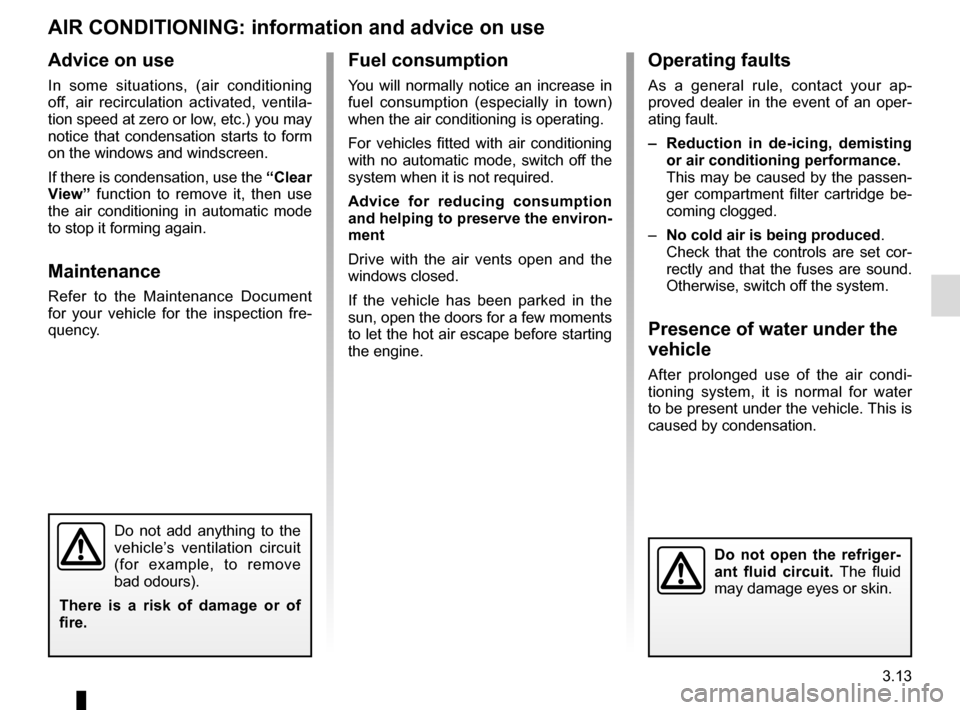
Operating faults
As a general rule, contact your ap-
proved dealer in the event of an oper-
ating fault.
– Reduction in de-icing, demisting or air conditioning performance.
This may be caused by the passen-
ger compartment filter cartridge be-
coming clogged.
– No cold air is being produced .
Check that the controls are set cor-
rectly and that the fuses are sound.
Otherwise, switch off the system.
Presence of water under the
vehicle
After prolonged use of the air condi-
tioning system, it is normal for water
to be present under the vehicle. This is
caused by condensation.
AIR CONDITIONING: information and advice on use
Do not open the refriger-
ant fluid circuit. The fluid
may damage eyes or skin.
Fuel consumption
You will normally notice an increase in
fuel consumption (especially in town)
when the air conditioning is operating.
For vehicles fitted with air conditioning
with no automatic mode, switch off the
system when it is not required.
Advice for reducing consumption
and helping to preserve the environ-
ment
Drive with the air vents open and the
windows closed.
If the vehicle has been parked in the
sun, open the doors for a few moments
to let the hot air escape before starting
the engine.
Advice on use
In some situations, (air conditioning
off, air recirculation activated, ventila-
tion speed at zero or low, etc.) you may
notice that condensation starts to form
on the windows and windscreen.
If there is condensation, use the “Clear
View” function to remove it, then use
the air conditioning in automatic mode
to stop it forming again.
Maintenance
Refer to the Maintenance Document
for your vehicle for the inspection fre-
quency.
Do not add anything to the
vehicle’s ventilation circuit
(for example, to remove
bad odours).
There is a risk of damage or of
fire.
Page 294 of 300

dimensions .............................................................\
............. 6.4
dipstick................................................................\
.....")
7.2
ALPHABETICAL INDEX (2/5)
dimensions .............................................................\
............. 6.4
dipstick................................................................\
................. 4.4
display ................................................................\
...1.54 → 1.61
doors/tailgate ....................................................1.4, 1.6 → 1.18
driver’s position .....................................................1.50 → 1.59
driving ....... 2.2 → 2.7, 2.12 – 2.13, 2.16 → 2.23, 2.29 → 2.42,
2.50 → 2.52, 2.56 → 2.64, 2.71 → 2.73
driving position settings ............................................................1.23 → 1.26
driving recommendations ......................................2.19 → 2.23
E
ECO driving ...........................................................2.19 → 2.23
ECO mode ........................................................................\
. 2.20
electric beam height adjustment ............................. 1.86 – 1.87
electric windows ..................................................... 3.15 – 3.16
electronic parking brake ........................................2.16 → 2.18
electronic stability control: ESC .............................2.29 → 2.38
emergency active braking......................................2.34 → 2.38
emergency brake assist.........................................2.29 → 2.38
emergency braking ................................................2.29 → 2.38
emergency key ........................................................... 1.6 – 1.7
emergency spare wheel ............................................. 5.2 – 5.3
engine technical specifications .................................................. 6.5
engine coolant ..................................................................... 4.8
engine oil ...................................................................4.4 → 4.7
engine oil capacity .....................................................4.5 → 4.7
engine oil level ...........................................................4.4 → 4.7
engine specifications .................................................... 6.3, 6.5
engine standby ........................................................ 2.8 → 2.11
engine start/stop button .............................................2.5 → 2.7
environment ............................................................\
........... 2.25
ESC: electronic stability control ....................1.56, 2.29 → 2.38F
4 wheel drive (4WD) ..............................................2.39
→ 2.42
faults operating faults ................................................5.34 → 5.40
filter air filter ........................................................................\
. 4.10
oil filter .................................................................4.5 → 4.7
passenger compartment filter ...................................... 4.10
fittings ...............................................................\
.....3.19 → 3.23
fixed sunroof ...................................................................... 3.16
front passenger air bag deactivation ................................. 1.47
front seat adjustment .............................................. 1.20 – 1.21
front seats adjustment ............................................... 1.19 – 1.21, 1.23
with electric controls .................................................... 1.22
fuel advice on fuel economy ...................................2.19 → 2.23
consumption ....................................................2.19 → 2.23
filling ........................................................1.54, 1.96 → 1.98
grade ................................................................1.96 →
1.98
fuel consumption ...................................................2.19 →
2.23
fuel economy .........................................................2.19 → 2.23
fuel filler cap ..........................................................1.96 → 1.98
fuel level ................................................................1.54 → 1.60
fuel tank capacity ...............................................................\
......... 1.96
fuel tank capacity ...................................................1.96 → 1.98
fuses ..................................................................\
....5.24 → 5.26
G
gear lever........................................................................\
... 2.14
grip control ........................................................................\
. 2.33
H
handbrake........................................................................\
.. 2.15
hands-free telephone integrated control ............................ 3.38