2017 RENAULT CLIO window
[x] Cancel search: windowPage 150 of 260

3.10
AUTOMATIC CLIMATE CONTROL (4/4)
76
Air recirculation (isolation of
the passenger compartment)
K
This function is managed automatically
(operation is confirmed by a warning
light on button 7), but you can also acti-
vate it manually.
The system determines whether or not
the air recycling function is used, based
on the quality of the outside air.Stopping the system
Turn control 6
to “OFF” to stop the
system. To start, turn control 6 again
to adjust the blower speed or press
button 1.
1
Manual use
Press button 7 – the integrated indica-
tor light comes on.
Prolonged use of this position may lead
to odours, caused by non-renewal of
air, and the formation of condensation
on the windows.
We therefore advise you to return to au-
tomatic mode as soon as air recircula-
tion is no longer needed, by pressing
button 7.
To exit this function, press button 7
again.
The demisting/de-icing will still take
priority over the air recirculation.
Page 151 of 260

3.11
AIR CONDITIONING: information and advice on use
Do not open the refriger-
ant fluid circuit. The fluid
may damage eyes or skin.
Fuel consumption
You will normally notice an increase in
fuel consumption (especially in town)
when the air conditioning is operating.
For vehicles fitted with air conditioning
with no automatic mode, switch off the
system when it is not required.
Advice for reducing consumption
and helping to preserve the environ-
ment
Drive with the air vents open and the
windows closed.
If the vehicle has been parked in the
sun, open the doors for a few moments
to let the hot air escape before starting
the engine.
Maintenance
Refer to the Maintenance Document
for your vehicle for the inspection fre-
quency.
Operating faults
As a general rule, contact your ap-
proved dealer in the event of an oper-
ating fault.
– Reduction in de-icing, demisting or air conditioning performance.
This may be caused by the passen-
ger compartment filter cartridge be-
coming clogged.
– No cold air is being produced .
Check that the controls are set cor-
rectly and that the fuses are sound.
Otherwise, switch off the system.
Presence of water under the
vehicle
After prolonged use of the air condi-
tioning system, it is normal for water
to be present under the vehicle. This is
caused by condensation.
Advice on use
In some situations, (air conditioning
off, air recirculation activated, ventila-
tion speed at zero or low, etc.) you may
notice that condensation starts to form
on the windows and windscreen.
If there is condensation, use the “Clear
View” function to remove it, then use
the air conditioning in automatic mode
to stop it forming again.
Page 152 of 260

3.12
ELECTRIC WINDOWS (1/2)
1
2
34
56
Avoid resting any objects against
a half-open window: there is a risk
that the electric window could be
damaged.
Driver’s responsibility
Never leave your vehicle
with the RENAULT card or
key inside, and never leave
a child, adult who is not self-suffi-
cient or a pet, even for a short while.
They may pose a risk to themselves
or to others by starting the engine
or activating equipment (such as the
gear lever or electric windows).
If any part of the body becomes
trapped, reverse the direction of the
window immediately by pressing the
relevant switch.
Risk of serious injury.
Passenger safety
The driver can prevent the
front and rear passenger
electric windows from op-
erating (and the driver’s window)
by pressing switch 4. A confirmation
message is displayed on the instru-
ment panel.
Electric windows
Press or pull the switch to raise or lower
a window to the desired height (the rear
windows do not open fully);
From the driver’s seat, use switch:
1 for the driver’s side;
2 for the front passenger side;
3 and 5 for the rear passenger win-
dows.
From the passenger seats, use
switch 6.
These systems operate
with the igni-
tion on or off, until one of the front doors
is opened (limited to about 3 minutes).
Page 153 of 260

3.13
One-touch mode
Depending on the vehicle, this mode
works in addition to the operation of the
electric windows described previously.
It is only fitted to the driver’s window.
Briefly press or pull switch 1 fully: the
window is fully lowered or raised.
Pressing the switch again stops the
window moving.
Note: If the driver’s window detects re-
sistance when closing (e.g. tree branch,
etc.), it stops and then lowers again by
a few centimetres.
ELECTRIC WINDOWS (2/2)
Manual window winder
controls
Turn handle 7.
7
Operating faults
In case of a fault when closing a window,
the system reverts to normal mode:
pull the switch concerned up as often
as necessary to fully close the window
(the window will close gradually), hold
the switch (still on the closure side) for
one second then lower and raise the
window fully to reinitialise the system.
If necessary, contact your authorised
dealer.
When closing the windows,
ensure that no part of the
body (arm, hand, etc.) is
protruding from the vehicle.
Risk of serious injury.
Page 215 of 260

5.27
Number Allocation
1 Front windscreen wiper,
controls under steering
wheel
2 Front left-hand daytime
running lights,
right-hand side lights,
left-hand main beam
headlight,
right-hand dipped beam
headlight,
front fog lights
3 Interior lighting,
registration plate lighting,
fog lights
4 Right-hand side lights,
rear side lights
5 Left-hand side lights,
front side lights
6 Dipped beams,
front right-hand daytime
running light,
left-hand side lights,
right-hand main beam
headlight
FUSES (3/5)
Number Allocation
7 Left-hand dipped beam
headlight
8 Right-hand main beam
headlight
9 Left-hand main beam
headlight,
steering column controls
10 Steering column controls,
speed limiter/cruise control,
interior rear-view mirror,
belt warning module,
Parking sensor,
additional heating,
electric headlight beam
adjustment,
rear screen de-icer
11 Central door locking,
rain and light sensor,
steering wheel angle
sensor,
vehicle start button,
electric rear windowsNumber Allocation
12 Courtesy light,
luggage compartment light,
air conditioning,
electric windows
13 ABS-ESC,
brake switch
14 Steering column controls,
brake switch
15 Horn
16 Rear fog lights
17 Cigarette lighter
18 Radio and multimedia,
diagnostic socket
19 Power-assisted steering
20 GPL
Page 217 of 260

5.29
Number Allocation
21 Airbag,
electric locking of steering
column
22 Injection,
starting,
fuel pump
23 Brake switch,
rear screen wiper,
passenger compartment
ECU
24 Daytime running lights
25 Electric headlight beam
adjustment,
rear screen,
heating,
parking sensor,
cruise control,
radio,
heated seat,
seat belt warning
26 Automatic gearbox
FUSES (5/5)
Number Allocation
27 Reversing lights, rear wiper,
passenger compartment
ECU, automatic gearbox
28 Instrument panel
29 Steering column controls,
Alarm
30 Air conditioning,
steering column controls,
energy ECU
31 Wipers,
rear reversing lights,
energy ECU
32 Central locking of opening
elements
33 Direction indicator lights
34 Passenger compartment
ECU,
hands-free accessNumber Allocation
35 interior lighting, electric
windows, air conditioning,
electric door mirrors, brake
lights,
ABS,
passenger compartment
ECU
36 Towbar socket
37 Heated seats
38 Heated rear screen
39 Electric door mirror
Page 224 of 260
5.36
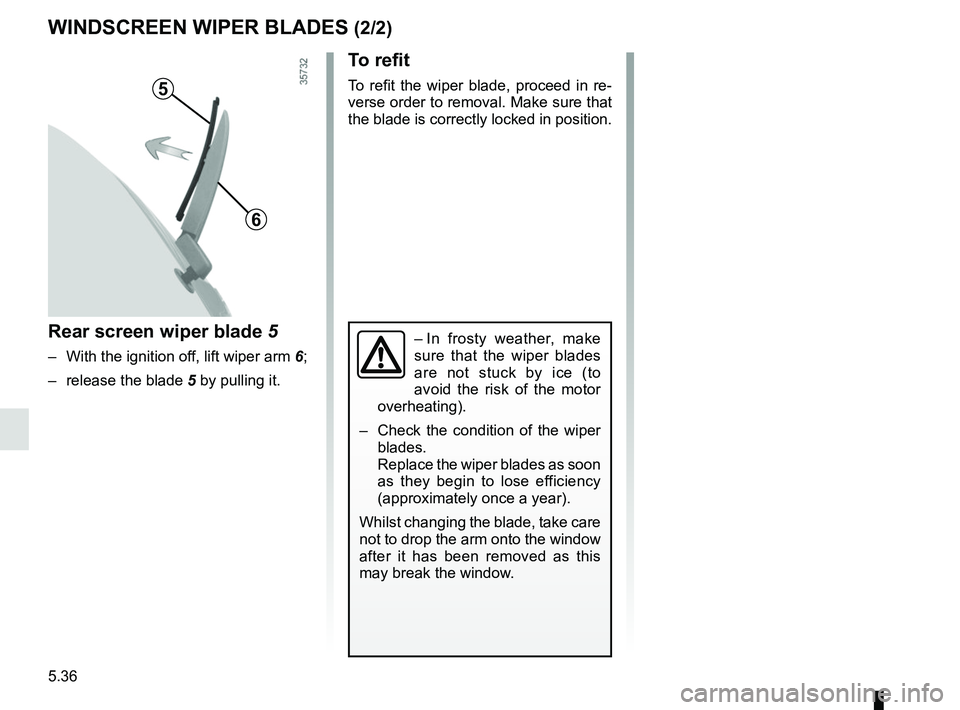
To refit
To refit the wiper blade, proceed in re-
verse order to removal. Make sure that
the blade is correctly locked in position.
Rear screen wiper blade 5
– With the ignition off, lift wiper arm 6;
– release the blade 5 by pulling it.
WINDSCREEN WIPER BLADES (2/2)
5
6
– In frosty weather, make
sure that the wiper blades
are not stuck by ice (to
avoid the risk of the motor
overheating).
– Check the condition of the wiper
blades.
Replace the wiper blades as soon
as they begin to lose efficiency
(approximately once a year).
Whilst changing the blade, take care
not to drop the arm onto the window
after it has been removed as this
may break the window.
Page 254 of 260

7.2
ALPHABETICAL INDEX (2/5)
driving ........2.2 → 2.5, 2.10 – 2.11, 2.13 → 2.17, 2.20 → 2.37,
2.44 → 2.46
driving aids ............................................................2.40 → 2.43
driving position settings ............................................................1.20 → 1.23
driving recommendations ......................................2.13 → 2.17
E
ECO driving ...........................................................2.13 → 2.17
ECO mode .................................................................. 2.15, 3.9
electric beam height adjustment ........................................ 1.81
electric windows ..................................................... 3.12 – 3.13
electronic stability control: ESC .............................2.23 → 2.26
emergency brake assist.........................................2.23 → 2.26
emergency braking ................................................2.23 → 2.26
emergency key ..........................................................1.2 → 1.4
emergency spare wheel ............................................5.2 → 5.5
engine technical specifications .................................................. 6.6
engine coolant ..................................................................... 4.7
engine oil ...................................................................4.4 → 4.6
engine oil capacity ...................................................... 4.5 – 4.6
engine oil level ...........................................................4.4 → 4.6
engine specifications .................................................... 6.3, 6.6
engine standby ..........................................................2.6 → 2.9
engine start/stop button .............................................2.3 → 2.5
environment ............................................................\
........... 2.19
ESC: electronic stability control ....................1.58, 2.23 → 2.26
external temperature ......................................................... 1.74
F
faults operating faults ................................................5.39 → 5.44
filter air filter ........................................................................\
... 4.9
oil filter .................................................................. 4.5 – 4.6 passenger compartment filter ........................................ 4.9
fitting a radio ...................................................................... 5.33
fittings ...............................................................\
.....3.16 → 3.19
front passenger air bag deactivation ................................. 1.48
front seat adjustment .............................................1.17 → 1.19
front seats adjustment .......................................................1.16 → 1.20
fuel advice on fuel economy ...................................2.13 → 2.17
consumption ...........................................2.13 → 2.15, 2.17
filling ........................................................1.56, 1.85 → 1.87
grade ................................................................1.85 → 1.87
fuel consumption ..........................................2.13 → 2.15, 2.17
fuel economy .........................................................2.13 → 2.17
fuel filler cap ..........................................................1.85 → 1.87
fuel level ................................................................1.56 → 1.61
fuel tank capacity ...............................................................\
......... 1.85
fuel tank capacity ...................................................
1.85 → 1.87
fuses ..................................................................\
....5.25 → 5.29
G
gear lever........................................................................\
... 2.12
H
handbrake........................................................................\
.. 2.12
hands-free telephone integrated control ............................ 3.32
hazard warning lights signal .............................................. 1.80
headlight beam adjustment ............................................... 1.81
headrest.................................................................... 1.16, 3.21
heated seats ...................................................................... 1.17
heated windscreen ..................................................3.7 → 3.10
heating and air conditioning system ........................ 3.4 → 3.11
heating system ........................................................ 3.4 → 3.11
Hill Start Assist.......................................................2.23 → 2.26
horn ...................................................................\
................ 1.80