Page 50 of 228

Bulk Fuel Storage — Diesel Fuel
If you store quantities of fuel, good maintenance of the
stored fuel is also essential. Fuel contaminated with water
will promote the growth of “microbes.” These microbes
form “slime” that will clog the fuel filtration system and
lines. Drain condensation from the supply tank and change
the line filter on a regular basis.
NOTE:When a diesel engine is allowed to run out of fuel,
air is pulled into the fuel system.
If the vehicle will not start, refer to “Maintenance
Procedures/Priming If The Engine Has Run Out Of Fuel”
in “Maintaining Your Vehicle” for further information.
WARNING!
Do not open the high pressure fuel system with the
engine running. Engine operation causes high fuel
pressure. High pressure fuel spray can cause serious
injury or death.
Diesel Exhaust Fluid Storage
Diesel Exhaust Fluid (DEF) is considered a very stable
product with a long shelf life. If DEF is kept in tempera-
tures between 10° and 90°F (-12° and 32°C), it will last a
minimum of one year.
DEF is subject to freezing at the lowest temperatures. For
example, DEF may freeze at temperatures at or below
12° F (-11° C). The system has been designed to operate in
this environment.
NOTE: When working with DEF, it is important to know
that:
• Any containers or parts that come into contact with DEF
must be DEF compatible (plastic or stainless steel).
Copper, brass, aluminum, iron or non-stainless steel
should be avoided as they are subject to corrosion
by DEF.
• If DEF is spilled, it should be wiped up completely.
48 STARTING AND OPERATING
Page 51 of 228

Adding Diesel Exhaust Fluid
The DEF gauge (located on the instrument cluster) will
display the level of DEF remaining in the tank. Refer to
“Instrument Cluster” and “Instrument Cluster Descrip-
tions” in “Understanding Your Instrument Panel” for fur-
ther information.
NOTE:
•Driving conditions (altitude, vehicle speed, load, etc.)
will effect the amount of DEF that is used in your
vehicle.
• Another factor is that outside temperature can affect
DEF consumption. In cold conditions, 12° F (-11° C) and
below, the DEF gauge needle can stay on a fixed position
and may not move for extended periods of time. This is
a normal function of the system.
• There is an electric heater inside the DEF tank that
automatically works when necessary. And if the DEF
supply does freeze, the truck will operate normally until
it thaws.
DEF Fill Procedure
NOTE: Refer to “Fluids, Lubricants, and Genuine Parts” in
“Maintaining Your Vehicle” for the correct fluid type.
1. Remove cap from DEF tank (located on drivers side of the vehicle or in fuel door).
DEF Filler Cap And Fuel Fill 1500/2500/3500 Models
1 — Diesel Exhaust Fluid Fill Location
2 — Fuel Fill Location
4
STARTING AND OPERATING 49
Page 52 of 228

2. Insert DEF fill adapter/nozzle into DEF tank filler neck.
NOTE:
•The DEF gauge may take up to five seconds to update
after adding a gallon or more of Diesel Exhaust Fluid
(DEF) to the DEF tank. If you have a fault related to the
DEF system, the gauge may not update to the new level.
See your authorized dealer for service.
• The DEF gauge may also not immediately update after a
refill if the temperature of the DEF fluid is below 12F
(-11C). The DEF line heater will possibly warm up the
DEF fluid and allow the gauge to update after a period
of run time. Under very cold conditions, it is possible
that the gauge may not reflect the new fill level for
several drives.CAUTION!
• To avoid DEF spillage, and possible damage to the
DEF tank from overfilling, do not “top off” the DEF
tank after filling.
• DO NOT OVERFILL. DEF will freeze below 12ºF
(-11ºC). The DEF system is designed to work in
temperatures below the DEF freezing point, how-
ever, if the tank is overfilled and freezes, the system
could be damaged.
• When DEF is spilled, clean the area immediately
with water and use an absorbent material to soak up
the spills on the ground.
• Do not attempt to start your engine if DEF is acci-
dentally added to the diesel fuel tank as it can result
in severe damage to your engine, including but not
limited to failure of the fuel pump and injectors.
(Continued)
50 STARTING AND OPERATING
Page 66 of 228

Intervention Regeneration Strategy — Message
Process Flow
This engine meets all required diesel engine emissions
standards. To achieve these emissions standards, your
vehicle is equipped with a state-of-the-art engine and
exhaust system. These systems are seamlessly integrated
into your vehicle and managed by the Powertrain Control
Module (PCM). The PCM manages engine combustion to
allow the exhaust system’s catalyst to trap and burn
Particulate Matter (PM) pollutants, with no input or inter-
action on your part.
Additionally, your vehicle has the ability to alert you to
additional maintenance required on your vehicle or engine.
Refer to “Instrument Cluster Display” in “Understanding
Your Instrument Panel” for further information.
WARNING!
A hot exhaust system can start a fire if you park over
materials that can burn. Such materials might be grass
or leaves coming into contact with your exhaust sys-
tem. Do not park or operate your vehicle in areas where
your exhaust system can contact anything that can
burn.
Maintenance-Free Batteries
Your vehicle is equipped with a maintenance-free battery.
The top of the maintenance-free battery is permanently
sealed. You will never have to add water, nor is periodic
maintenance required.
WARNING!
Battery posts, terminals, and related accessories con-
tain lead and lead compounds. Always wash hands
after handling the battery.
CAUTION!
It is essential when replacing the cables on the battery
that the positive cable is attached to the positive post
and the negative cable is attached to the negative post.
Battery posts are marked (+) positive and negative (-)
and are identified on the battery case. Also, if a “fast
charger” is used while the battery is in vehicle, discon-
nect both vehicle battery cables before connecting the
charger to the battery. Do not use a “fast charger” to
provide starting voltage.
64 MAINTAINING YOUR VEHICLE
Page 73 of 228
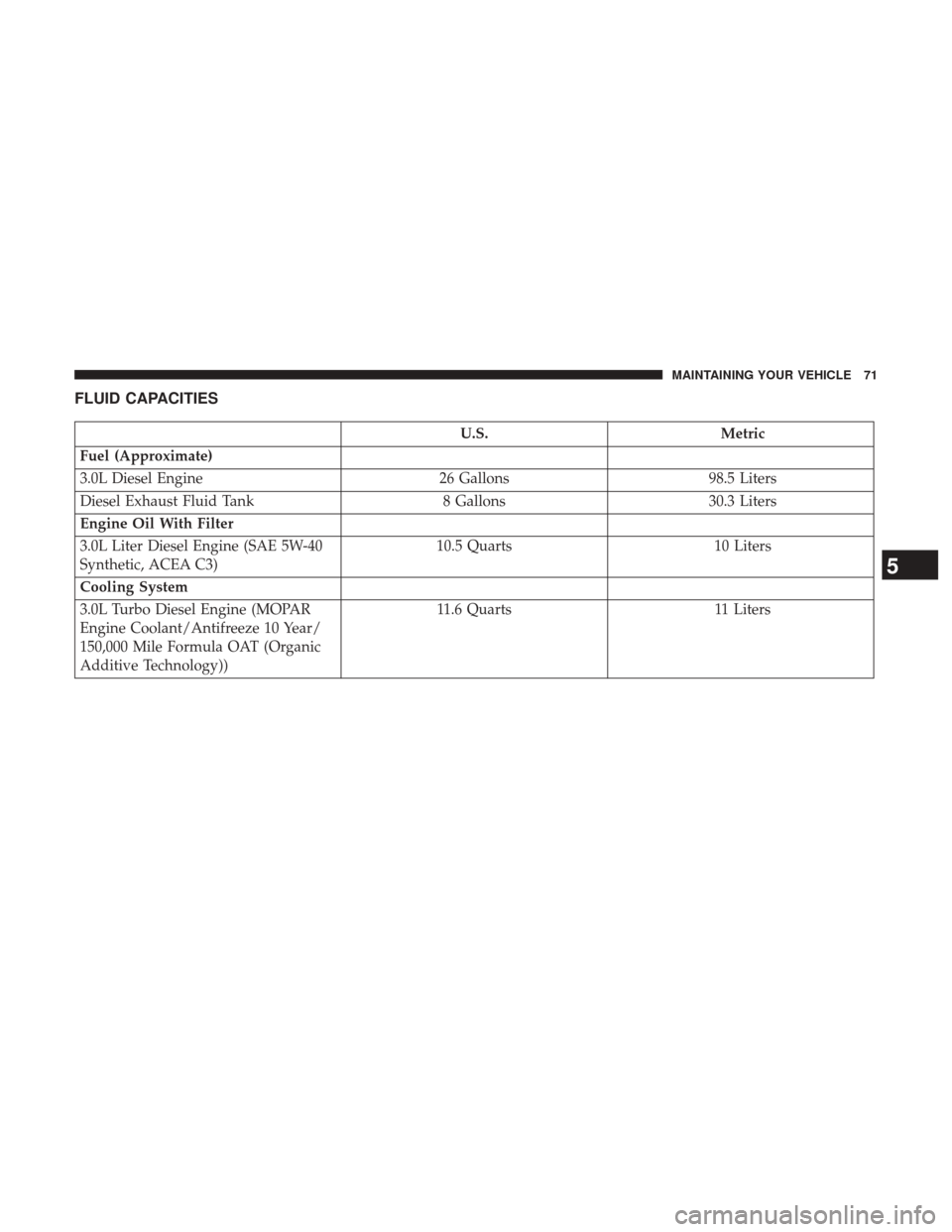
FLUID CAPACITIES
U.S.Metric
Fuel (Approximate)
3.0L Diesel Engine 26 Gallons98.5 Liters
Diesel Exhaust Fluid Tank 8 Gallons30.3 Liters
Engine Oil With Filter
3.0L Liter Diesel Engine (SAE 5W-40
Synthetic, ACEA C3) 10.5 Quarts
10 Liters
Cooling System
3.0L Turbo Diesel Engine (MOPAR
Engine Coolant/Antifreeze 10 Year/
150,000 Mile Formula OAT (Organic
Additive Technology)) 11.6 Quarts
11 Liters
5
MAINTAINING YOUR VEHICLE 71
Page 75 of 228
ComponentFluid, Lubricant, or Genuine Part
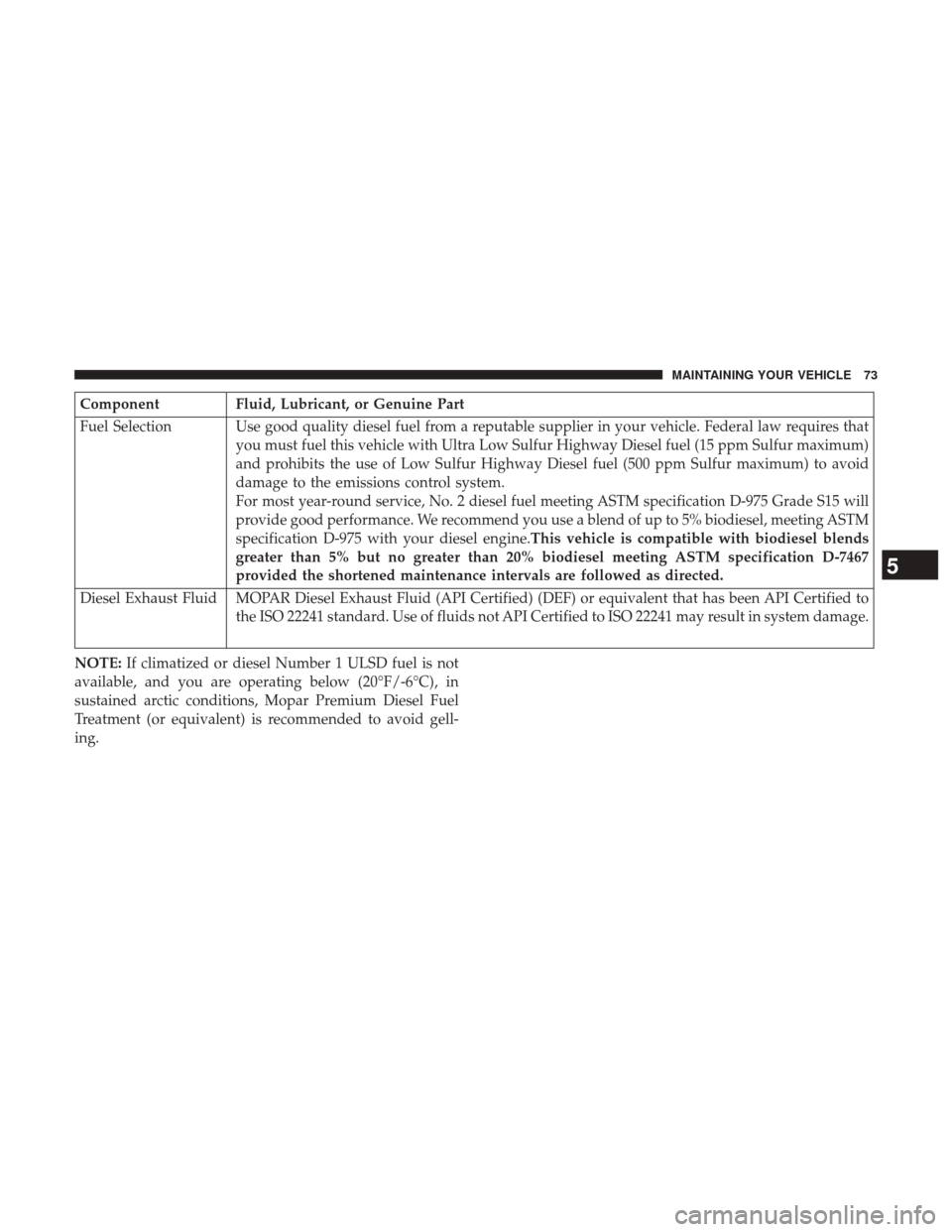
Fuel Selection Use good quality diesel fuel from a reputable supplier in your vehicle. Federal law requires that you must fuel this vehicle with Ultra Low Sulfur Highway Diesel fuel (15 ppm Sulfur maximum)
and prohibits the use of Low Sulfur Highway Diesel fuel (500 ppm Sulfur maximum) to avoid
damage to the emissions control system.
For most year-round service, No. 2 diesel fuel meeting ASTM specification D-975 Grade S15 will
provide good performance. We recommend you use a blend of up to 5% biodiesel, meeting ASTM
specification D-975 with your diesel engine.This vehicle is compatible with biodiesel blends
greater than 5% but no greater than 20% biodiesel meeting ASTM specification D-7467
provided the shortened maintenance intervals are followed as directed.
Diesel Exhaust Fluid MOPAR Diesel Exhaust Fluid (API Certified) (DEF) or equivalent that has been API Certified to the ISO 22241 standard. Use of fluids not API Certified to ISO 22241 may result in system damage.
NOTE: If climatized or diesel Number 1 ULSD fuel is not
available, and you are operating below (20°F/-6°C), in
sustained arctic conditions, Mopar Premium Diesel Fuel
Treatment (or equivalent) is recommended to avoid gell-
ing.
5
MAINTAINING YOUR VEHICLE 73
Page 81 of 228
Maintenance Chart — Diesel Fuel Up To B5
Biodiesel
Required Maintenance
Refer to the Maintenance Schedules on the following pages
for required maintenance.
At Every Oil Change Interval As Indicated By OilChange Indicator System:
•Change oil and filter.
• Completely fill the Diesel Exhaust Fluid tank.
• Drain water from fuel filter assembly.
• Rotate the tires. Rotate at the first sign of irregular
wear, even if it occurs before the oil indicator
system turns on.
• Inspect battery and clean and tighten terminals as
required.
At Every Oil Change Interval As Indicated By Oil
Change Indicator System:
•Inspect brake pads, shoes, rotors, drums, hoses and
park brake.
• Inspect engine cooling system protection and hoses.
• Inspect exhaust system.
• Inspect engine air cleaner if using in dusty or
off-road conditions.
6
MAINTENANCE SCHEDULE 79
Page 82 of 228
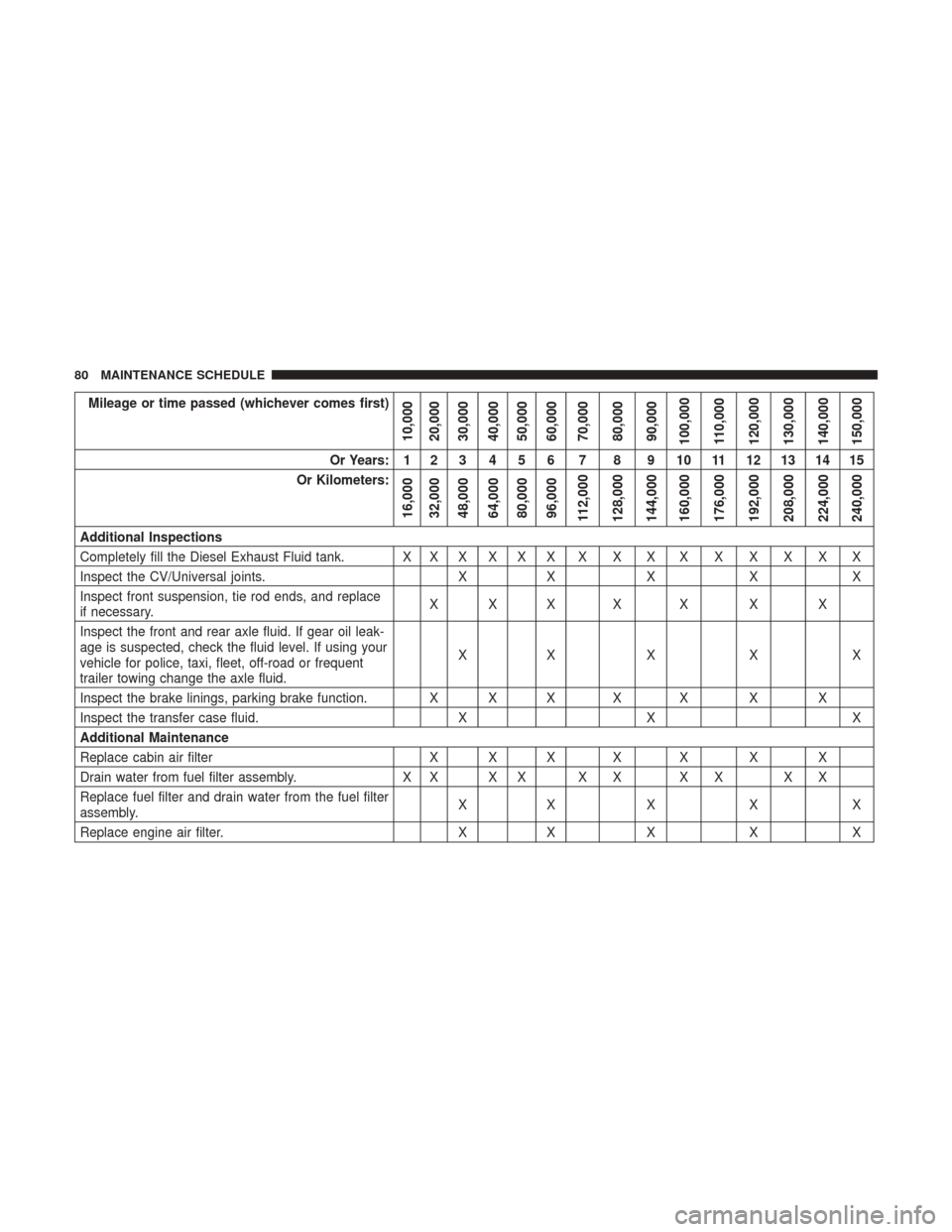
Mileage or time passed (whichever comes first)
10,000
20,000
30,000
40,000
50,000
60,000
70,000
80,000
90,000
100,000
110,000
120,000
130,000
140,000
150,000
Or Years: 1 2 3 4 5 6 7 8 9 10 11 12 13 14 15
Or Kilometers:
16,000
32,000
48,000
64,000
80,000
96,000
112,000
128,000
144,000
160,000
176,000
192,000
208,000
224,000
240,000
Additional Inspections
Completely fill the Diesel Exhaust Fluid tank. X X X X X X X X X X X X X X X
Inspect the CV/Universal joints. XX X X X
Inspect front suspension, tie rod ends, and replace
if necessary. XXX X X X X
Inspect the front and rear axle fluid. If gear oil leak-
age is suspected, check the fluid level. If using your
vehicle for police, taxi, fleet, off-road or frequent
trailer towing change the axle fluid. XX X X X
Inspect the brake linings, parking brake function. X X X X X X X
Inspect the transfer case fluid. XX X
Additional Maintenance
Replace cabin air filter X X X X X X X
Drain water from fuel filter assembly. X X X X X X X X X X
Replace fuel filter and drain water from the fuel filter
assembly. XX X X X
Replace engine air filter. XX X X X
80 MAINTENANCE SCHEDULE