2017 Peugeot Partner Tepee remove seats
[x] Cancel search: remove seatsPage 105 of 292

103
Partner2VP_en_Chap04_Ergonomie_ed02-2016Partner2VP_en_Chap04_Ergonomie_ed02-2016
Automatic switching on/off
The front courtesy lamp comes on
when the key is removed from the
ignition, when the vehicle is unlocked,
when one of the front doors is opened
and for location of the vehicle using the
remote control.
It goes off gradually after the ignition
is switched on and when the vehicle is
locked.Front seats: comes on when
one of the front doors is
opened.
These are switched on and off by
means of a manual switch, with
the ignition on.
Rear seats: comes on when
one of the rear doors is
opened.
If the doors remain open for
a few minutes, the courtesy
lamps go off.
Permanently off.
Permanently on, ignition on.
Front courtesy lamp
COURTESY
LAMPS
Rear courtesy lamp Front individual reading lamps
EASE OF USE and COMFORT
4
Practical information
Page 106 of 292

104
Partner2VP_en_Chap04_Ergonomie_ed02-2016Partner2VP_en_Chap04_Ergonomie_ed02-2016
LOAD SPACE COVER (5 SEAT VERSION)
This rigid shelf conceals the objects
stored in the boot.Removing
Fold the load space cover.
Detach it from the notches A and B
pulling it towards you.
Raise it and remove the assembly.
Refitting
Place the load space cover in front
of
A and B.
Push it forwards to insert the lugs in
the notches.
Unfold and clip into the notches C.
Folding
From the boot, fold the half-shelf,
raising it to detach it from the notch C. Storing (according to version)
A location is provided in the back of the
rear seats to accommodate the load
space cover folded onto itself.
Slide it vertically between the side
guides located at mid seat back height.
Insert the hinge first, with the free flaps
turned upwards.
This rigid load space cover can
form a shelf. However, as a safety
measure, do not place objects
on it which could become dangerous
projectiles in the event of sharp braking
or rear impact.
Practical information
Page 111 of 292
109
Partner2VP_en_Chap04_Ergonomie_ed02-2016Partner2VP_en_Chap04_Ergonomie_ed02-2016
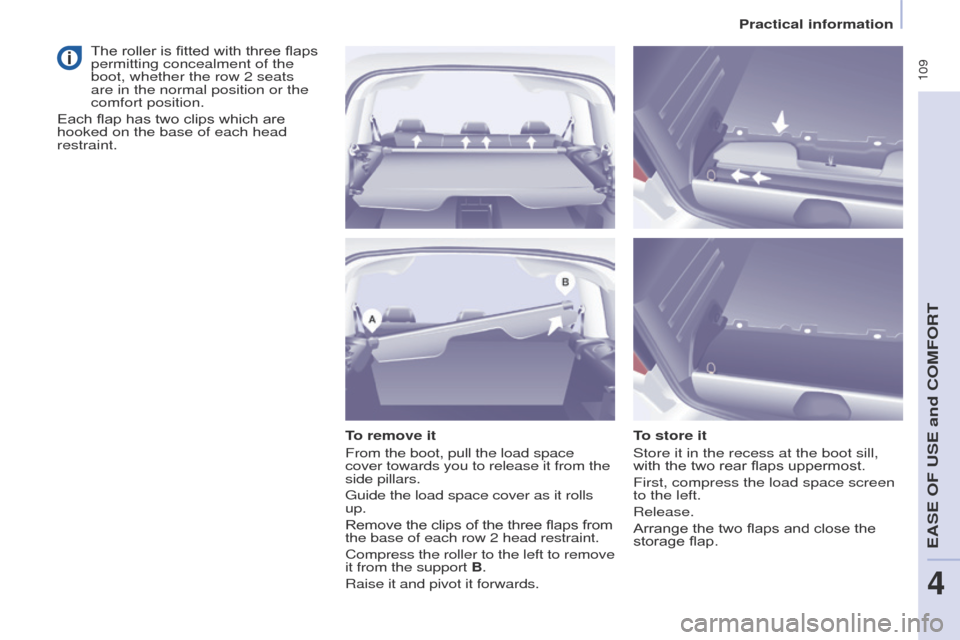
To remove it
From the boot, pull the load space
cover towards you to release it from the
side pillars.
Guide the load space cover as it rolls
up.
Remove the clips of the three flaps from
the base of each row 2 head restraint.
Compress the roller to the left to remove
it from the support B.
Raise it and pivot it forwards. To store it
Store it in the recess at the boot sill,
with the two rear flaps uppermost.
First, compress the load space screen
to the left.
Release.
Arrange the two flaps and close the
storage flap.
The roller is fitted with three flaps
permitting concealment of the
boot, whether the row 2 seats
are in the normal position or the
comfort position.
Each flap has two clips which are
hooked on the base of each head
restraint.
EASE OF USE and COMFORT
4
Practical information
Page 132 of 292

130
Partner2VP_en_Chap05_Securite_ed02-2016
130
Partner2VP_en_Chap05_Securite_ed02-2016
Advice
Sit in a normal upright position.
Wear a correctly adjusted seat belt.
Do not allow anything to come between
the occupants and the airbags
(a child, pet, object...), do not attach or
fix anything near to the airbags or their
trajectories when inflating as this could
cause injuries when the airbags are
deployed.
Never modify the original definition of
your vehicle, particularly in the area
directly around the airbags.
After an accident or if the vehicle has
been stolen or broken into, have the
airbag systems checked.
All work on the airbag system must be
carried out by a PEUGEOT dealer or a
qualified workshop.
Even if all of the precautions
mentioned are observed, a risk of
injury or of minor burns to the head,
chest or arms when an airbag is
deployed cannot be ruled out. The bag
inflates almost instantly (within a few
milliseconds) then deflates within the
same time discharging the hot gas via
openings provided for this purpose.Front airbags
Do not drive holding the steering wheel
by its spokes or resting your hands on
the centre part of the wheel.
Passengers must not place their feet
on the dashboard.
Do not smoke as deployment of the
airbags can cause burns or the risk of
injury from a cigarette or pipe.
Never remove or pierce the steering
wheel or hit it violently.
Do not fit or attach anything to the
steering wheel or dashboard, this could
cause injuries with deployment of the
airbags.
Lateral airbags
Use only approved covers on the
seats, compatible with the deployment
the lateral airbags. For information
on the range of seat covers suitable
for your vehicle, you can contact a
PEUGEOT
dealer.
For more information on accessories,
refer to "Other accessories" in section 6.
Do not fix or attach anything to the seat
backs (clothing...). This could cause
injury to the chest or arms if the lateral
airbag is deployed.
Do not sit with the upper part of the
body any nearer to the door than
necessary.
Airbags only operate when the
ignition is switched on.
This equipment only operates once.
If a second impact occurs (during the
same or a subsequent accident), the
airbag will not operate.
The deployment of an airbag or airbags
is accompanied by a slight discharge
of smoke and a noise, due to the
activation of the pyrotechnic cartridge
incorporated in the system.
This smoke is not harmful, but
sensitive individuals may experience
some irritation.
The noise of the detonation may result
in a slight loss of hearing for a short
time.
The passenger's front airbag must
be deactivated if a child seat is
installed rearward facing.
Chapter 5, "Child safety" section.
Airbags
Page 142 of 292

140
Partner2VP_en_Chap05_Securite_ed02-2016
140
Partner2VP_en_Chap05_Securite_ed02-2016
SEATS WITH A SUPPORT LEG
Care must be taken when installing
a child seat with a support leg in
the vehicle. In particular you should
look for the presence of a storage
compartment below the rear seat
footwells.
The centre rear seat does not have
a storage compartment below the
footwell. You can therefore easily fit a
child seat with a support leg, whether
installed with the ISOFIX mountings or
using the 3 point seat belt.
Do not place the support leg on
the storage compartment cover;
it might break in a serious impact.
Where the adjustments of the support
leg allow it, we suggest two other
possibilities for installation.
At the bottom of the storage
compartment
If the support leg is long enough, you
can adjust it so that it contact the
bottom of the storage compartment.
Remove all objects from the storage
compartment before installing the
support leg.
Away from the storage
compartment area
If the support leg is long enough and
can be inclined sufficiently (always
by following the recommendations
given in the installation instructions for
the child seat), you can position the
support leg so that it contacts the floor
away from the storage compartment.
Adjust the longitudinal position of
the front or rear seat to obtain a
satisfactory position for the support leg
away from the storage compartment.
If you cannot position the support
leg in the way described, you
should not fit a child seat with
support leg to the seat.
Child safety
Page 144 of 292

142
Partner2VP_en_Chap05_Securite_ed02-2016
142
Partner2VP_en_Chap05_Securite_ed02-2016
(a) Universal child seat: child seat
that can be installed in any vehicle
using the seat belt.
(b)
Group 0: from birth to 10 kg.
Cots and baby carriers cannot be
installed on the front passenger
seat or in row 3. When installed in
row 2, they may prevent the use of
one or more seat in this row
.
(c)
Refer to the legislation in force in
your country before installin
g your
child on this seat.
(d)
When a rearward facing child seat
is installed on a
front passenger
seat, the passenger's front airbag
must be deactivated. Otherwise,
the child would risk being
seriously injured or killed if the
airbag is deployed.
When a forward facing child seat
is installed on a
front passenger
seat, the passenger's front airbag
must remain active. Remove and stow the heads
restraint, before installing a child
seat with backrest on a passenger
seat.
Refit the head restraint once the child
seat has been removed.
(e)
When a child seat is installed at
the rear
, forward facing or rearward
facing, move the vehicle's seats
in the row in front forwards and
straighten their backrests to leave
enough space for the child seat or
the child's legs.
(f)
Put the backrests of the outer and
centre seats in row 2, located in
front of seat occupied by a child
seat, in the table position, or if this
is not sufficient, remove the seats in
row 2, so that the child seat or the
child's legs do not touch the seats in
row 2.
(g)
If the seats in row 3 are occupied,
do not leave a child seat installed
on the foldable row 2 seat, to allow
easy access to row 3.
Child safety
Page 145 of 292

143
Partner2VP_en_Chap05_Securite_ed02-2016
143
Partner2VP_en_Chap05_Securite_ed02-2016
ISOFIx MOUNTINGS
Your vehicle has been approved in
accordance with the latest ISOFIX
regulation.
The mountings comprise three rings for
each seat.
Two front rings A, located between
the vehicle seat backrest and cushion,
indicated by a marking.A rear ring B, located on the back
of the vehicle's seat backrest, for
securing the upper strap referred to as
the Top Tether.
The Top Tether is used to secure the
upper strap of child seats that have
one. This arrangement limits the
forward tipping of the child seat in the
event of a frontal impact.
This ISOFIX mounting system
guarantees you fast, reliable and safe
fitting of the child seat in your vehicle.
The ISOFIX child seats are fitted with
two latches which are secured on the
two front rings A.
Some also have an upper strap which
is attached to the rear ring B. Follow strictly the instructions for
fitting child seats contained in the
manufacturer's installation guide.
To secure the child seat to the
Top Tether:
-
remove and stow the head restraint
before installin
g the child seat in
this seating position (refit it once
the child seat has been removed),
-
pass the upper strap of the child
seat over the top of the seat
backrest, between the apertures for
the head restraint rods,
-
secure the hook on the upper strap
to the rear ring,
-
tighten the upper strap.
The incorrect installation of a child
seat in a vehicle compromises the
protection of the child in the event
of an accident.
Refer to the table for information on
the installation of ISOFIX child seats in
your vehicle.
SAFETY
5
Child safety
Page 147 of 292

145
Partner2VP_en_Chap05_Securite_ed02-2016
145
Partner2VP_en_Chap05_Securite_ed02-2016
LOCATIONS FOR CHILD SEATS ISOFIx
* In the 7 seat version, all three seats
in row 2 must be present when child
seats are installed.
**
A
child seat with support leg must
never be installed on an outer
passenger seat in row 2, unless you
are able to install it in line with the
recommendations under "Installing a
child seat with a support leg".
In accordance with European regulations, this table indicates the option\
s for the installation of ISOFIX child seats on the
vehicle seats fitted with ISOFIX mountings.
In the case of the universal and semi-universal ISOFIX child seats, the \
child seat's ISOFIX size category, determined by a
letter from A to G, is indicated on the child seat next to the logo ISOFIX.
Weight of the child / indicative age
Less than 10 kg
(group 0)
Up to 6 months approx Less than 10 kg
(group 0)
Less than 13 kg (group 0+)
Up to 1 year approx From 9 to 18 kg
(group 1)
From 1 to 3 years approx
Type of ISOFI x child seat Infant car seat rearward facing
rearward
facing forward facing
ISOFI x size category
F G C D E C D A B B1
Row 2
(5 and 7* seats) Outer seats**
IL-SUIL-SUIL-SUIUF, IL-SU
Centre seat Not ISOFI x
Row 3
(7 seats)
All seats
Not
ISOFI xIUF:
seat suitable for the installation
of an ISOFIX Universal child seat,
Forward facing and secured with an
upper strap.
IL-SU: seat suitable for the installation
of a ISOFIX Semi-Universal child seat,
either.
-
rearward facing equipped with an
upper strap or a support leg,
-
forward facing equipped with a
support leg, Remove and stow the head
restraint before installin
g a
child seat with a backrest on a
passenger seat.
Refit the head restraint once the child
seat has been removed.
-
a cot equipped with an upper strap
or a support leg.
T
o attach the upper strap, refer to
chapter 5, "ISOFIX mountings" section.
SAFETY
5
Child safety